
1916 Intersectionality: Colgate @ Illinois

Note: If you support Trump and his fascist ICE goons, you are not welcome here. I try to keep this blog focused on old-time football, but our nation is in crisis today and decent people need to speak up. Please find your way to make your voice known.
Bob Zuppke took the reins of Illinois’ football program in 1913, after creating a sensation as the head coach at Oak Park High in suburban Chicago. His first Illini eleven went 4-2-1 and his second was 7-0, retroactively earning a share of the national championship. The Illini were 5-0-2 in 1915, good enough to share the Big Ten title, so when they opened the season with a 30-0 win over Kansas, their upcoming home game with Colgate scared nary a flatlander.
Other than those in the postage-stamp-size states of the Northeast, most schools of the time played only teams from their home and neighboring states, and sometimes the next one over. Before meeting Colgate, the only teams east of Ohio that Illinois faced came in a home-and-away series with Syracuse in 1909 and 1910, and two games with Carlisle in 1897 and 1898, both played in Chicago. After facing Colgate in 1916, their next Eastern opponent was Penn in 1925.
The Colgate Raiders had success under Laurence Bankart, a former Dartmouth player, going 16-4-1 over the last three seasons, and shutting out Army and Yale in 1915. Colgate was similarly regional, limiting itself to opponents in New England and the Mid-Atlantic. They travelled as far west as Pittsburgh in 1909 to meet Carnegie Tech and spent a day in Happy Valley in 1911. Ohio Wesleyan, which Colgate hosted in 1914, was the westernmost foe they had faced on the gridiron.
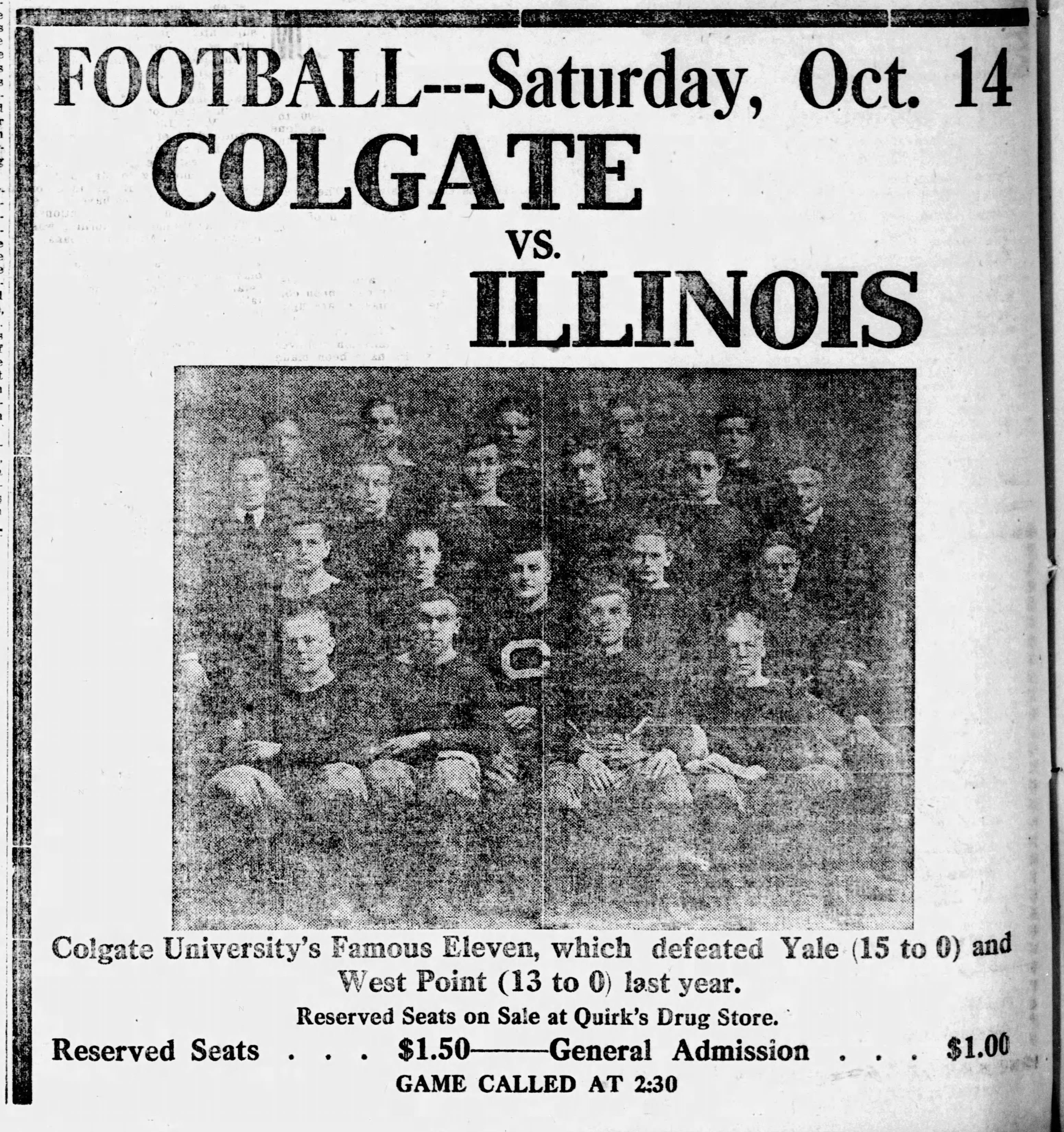
Besides never playing one another and sharing few common opponents, Illinois was a land grant school with 5,000 students, while Colgate was a private institution with a mere 575 enrollees. It would have been easy for the Illini to overlook the boys from the Chenango Valley had it not been for their Eastern football pedigree, where things remained as competitive as anywhere, though that light was beginning to fade.
Colgate started the 1916 season shutting out Susquehanna and Maine, the latter of which was scouted by Illinois football assistant and head basketball coach Ralph Jones. Jones knew his stuff. He coached Illinois to a national basketball championship in 1915, led the Chicago Bears to the NFL championship in 1932, and co-developed football’s T formation with Clark Shaughnessy and George Halas.
Jones returned from his scouting trip claiming that Colgate was better than any Midwestern team of 1915, except Minnesota. Despite the warning, Zuppke sensed overconfidence in his players, so he worked them hard, yelled more than usual, and toyed with lineup changes, such as putting junior fullback George Halas at right half, though a practice injury prevented Halas from playing against Colgate.
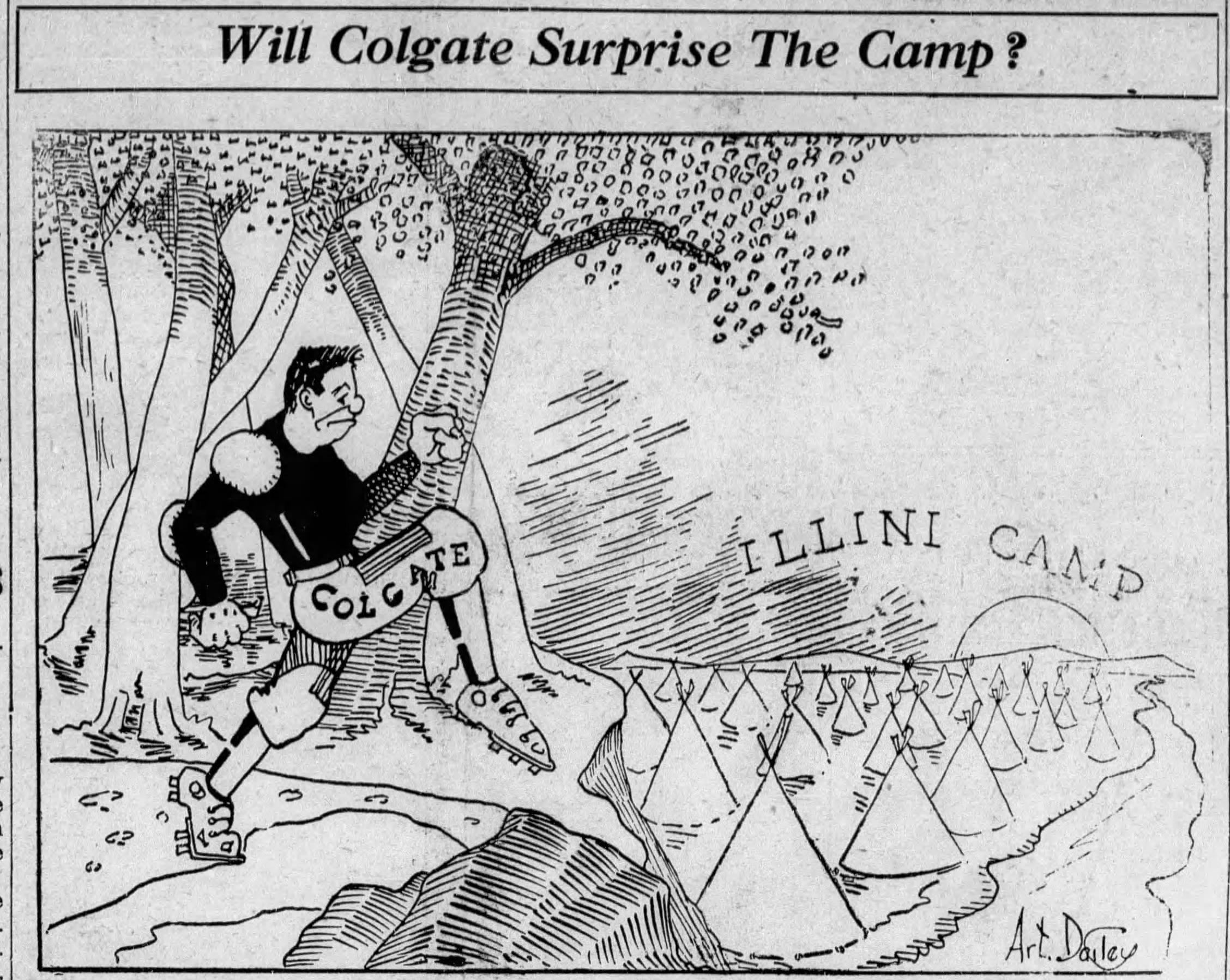
As the season’s first intersectional game, the contest drew national attention, while Illinois’ athletic department heavily promoted it. AD George Huff and others went on the road, encouraging fans to motor in car caravans to see the game.
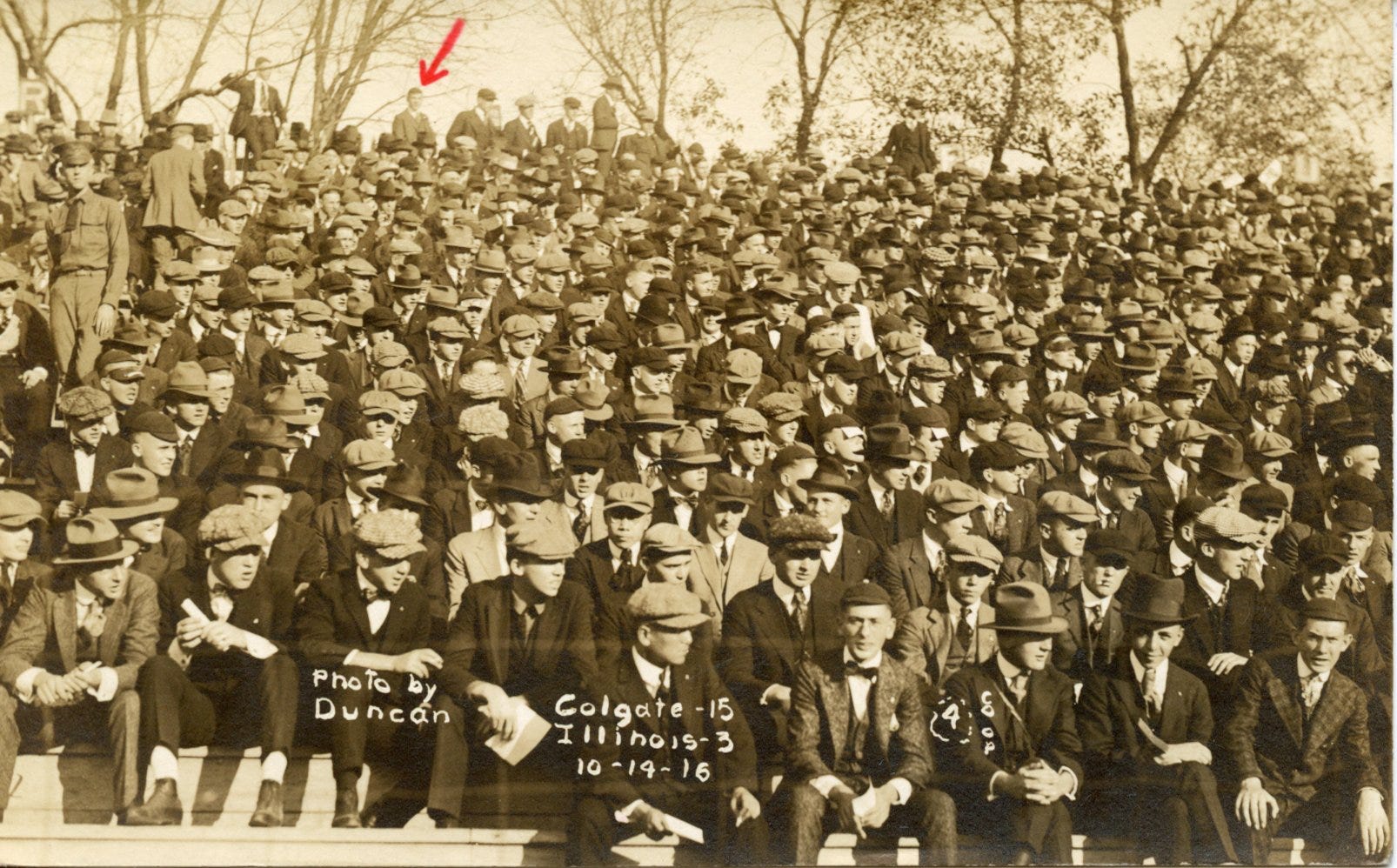
Game day broke to perfect October conditions, at least for the Midwest. The locals and car caravaners combined for a good crowd at Illinois Field.
Despite the forecast, the Illini struggled to weather the Eastern storm. While Zuppke expected his line to compete with Colgate’s, the Raider line, led by tackles Belford West and Clarence Hornung, paved the way for Gillo, a 200-pounder from Milwaukee, who consistently ran through openings in the forward wall. Colgate’s Belford West placekicked a field goal in the first quarter, and a series of forward passed by Ockie Anderson led to a rushing touchdown by Spencer in the second. Illini’s Macomber answered with a field goal in the third quarter before Colgate’s Anderson again started throwing the pea in the fourth, including a touchdown pass to Hubbell, and a 15-3 victory.
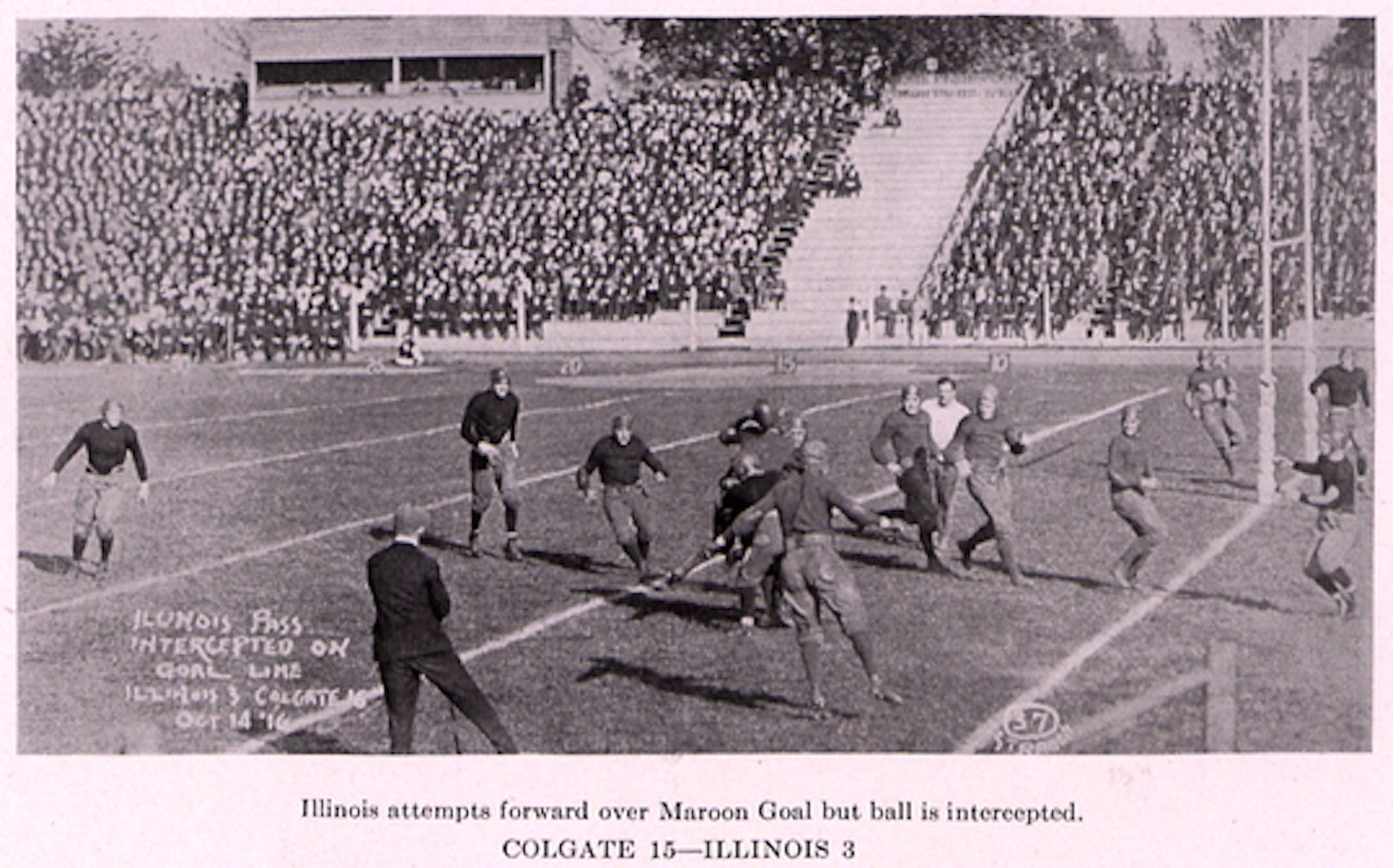
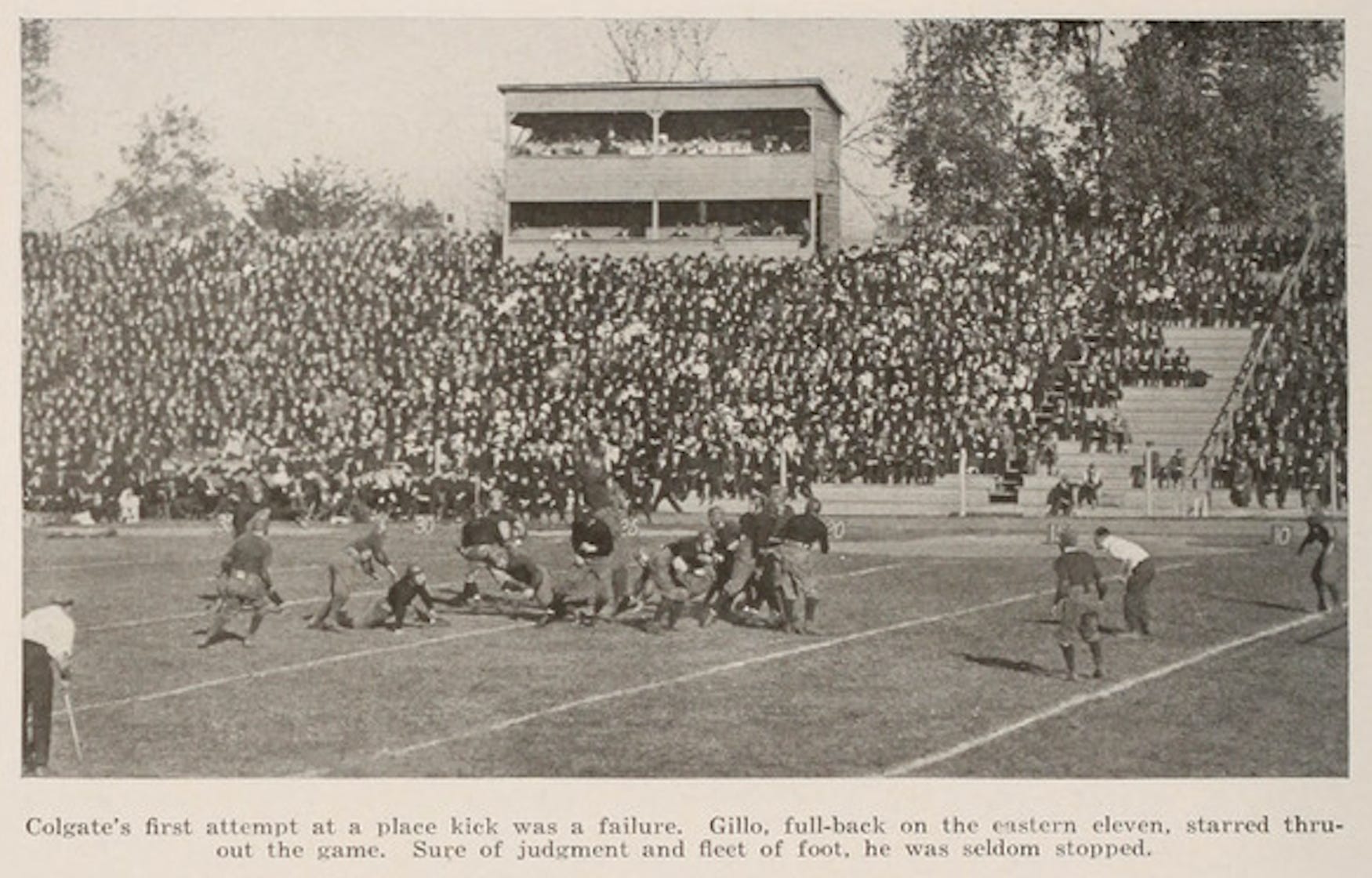
It was a satisfying victory for the Raiders in their first trip west. They went on to an 8-1 season, losing at Yale 7-3, and placing three players on Walter Camp’s All-American first team. Yale had two All-Americans, and other Easterners claimed three spots, while the Big Ten earned two spots, and the rest of the country had none. Who says Walter Camp was not regionally biased?
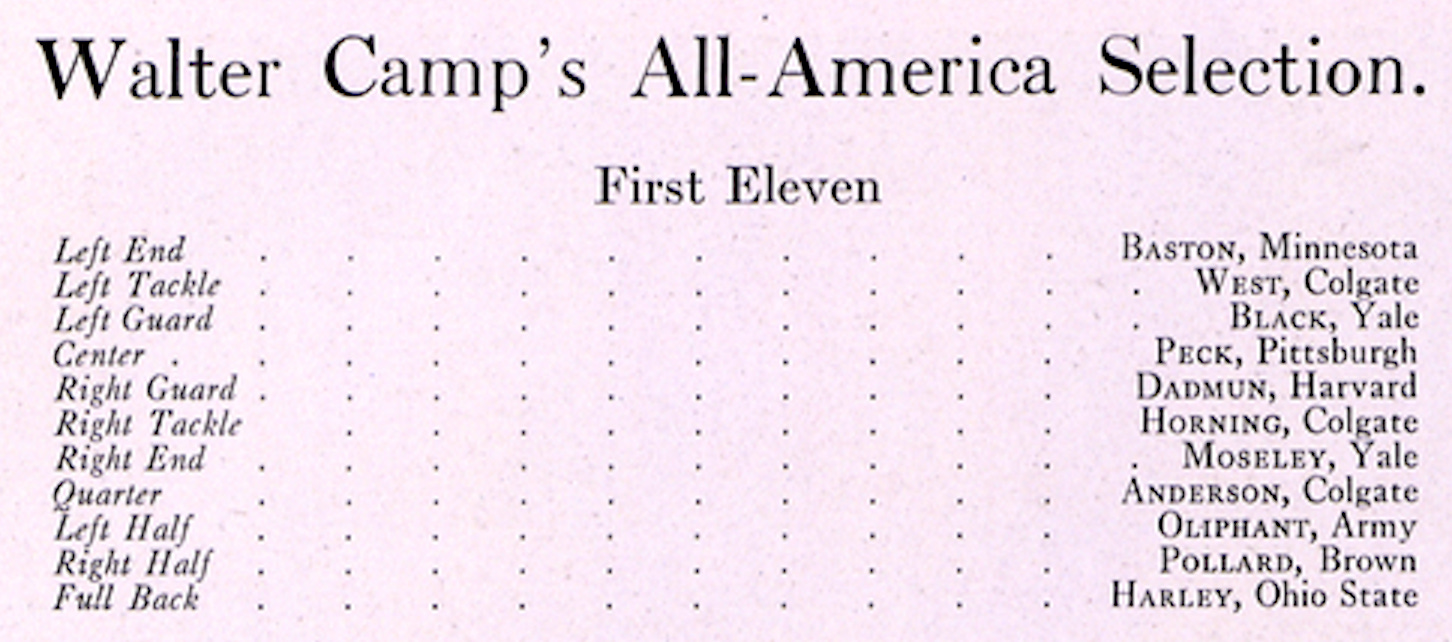
Walter Camp could do little to stem the tide of football supremacy shifting from private Eastern schools to the state schools in the hinterlands. Colgate ventured afield from time to time, going 3-5-1 against Big Ten teams and 24-37-1 against future Big Ten members Michigan State, Nebraska, Penn State, and Rutgers. Its last victory against those teams came against Rutgers in 1978, several years before dropping to the FCS level.
College football had many examples of smaller schools competing with the big boys until the big boys got much bigger. There have been fewer examples of those in recent years. Tulsa has the smallest enrollment among FBS schools, but it is a non-factor nationally. Other smaller schools playing the FBS game include the service academies and a handful of wealthy private schools, though most have struggled against P4 teams in football over the last several decades. However, the recent success of SMU, Tulane, Duke, and Vanderbilt suggests that anything can happen now if you combine good coaching and lots of money, but we’ll have to wait a few years to see where that road goes in the new college football world.
Regular readers support Football Archaeology. If you enjoy my work, get a paid subscription, buy me a coffee, or purchase a book.


Nice.... one bit of old-time football parlance, from those one-platoon minimal-substitution days, is referring to the starters as "the eleven."
I am trying to make "Starting X" catch on in baseball since every league uses a designated hitter. If it ever takes, it will be a bigger miracle than the 1969 Mets.