

Over the past few years, I’ve picked up four pre-1910 postcards whose subject matter is football, or, at least, American college athletics. Two show a scene from the 1901 Harvard-Yale game.
What unites the four is that the senders’ comments are in German or French, which begs the question of why someone would send a football-themed postcard -an All-American activity- while writing their message in a language other than English. Were the senders immigrants, international students, or what? And, in the days before telephones and text messages came into common use, what information did people transmit using football-themed penny postcards?
Postcards of the time often have messages related to the postcard’s subject matter. Still, in many cases, people wrote messages on whatever postcard they had lying around, or that was readily available. Until partway through 1907, the reverse side of postcards was for the addressee information only; USPS regulations prohibited messages on the reverse. As a result, postcards often had substantial white space on the front for messages, and people scribbled messages wherever they could find space. So, let’s look at the postcards’ subject matter and decipher the messages sent more than one century ago. (Some of the messages are difficult to read and translate, so the transcriptions and translations below are my best attempt, substantially aided by AI.)
The first two postcards show a scene from the 1901 Harvard-Yale game, the last of those matches played in Cambridge before Harvard Stadium opened in 1903. After their 22-0 beatdown of Yale that day, Harvard was generally considered the 1901 national champion. This image of Harvard, close to scoring from their tackles-back formation, captures the game.
1901 Harvard-Yale game action postcard #1
The first set was sent from a woman named Rosa H., who appears to be an employee of Mr. Henrici, who has been ill. Both live in Boston.
She mailed the postcard to August Kuhnert, a businessman in Waterville, Maine, on November 3, 1903, 11 days before Harvard christened their new stadium in a game against Dartmouth.'
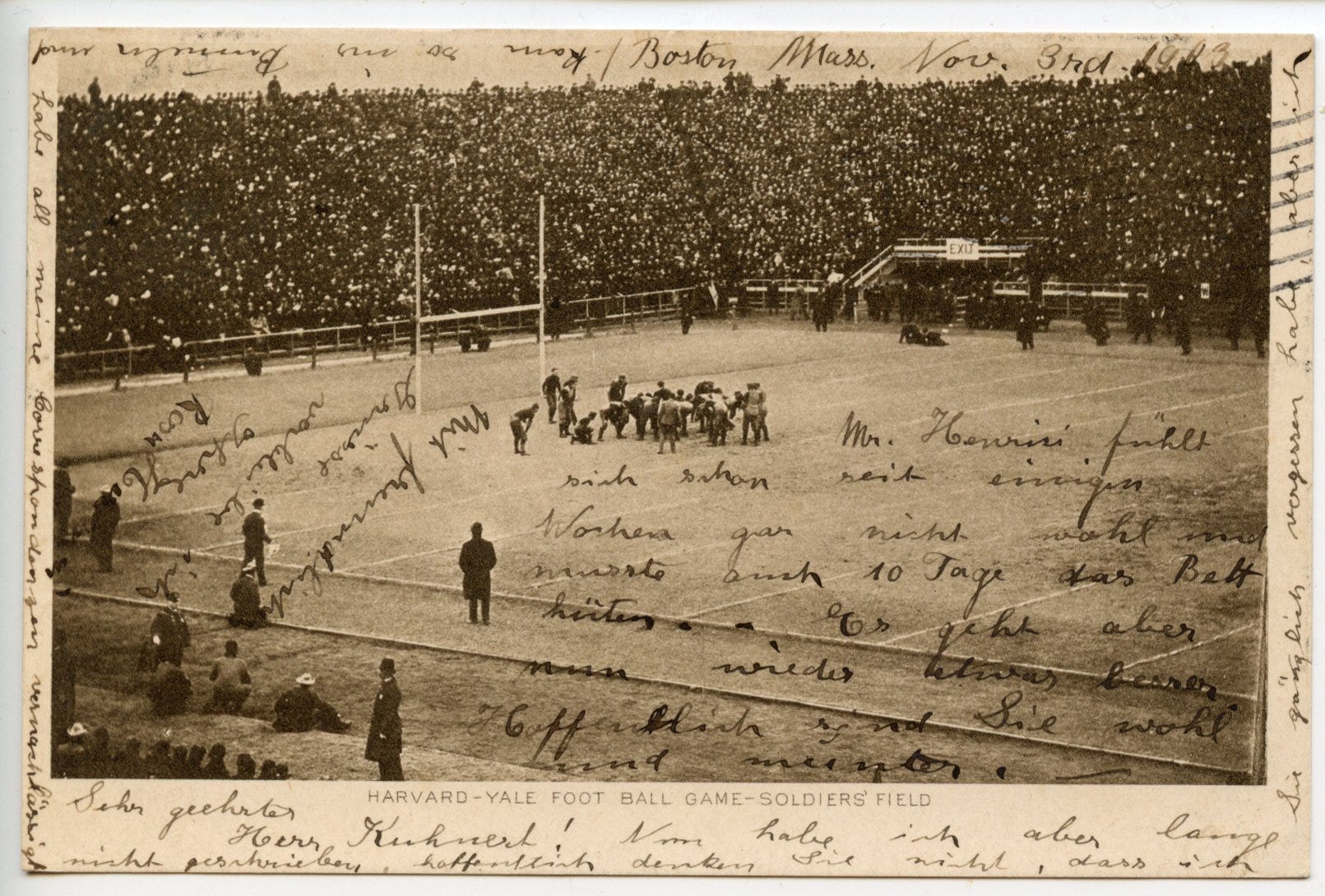
Boston, Mass. Nov. 3rd 1903 (Written in English by a German speaker using the American date form.)
Sehr geehrter Herr Kuhnert! Nun habe ich aber lange nicht geschrieben, hoffentlich denken Sie nicht, dass ich …Sie ganz lieb vergessen habe. Aber ich habe all meine Correspondenzen vernachlässigt … zur Erinnerung an so manch[e] …
Mr. Henrici fühlt sich schon seit einigen Wochen gar nicht wohl und musste auch 10 Tage das Bett hüten. Es geht aber nun wieder etwas besser. Hoffentlich sind Sie wohl und munter.
Mit freundliche[n] Grüsse[n] verbleibe ich Rosa Ha…
Boston, Mass. Nov. 3rd 1903
Dear Mr. Kuhnert! Well, I haven’t written in a long time now — I hope you don’t think that I have quite forgotten you. But I have neglected all my correspondence, … as a memento of many a …
Mr. Henrici has been feeling quite unwell for some weeks now and even had to stay in bed for 10 days. But it’s going somewhat better again now. I hope you are well and in good spirits.
With friendly greetings, I remain, Rosa Ha…
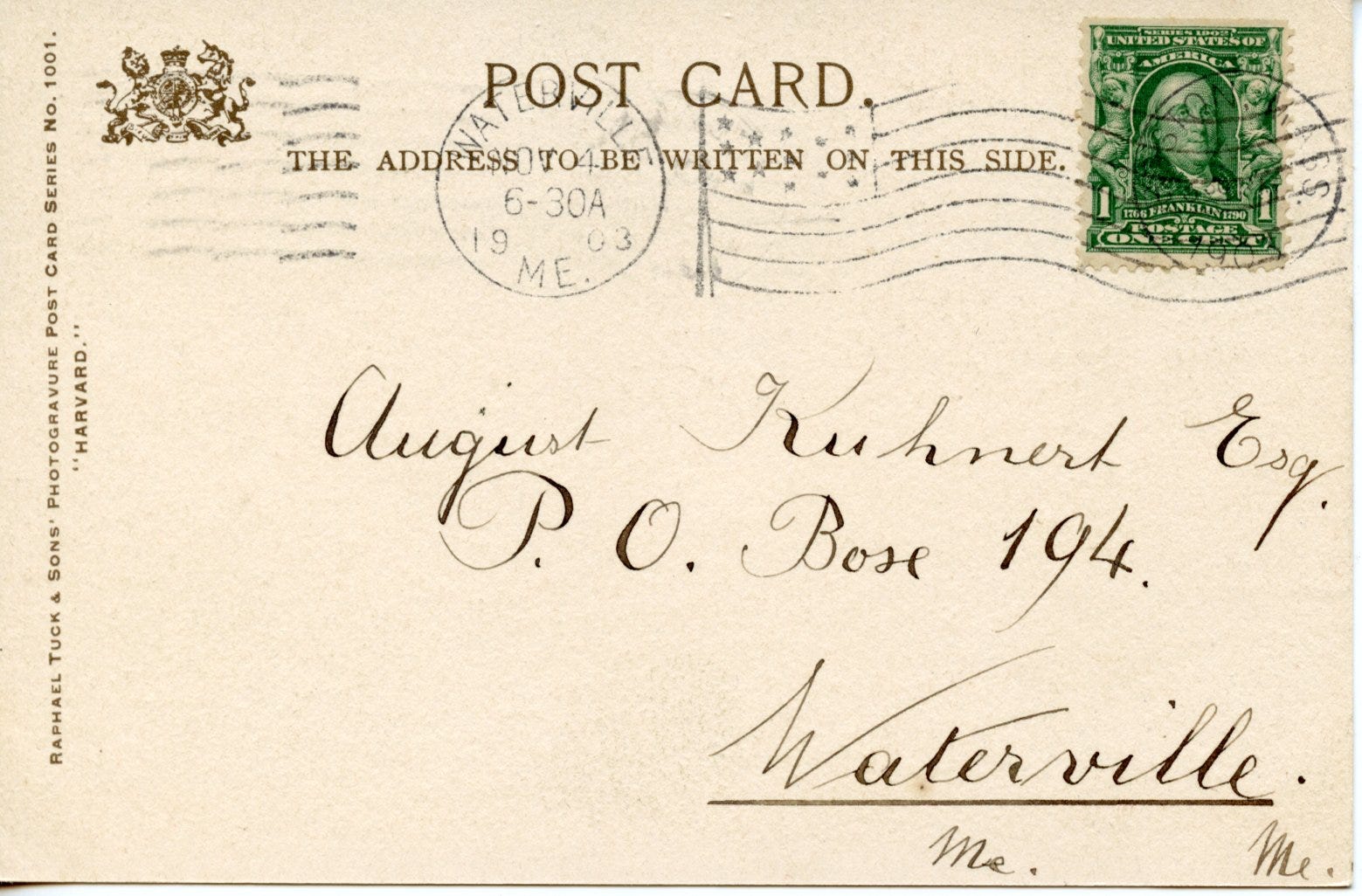
August Kuhnert Esq.
P. O. Box 194
Waterville, Me.
The sender dated the card November 3, and it was received in Waterville the following day.
1901 Harvard-Yale game action postcard #2
Another copy of the postcard with the 1901 Harvard-Yale image was mailed from Boston on November 21, 1903, several hours after the 1903 Harvard-Yale game. Unlike the previous postcard, this one was sent to France, with the message in French. Also, unlike the previous postcard, this message largely concerns the football game and atmosphere around town, especially the number of horse-drawn carriages and automobiles streaming to the game, suggesting there were more of the latter than the former.
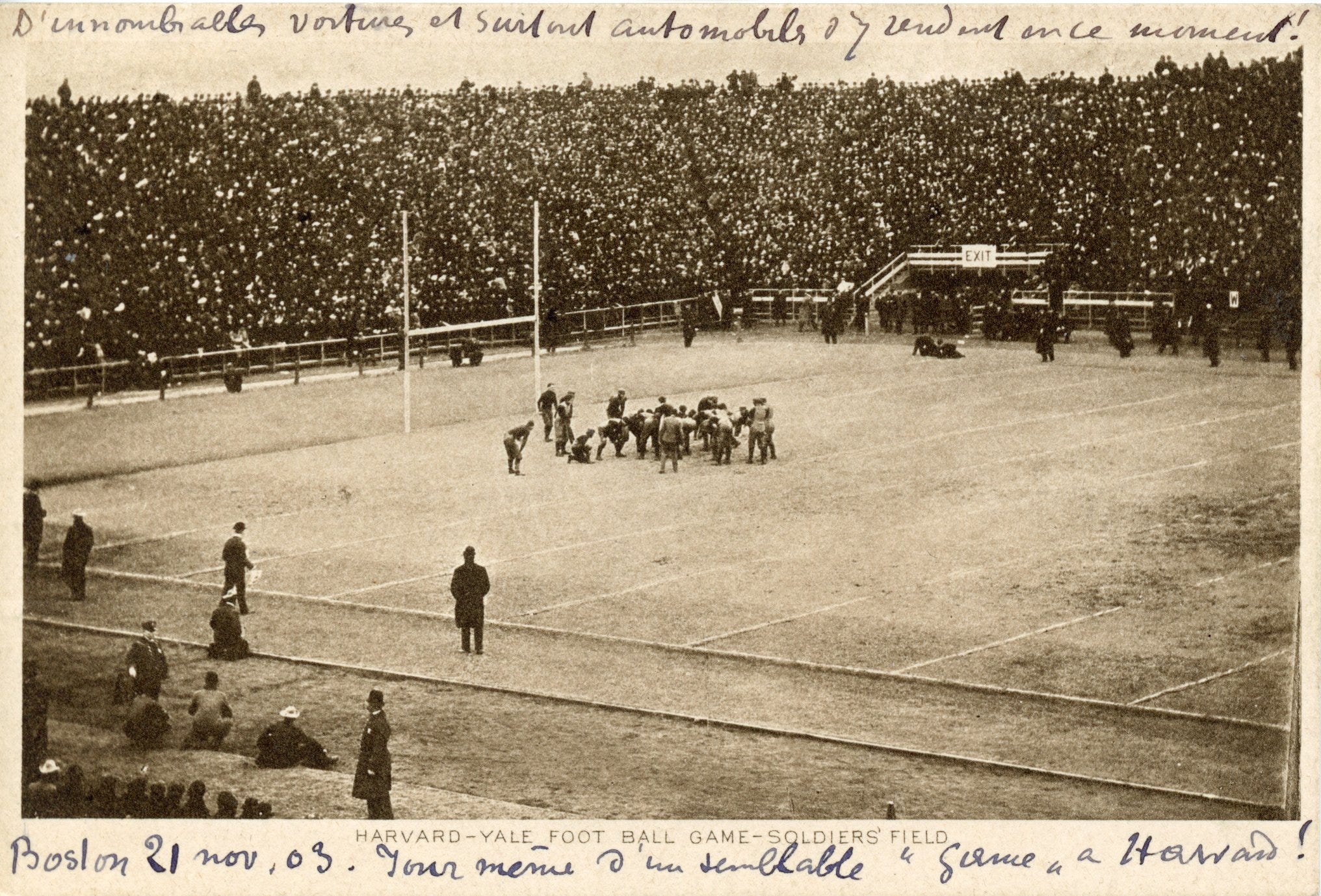
Boston 21 nov. 03. Jour même d’un semblable « game » à Harvard!
D’innombrables voitures et surtout automobiles s’y rendent en ce moment!
(The writer uses the English word “game,” suggesting a direct equivalent did not exist in French.)
Boston, 21 Nov. ‘03. The very day of a similar “game” at Harvard!
Countless carriages, and above all automobiles, are heading there at this very moment!
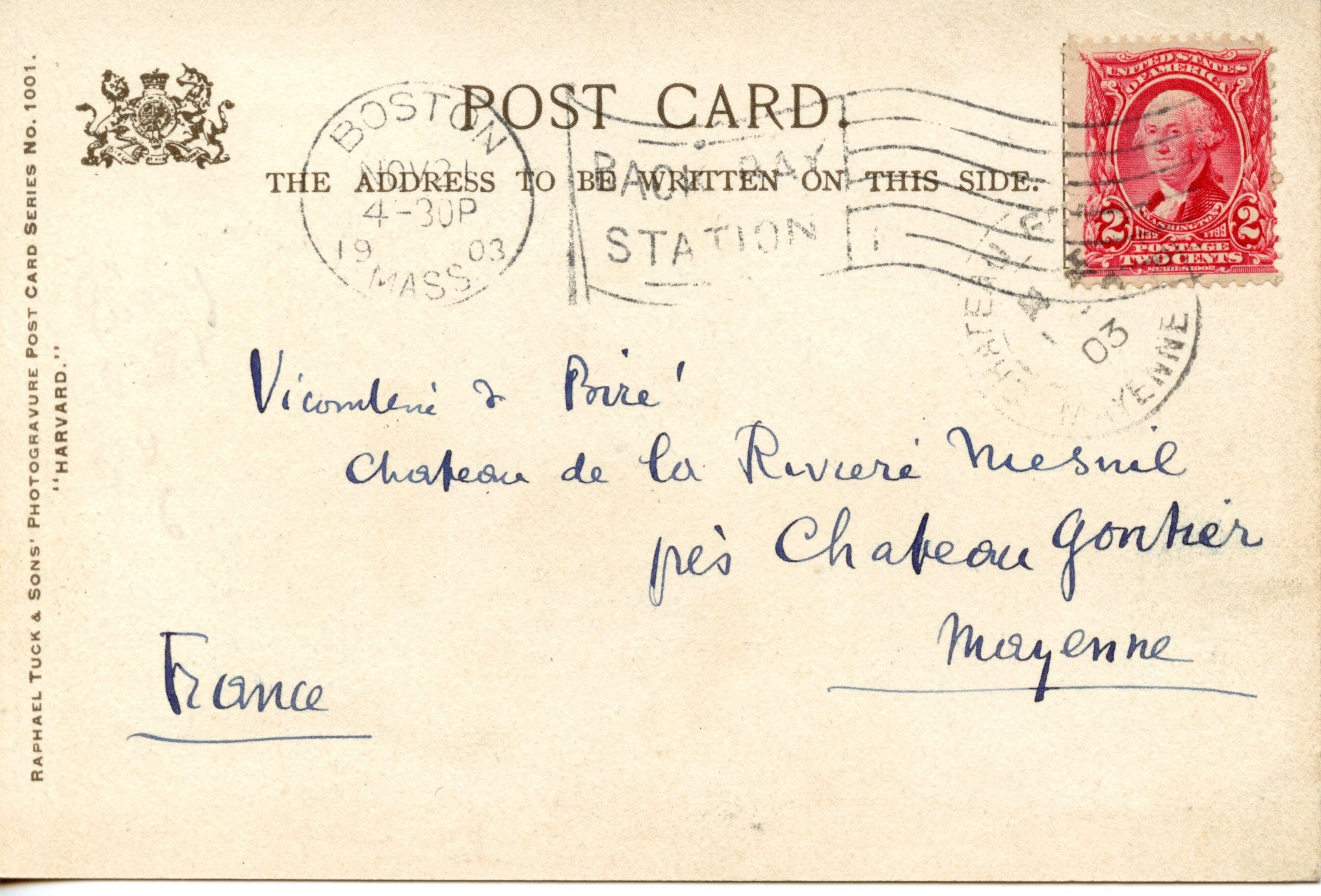
Postmarked Boston, Back Bay Station, Nov 21, 1903, 4:30 PM, with a Château-Gontier (Mayenne) receiving mark.
Vicomtesse de Poiré
Château de la Rivière Mesnil près Château-Gontier
Mayenne
France
1907 Northwestern pennant postcard
Our third postcard isn’t football-themed per se, but it’s close enough for our purposes. It has a Northwestern pennant on the front and is part of a College Pennant Series that included hundreds of other schools. Canceled in Chicago at 9 AM on August 16, 1907, the postcard arrived in Beecher, Illinois, by 5 PM the same day. (Beecher is 45 miles south of Chicago along a railroad, and had a large German immigrant community.)
This is another postcard whose subject matter was seemingly drawn at random. It appears that B. H[o]rn of Chicago is replying to a previous message from Mrs. Emmy Sass, who asked to extend her visit in Beecher, where she is staying with Mrs. L. R[ü]stenpart.
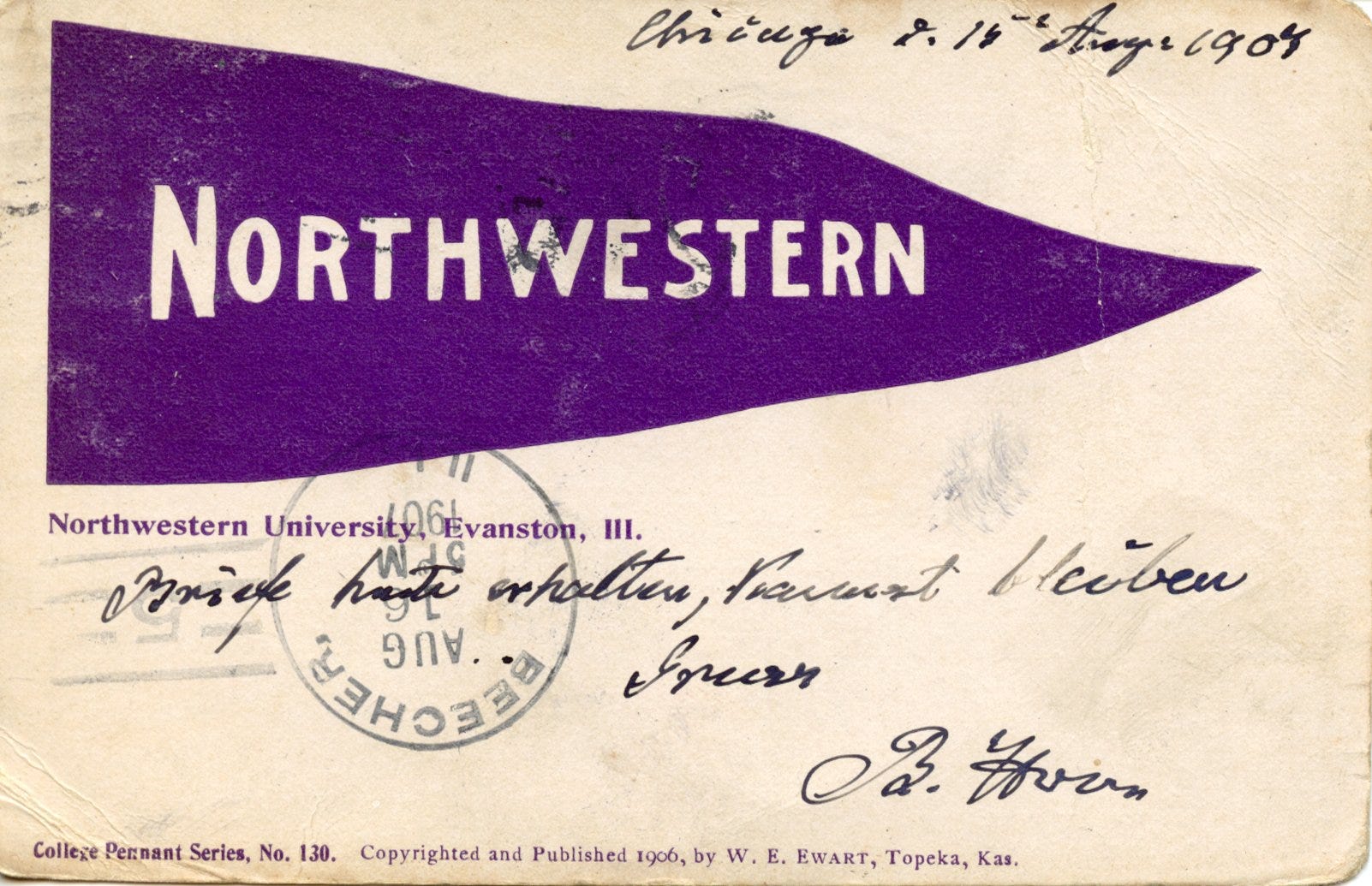
Chicago d. 15ten Aug[us]t 1907
Brief habe erhalten, [k]annst bleiben. Gruss B. H[o]rn
Chicago, the 15th of August 1907
Received [your] letter — you may stay. Greetings, B. H[o]rn
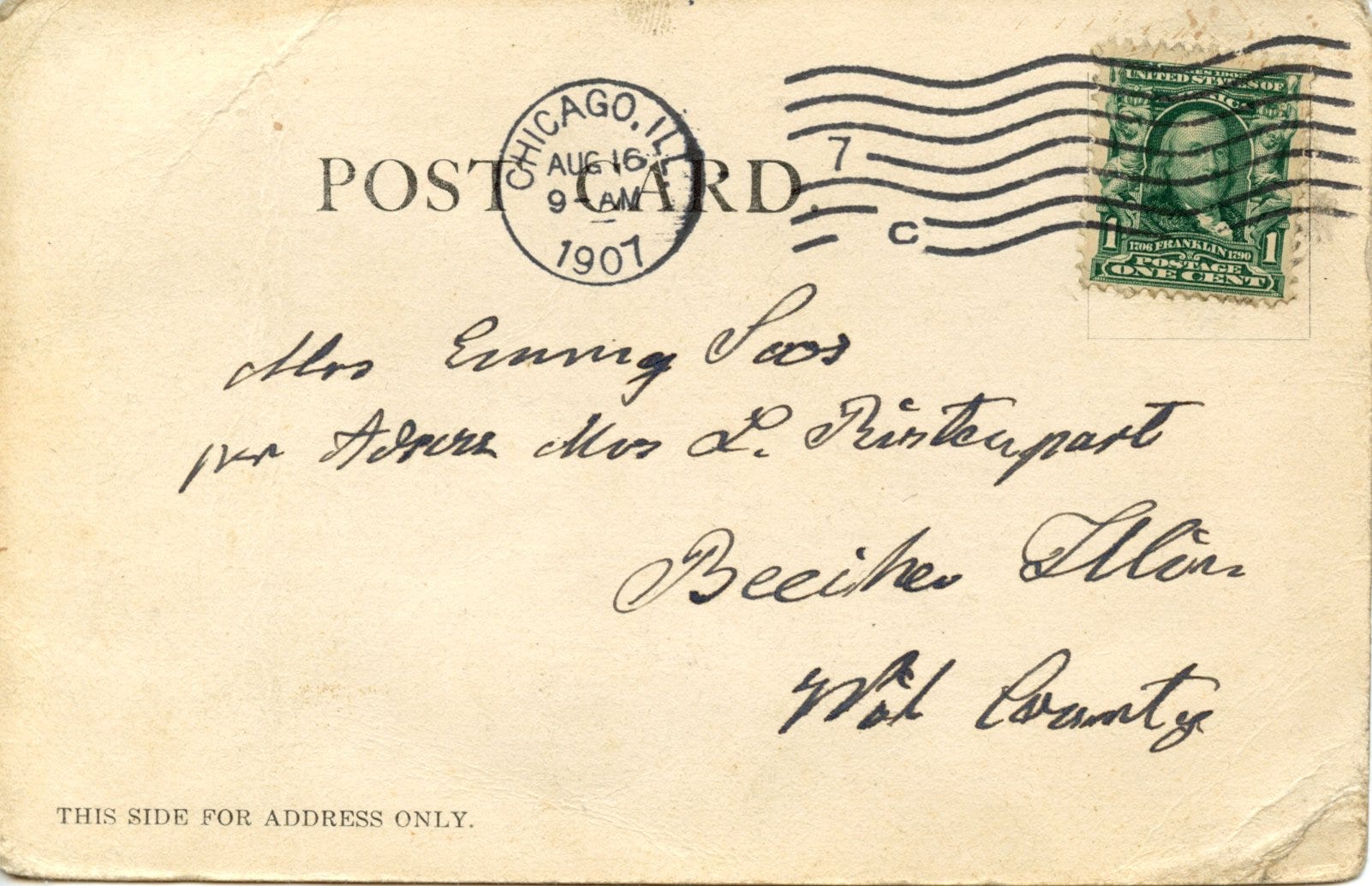
Mrs. Emmy Sass
per Adresse Mrs. L. R[ü]stenpart (“per Adresse” is the German equivalent of “c/o”)
Beecher, Ill.
Will County
1908 Harvard Annual Practice
The fourth postcard shows a practice game or scrimmage at Harvard Stadium. Herman Harck mailed it on January 22, 1908, from Boston to Otto Seidemann or Heidemann, of Berlin. (The postcard was in Estonia by the time it was offered on eBay and has since been repatriated.)
The addressee is an engineer or draftsman, based on the honorific “Mr. Ingenieur” used in addressing the postcard. The sender explains that the postcard shows the football field at Harvard, which adds local color to the note, but the message primarily informs his friend in Berlin of his new mailing address in Boston.
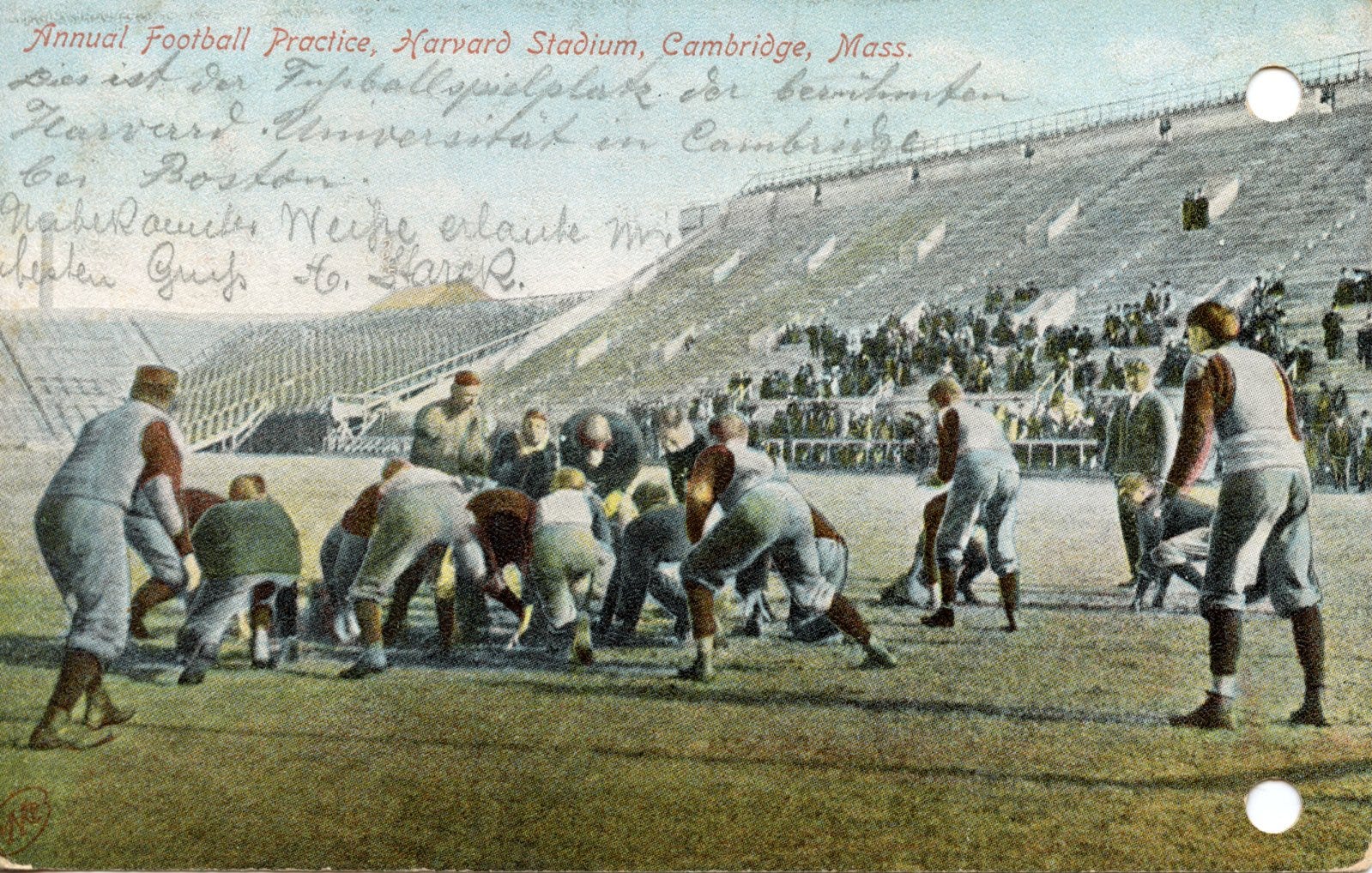
Dies ist der Fußballspielplatz der berühmten Harvard-Universität in Cambridge bei Boston.
Nebst tausend Grüßen erlaube mir … besten Gruß H. Harck
This is the football field of the famous Harvard University in Cambridge, near Boston.
Along with many greetings, allow me to … best regards, H. Harck
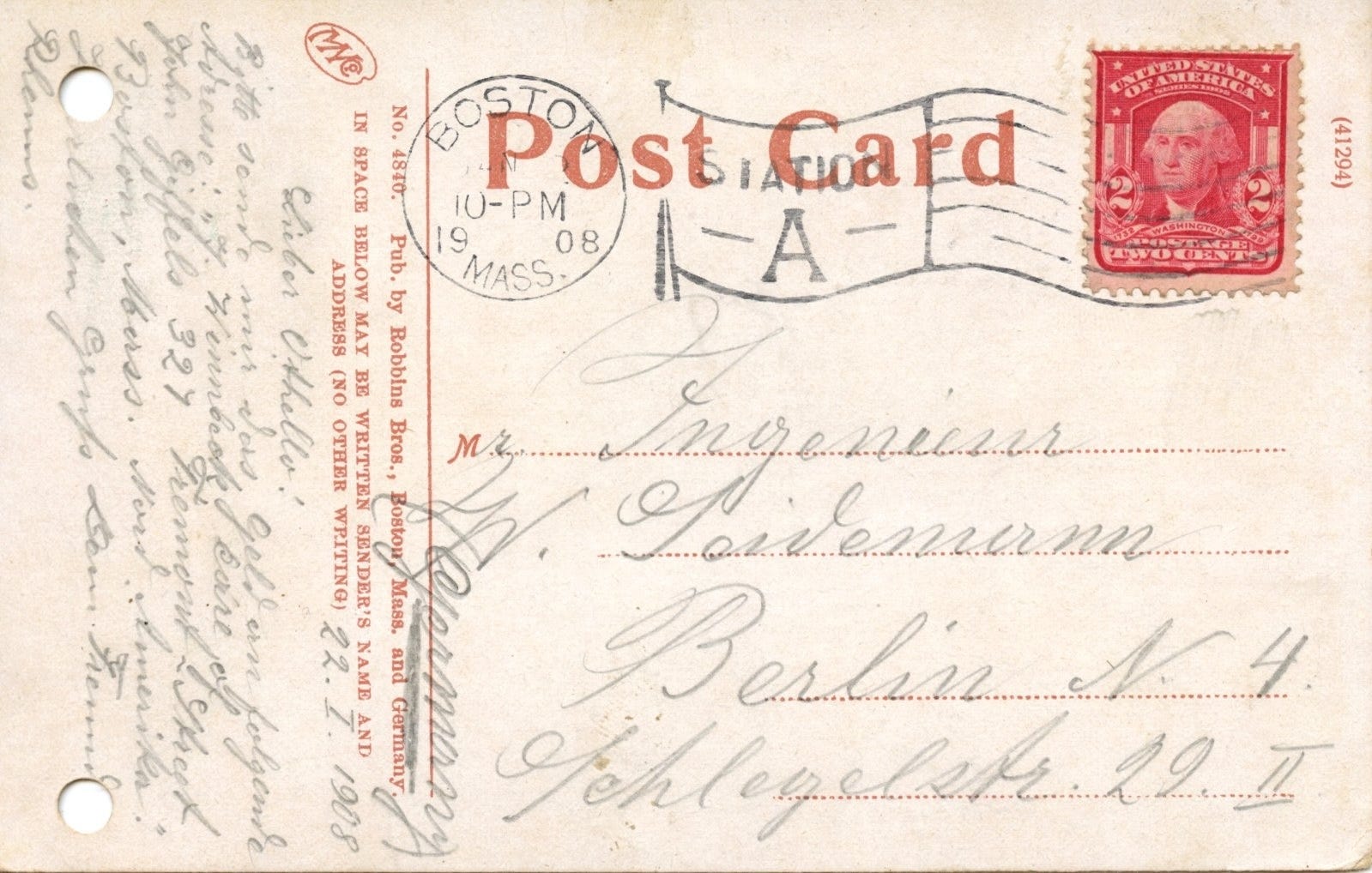
Mr. Ingenieur W. [Seidemann / Heidemann]
Berlin N. 4 Schlegelstr.
29 II Germany
22. I. 1908 or 22. 7. 1908
Lieber Otto! Bitte send[e] mir das … an folgende Adresse: … … 329 Tremont St. Boston, Mass., Nord-Amerika
Herzlichen Gruß, Dein Freund Hermann
22 January 1908 or 22 July 1908
Dear Otto! Please send me the … to the following address: … 329 Tremont St., Boston, Mass., North America.
Warm regards, your friend Hermann
So, the messages are not particularly surprising. Postcards were an inexpensive way to communicate a limited amount of information. The messages were often simple and functional. When sent to a nearby city, they could be delivered the next day, making them a timely way to communicate. When sent to Europe, they traveled by boat, which took a tad more time.
Two of the four, the two mailed to Europe, appear to be from students, visitors, or recent emigres who highlighted the football content, providing a friend or family member across the water with a sense of the strange game embraced by Americans. The other two appear to be first- or second-generation immigrants living and working in America, who sent their messages on football-themed postcards for no apparent reason. Both were messages sent in their mother tongue to someone who understands the language, as still happens among immigrants in America today, though we use other technologies.
BTW: If someone is better at reading and translating turn-of-the-century German or French than what is shown above, please suggest alternatives.
If you enjoy Football Archaeology and are not a paid subscriber, consider buying me a cup of coffee now and again. You can also buy a paid subscription or purchase one of my books.

