

When building or expanding their stadiums, college football programs try to strike a balance between handling peak attendance and maintaining some level of ticket scarcity. FBS power conference programs today typically have crowds of at least 75% of capacity; some reach 100%, while others fall much lower.
Early in football history, few schools had large on-campus stadiums, so they played the big games that attracted sizable crowds at alternative venues, often at major- or minor-league baseball stadiums distant from both schools. The early IFA championship games in New York City often featured Yale and Princeton. Hampton Park in Springfield, Massachusetts, was another favorite location for big Eastern games of the 1800s.

Army and Navy faced a similar situation. Their first four games (1890 to 1893) were on campus, but only two -their 1942 and 1943 games- have been on campus since then. Seventy percent of their games have been in Philadelphia, and another twenty-six percent in New York or Baltimore/Washington, D.C.
After not playing each other from 1894 through 1898, they scheduled neutral-site games at Franklin Field in Philadelphia from 1899 through 1904, at which point, the demand for tickets exceeded the supply. Penn was a gracious host by all accounts, allocating one-third of the tickets to Army, Navy, and themselves. Penn distributed their portion of the tickets to Penn students and its athletic supporters, and donated all money earned to Army and Navy widows’ relief funds.
By 1905, however, the Army and Navy each wanted more than the third of the tickets they had received previously. Navy’s enrollment had expanded, and contributors to both schools’ athletic associations, which funded sports, wanted access to the increasingly attractive tickets. And, in a theme that may sound eerily familiar, members of Congress threatened to withhold funding for academy activities unless the nation’s representatives received the ticket allotments they desired.
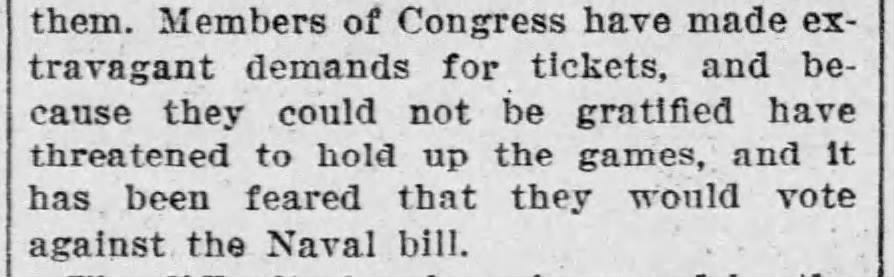
The situation put both ADs in a pickle. Their commandants and the athletic associations sought a contractual change that Penn opposed, leading to an impasse and a public debate documented in an exchange of letters between Penn and the academy athletic directors, both minor figures at the time who went on to prominence.
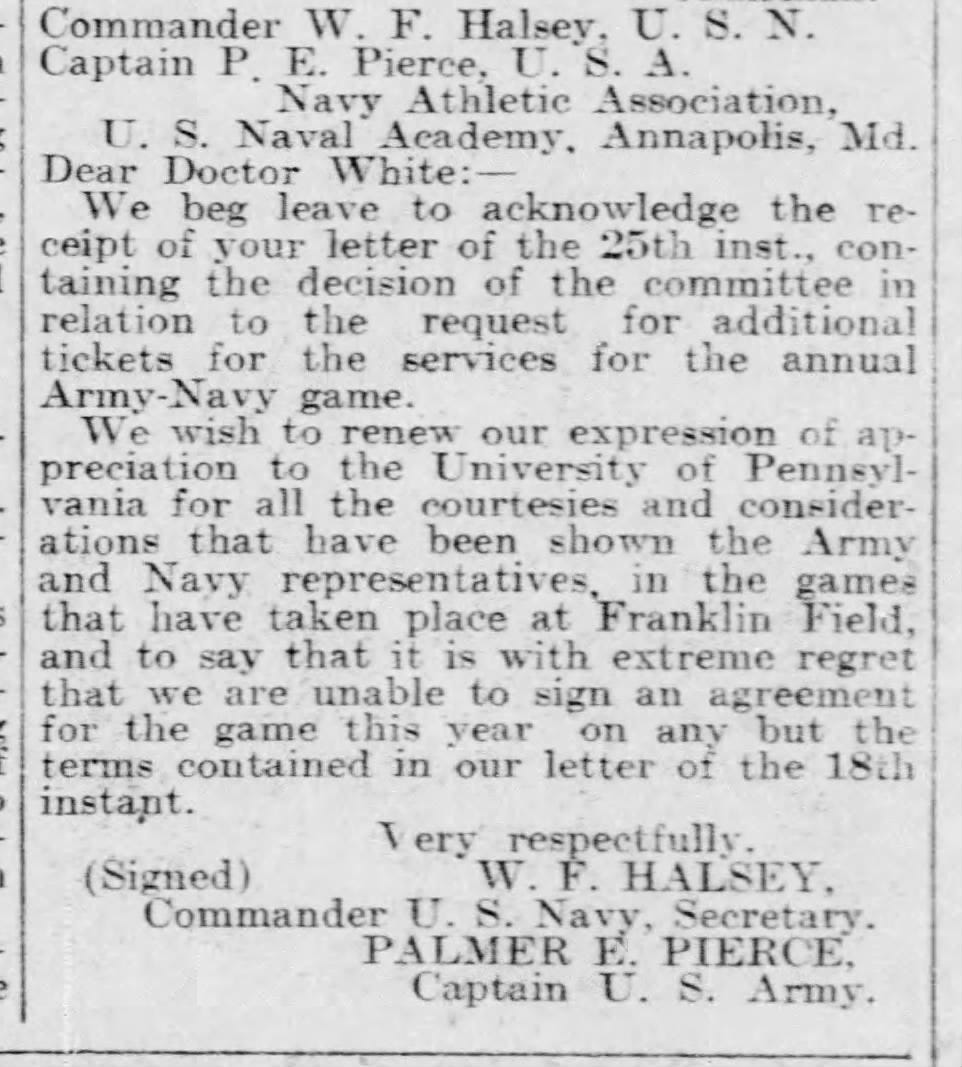
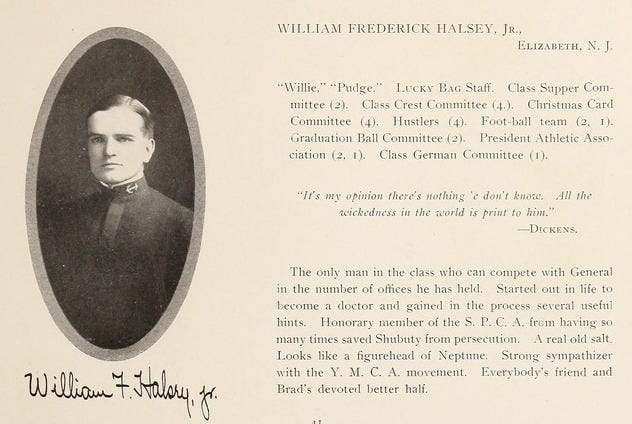
Representing Navy was William F. Halsey, Jr., who played fullback and graduated from the Naval Academy in 1904. He also played fullback in one of the first American football games played in Europe while touring with the Great White Fleet in 1909. More important, Halsey was #2 man in the U.S. Navy during WWII, commanding the South Pacific Area and later, the Third Fleet.

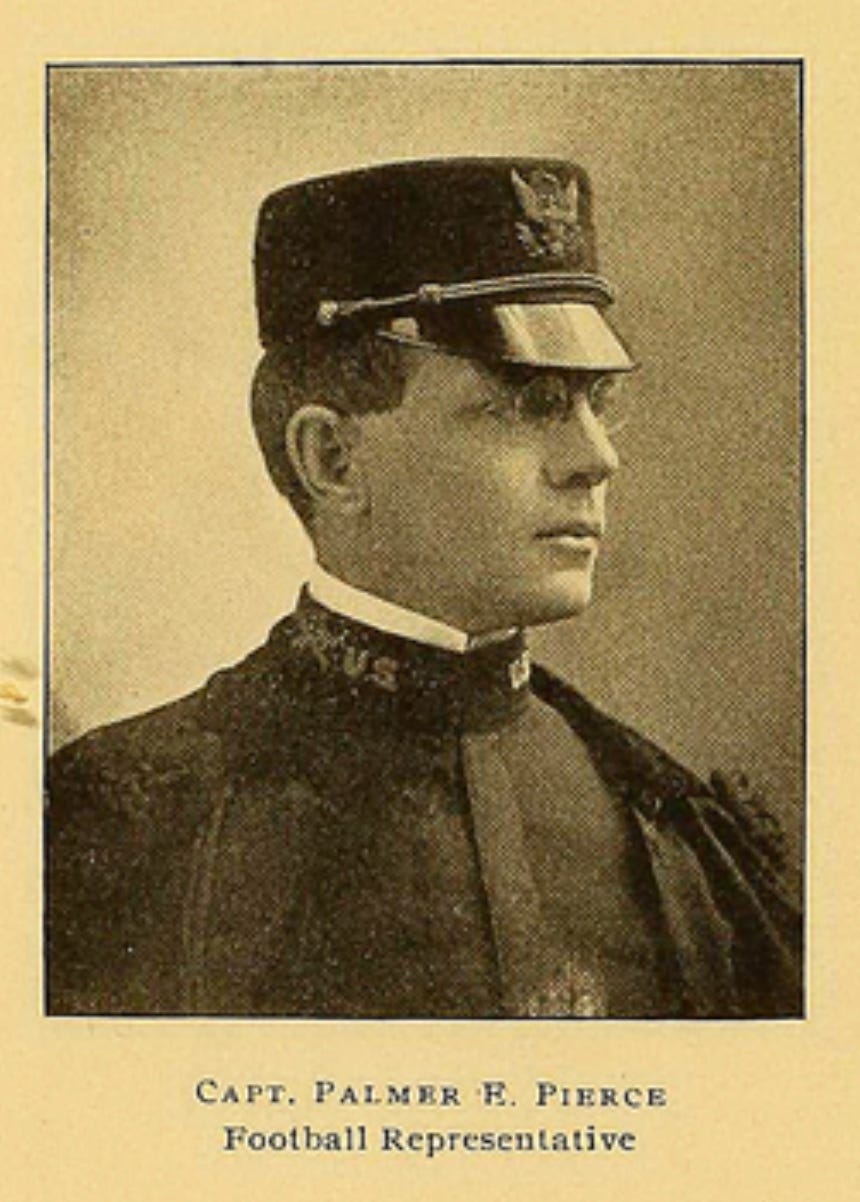
Palmer E. Pierce is a relative unknown today. However, he was an 1891 West Point graduate who served in the Spanish-American War, the Philippines, the Boxer Rebellion, and commanded the 54th Infantry Regiment in France during WWI. As West Point’s athletic director in 1905, he played a key role in the formation of the Intercollegiate Athletic Association of the United States (IAAUS). The IAAUS developed the 1906 football rules and oversaw the game before being renamed the NCAA in 1910. Notably, Pierce was the IAAUS/NCAA president from its 1906 founding until 1913, and served a significant role in the organization until 1930.
The academies would not accept Penn’s requirement that it retain one-third of the tickets, so Army and Navy chose to play the game at Princeton. Ol’ Nassau met their demands for 7,000 tickets apiece rather than the 6,117 each received from Penn.
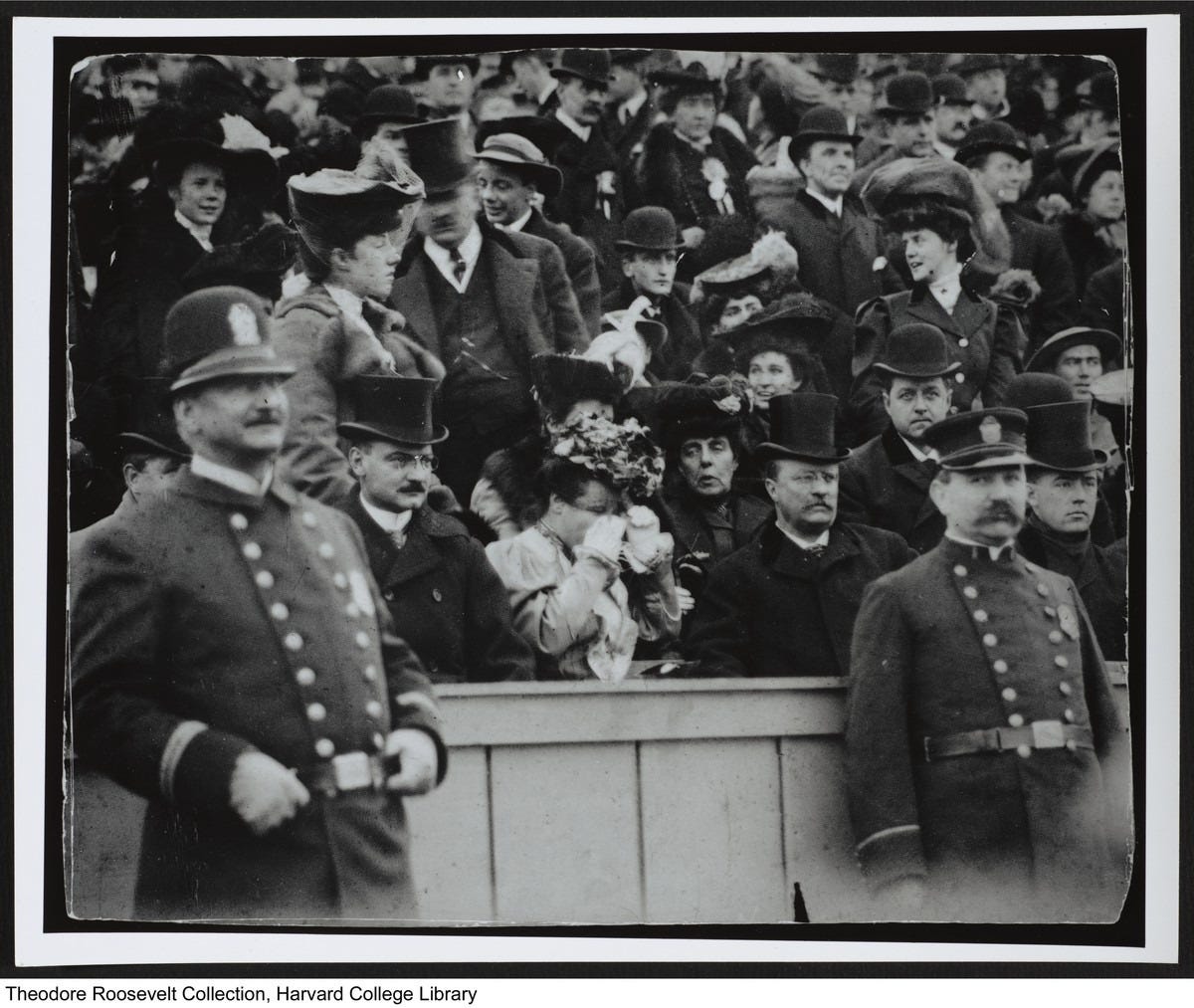
The game at Princeton proved a disaster, despite the attendance of Teddy Roosevelt and an estimated 25,000 others. It wasn’t the game itself, played on a muddy field and ending in a 6-6 tie due to darkness. Instead, Princeton lacked the infrastructure and facilities to handle the influx of people and special trains that descended on the city. Train delays, too few hotels, and insufficient restaurant capacity caused more dissatisfaction than any ticket shortfall ever had, so it was back to the drawing board.
In January 1906, Army and Navy considered moving to New York City or Washington, D.C. for the next game. They even looked at playing in Philadelphia’s major league parks, but Franklin Field was built for football and made the most sense from a location and capabilities standpoint. The breakthrough came when Penn agreed to install several thousand temporary bleachers behind the west goal line and to allocate the added seats to Army and Navy. Since everyone got what they had before and Army and Navy got more, they quickly agreed to return to Franklin Field. The change allowed everyone to walk away happy, while Pierce returned to helping figure out the rules football would play under for 1906.
Many colleges built large on-campus stadiums in the 1920s to handle a handful of games each fall. A few cities did the same, including Pasadena, which built a stadium that they filled only one day each year. The trend continued, so that nearly every FBS school today has an on-campus stadium to handle big crowds, even for its biggest rivalry game, and, by and large, people expect games to be played on campus.
Army and Navy never went in that direction, choosing to maintain smaller on-campus stadiums that tap out in the mid-30,000s today. Other than the two WWII games, they have played all their rivalry games at larger neutral-site stadiums, though they never returned to Princeton.
Regular readers support Football Archaeology. If you enjoy my work, I encourage you to get a paid subscription, buy me a coffee, or purchase a book.


The proposed location for this 1914 DC stadium to host the Army-Navy game might be the same site from which US Air Mail originated: https://www.newspapers.com/image/79941103/. DC has never hosted the game.