

With the Winter Olympics arriving in a few weeks, it is worth pointing out that Sweden’s Gillis Emanuel Grafström won gold medals in figure skating in the 1920, 1924, and 1928 Olympics. Since figure skating was part of the 1920 Summer Olympics, Grafström is one of two people to have earned gold medals in the Summer and Winter Olympics.
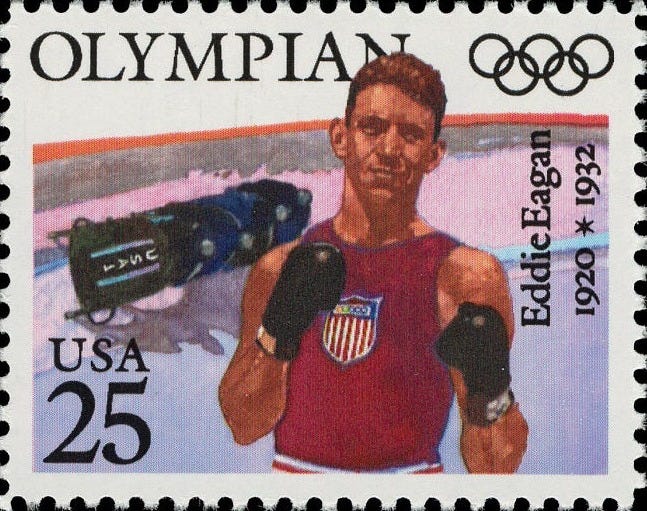
Eddie Eagan is the only other person to win gold in the Summer and Winter Olympics, doing so in distinct events, plus he played college football and enjoyed a rather interesting life.
Eagan grew up in Colorado and attended the University of Denver for a year, during which he served as a substitute on the freshmen football team. A solid athlete, Eagan was also a skilled boxer, having learned a thing or two taking on cowpokes as a teen. While at Denver, he won the Rocky Mountain AAU middleweight championship before WWI interrupted his studies.
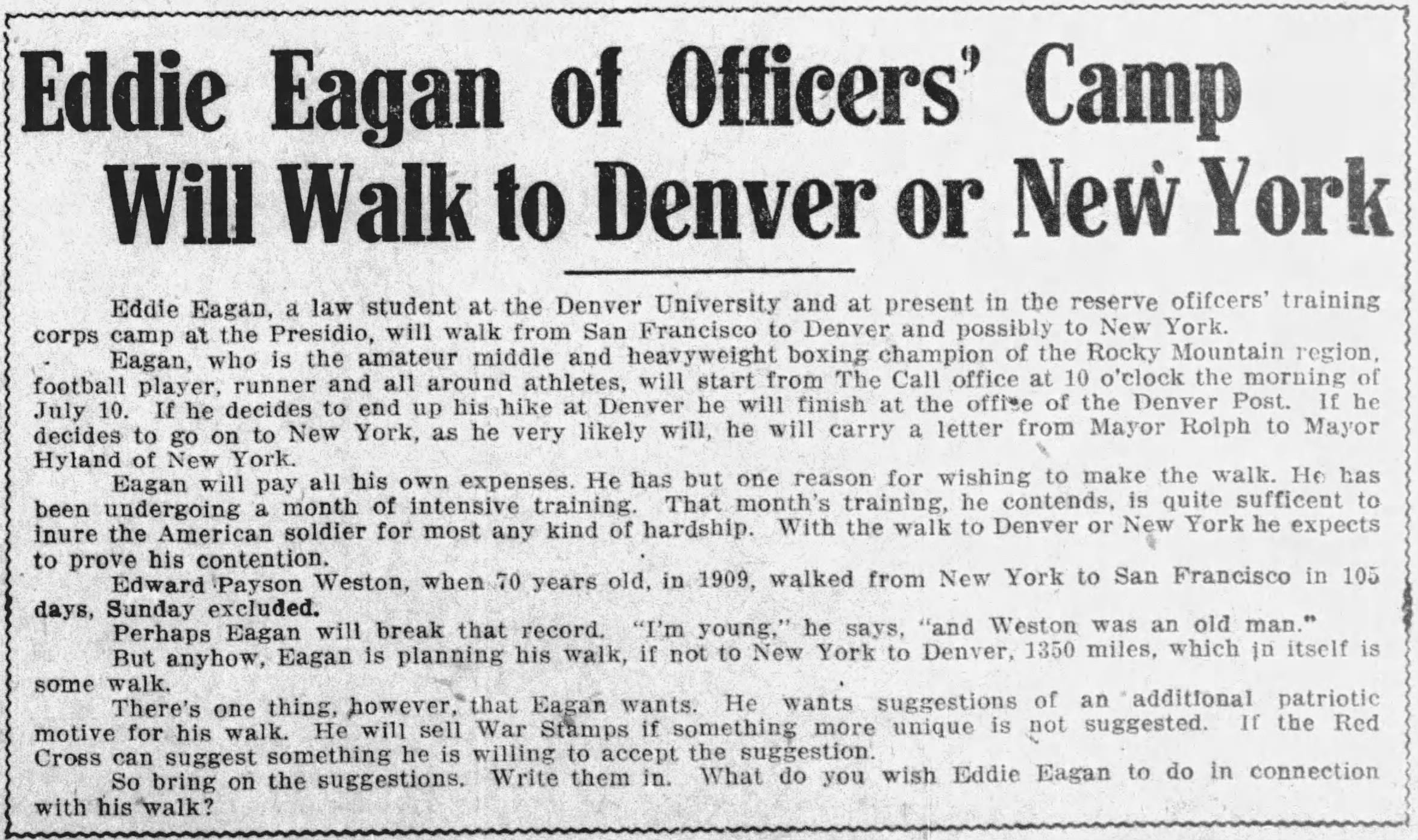
Upon completing officer training at the Presidio in San Francisco, he announced plans to walk to Denver or New York to demonstrate how well the Army conditioned the nation’s soldiers.
The Army had other ideas and sent him to Camp Taylor in Kentucky, where he appears to have remained for the rest of the war. Discharged in January 1919, he entered Yale, but, having served in the armed forces during the war, he traveled to France that summer to compete in the Inter-Allied games, an Olympic-like tournament among the Allied armed forces, where he won the middleweight boxing title.
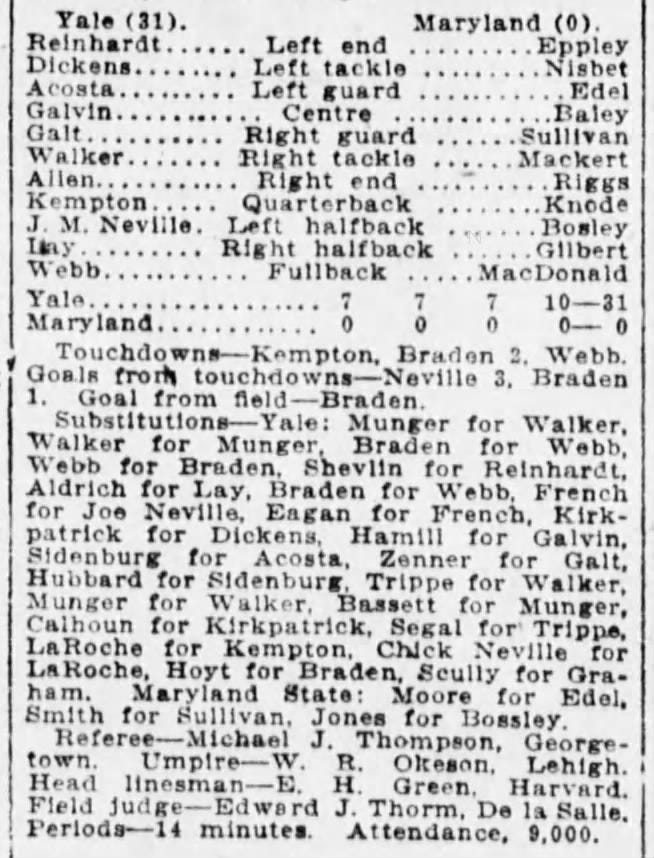
He returned home in time to join Yale’s football team as it trained for the 1919 season. Given his pugilistic past, he was plenty tough enough, yet despite trying him at multiple positions, he never found a fit. I confirmed only one game in which he appeared, when he substituted for French, who had substituted Joe Neville at left halfback, versus Maryland.
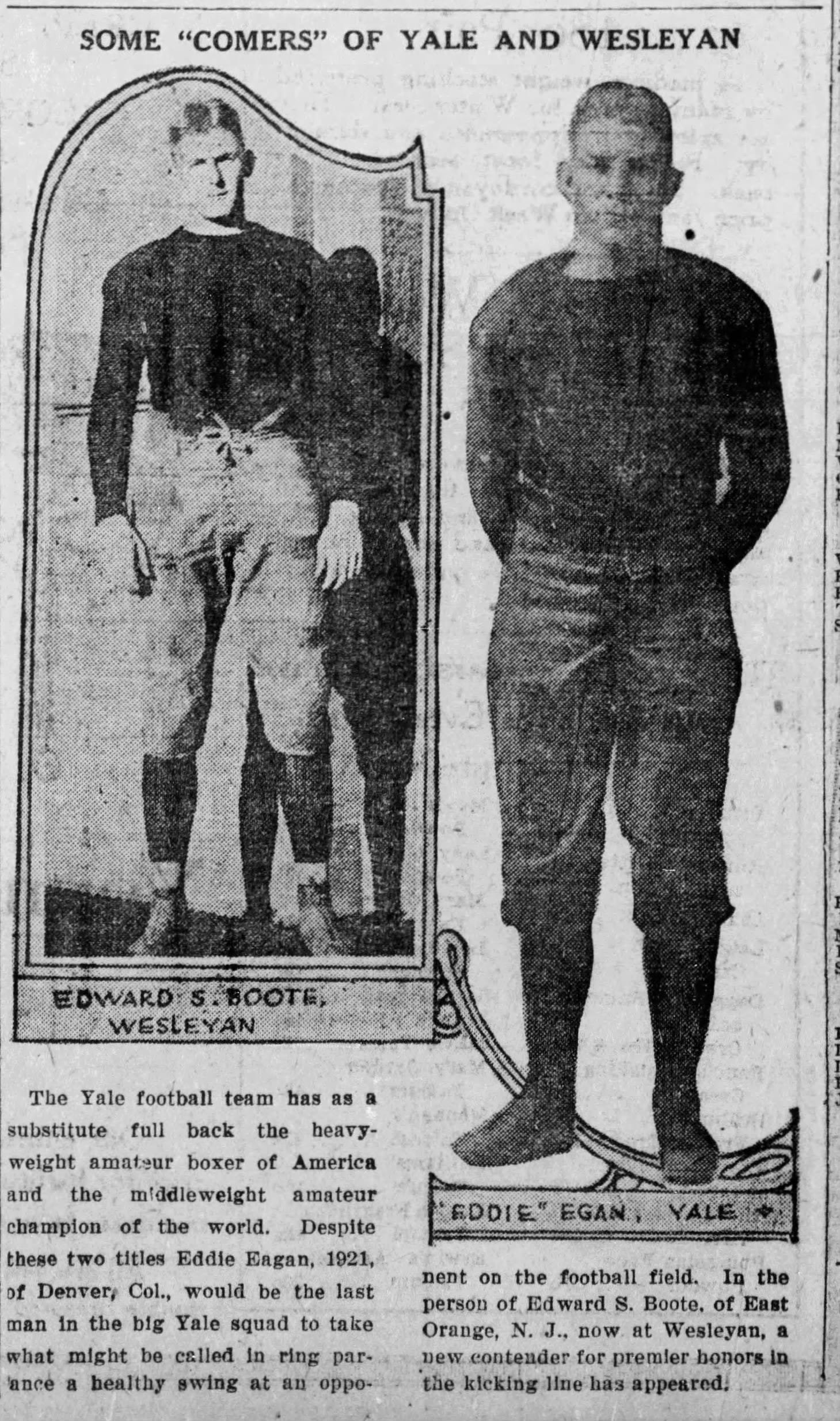
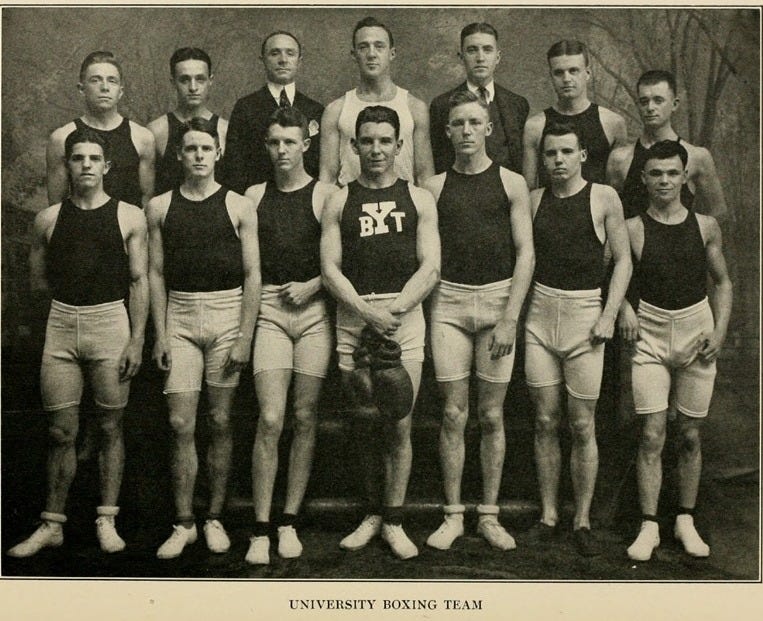
Eagan’s most significant contribution to Yale sports was his role in starting Yale’s boxing program, which they recognized as a varsity sport in 1920. Plus, before starting training camp for Yale’s 1920 football season, he spent a few weeks in Antwerp, where he won Olympic gold as a middleweight.
Upon graduating from Yale in 1921, Eagan became a Rhodes Scholar, earning a Ph.D. at Oxford University, before settling into a law career. He also made the 1924 Olympic team as a heavyweight, losing his first bout but battering his opponent so severely that he forfeited his remaining matches.
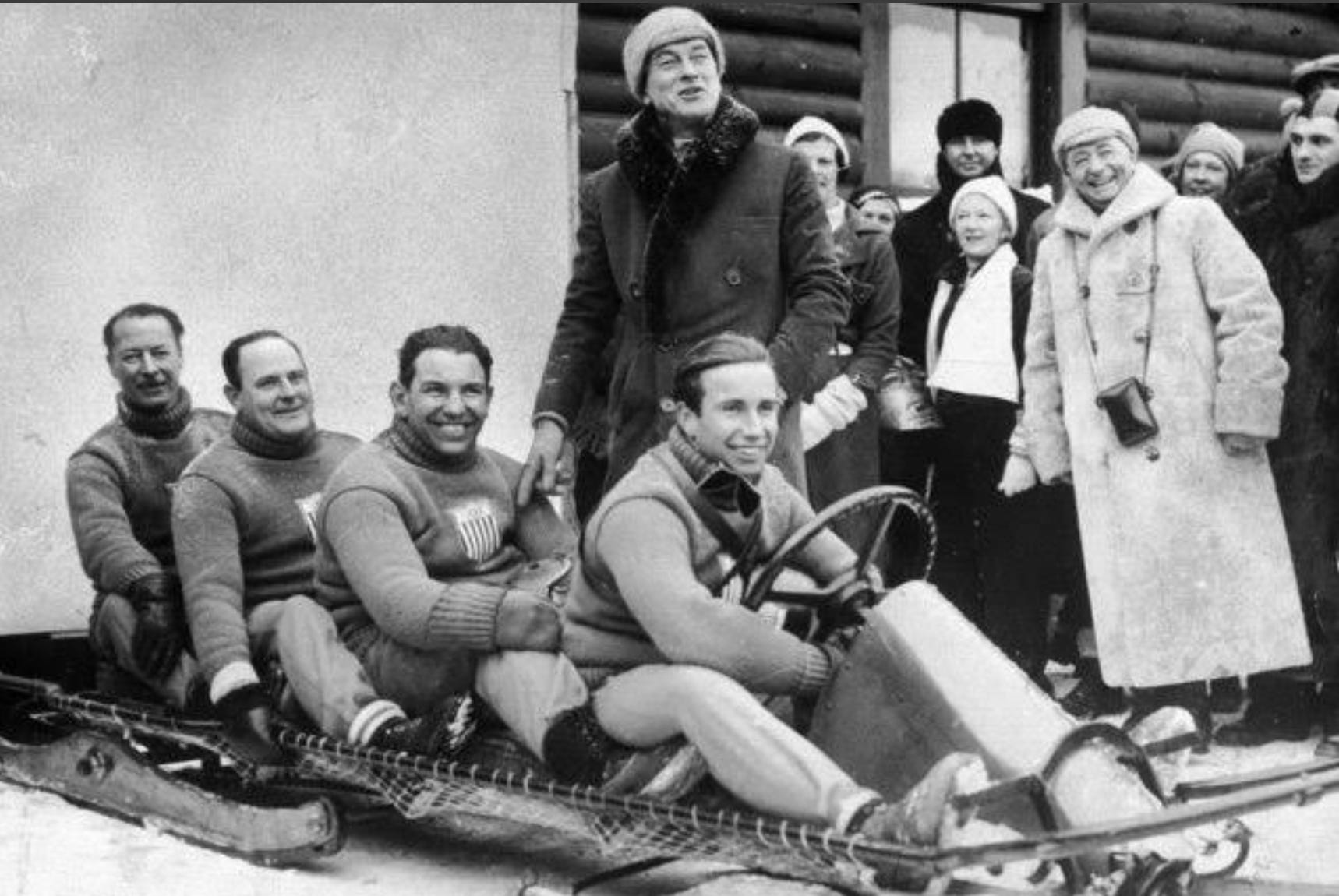
During his legal career, Eagan remained the adventurous sort, willing to try anything. While living in New York in January 1932, a member of the four-man Olympic bobsled team chose to focus on the two-man team, leaving a spot open on the four-man team.
The Winter Olympics were still the domain of wealthy sportsmen then, so when Eagan had dinner with his friend, Billy Fiske, the captain of the four-man bobsled team, Fiske invited Eagan to join the team as their pusher. Despite never having ridden a bobsled before, he returned home and told his wife he had become a member of the 1932 Olympic bobsled team and competed at Lake Placid shortly thereafter. Of course, the four-man team won the damn thing, which is how Eagan became the only person to win gold in distinct events at the Summer and Winter Olympics.
Eagan’s adventures and record-setting did not end there. After serving with the Army Air Forces’ Air Transport Command during WWII, Tom Dewey named him to the New York Athletic Commission, but his record-setting came as a member of the Circumnavigator’s Club. The club members where those who had crossed each of the Earth’s degrees of latitude, which Eagan qualified for in 1927. Primarily a social and networking club, it was the vehicle by which another opportunity fell into Eagan’s lap. Robert Ripley, of Ripley’s Believe It Or Not, had arranged with Pan American Airlines to set a record by circumnavigating the globe in the shortest time on regularly scheduled flights. When Ripley fell ill shortly before his round-trip was to start, Eagan took his place. The trip took him from New York to Boston, to Gander, Shannon, and London. From there, he flew to Brussels, Istanbul, Damascus, Karachi, Delhi, and Calcutta. Next came Bangkok, Manila, Guam, Wake, Midway, and Honolulu, followed by San Francisco and then across the U.S. to LaGuardia. Believe it or not; by circling the world in 147 hours and 15 minutes, he broke the previous record by 20 hours and 15 minutes.
While Eagan was not much of a football player, he’s one of those figures it is hard to believe ever existed. He would have been fun to have a beer with and listen to a few stories, but I wouldn’t have wanted to fight him.
Football Archaeology is reader-supported. Support the blog by buying one of your favorite blog-used item on eBay.
He went on to be Chairman of the New York State Athletic Commission at a fascinating time too. It was effectively the Global governing body for boxing but under threat from 13 other states who formed the NBA. And real power in the sport was shifting from Mike Jacobs to IBC too. Eagan was the main person against reinstating Rocky Graziano too after he was banned for not reporting a bribe offer.
Holy cow! What an amazing life this man led! Thank you for the research on this incredible person.