
Giving Voice to Football: Crying “Down” and “Held”

Voice commands are verbalizations that tell football players what to do during games or what they cannot do. Voice commands played a major role in early football, with some disappearing, others evolving, and new ones emerging.
Initially, voice commands came only from players and officials. Coaches didn’t exist early on, and once they did, they were prohibited from instructing or coaching players during games until the 1960s (at the college level).
Since the game has had various voice commands throughout its history, I’ll split the discussion into a few articles, with the first examining the ball carrier crying “Down” when tackled and the tackler yelling “Held” at times.
Football’s original rules of 1876 required the ball carrier to cry, “Down,” when tackled to the ground and held, a rule that carried over from the Rugby Union.

Yelling “Down” stopped play and reduced the threat of piling on, so it was in the ball carrier’s best interests to be loud and clear when acknowledging that he had been stopped.
Recall that before 1880, all scrimmages were contested, just like rugby today. But American players wanted a more open, scientific game, so they introduced the system of possession in 1880, which allowed one team to retain possession of the ball and start play during a scrimmage by heeling the ball back with the foot to a teammate.
By norm, teams that failed to move the ball punted after a few attempts, though the rules did not require them to give up the ball. It did not take long for a team named Princeton to decide it was sometimes to their advantage to stall by keeping the ball play after play, seldom giving up possession, in what became known as “block” games.
While Princeton traditionally gets all the blame for the block games, Harvard employed a similar trick, and perhaps others did, too.
When Harvard hosted a club from Montreal in October 1881, the Montrealers played by Rugby Union rules when they had possession, meaning they employed the contested scrimmage. Harvard did not. They snapped it back American-style when they had the ball. Montreal soon became frustrated, especially when, during Montreal scrums, Harvard players pulled a stalling trick. During play, the Crimson youths would lie on or touch the ball on the ground and yell “Down,” stopping play. Harvard also knelt behind their goal line for safety touches, which did not yet score a point or two for the other team. So, the Bostonians were stallers just as much as the Princetonians.
Due to all the stalling, the 1882 rule book introduced the system of downs, which forced teams to gain five yards in three downs or surrender the ball. Less often mentioned is that another rule change required the player making the tackle to cry “Held,” in addition to the runner crying “Down.”
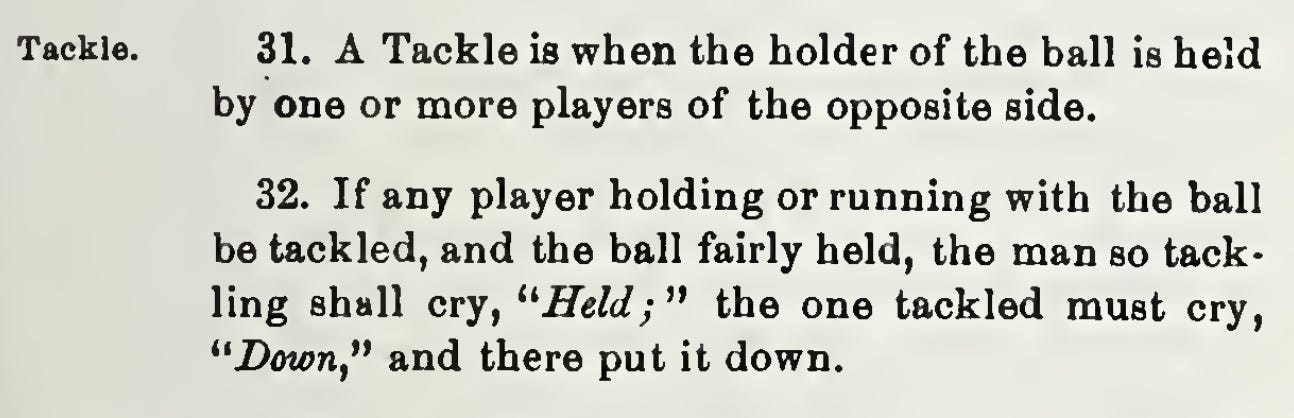
I’m reading between the lines here, but it appears that requiring the defender to yell “Held” before the runner yelled “Down” kept offenses from unilaterally downing the ball unless they ran out of bounds.
The rule requiring the defender to cry “Held” remained in the rule book through the 1887 season, but disappeared in 1888 when they allowed either the ball carrier or the ref to cry “Down” to end play.
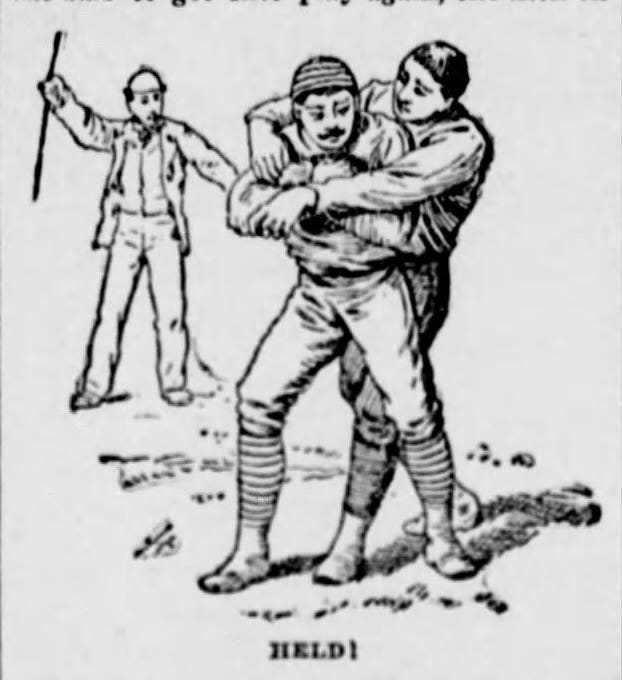
Then, in 1889, another rule change instructed the referee to use a whistle to signal the end of play. Presumably, whistles were so effective at ending play that players’ verbal calls were no longer needed. By 1895 or 1896, the tackler no longer had to cry “Held.”
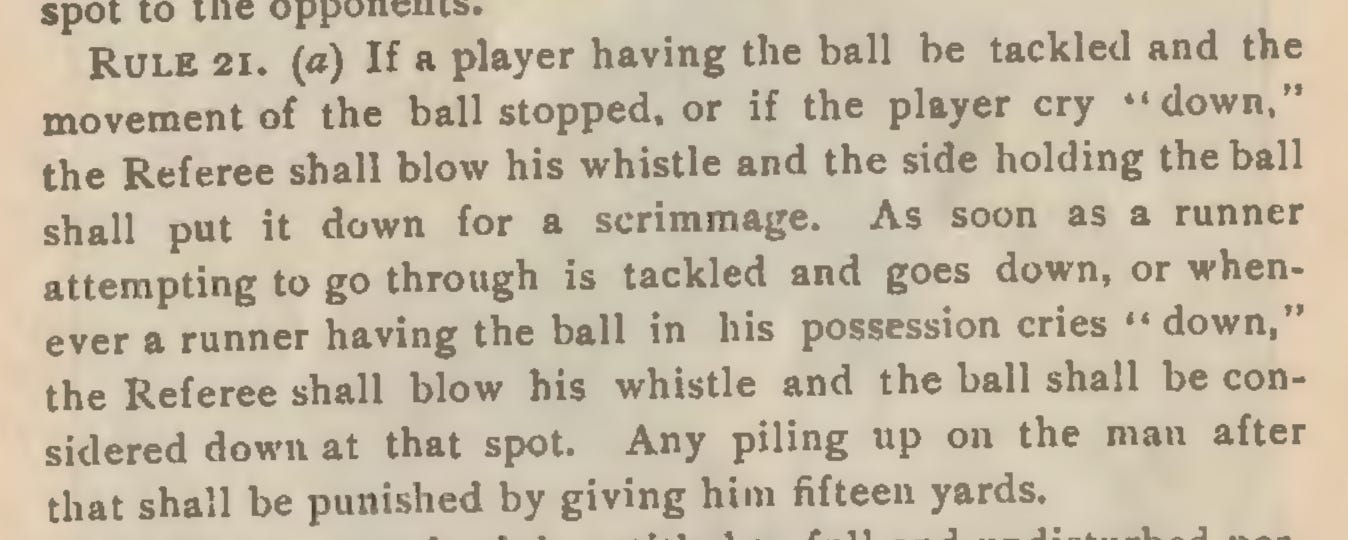
So, “Held” went away in the mid-1890s, but what about the runner crying “Down?” The 1896 rule indicates that the runner still had the option to cry “Down,” which would cause the referee to blow his whistle. This procedure appears to have remained in place to give ball carriers a method to voluntarily end the play, much like taking a knee accomplishes today.
That need remained in place until 1932, when the rules changed so the ball carrier was considered down when any part of his body other than his feet and hands touched the ground. That meant a ball carrier could give himself up simply by taking a knee. Surely with that rule in place they could eliminate the option to cry “Down,” right?
Not so fast, my friends. The football rulemakers have sometimes worked in mysterious ways, leaving rules in place long after teams stopped taking advantage of them (e.g., return kicks) and other times failing to institute rules since everyone already followed the practice without the rule (e.g., requiring face masks). Some rules left in place, like this one, didn’t hurt anyone by being there, so they let them sit.


In this case, runners could still cry “Down” until 1963, when the rule in the 1962 rulebook disappeared from the game.
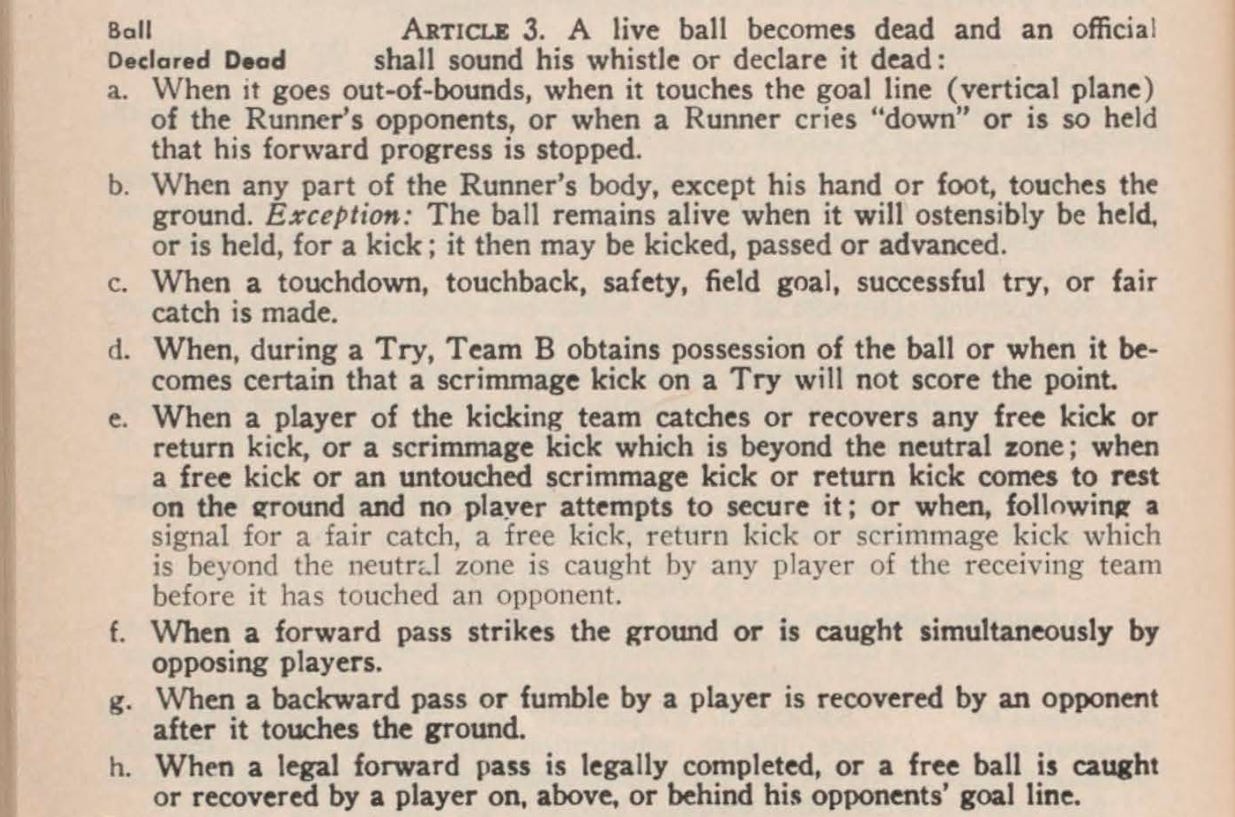
The rule change may have resulted from a change in the Rules Committee’s leadership, with David Nelson becoming the NCAA Football Rules Committee’s secretary-rules editor in 1962. However, they didn’t eliminate the return kick until 1967, despite few using it for years.
So, “Down” came into football with its original rugby rules; “Held” followed soon after, but was booted after a decade or so, while “Down” remained an option into football’s modern era.
In the next few days, we’ll tell the story of some verbal commands issued by the referee, umpire, and linesman before and after whistles entered the game.
If you enjoy Football Archaeology and are not a paid subscriber, consider buying me a cup of coffee now and again. You can also buy a paid subscription or purchase one of my books.

