
Pvt. Hastings, What a Long Strange Trip It’s Been

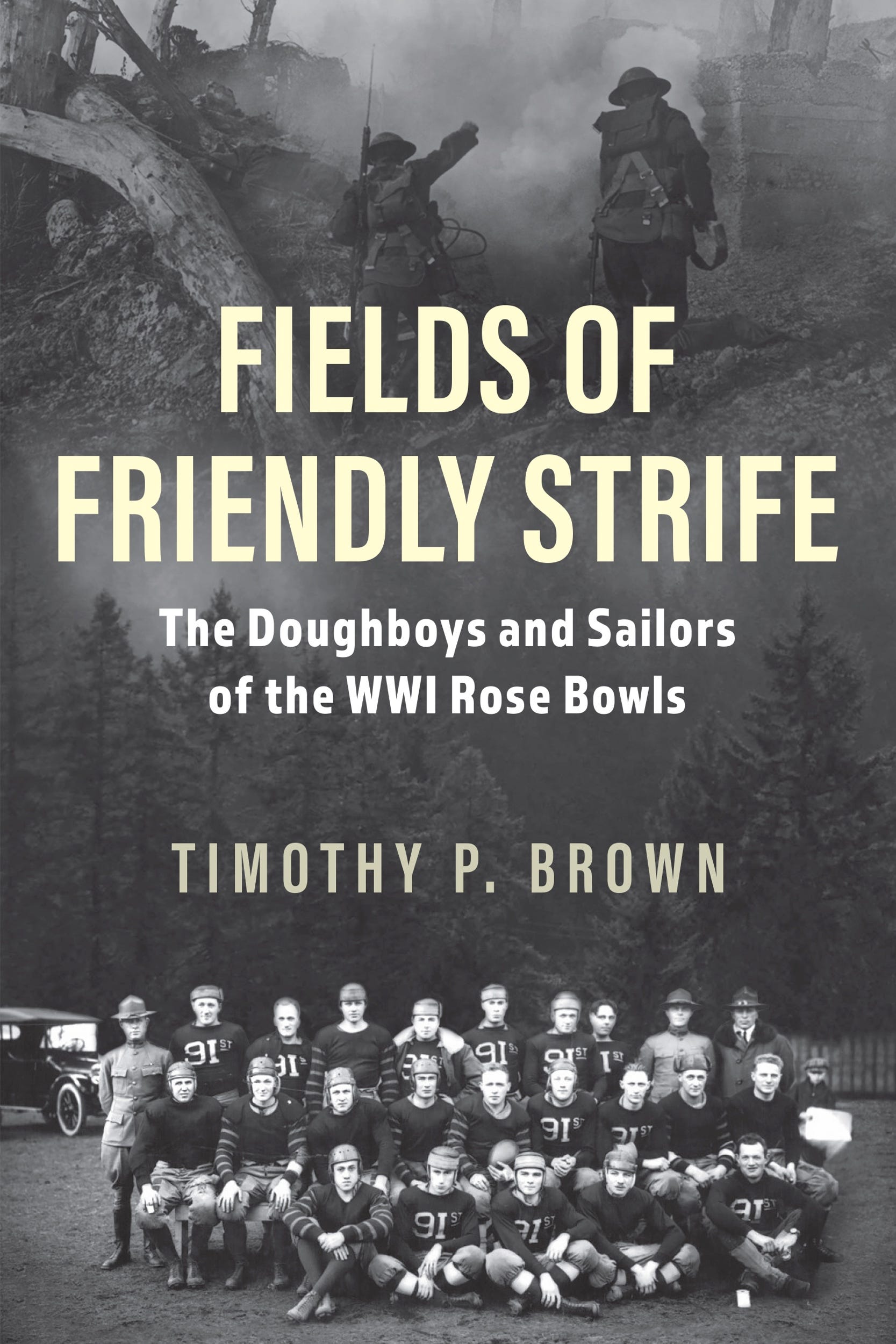
My first book, Fields of Friendly Strife, came out in 2017 and told the story of the soldiers, sailors, and Marines who played for military teams in the 1918 and 1919 Rose Bowls. It covered their military training and football seasons, their time serving Over There and dealing with the Spanish Flu here, while also tracing where the players came from and went after WWI.
Four died in action in France, and many others were wounded. Over time, various team members saw action at Belleau Wood, Meuse-Argonne, the Banana Wars, Pearl Harbor, Guadalcanal, Tarawa, Saipan, Iwo Jima, and Korea. Of the 20+ who played for the 1917 Mare Island Marines, five became Marine Corps generals, and one, by happenstance, served with the 13th Marines in France, the same unit as my maternal grandfather.
Following the war, 18 played in the early NFL, and 6 became NFL head coaches; others coached college football, including George Halas, Paddy Driscoll, Roy Andrew, Jimmy Conzelman, Dick Hanley, Dick Romney, and Charlie Bachman. Of course, most team members were not so famous, living everyday lives.
I know what happened to most of them because I spent an inordinate amount of time tracing every one of the 178 men I identified as playing a part on one of the four teams. I had to track each man down because the book was meant to verify or disprove a 1969 claim by one of those Marine Corps generals that half the players in the 1918 Rose Bowl had died in service to their country.
I eventually proved his claim was untrue, but the only way to confirm it was false was to track every individual mentioned as practicing and playing with the teams, and sort out where they went. That was not an easy task. One of my first blog stories described the challenges of dealing with misinformation, misspellings, typos, and other errors that took me down incorrect paths.

Despite scouring military records, newspaper archives, genealogical sites, and college archives, I could not find some of the 178 guys, so I appealed to anyone who might have information on the remaining 11.

Periodically, I have looked for the remaining 11, but I didn’t find anything until now, leaving 10 to be identified.
Several times recently, when I encountered research brick walls, I turned to AI to help. I did so the other day with Hastings, and after numerous queries and dead ends, AI turned over a stone I had not. One thing led to another, and now I can tell the story of the guy named Hastings on Camp Lewis’ 1918 Rose Bowl team.
Back in 2017, I only knew Hastings’ surname and that he supposedly played football for Fresno High School, though most California high schools played rugby at the time. The records I had showed he did not appear in a game all season, yet suddenly, he was on the traveling squad for the Rose Bowl, so I half-assumed the name was a typo or some other error. Still, my 10-year-old notes show that I investigated a dozen guys named Hastings among the 30,000+ soldiers who trained with the 91st Division at Camp Lewis, near Tacoma.
One way or another, I or AI had a breakthrough and found an article listing the Camp Lewis team roster that provided Hastings’ first name:
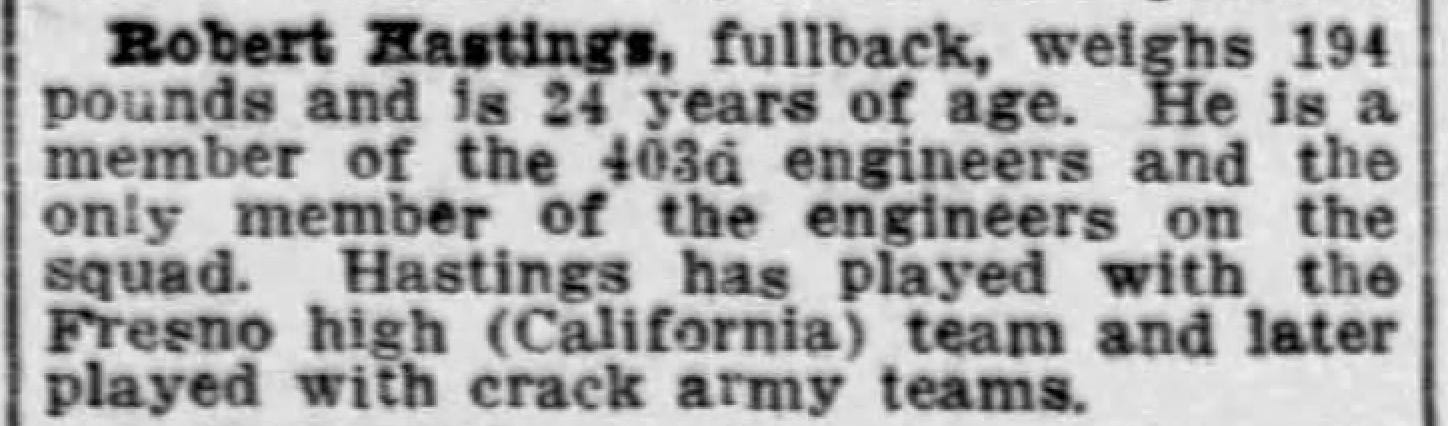
Armed with his first name, I found Robert Roy Hastings’ WWI Draft Registration form from June 1917, showing he was born in Chicago, lived in Fresno, and was employed at the Preston School of Industry, a state reform school for boys, so he was a Central Valley guy.
My notes from 2017 show that I looked at him then, but could not find any links, so I moved on. Part of the challenge of tracking him down back then was confusion about his unit at Camp Lewis. The newspaper listed him as part of the 403rd Engineers, a group that did not exist, at least not by that name. In fact, he served with the 403rd Aero Squadron, which was formed at Camp Lewis in 1917 and was briefly known as the 403rd Aero Construction Squadron (Engineers). Rather than a group of flyboys in training, the 403rd was involved in logging efforts in the Northwest, since the area’s Sitka spruce produced the wood for WWI airplane frames.
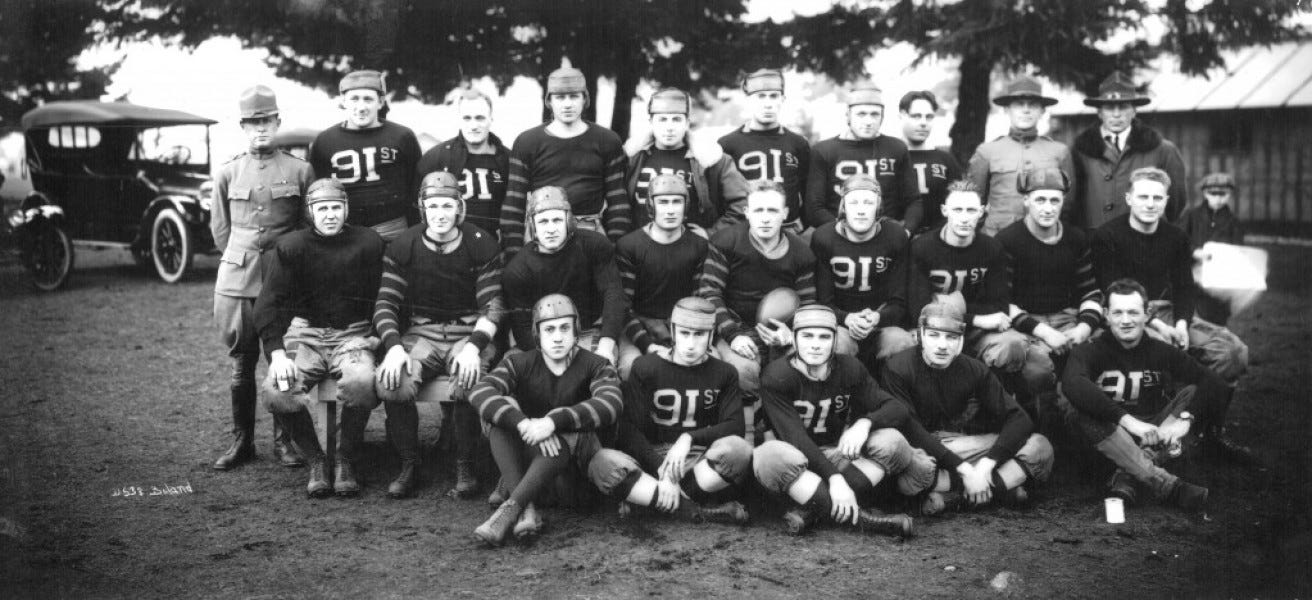
Despite not playing a game all season, the record shows that Hastings traveled with the team to the Rose Bowl. While I have not found evidence that he played, he is listed on the injury report with a bad ankle.
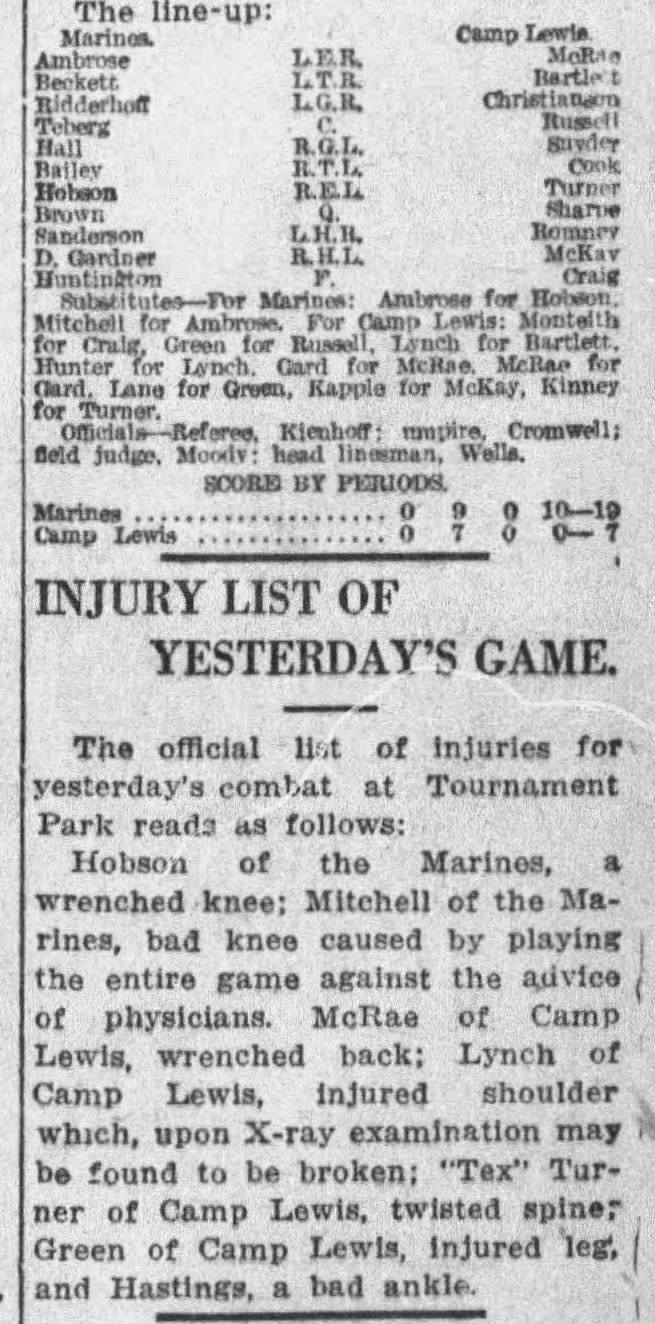
Stories published a few years later indicate he played in the game -some said he starred in the game- and suffered a broken ankle or leg requiring a silver plate to stabilize the damage. The injury led to his discharge from the Army in early 1918.
Hastings shows up again in October 1918 as the coach at Pomona High, east of LA. Since many California high schools had played rugby since 1906 and were just getting back into football, Pomona was lucky to have a guy with his football background volunteer to assist the team. Newspapers covering his hiring reported that he played at Harvard and was an all-star in several sports. However, he quickly clarified, saying his football experience came from playing on Fresno-area town teams.
The Pomona High kids loved him; he soon became their paid head coach and led them in a season that extended into February, as numerous games were postponed due to Spanish Flu quarantines.
He married and had a little girl in Pomona in January 1921. There was a story or two about him briefly coaching Fresno State Normal’s football team in 1921, though I couldn’t corroborate it.
Then, seemingly out of thin air, Hastings gained all kinds of unwanted publicity in December 1921, when he traveled with a pilot named E. H. Tanner from Fresno to San Francisco, where a local newspaper promoted an airplane stunt show that described Hastings as the general manager of the Marina Flying Association.
On Saturday, December 4, 1921, Hastings got in the backseat of E. H. Tanner’s plane. After taking flight, the plane rose to 2,500 feet, at which point Hastings jumped from the plane.
When his parachute opened at 2,000 feet, 3,000 earthbound spectators saw a trapeze hanging beneath the canvas chute. The plan was for Hastings to strap both wrists to the trapeze and perform tricks while descending. However, witnesses saw Hastings hanging from the trapeze by only one arm, and as he reached with the other arm, his bound hand slipped from the strap. He fell, landing in the city, east of the Presidio, near Divisadero and Lombard Avenues.
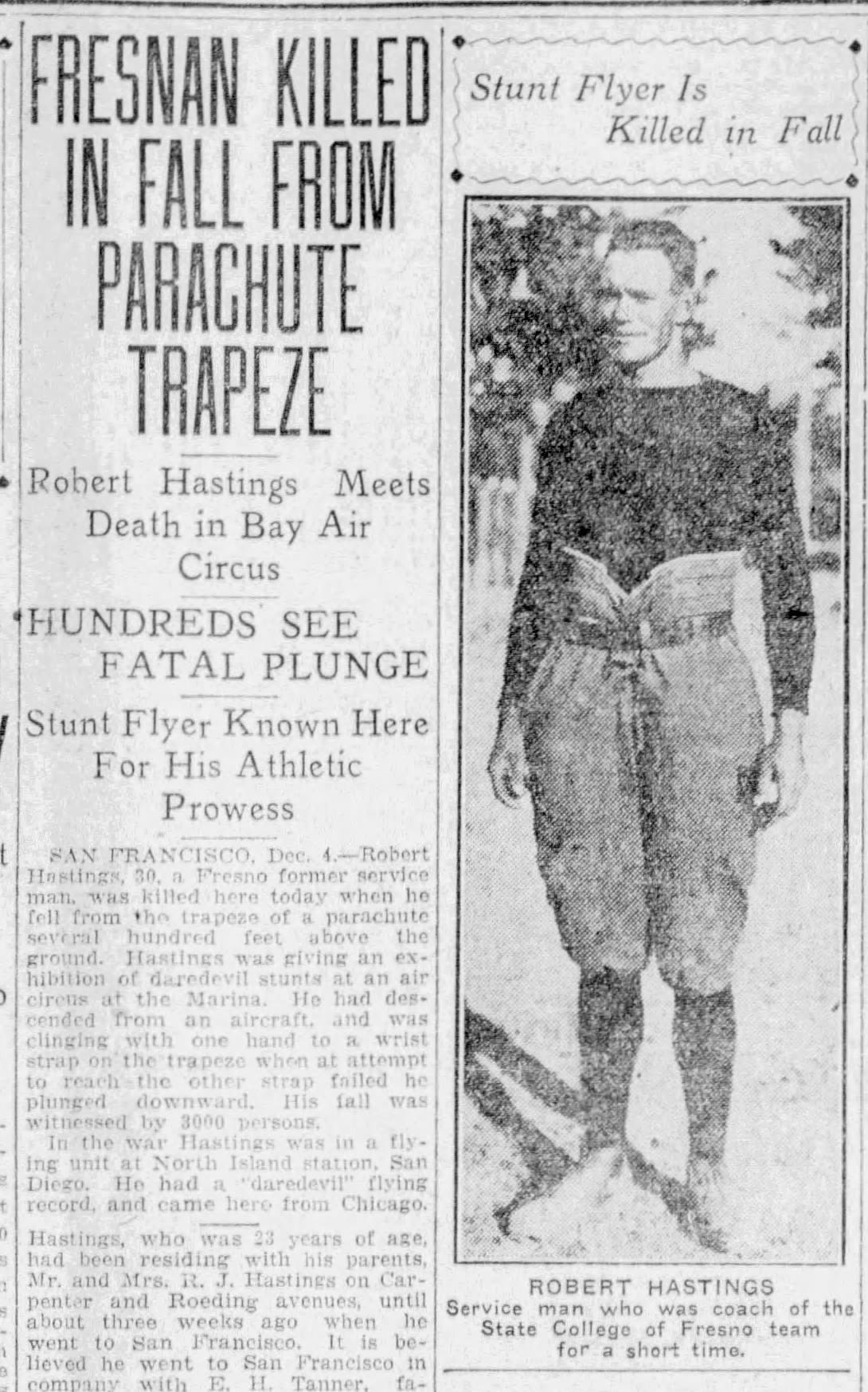
It’s unclear where Hastings got his aviation background. The obituaries claimed he served with an aero squadron in San Diego, but he was at Camp Lewis in December 1917, broke his leg, and was discharged, so if he ever flew in the military, it was before he arrived at Camp Lewis. Perhaps he got involved in the aviation stunt game after the war. It’s anyone’s guess now, but we know it didn’t work out well in the end.
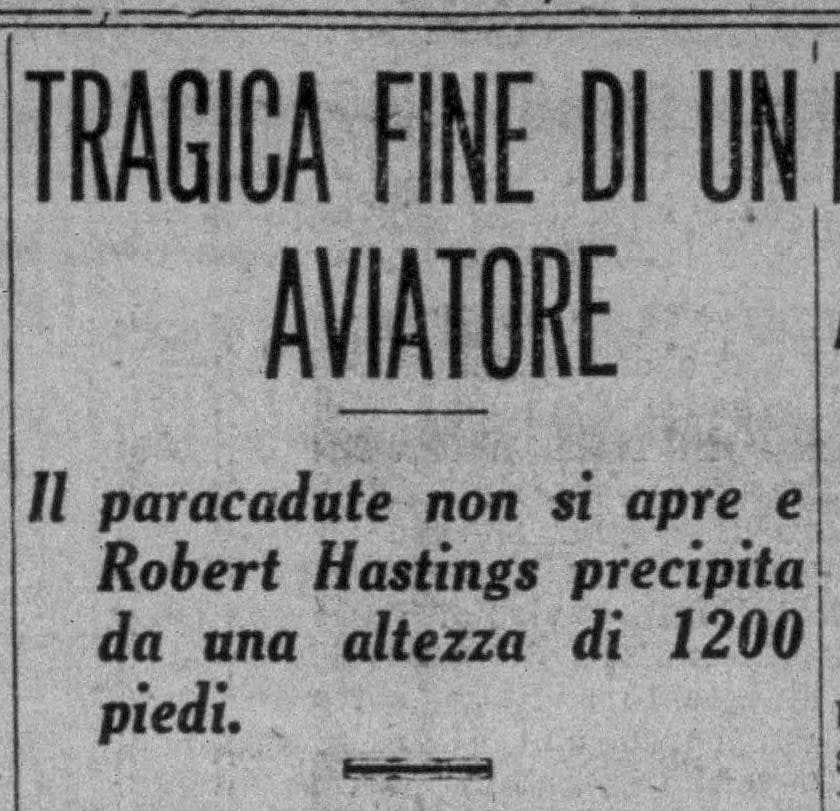
In death, Hastings joined those who perished during the war, and a Rose Bowl opponent, Marine aviator Dutch Molthen, whose plane crashed at Quantico in 1920. There was a Great Lakes player who died from football injuries in a 1919 college game, so while a few who died young, most of those who played for the four Rose Bowl teams lived good, long lives, at least for their day.
Now, after identifying Robert Hastings a decade after 168 others, Hastings becomes 169 of 178, so only 10 more to go. I’ll report back if future searches prove fruitful.
Football Archaeology is reader-supported. If you enjoy my work, get a paid subscription, buy me a coffee, or buy Fields of Friendly Strife.

The man had a football history lost to time. Another case solved by the Football Archaeologist! Sherlock and Watson watch out! Tim Brown and Claude are on the case to find 10 more.
It's fun to follow your obsession! Keep up the good work.