

You wouldn’t think that Southeastern State Normal School of Oklahoma emblemized how schools worked through eligibility standards and boosterism related to their football team. However, both issues were front and center with them in 1911.
Oklahoma became a state in 1907, and by 1909, it established a set of normal schools, including Southeastern Normal (now Southeastern Oklahoma University) in Durant. Southeastern fielded a football team that first year and the next, though the 1910 team disbanded due to disagreements with the faculty concerning academic standards. Their situation was similar to that of schools across the country wrestling with the requirements for students in athletic competition, a challenge that persists today.
The 1911 team faced similar challenges, though they became apparent during training camp, and the team had time to adjust. Normal schools of the time drew students from the surrounding area, many of whom were enrolled part-time students due to other obligations. Despite having many part-time students, Southeastern’s faculty insisted that students participating in intercollegiate athletics take at least four classes, attend 80 percent of them, and carry a 75 average or better in each. The standard barred many students who otherwise could have contributed to the football team.
Their schedule showed the team playing various small schools, including other normal schools, though it appears the did not played all those games.
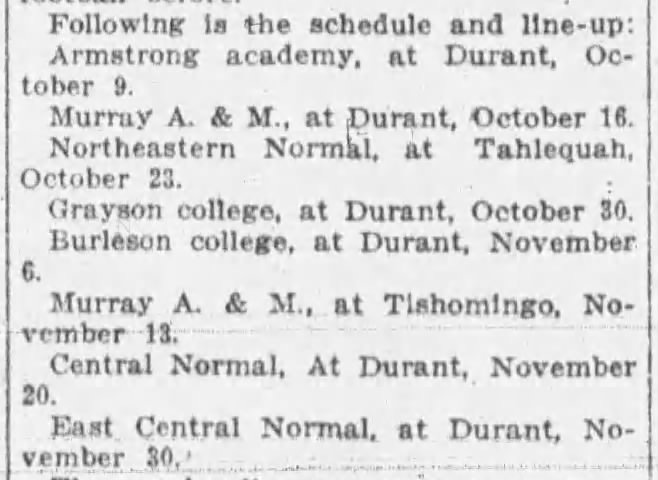
Their first test came against nearby Armstrong Academy, a school serving Choctaw Indians, who proceeded to outrun the Normalites and leave town with a 24-15 victory. However, the newspapers noted that the Armstrong game was merely a practice game because Ardmore did not require players to maintain a B average in their classes. The teams played again a few days later when the Southeastern team “played with more snap” the second time around and won 16-0.
About a week later, the team left Durant on Friday night on a road trip to play Oklahoma Baptist and Northeastern Oklahoma. Oklahoma Baptist, in Shawnee, was established only a year earlier. Its football fortunes were enhanced the week of the game by its merger with Carey College, which added talent and numbers to the Baptist squad. A 6-6 tie resulted, though we know little else about the game. Likewise, Northeastern Oklahoma’s school records indicate they lost to Southeastern 9-5, though the details of the game are unknown.
Following their return to Durant, the school president and faculty hosted a reception for the team that featured school yells, piano recitals, and readings. The description of the reception earned more newspaper space than the typical game, but it is clear they wanted to promote the team to the student body and larger community.
One speaker who had accompanied the team on the recent trip noted that many businesses in Shawnee closed during Oklahoma Baptist games as a way to encourage the community to support the team. A Miss Atkinson, speaking for the faculty, said that the football team played to “do honor to their college and the city in which it is located, and the people owe them a debt of gratitude, and should pay it by encouraging them by their patronage.” Higher ticket sales and attendance would demonstrate school and community pride.
For their next battle, the Southeasterners traveled 100 miles south to take on Dallas University. The boys from Dallas must have had a sizable team since Dallas has three squads played the Normalites in shifts, wearing them out, and winning 35-11. Several Southeastern players suffered injuries during the game and were unable to play two days later against Hargrove College, yet the boys from Durant still blew out Hargrove 54-0. (Hargrove closed in 1913, though it likely had nothing to do with the loss to Normal.)
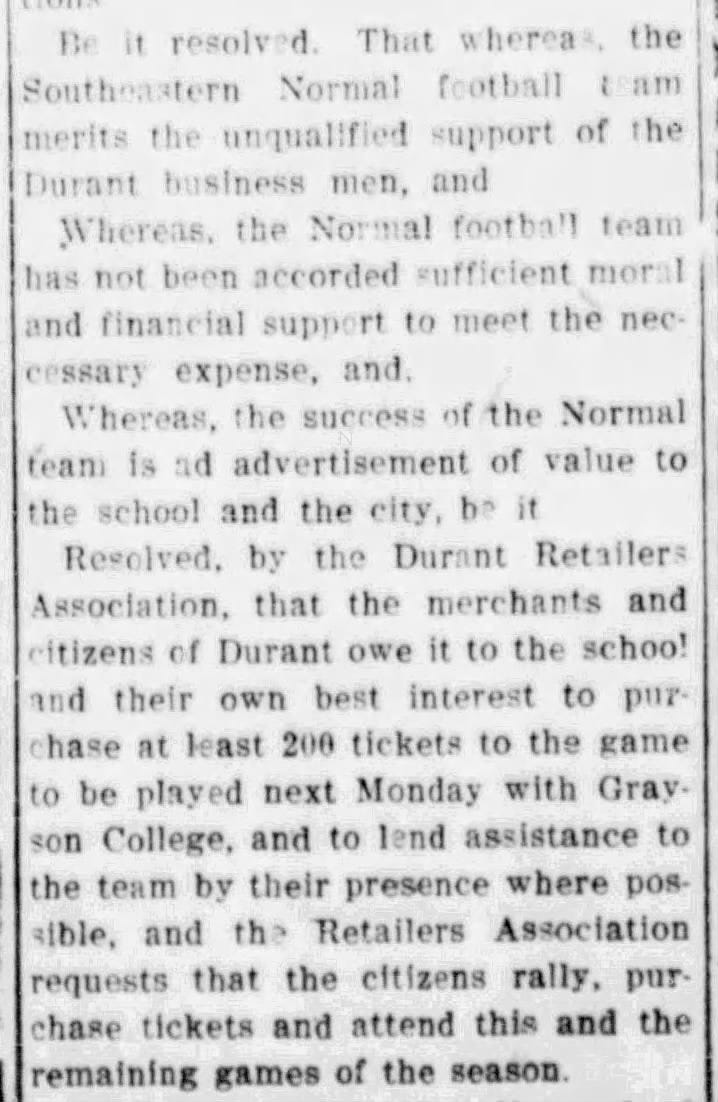
Over the next few days, the Durant Retailers Association held a meeting to discuss their support for the football team. After hearing of how the Shawnee retailers supported their team, the Durant retailers argued that while they supported the football team, closing their businesses during games would be bad business and inconvenient for their customers, many of whom were farmers who might spend a good part of a day getting into town, doing their shopping, and returning home. However, like any good Retailers Association meeting, they ended the session with a “whereas” or two and a “be it resolved” or three. They also agreed to actively support the team by selling or purchasing at least 200 tickets for the upcoming game with Grayson College. Some promised to give their employees the afternoon off to attend the game.
Before a larger-than-typical crowd, the local boys put on a good show against Grayson, scoring two first-half touchdowns to win 12-0, as the “local enthusiasts were greatly surprised and much pleased over the marked improvement in the speed and vigor of the local team.” (Grayson closed in 1912, though it likely had nothing to do with the loss to Normal.)
Next up was a return match against Oklahoma Baptist, who Normal tied 6-6 earlier in the year. With the game to be played in Durant, many local merchants posted broadsides in their shop windows to promote the game. Alas, despite their best efforts, the Normalites fell to the Baptists 3-0 on a fourth-quarter field goal.
Following a 5-5 tie with East Central Normal, the Normalites finished the season with a third game against Armstrong on Thanksgiving Day.
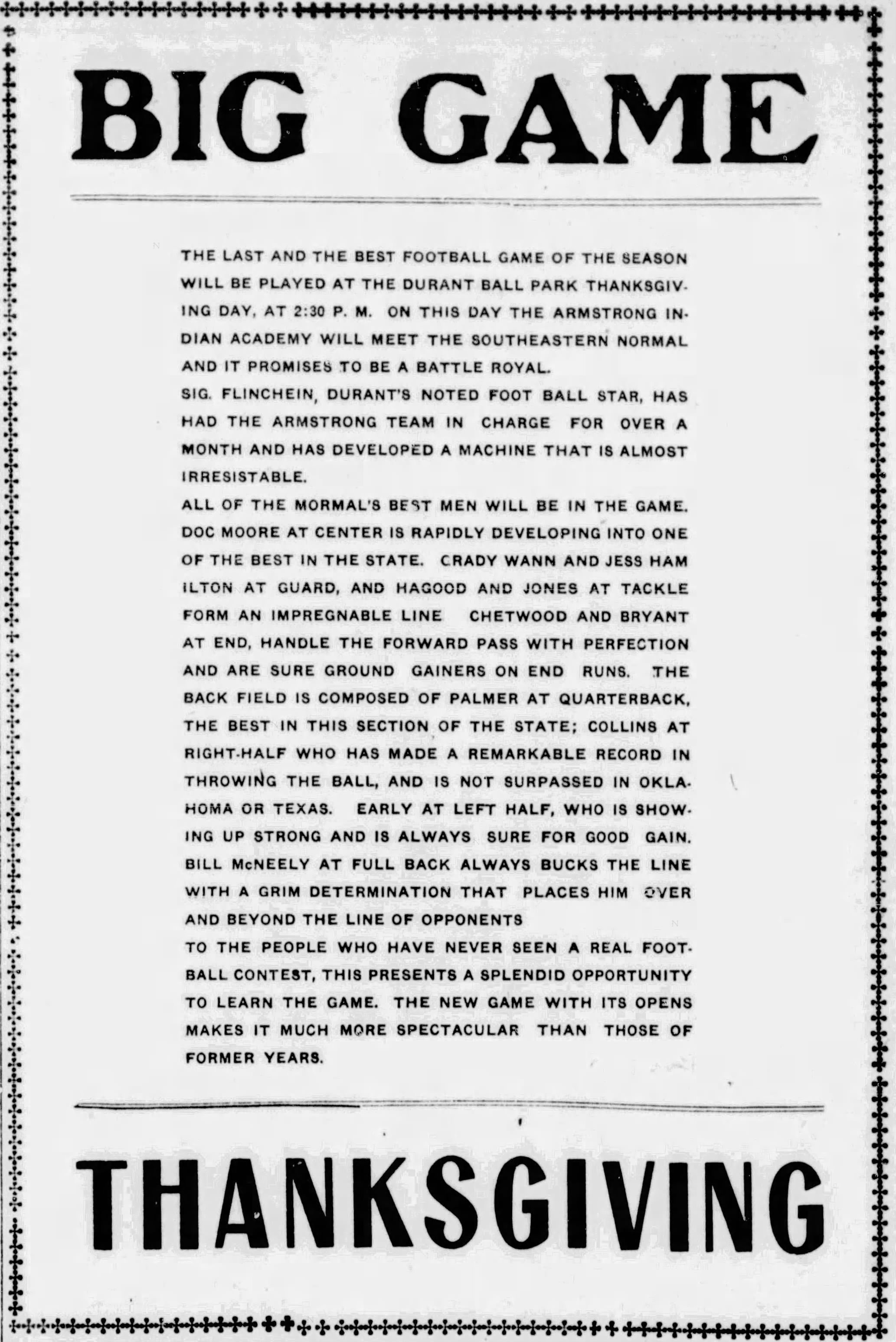
While the game ended in a 53-0 rout by the home team, the crowd enjoyed extra fun by promising Collins, the right halfback, $5 for each additional touchdown he scored. After he added three tallies, the spectators passed the hat and pinned a few $5 bills on Collins’ hard-earned letter sweater.
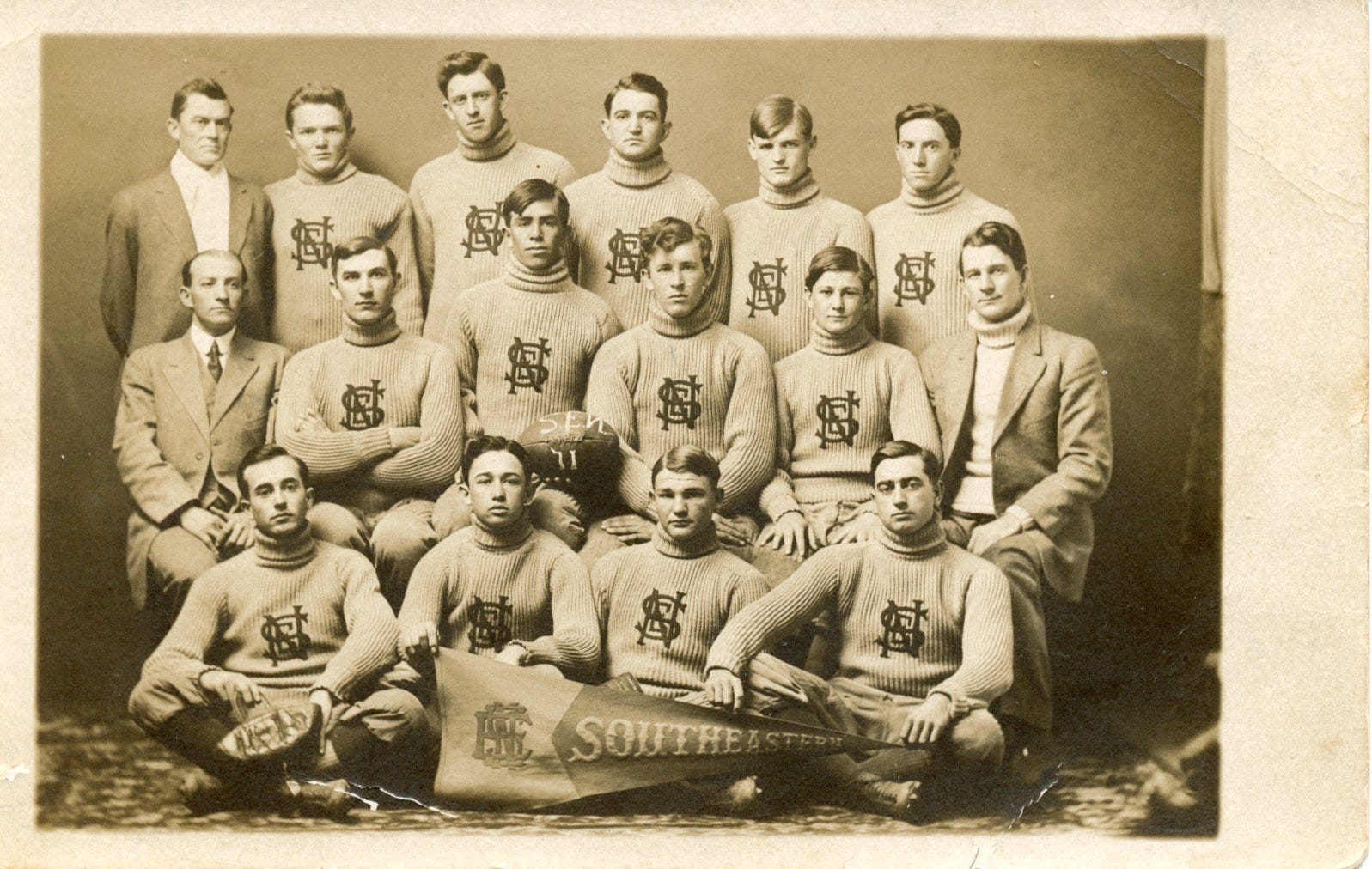
The game left the team with positive feelings and pride in the community support they started building. On the other hand, a local news reporter was pleased with the team, but less so with the community:
The game yesterday was the last of the season, and Southeastern Normal has come out well... They have done much to put Durant on the map, as nothing advertises a town better than a good football team, and the boys have done their part well. While the support to the team has not been at all times what it should have been, the boys are grateful to the citizens of the city and will begin next season with a team that will be second to none in the state.
‘S. E. N. Defeats The Indians,’ Durant Daily Democrat, December 1, 1911.
In retrospect, the 1911 Southeastern Normal football team did not put Durant on any football map I have ever seen, but football and spectator sports are generally tribal, and oftentimes, local. The folks in Durant, Oklahoma, in 1911, hoped the local normal school football team might bring fame and glory to the community, though most of the world had no idea they ever existed.
Postscript: The article originally said Dallas University became SMU, but two Texans corrected me in the comments below. :)
Football Archaeology is reader-supported. Click here to donate a couple of bucks, buy one of my books, or otherwise support the site.
I don’t believe “Dallas University” and Southern Methodist University (SMU) have any connection other than their home city. SMU was founded in Dallas in 1911 but did not hold its first classes until 1915. “Dallas University” was most likely a Catholic college called the University of Dallas, which began operating under that name in 1910 after being founded five years earlier as Holy Trinity College. It closed in 1928, and its charter changed hands a pair of times before a new University of Dallas was opened in 1956.
Cool piece of history, thanks. The pinned 5 dollar bills were NIL 1.0