

Football is filled with rules created for long-forgotten reasons that many assume have always been around or don’t think about how they originated. One such rule concerns the free kick allowed to teams following a fair catch. It has, in fact, always been around, coming over to football with the Rugby Union rules of 1876:
Rule 43: A player who has made and claimed a fair catch shall therefore either take a drop kick or a punt or place the ball or a place kick.
As stated, the rule allowed the player making the fair catch to attempt a dropkick for a goal, punt it, place it down for a scrimmage play, or attempt a placekicked goal. Despite the rule being as old as football, it applied only in the NFL after the colleges dropped it in 1950 or 1951 (depending on how you count). While the Division I Football Bowl Subdivision Oversight Committee approved the return of the fair catch free kick in 2026, this article will explain how the fair catch free kick evolved and why it disappeared from the college game in the first place.
In the early days of football, a player designated that he was making a fair catch by “heeling in;” that is, he dug one of his heels into the ground while making the catch. The late nature of the signal meant that coverage teams often did not wait for the signal and hit the return man, incurring a penalty and potentially hurting the returner. An 1894 rule required the returner to raise one arm in the air to signal a fair catch.
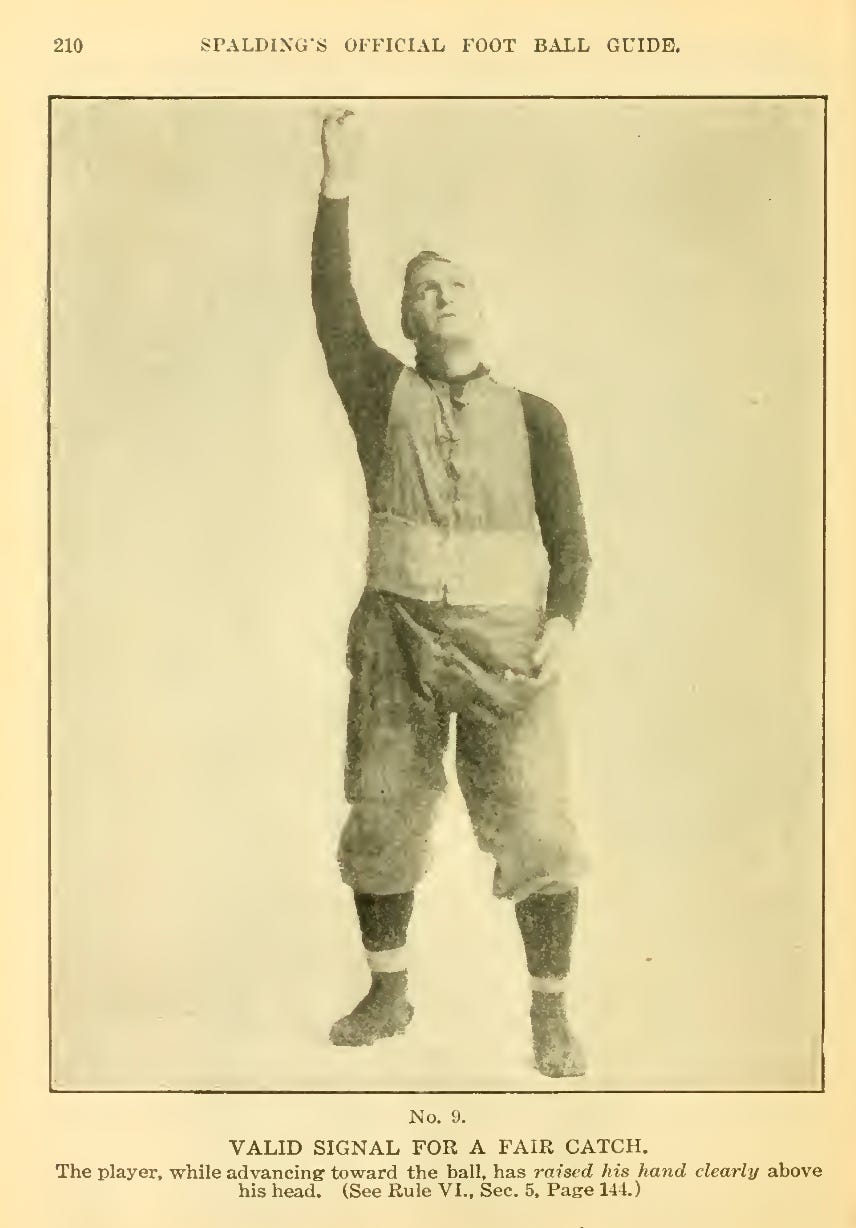
About the same time, football introduced the onside kick from scrimmage, which was governed by several sets of rules. However, from 1906 through 1922, punts that hit the ground could be recovered and advanced by the kicking team, which provided an additional incentive for the return team to catch punts on the fly, whether fair caught or not.
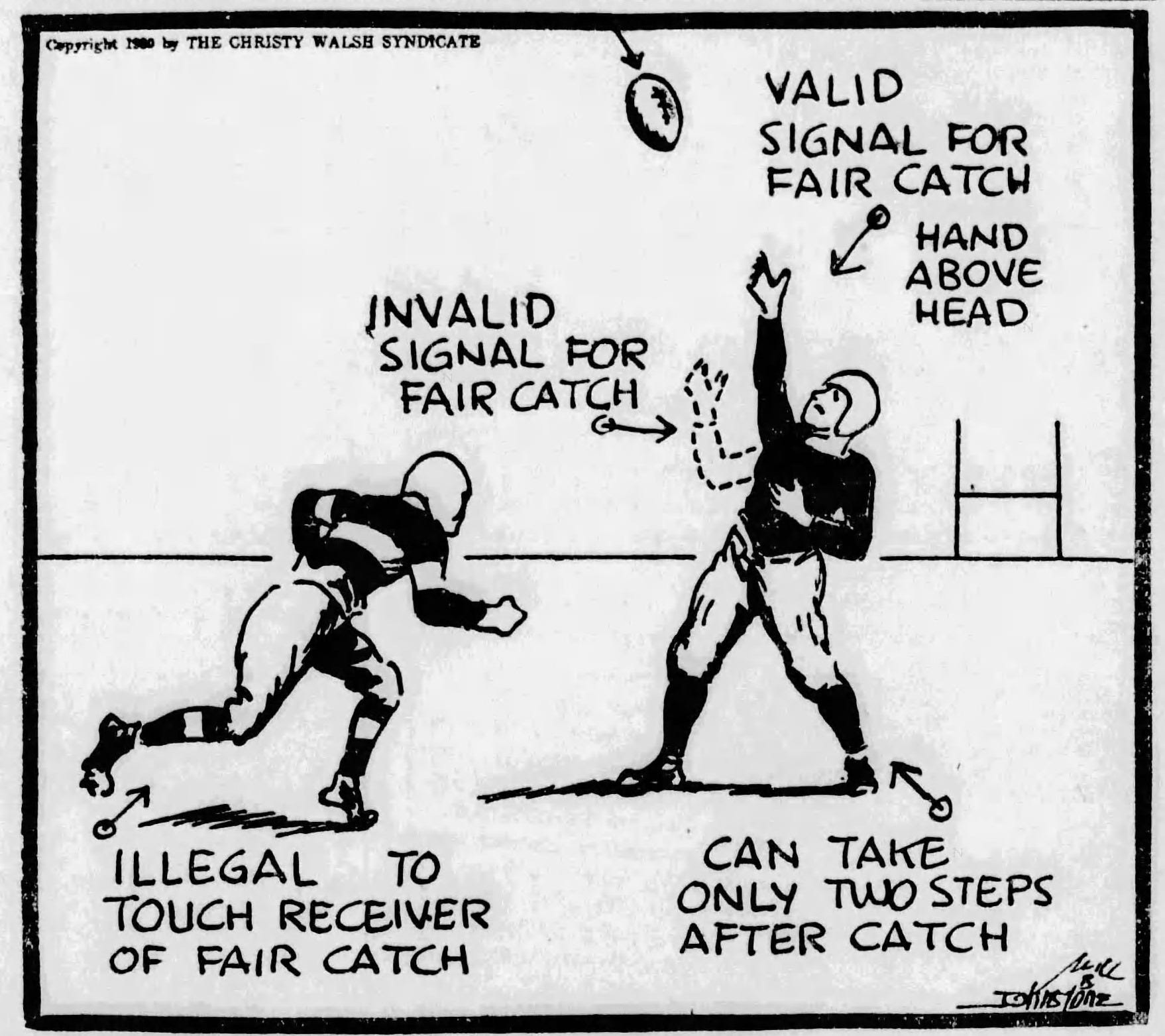
It is difficult to know how often teams fair caught punts once the onside kick went away, but it is fair to assume they did so far less often than today. While there are no statistics to support that assumption, statements by coaches and writers of the 1930s and 1940s suggest that it was the case. For example, a columnist in 1932 wrote:
The fair catch and free kick are two plays more or less of a mystery to the average fan. In reality they are quite simple, and the difficulty in understanding them is due mainly to their rarity.
‘Roundy Says,’ Wisconsin State Journal (Madison), October 20, 1932.
Another writer indicated in 1940 that high school players rarely fair caught the ball. Meanwhile, Duke coach Wallace Wade said in 1950 that he did not recall either Duke or its opponents fair-catching the ball during the 1949 season, and around the same time, Fritz Crisler, Michigan’s coach, claimed to have witnessed only one fair catch in the last 13 years.
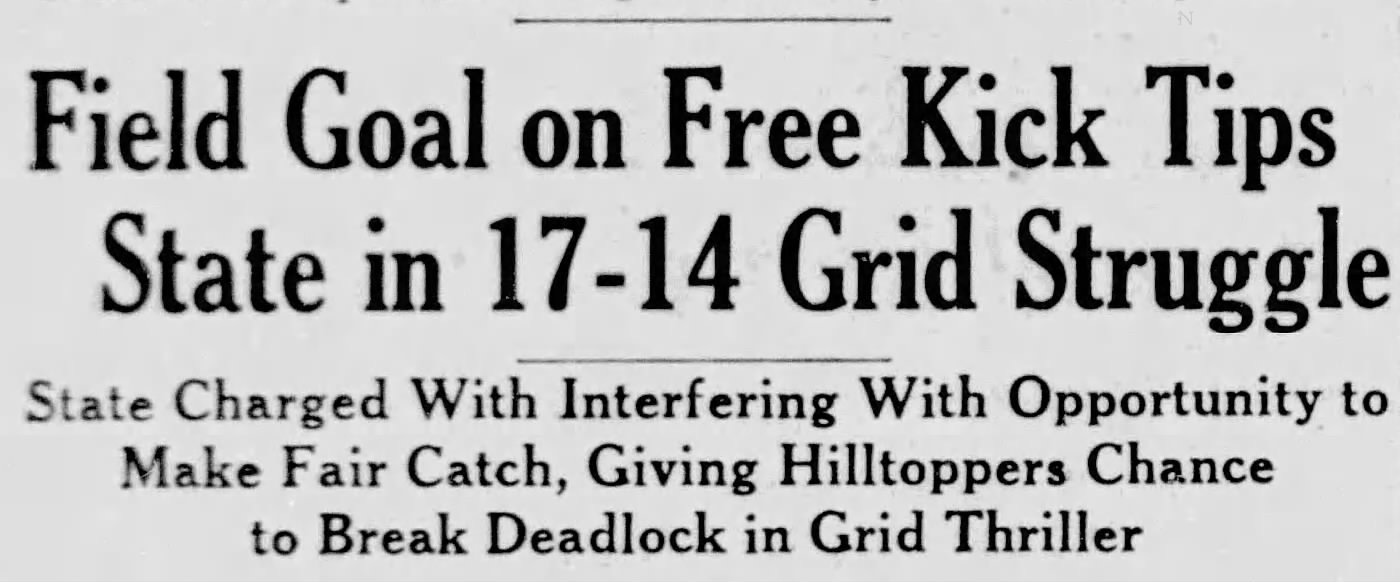
With the fair catch seldom being used, the free kick after a fair catch was rarer still. Northwestern missed a last-second attempt versus Michigan in 1933, and Marquette beat Michigan State on another last-second free kick in 1939. Both attempts received media attention but were soon forgotten by many.
Believing punt returns were exciting and that the fair catch was seldom used, the 1950 rulemakers eliminated the fair catch from the college game. However, as soon as the 1950 season began, a movement started building to return the fair catch to the game.
A key reason behind reversing the rule change was the increased use of the spread punt formation. In the late 1940s, teams began taking advantage of the free substitution rules by using specialist punters and substituting some linemen on punt teams. The spread punt formation positioned the punter 15 yards behind the line and spread the linemen three to five yards apart, allowing them to brush-block the defensive line and run downfield in coverage. Unable to call for a fair catch, courageous return men often suffered the consequences.
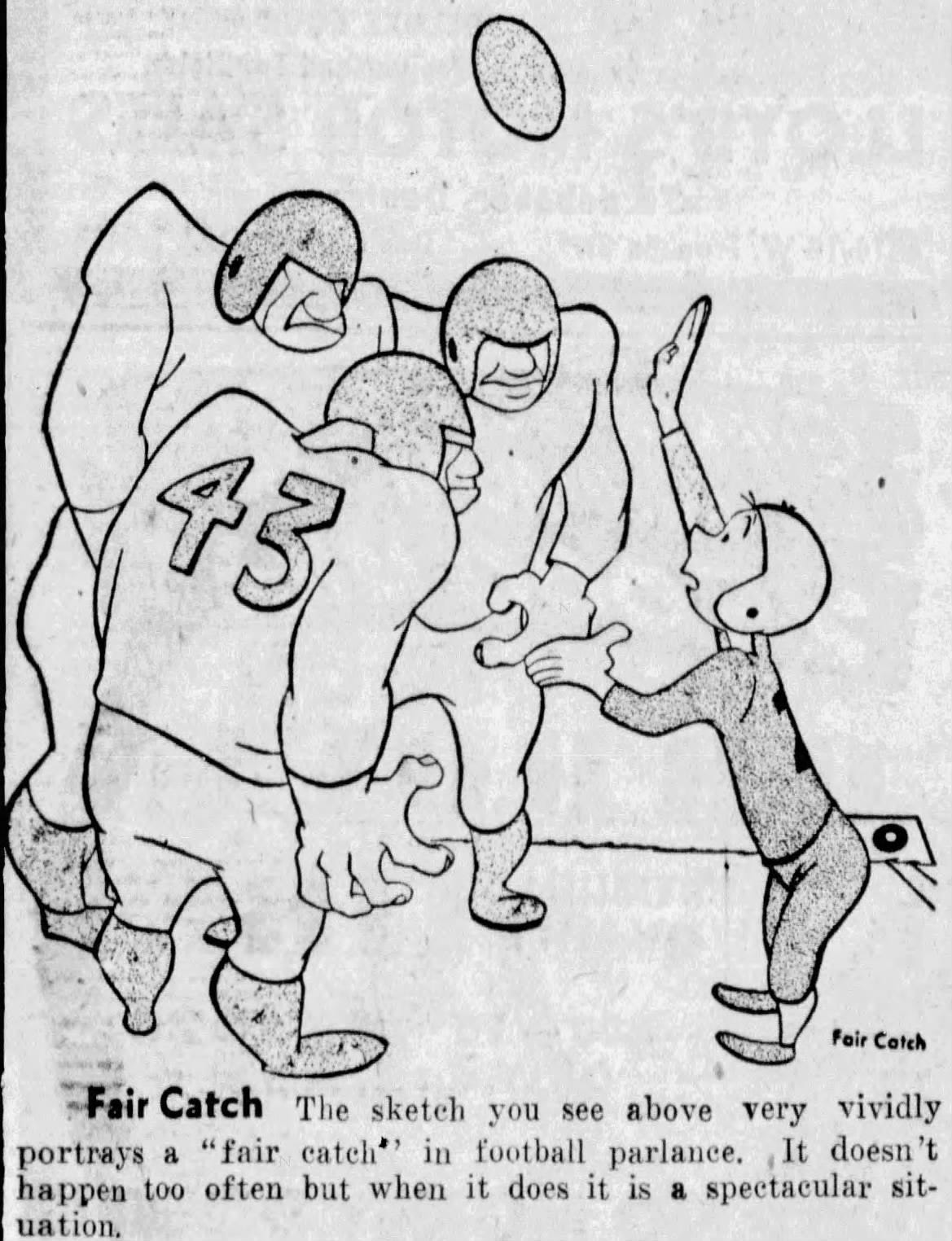
The rulemakers listened to their audience and returned the fair catch to the game for the 1951 season. However, while they restored the fair catch, they did not allow a free kick after it. Fritz Crisler, who was also the chair of the Rules Committee, justified the decision by saying the free kick had been largely obsolete since the college game moved the goal posts to the end line in 1927.
But the times they are a’changin,’ and while you likely need to be 85 years or older today to remember the 1949 season, when college teams could last attempt a fair catch free kick, you will see a few in 2026 given the advent of soccer-style kickers and the length of today’s kicks.
And remember that 1939 Marquette win over Michigan State? As best as I can tell, that was the last fair catch free kick made in a college game. Since Marquette no longer plays football, they are unlikely to kick another one this year, but Sparty better watch out. Lightning sometimes strikes twice.
Regular readers support Football Archaeology. If you enjoy my work, get a paid subscription, buy me a coffee, or purchase a book.


I was unaware the free kick after touchdown ever went away in the NCAA rule book. It has been in the NFHS rule book the past 25 years I’ve been aware of it.
As a 49ers fan, I recall the free kick after fair catch being used unsuccessfully in 2013 and in 1989. In this clip, John Madden and Pat Summerall also recount their own memories of the rule being used in the NFL.
https://youtu.be/WvcbdmkujfE?si=OIwTn4aU2llTnCIq
The rugby rule that this was based on required the person who caught the ball to yell “Mark!” In a match I was playing in once, one of my teammates was named Mark. After he caught a kick, another teammate yelled his name to let him know he was open for a pass. The referee blew the play dead thinking we wanted a free kick.