
The NFL’s Conversion From In The Grasp To Down By Contact

The previous story about Michigan’s quarterback being tackled and getting up again to complete a punt return for a touchdown against Wisconsin in 1923 concerned a controversial call, made possible by the college rule that did not require tackled players to be in the grasp until 1932. That story led reader, Chris Cavanaugh, to ask how the “in the grasp” rule worked in the NFL, since he recalled seeing NFL highlights from the 1950s in which runners continued running after being knocked down.
Today, we think of a runner being tackled as synonymous with the runner being downed, but that was not the case in earlier years. They thought of tackling as much more of a process, which it still is, but a player tackled to the ground was not necessarily down in the old days. The runner was only down when he yelled “Down” or was held to the ground by an opponent. The 1906 rule made a ball carrier down when any part of his body other than his hands and feet touched the ground while in the grasp of an opponent.
That rule remained in place until 1932, when the college rules eliminated “in the grasp” as a criterion, so the ball carrier was down even if he was not in the grasp or if he slipped and went to the ground without contact.
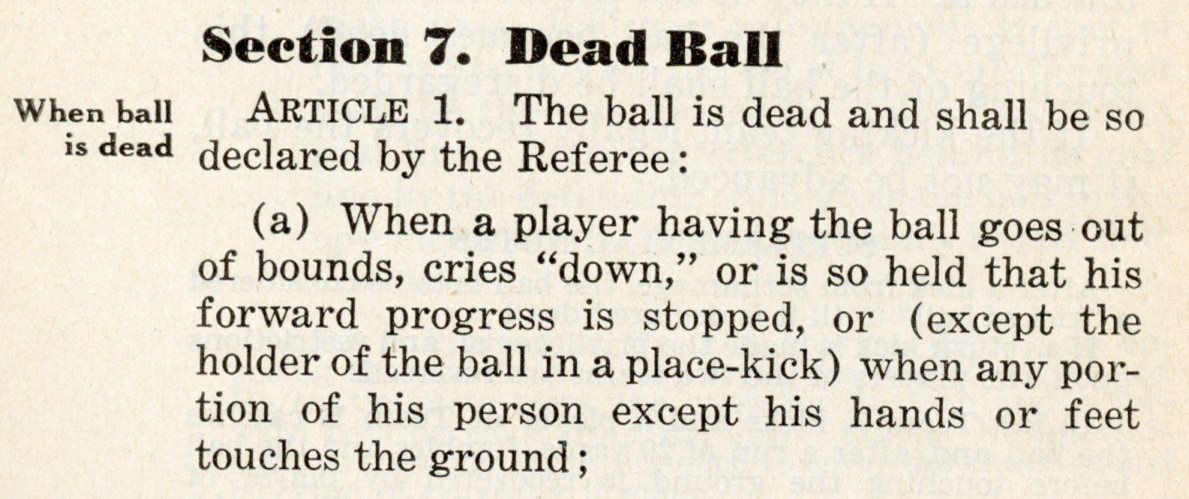
The NFL followed the NCAA rule book until 1933, when it chose to go its own way on a select number of rules, including when the runner was down. The NFL omitted the last phrase of the NCAA rule concerning the hands or feet touching the ground. However, by 1939, they were back in agreement with the NCAA, with the significant exception that they required the runner to be in the grasp. (The rule change may have come in 1938, since I do not have a copy of that NFL rule book.)
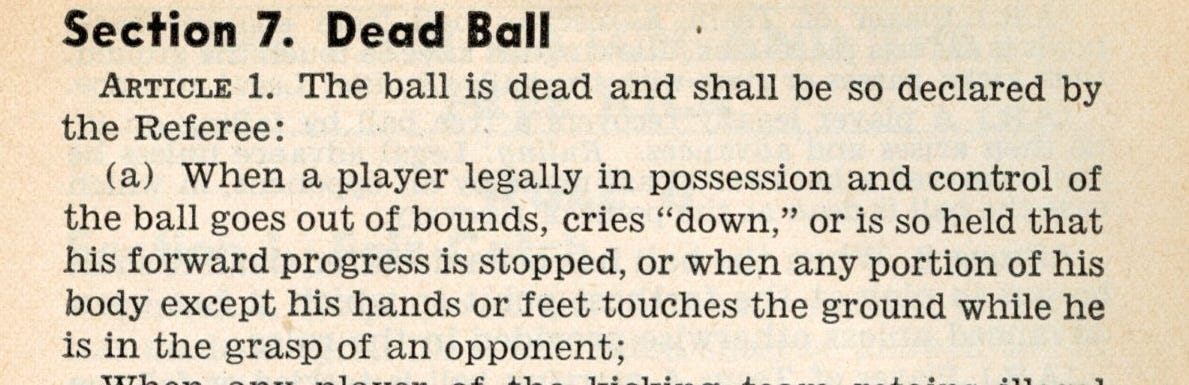
Runners who were not in the grasp could get back up and run, so defenders often hit them when they were on the ground, leading to injuries. George Halas and George Preston Marshall, the Redskins’ owner, called for a rule change after the 1953 season, but the owners did not approve it.
Bert Bell, the NFL Commissioner, and many owners, coaches, and players did not want to follow the college rule, believing that fans found it thrilling to see players get up and continue. Plus, it positioned the league’s players as tougher than the softies on the nation’s campuses.
All levels of football were a rougher game back then, but the NFL was especially so. For example, the Time for Football highlights from Week 6 of the 1954 season show many plays you do not see in today’s game. Consider the examples in the first twelve minutes of the highlights (approximate times):
1:31 Run knocked down, gets up, and runs
2:00 Piling on
3:00 Pass receiver tackled at goal line/jumps into end zone
4:22 Late hit in end zone
8:32 Piling on, though legal at the time
11:28 Interception returner knocked down, gets up and runs
Another great example of a ball carrier continuing after being knocked down came in the 1954 NFL Championship Game between the Cleveland Browns and Detroit Lions. As seen below, the Browns intercepted a Lions pass and returned it to the 8-yard line. On the following play, Otto Graham hit left end Pete Brewster on an in route that Brewster converted into a touchdown, but not before a Lions defender knocked him down. Still, he continues by jumping into the end zone and scoring.
Despite the rough, thrilling play, a rash of injuries to NFL ball carriers during the 1954 season shifted the balance, leading to a rule change for 1955.
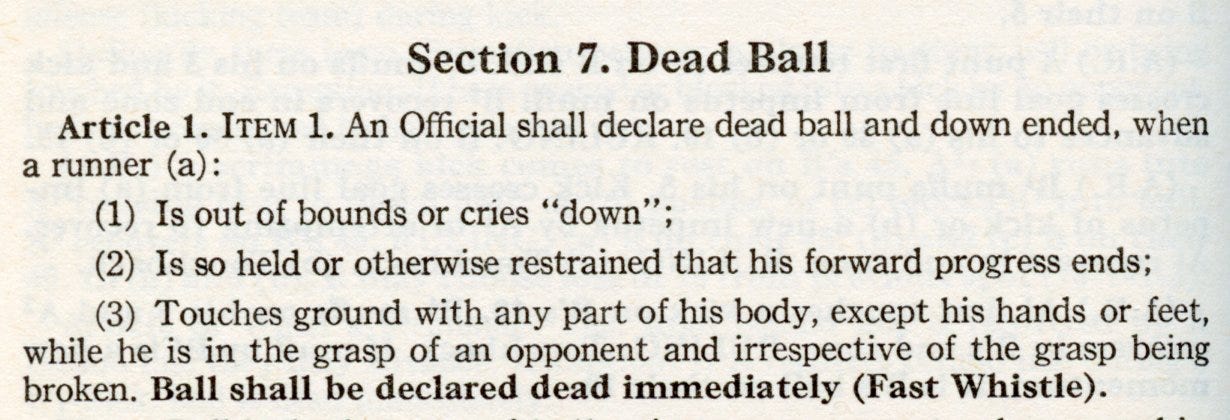
The NFL’s 1955 rule considered the ball carrier down if tackled to the ground in the grasp of an opponent, even if the grasp broke upon hitting the ground. In effect, the NFL wanted officials to blow a fast whistle to avoid piling on injuries while still allowing for some old thrills.
Additional injuries and inconsistencies in when officials blew their whistles led to a 1956 rule change. The new rule made the runner down if any part of his body, other than his hands or feet, touched the ground following contact by an opponent. So, the NFL’s down-by-contact rule was adopted in 1956 and has largely remained unchanged since.
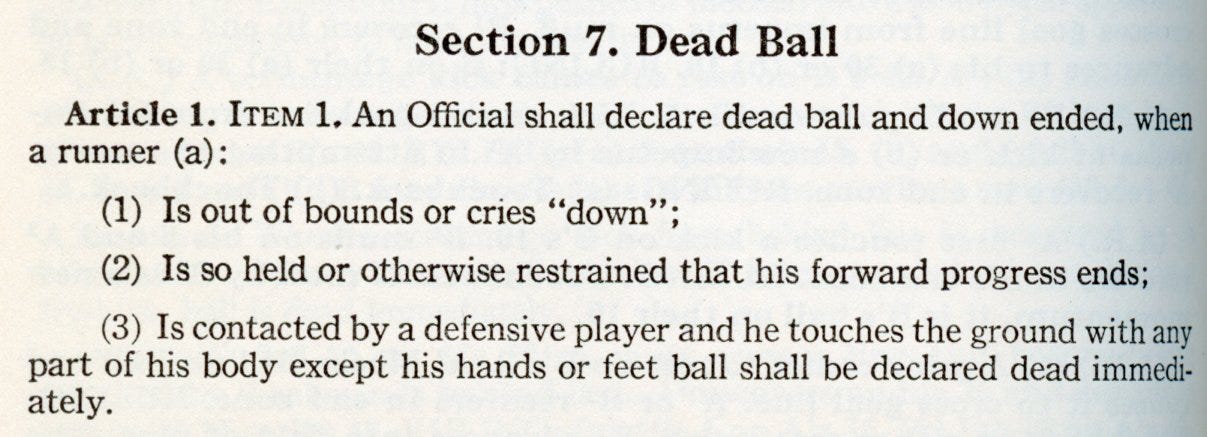
Since the 1970s, the league has instituted multiple exceptions for quarterbacks, but rather than allowing them to get up and run after being tackled, they receive a quicker whistle. Quarterbacks who are in the grasp cannot be taken to the ground, and those sliding feet first are granted exemptions from the standard rule to protect the league’s most valuable assets.
Regular readers support Football Archaeology. If you enjoy my work, get a paid subscription, buy me a coffee, or purchase a book.


Now I'm wondering what circumstances would cause a ball carrier to cry “down.” After the fifth defender has piled on, perhaps? “I'm down already, for crying out loud!”