
The Origins of Football’s Distance Penalties

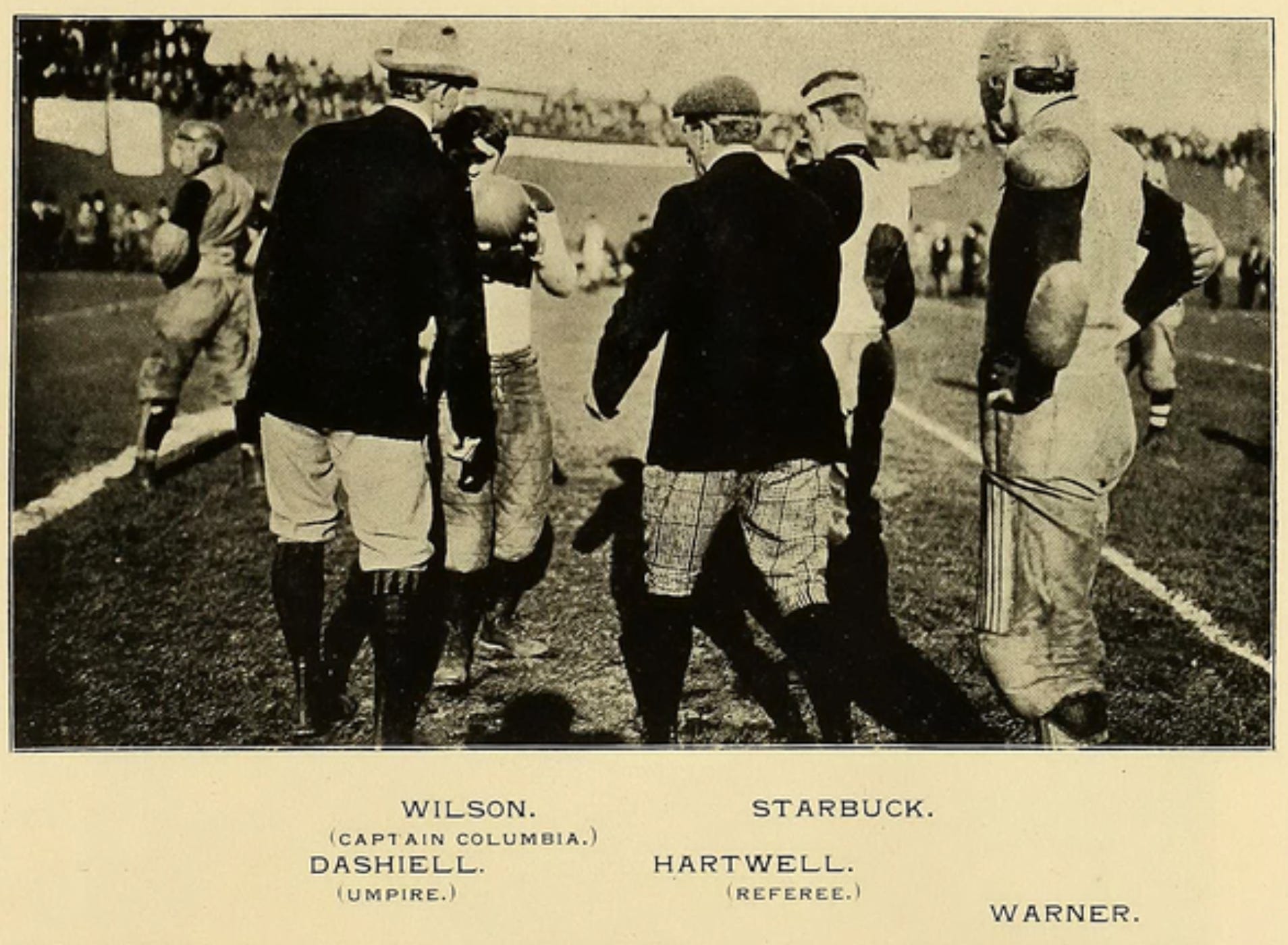
Soccer and rugby are British games that formally split when rugby established its laws in 1871. American football split from rugby several years later with the founding of the Intercollegiate Football Association. While that happened in the distant past, watching World Cup games reminds us that the three games share common roots. Each is played in an enclosed space, with teams working to move the ball into their opponent’s territory, where they kick it under or over the crossbar.
Though commonalities remain, football has changed in both sudden steps and gradual ways. Adopting the system of downs in 1882 was a sudden step, fundamentally changing the game all at once. A more gradual process change was how football has punished fouls, as it evolved from rugby’s three simple fouls: awarding a free kick, loss of possession, and disqualification.
Football’s approach to penalties changed following the 1882 adoption of the system of downs, which gave teams possession of the ball for three downs, with an additional set of downs granted for gaining five or more yards. The system of downs increased the value of yardage and precision around yard lines.
Several years after adopting the system of downs, football was beset by complaints that the game was too rough. Harvard’s faculty threatened to ban the game unless rule changes eliminated rough play, a threat they carried through on during the 1885 season. Princeton’s faculty issued similar threats, though the Tigers continued to play.
After Harvard’s faculty announced its football ban in early 1885, a Harvard student committee recommended several rule changes related to officiating and fouls that, if enacted, would allow the resumption of play. Among their proposed changes were to:
Change the officiating crew so the referee is responsible for managing the ball, and an umpire monitors the players, focusing on fouls.
Have the referee make decisions without consulting captains or judges.
Allow the referee to punish unsportsmanlike acts, such as piling on, not explicitly covered by the rules.
Develop a system of graduated penalties, up to season-long disqualifications for striking with an open hand.
Meanwhile, Princeton argued for awarding points for certain fouls, including:
A two-point penalty for violating Rule 28, which concerned throttling, hacking, tripping, and other forms of unnecessary roughness
A one-point penalty and player disqualification for intentional delay of the game.
The IFA passed both rules at its February 1885 meeting, but changed the penalty for intentional delay of the game in October, so the offending player was disqualified and his team suffered a five-yard loss, making it football’s first distance penalty. I have not found documentation that the IFA revoked the two-point penalty; neither have I found examples of it being invoked in a game, so it was likely tossed out in October 1885 as well. (I have yet to locate copies of the 1885, 1886, and 1887 rule books, so I’m working from newspaper reports for this topic.)
Football’s continued violence led to other calls for change, but the IFA team captains were unwilling to make them, instead committing to encouraging their teams to play fairly.
We, the undersigned, captains of the intercollegiate football teams, hereby pledge ourselves to coach our teams to stop holding in touch line, slugging, and all other improper plays.
‘Football Rules Changed,’ New York Herald, March 27, 1887.
Later that year, the IFA turned most rulemaking, the assignment of game referees, and other major decision-making over to an alumni board headed by Walter Camp, marking the point at which the players effectively ceded control of the game to the adults in the room. The adult made the rules from then on.
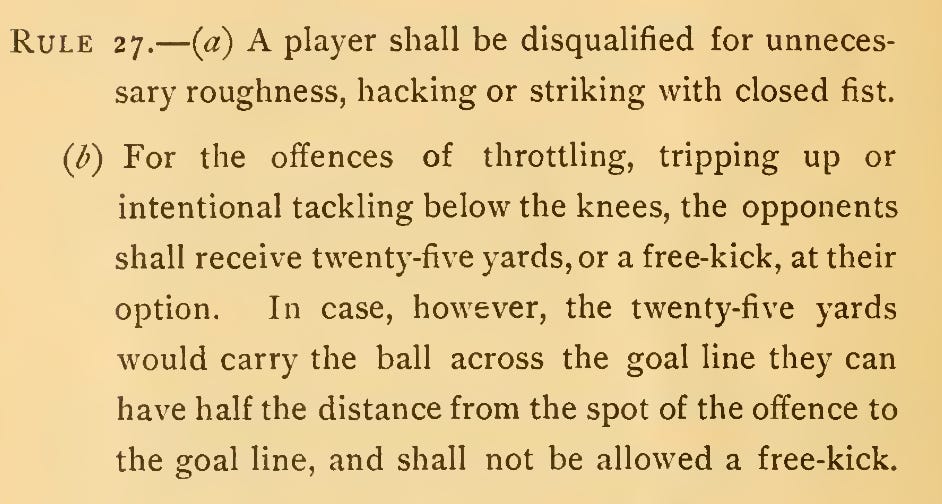
The 1888 rule book noted that, unless otherwise noted, all offensive fouls resulted in a loss of a down, while defensive fouls resulted in a five-yard penalty, enough for a first down in most instances. One or two other fouls led to the loss of possession, and unnecessary roughness resulted in player disqualification, which was supposed to limit violence, but was not called often enough to do so.
Additional rule changes came in 1889, when they required the referee and umpire to use whistles, a tool whose volume had been greatly improved by England’s James Hudson’s invention of the Acme whistle in 1883, to indicate the cessation of play on fouls and downs. Presumably, the use of whistles reduced piling on and other fouls occurring after plays.

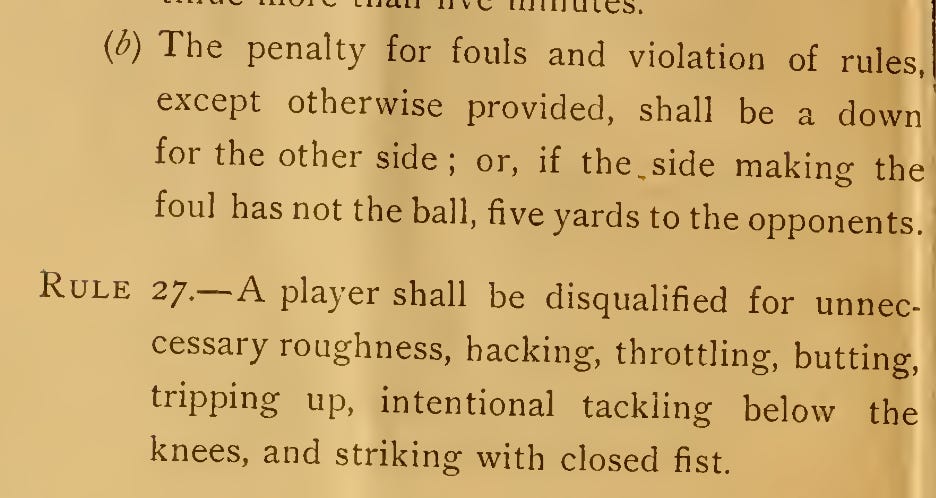
In addition, the rulemakers further graduated the penalties for foul acts. Players continued to be disqualified for unnecessary roughness, hacking, and striking with a closed fist, while throttling (choking), tripping up, and intentional tackling below the knees resulted in the offending team being given the choice of a 25-yard penalty or a free kick. The 25-yard penalty is also the point at which football introduced the half-the-distance concept for fouls committed near the offending team’s goal line.
In 1894, piling on warranted a fifteen-yard penalty, and offside play incurred a ten-yard step-off; these distances were later applied to other types of fouls.
Football instituted a two-yard penalty in 1906 for teams calling more than three timeouts per half.

Football added its only horizontal-distance penalty in 1913, which applied to punters who feinted a punt during the puntout. Since the punter executed the play from behind his opponent’s goal line, they had the offender move five yards further from the goal posts rather than applying a vertical distance penalty. Puntouts went away in 1920, and with it, the horizontal-distance penalty.

Since the 1920s, football’s rule book has expanded and now includes an almost uncountable number of fouls, most of which carry distance penalties. The 2026 NCAA Rule Book includes nine different types of penalties applied to a host of transgressions:
45 fouls lead to a five-yard penalty
15 fouls resulting in a ten-yard penalty
44 fouls call for a fifteen-yard penalty
10 offensive fouls leading to the loss of a down
1 foul (defensive pass interference) leads to the ball being spotted where the foul occurred
21 defensive fouls result in an automatic first down
6 fouls result in a charged timeout
9 fouls lead to player disqualification
1 foul, for unfair acts, gives the referee wide discretion over the penalty, including awarding points to the offended team.
Of course, the breadth of penalties and fouls is an attempt to make the punishment proportionate to the crime. Early football had few fouls and penalties, but the game’s increasingly complex, technical nature led to a wider range of them. Of football’s three original penalties -awarding a free kick, loss of possession, and disqualification- only disqualification survives, and it is most often applied today to targeting, likely the game’s most controversial penalty.
As has occurred on many occasions in the game’s history, attempts will be made to modify the rules, improve call accuracy, or revise penalties for certain fouls. Regardless, people will complain about the situation, just as they did in the 1880s. It’s just the nature of sports, and the judgment calls officials make when enforcing the rules.
If you enjoy Football Archaeology and are not a paid subscriber, consider buying me a cup of coffee now and again. You can also buy a paid subscription or purchase one of my books.


Very insightful. Thanks so much for sharing.