

We take for granted modern playbooks, which are easily printed, duplicated, or distributed electronically, but in 1914, when C. R. Thompson took over as Physical Director at the Moses Brown School in Providence, pencil and paper were the playbook technologies.

Back then, a school’s physical director coached all or most teams, taught physical education classes, and served as the athletic director. Thompson graduated from Bates in 1913, coached at Tilton Academy in 1913, and then replaced another Bates graduate at Moses Brown for the 1914-15 school year.
His inaugural season at Moses Brown proved successful, as shown by a copy of their schedule with scores filled in. However, period newspaper articles indicate they played and lost another game or two that do not appear on the schedule.
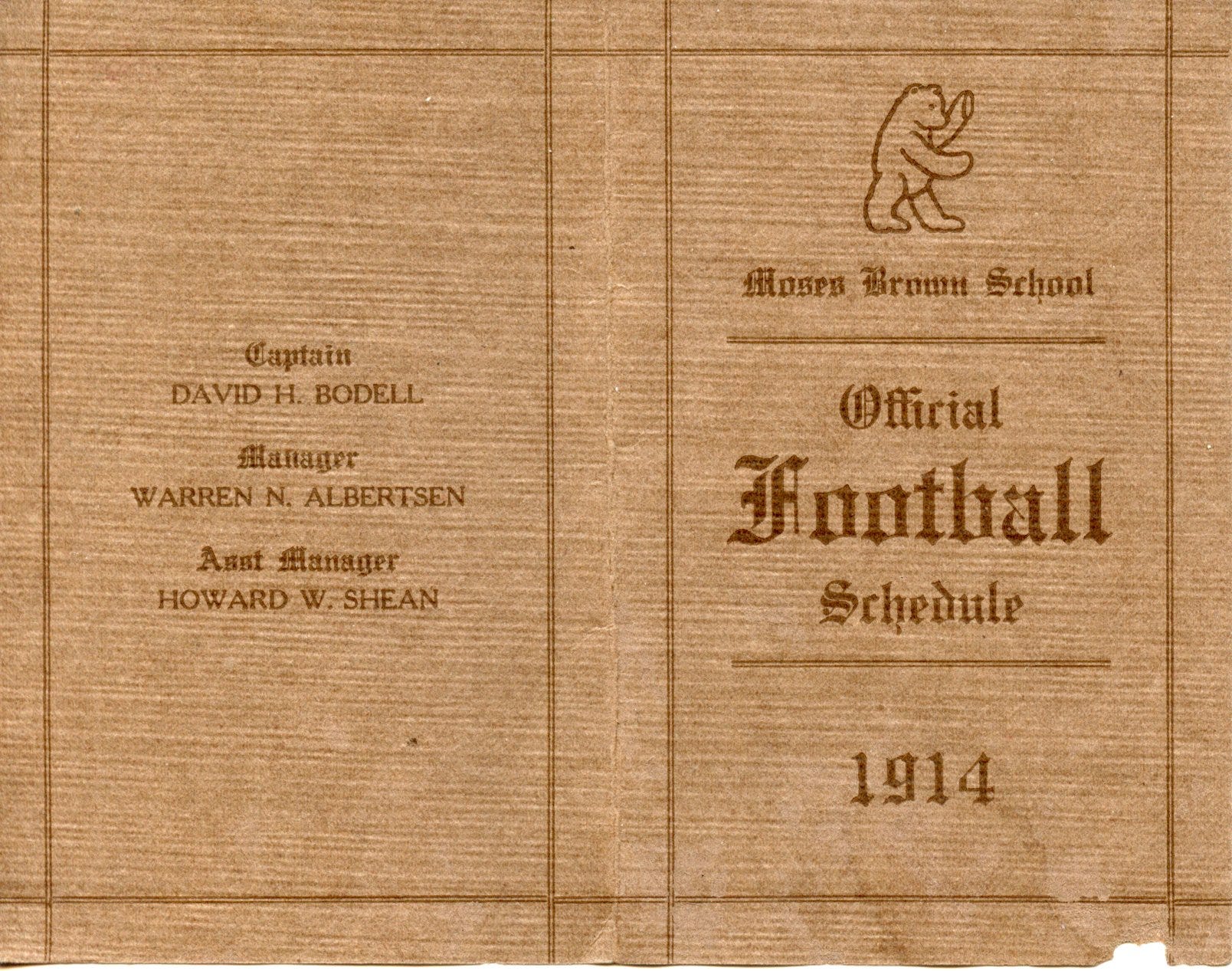
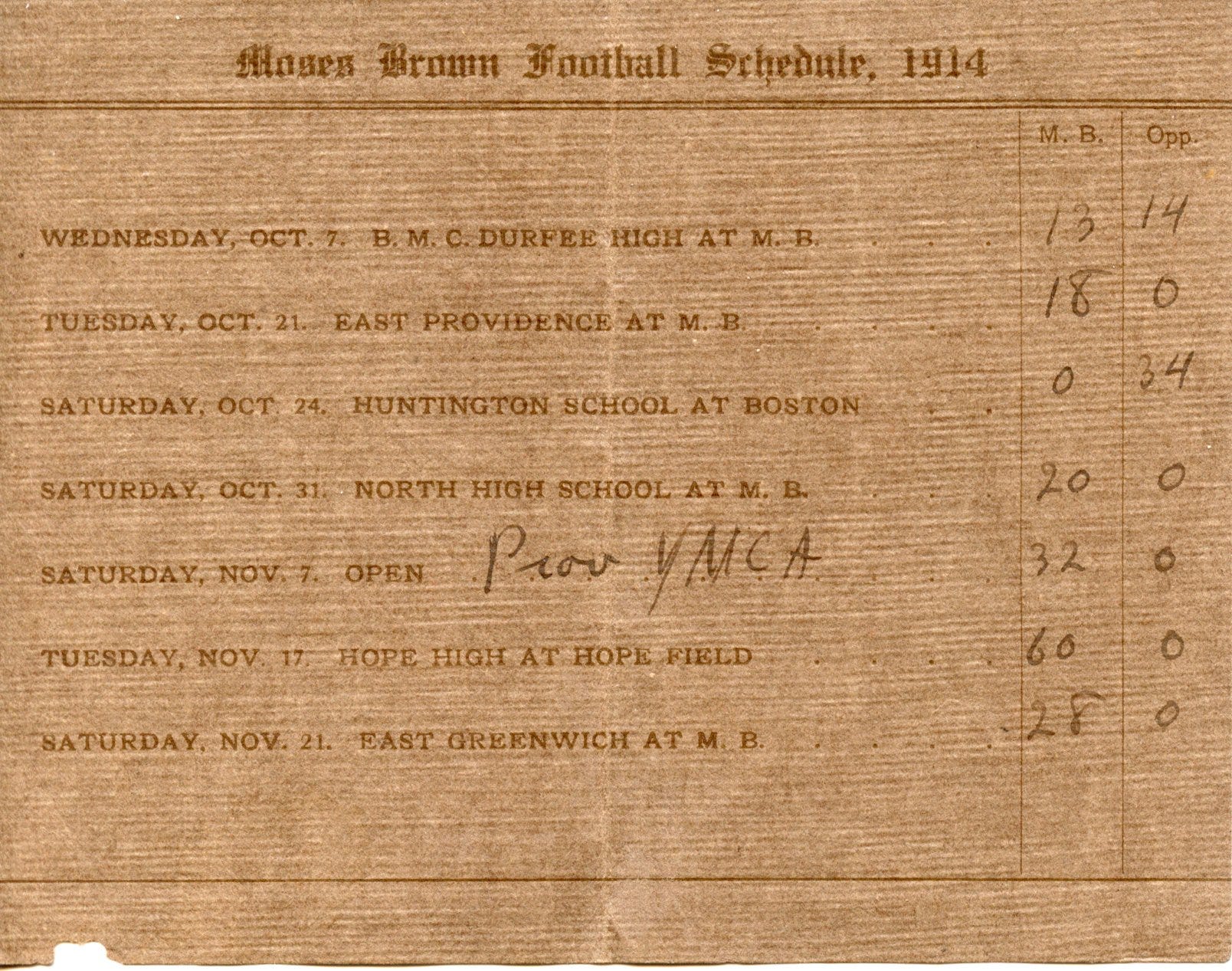
Whether Moses Brown succeeded due to talent or coaching is difficult to know 110 years later, but we gain some insight into Thompson’s coaching from nine pages of the Moses Brown playbook that was packaged with the schedule. The pages are likely a team member’s handwritten and hand-drawn notes from Coach Thompson-led chalk talks, since that was common practice before mimeograph machines.
The notes are of two types. First, there are the coaching shibboleths or bromides, and then there are the play designs. So, first things first...
Shibboleths and Bromides
The first page in this category is titled, Fundamentals win games, nearly all of which apply to football 110+ years later.

The words on the page are captured below:
Falling on ball
Blocking! Blocking! Blocking. “shoestring” Knees
Tackling
Using hands
Line bucking thru! Don’t wait, charge!
Line opening holes
Backs hitting line + stiff arm on other runs
Backs open field running, dodging
Throwing + catching passes
Punting + running back punts
Kicking off + receiving kickoff
Punt out
Goal kicking
Fair catching + placement kicking
Hide the ball! Conceal every play
A few of the fundamentals show their age. Falling on fumbled balls remains an important skill, though teams do not practice it with the same intensity as they once did. While shoestring plays were once a popular trick, the “shoestrings” reminder for linemen probably told them to stay low, and “punt out” presumably refers to the puntout process that left the game in the early 1920s.
While the fundamentals were the things players should do, the Don'ts were the things to avoid. They also apply today.
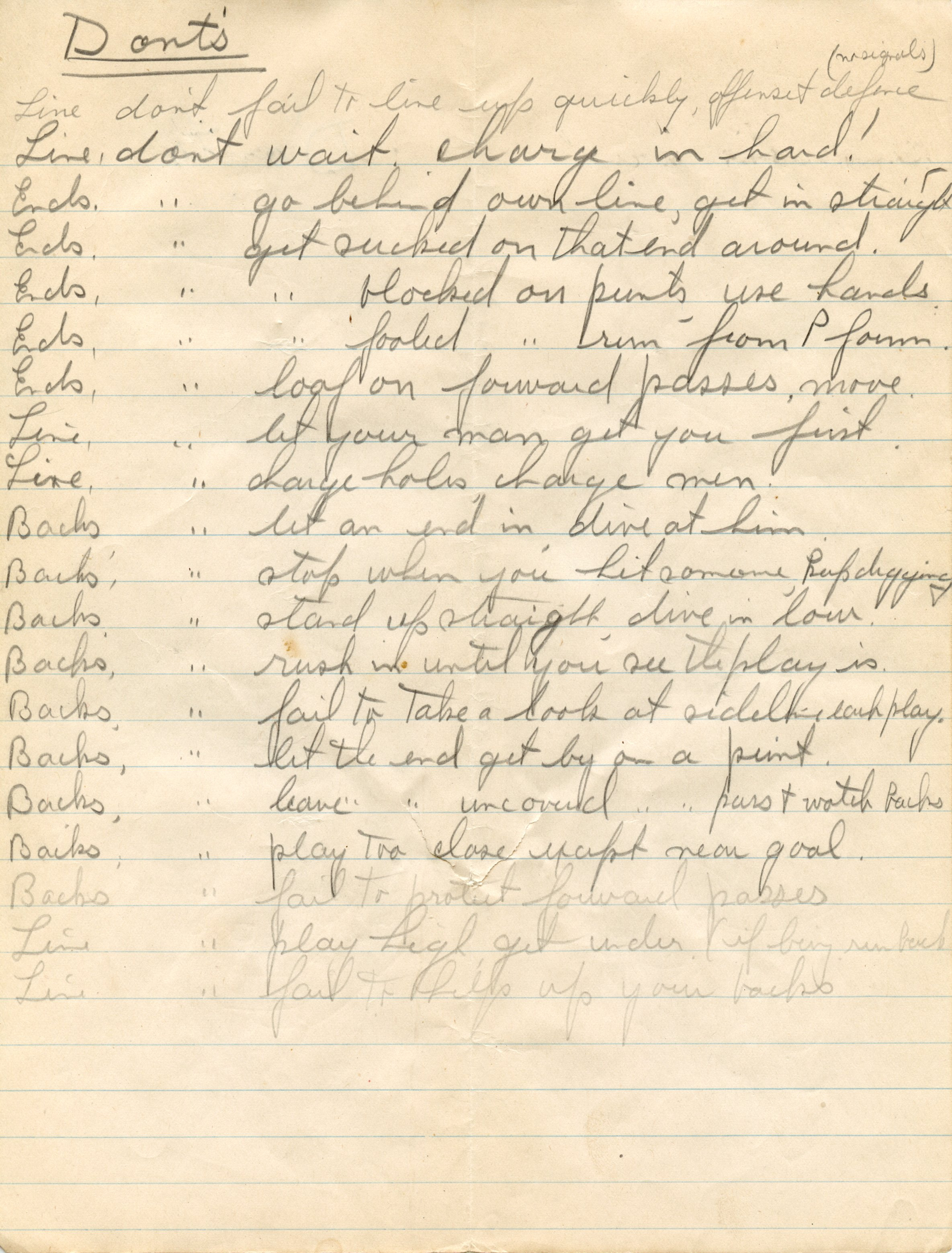
Line, don’t fail to line up quickly offense defense (no signals)
Line, don’t wait, charge in hard
Ends, don’t go behind own line, get in straight
Ends, don’t get sucked on that end around
Ends, don’t get blocked on punts, use hands
Ends, don’t get fooled on run from P form
Ends, don’t loaf on forward passes, move
Line, don’t let your man get you first
Line, don’t charge holes, charge men
Backs, don’t let an end in, dive at him
Backs, don’t stop when you hit someone, keep digging
Backs, don’t stand up straight, dive in low
Backs, don’t rush in until you see the play is
Backs, don’t fail to take a look at the sideline each play
Backs, don’t let the end get by on a punt
Backs, don’t let the end get by uncovered on a pass + watch backs
Backs, don’t play too close except near goal
Line, don’t play high get under (if being run back)
Line, don’t fail to help up your backs
The reminder to look to the sideline each play suggests that Moses Brown might have played a little fast and loose with the rules since coaching from the sideline was illegal at the time.
Plays
Besides the bromides, there were seven pages of plays, including one that may have been a scouting report. For space and attention span considerations, I’ll cover only a few.
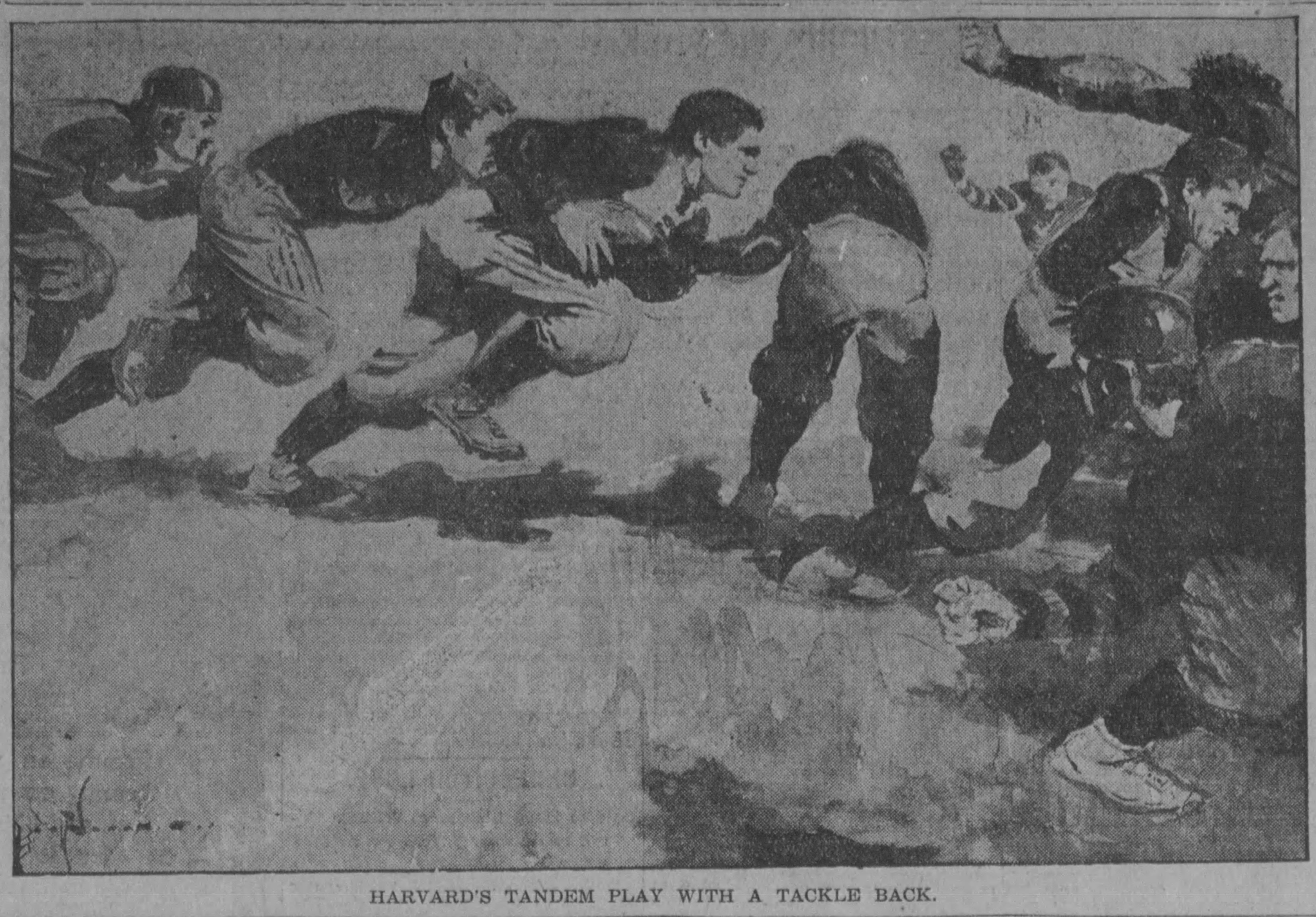
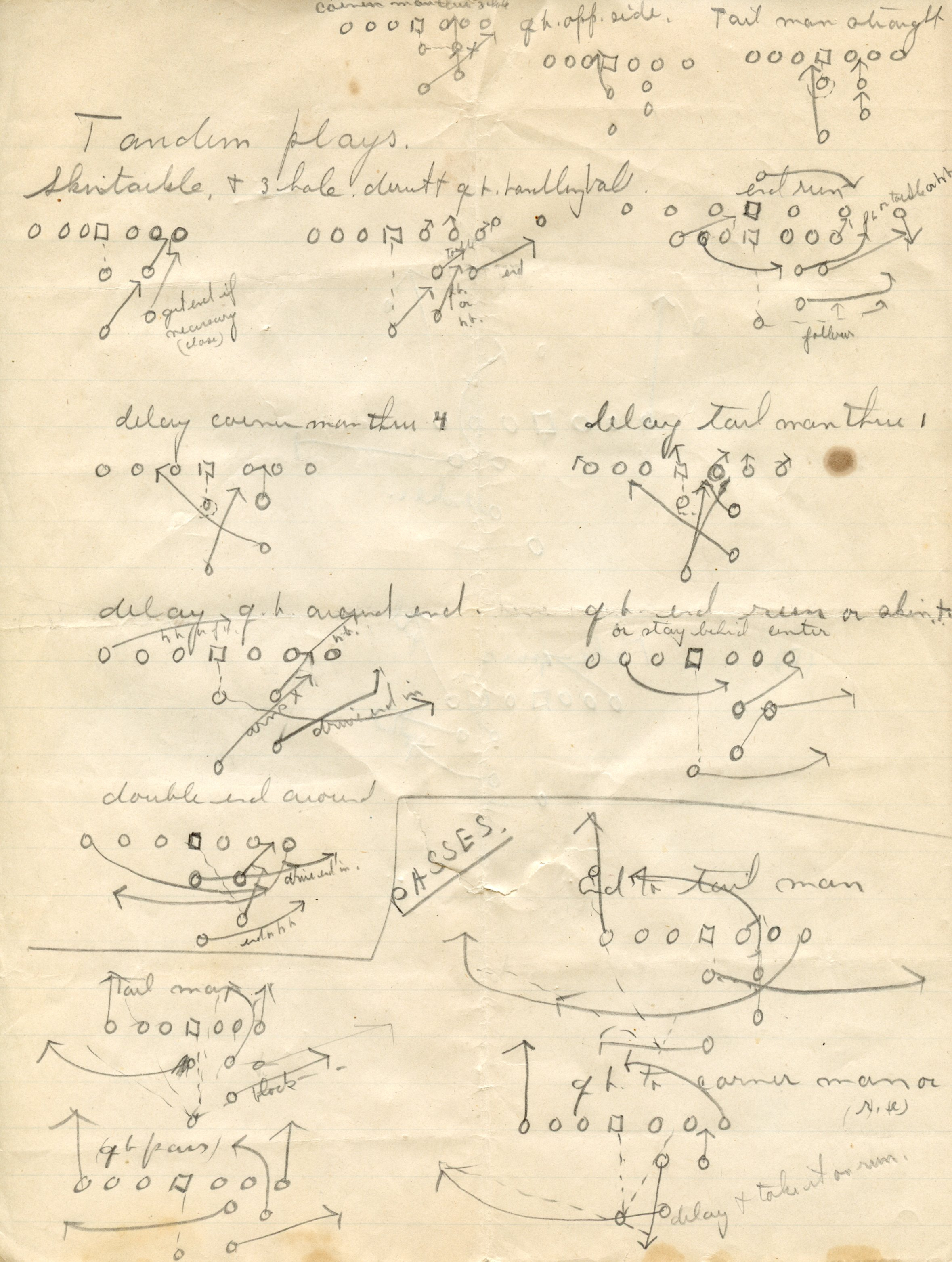
One page covers the team’s tandem plays. There were several versions of tandem formations that originated during the mass and momentum era. When the rules limited the number of players in motion at the snap, teams had their backs line up one behind another so they had a lead blocker, and one or more following backs to push the ball carrier. The illustration below shows Harvard giving the ball to the first back so his buddies could push him from behind.
Moses Brown had a series of tandem plays in their playbook, including a few passes out of the tandem. In some cases, it is difficult to know who carried the ball on these plays, but they typically involved off-tackle runs, misdirection away from the tandem, or end runs.
Their playbook also included a series of trick plays. The top two and the next two on the left side show pairs of plays in which the first play sets up the second. The first set shows an off-tackle run from the tandem formation, which, after showing that a few times, led to an end-around pass. UChicago ran a similar play in 1908 since their right end was an accurate passer and a lefty, so perhaps Moses Brown had a similarly skilled end.
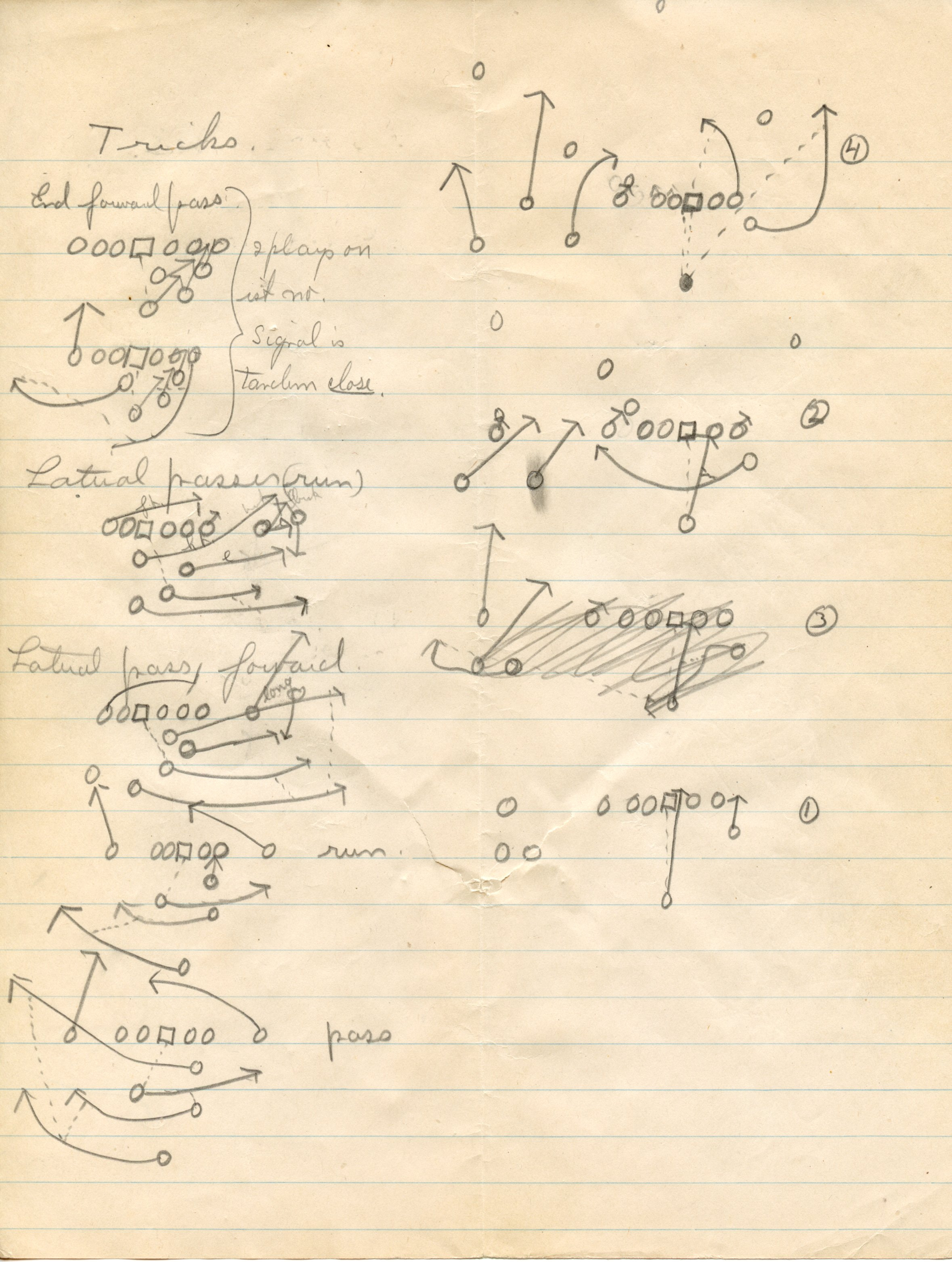
The second set on the left shows a lateral pass to a halfback sweeping right, a play Yale popularized in 1914, and a trick halfback option pass off the lateral.
Moses Brown also had trick plays for use Inside the 20 or 15. These included a lateral pass from their dropkick and tandem formations, the previously seen end-around pass, and a third-down play with two backs set wider than the left tackle, presaging today's single-back formations.
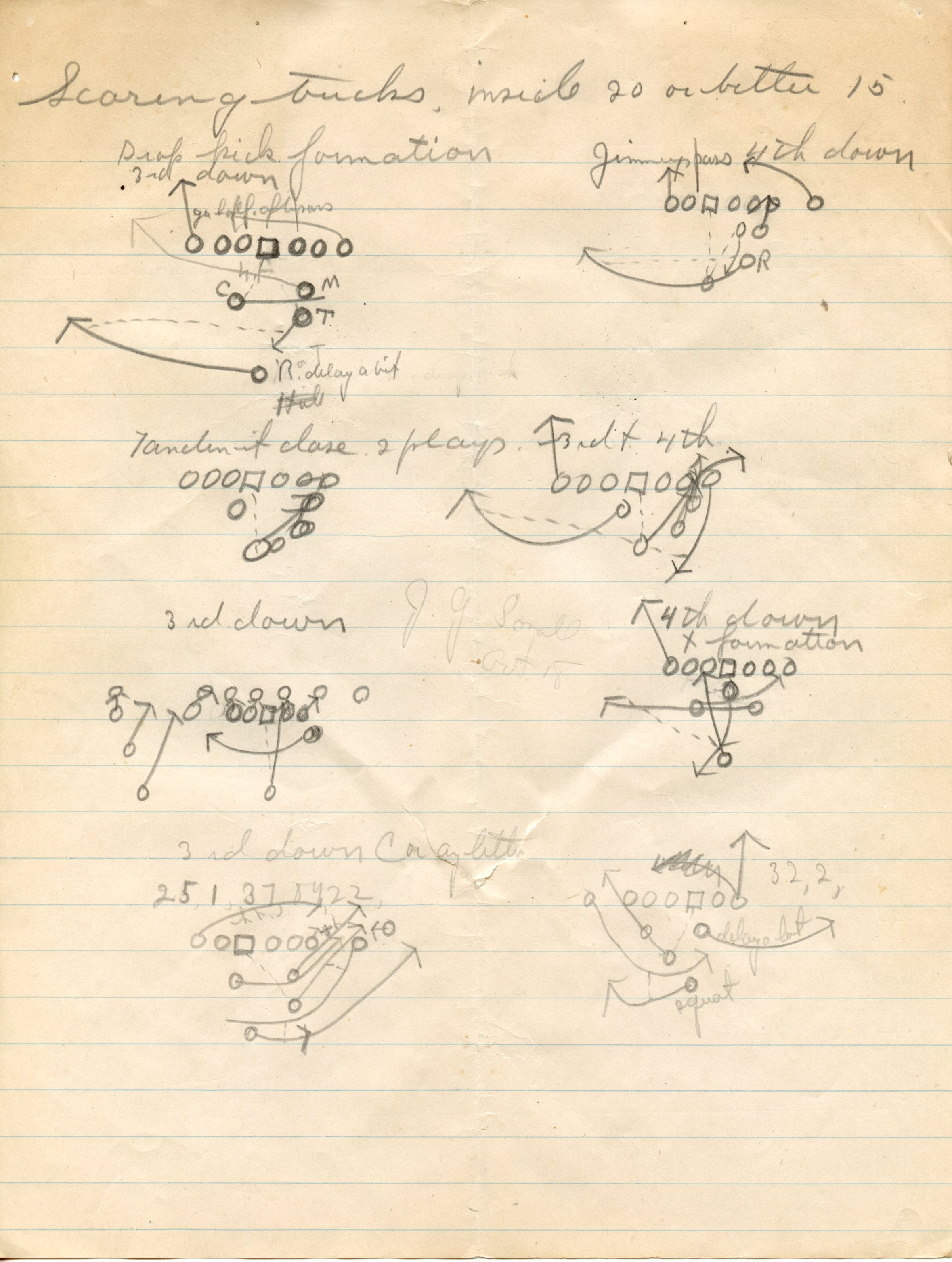
As discussed in When Football Came To Pass, the forward pass was heavily restricted in 1914, and with offensive linemen unable to use their hands when blocking, teams primarily protected passers through play-action. Moses Brown's passing plays reflected that approach, and the rest of their plays reflected the current thinking among Eastern college teams, so they were likely to run a relatively progressive offense for a high school team of the era.
A final observation is that the bromides and shibboleths of 1914 stand the test of time. Staying low and alert mattered then and now. The specific formations and plays Moses Brown ran in 1914 are another matter. The game has evolved since then, but the building blocks of good play are much the same.
Football Archaeology is reader-supported. Click here to donate a couple of bucks, buy one of my books, or otherwise support the site.
My father went to Moses Brown and played football, basketball, and baseball there. He will enjoy reading this. After Moses Brown, he went to Brown and played football and baseball there, with a 2.5-year interruption for the war in Korea.
The Olmsted Archives on Flickr have a few documents relating to Moses Brown, dated 1911 and 1926. It doesn't explicitly show a football field, but one might assume it was inside the track or on the "Big Boys Playfields".