

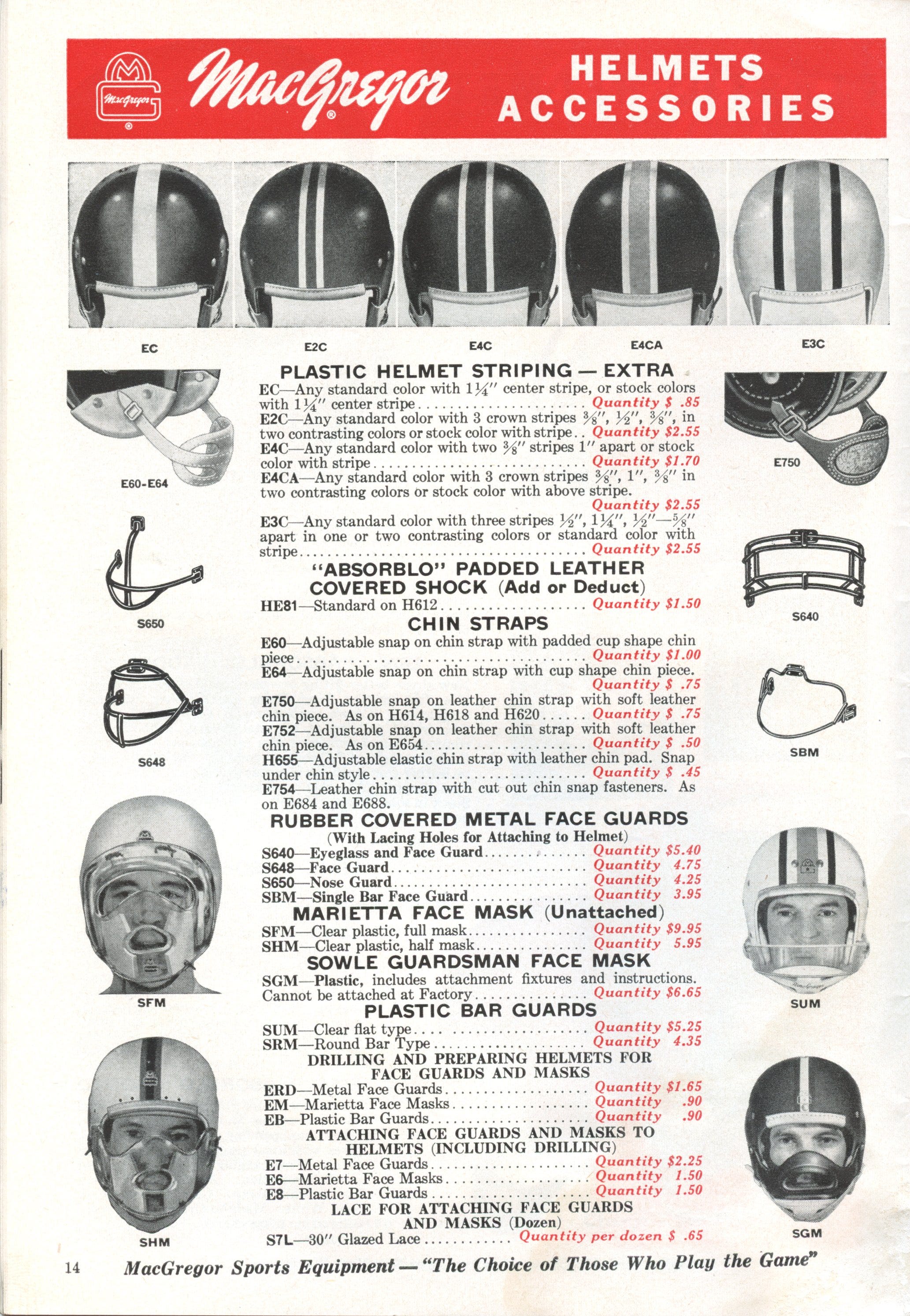
When researching football’s past, I sometimes come across information that doesn’t catch my attention until I stumble upon something else that connects the dots. That’s the case with a 1955 MacGregor catalog I acquired a few years ago. Since I’ve written several times since then about the evolution of football face masks, I’ve looked at the catalog multiple times. Yet, I didn’t pay attention to the catalog’s distinction between the Marietta, Sowle, and Plastic Bar styles of face masks.
For decades, football catalogs featured equipment named after coaches, players, or schools, so I assumed the Marietta face mask had some association with Marietta College, while I gave little thought to the Sowle mask. However, I recently came across a 2015 Flashback: Dallas article about a Dallas dentist, Dr. Michael T. Marietta, for whom the Marietta mask is named. The name was not related to Marietta College.
Marietta’s first foray into the facial enhancement and protection arena came when he fashioned a plastic nose for a man who had lost his to a disease. Later, when Marietta was the team dentist for the United States Hockey League’s Dallas Texans in the 1940s, Marietta fashioned a plastic mask to protect the broken nose of their right wing, Lou Smrke. The exact year when Smrke broke his nose is unclear, but he played for Dallas from 1945 to 1948, so Marietta had to design his first mask by 1948.
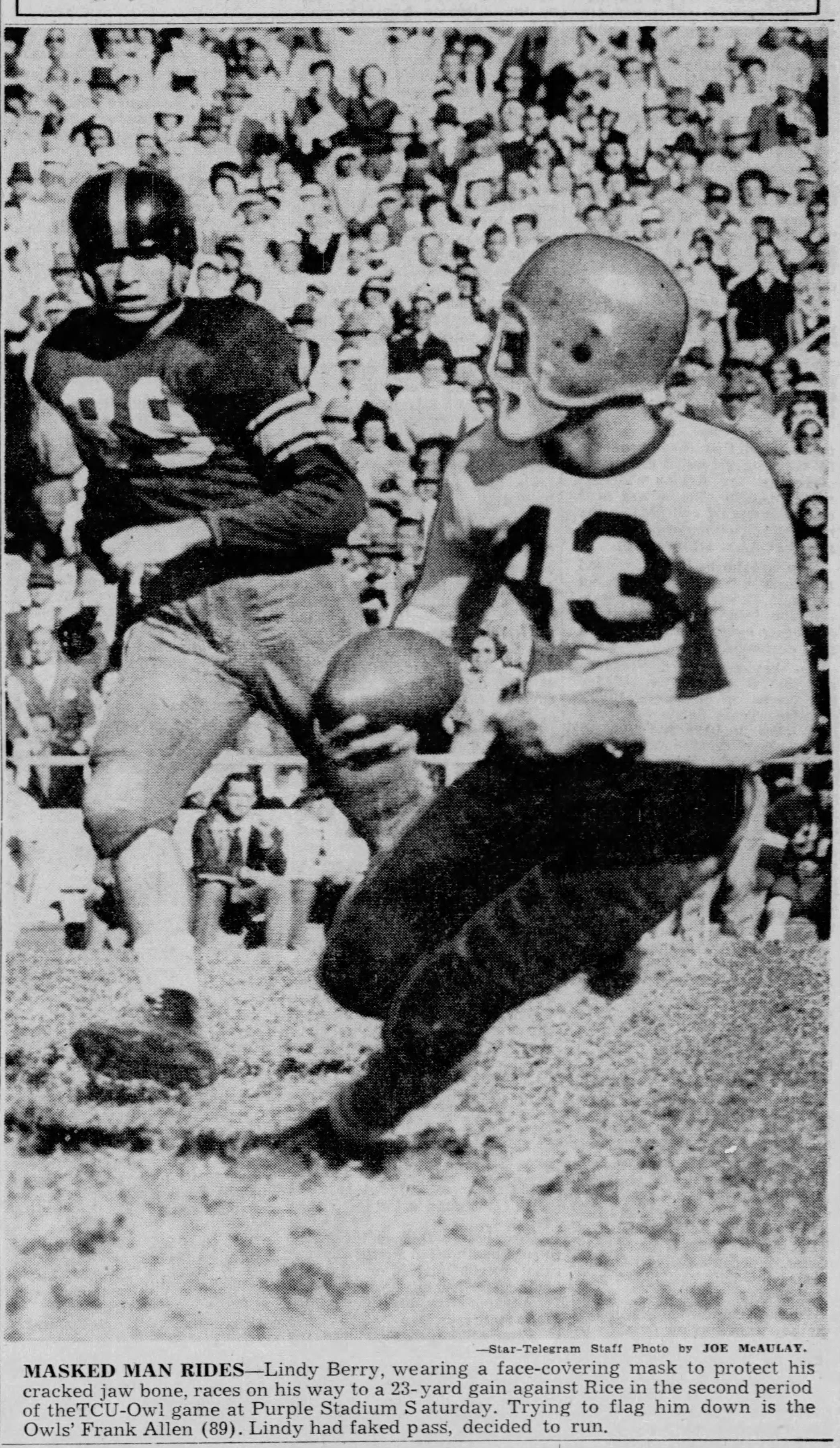
Marietta’s mask-making ability gained additional publicity in 1948, when TCU’s star quarterback, Lindy Berry, broke his jaw. Marietta custom-fitted a mask for Berry, allowing him to finish the season without missing a game.
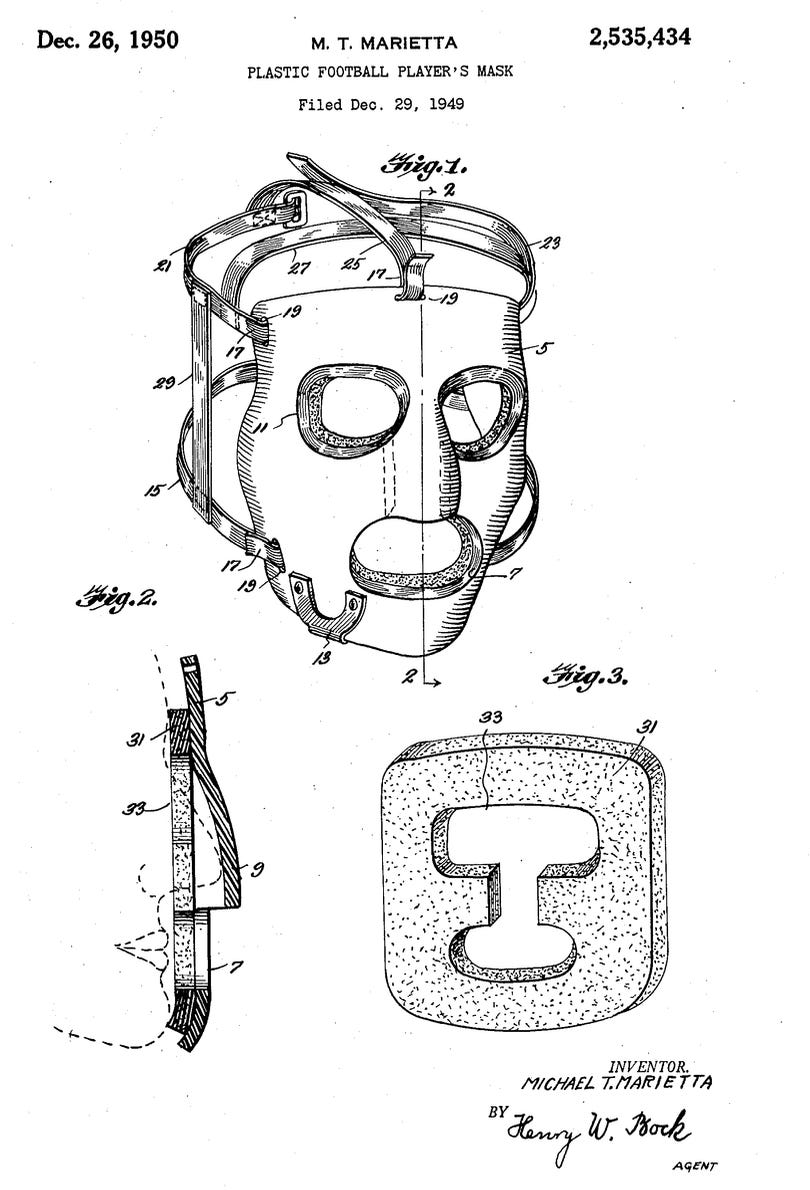
Although Marietta performed much of his early work for free, he applied for a patent in 1949 to protect his intellectual property. His earliest patent covered a full face mask that sat directly on the player’s face, with rubber pads for cushioning. Straps wrapping around the back of the head kept the mask in place.
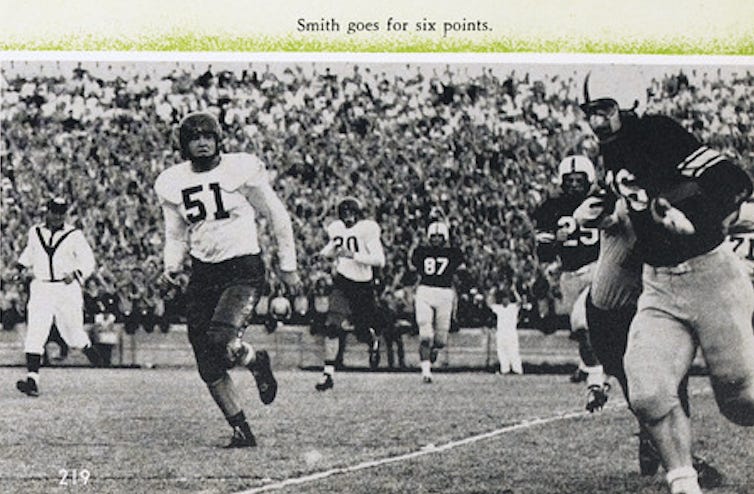
Marietta created other masks in 1950, including one for Texas A&M running back Bob Smith.
Rather than continuing to make custom masks, Marietta began manufacturing standardized face masks of die-stamped plastic. When Drake’s Johnny Bright famously had his jaw broken in 1951, Marietta sent him masks so Bright could continue playing.
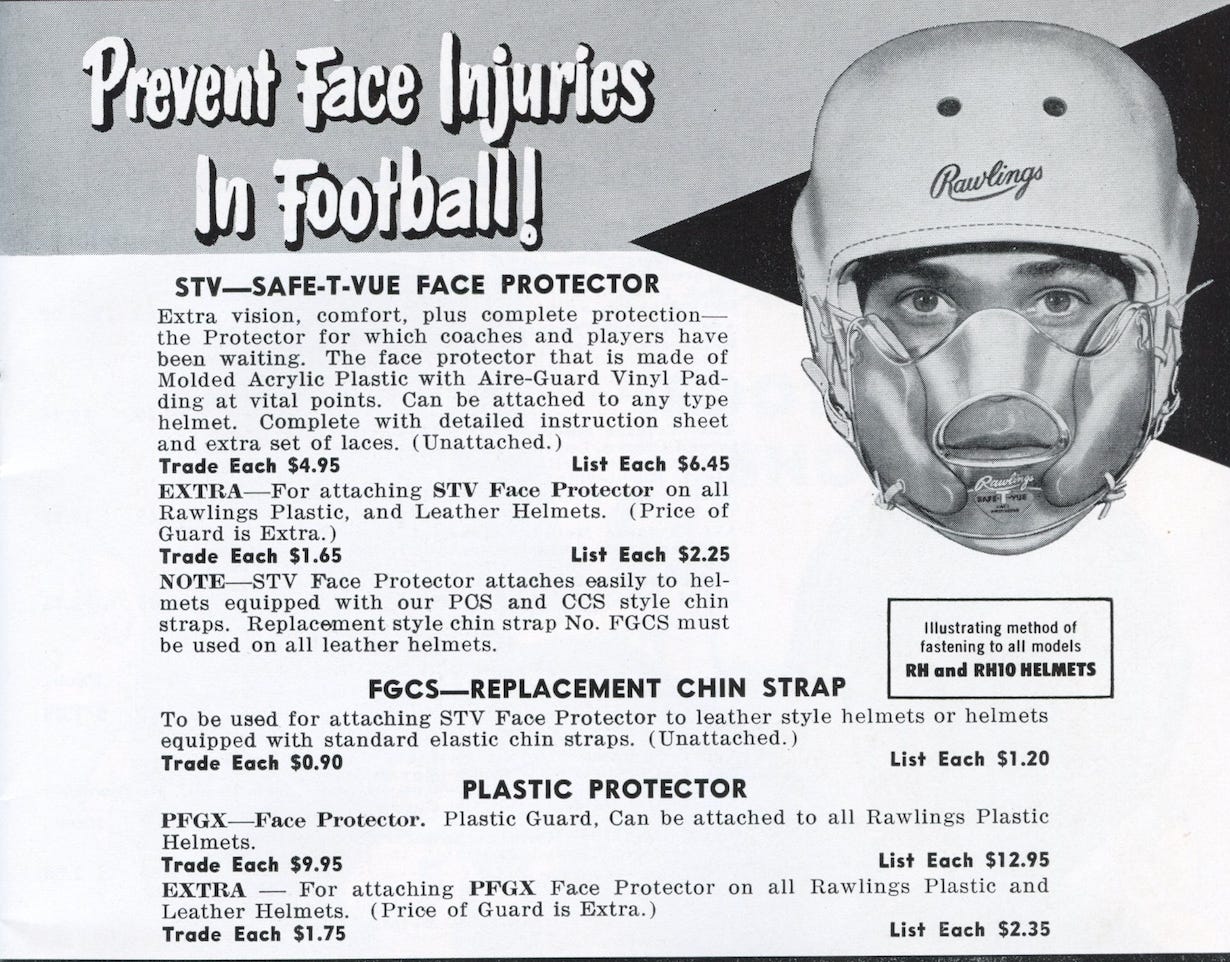
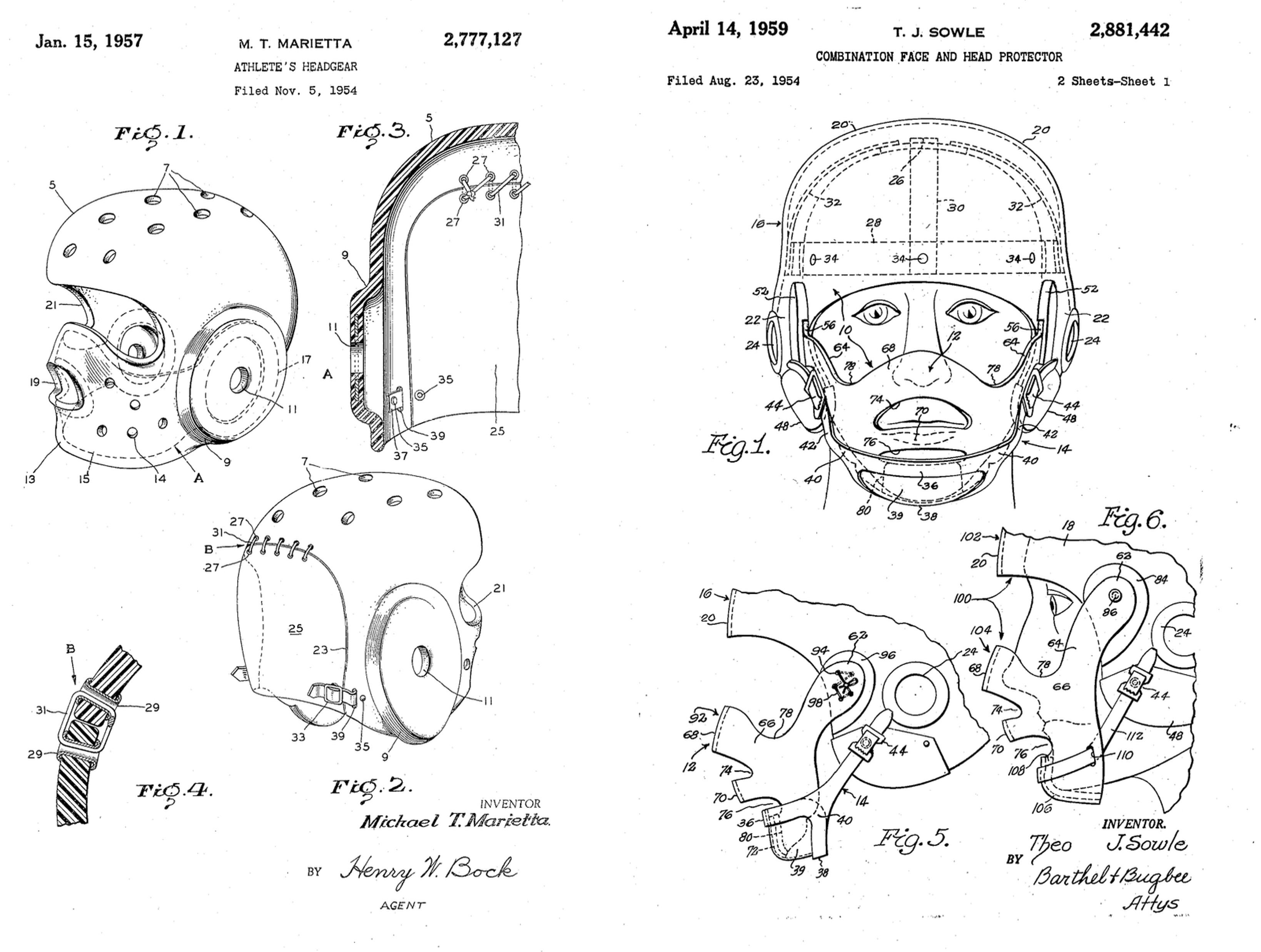
Marietta applied for another face mask patent in 1954 and licensed or sold rights to one of his mask designs to Rawlings, which they sold under the Safe-T-Vue name. The Safe-T-Vue mask rested on the face, just as Marietta’s full masks did.
The same year, Ted Sowle, the head football coach at Grand Rapids (MI) High School, developed a somewhat similar face mask, though Sowle’s mask projected out from the helmet like the bird cage or rubber-covered bar masks used since the 1930s for players with facial injuries or who wore eyeglasses.
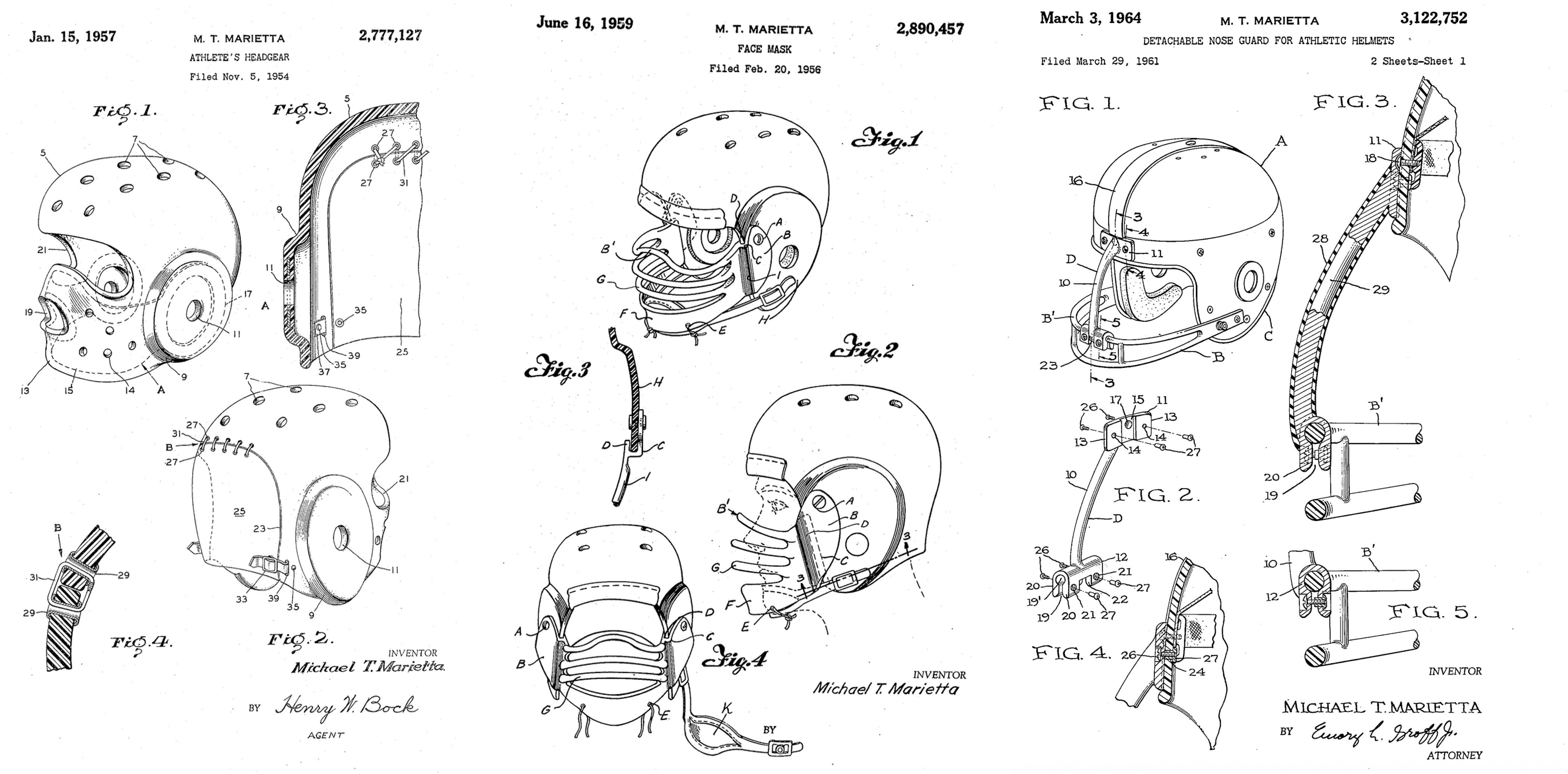
During the 1950s and 1960s, Marietta also designed and received patents for masks that projected out from the helmet, nose guards that supplemented bar-style face masks, interior helmet padding, and other designs.
The 1955 catalog I had overlooked previously showed that MacGregor sold rubber-covered bar or bird-cage masks, Marietta- and Sowle-style masks, and clear plastic bar guards. Selling all four options made sense, since some state high school associations banned projecting masks for fear they could injure other players. Also, mask styles sometimes differed by position. For example, Duffy Daugherty at Michigan State indicated he planned for his backs to wear bar-style masks and his linemen to wear Sowle Guardsmen masks. However, images from the 1955 season suggest they all wore bar-style face masks, after almost none of the Spartans wore face masks in 1954.
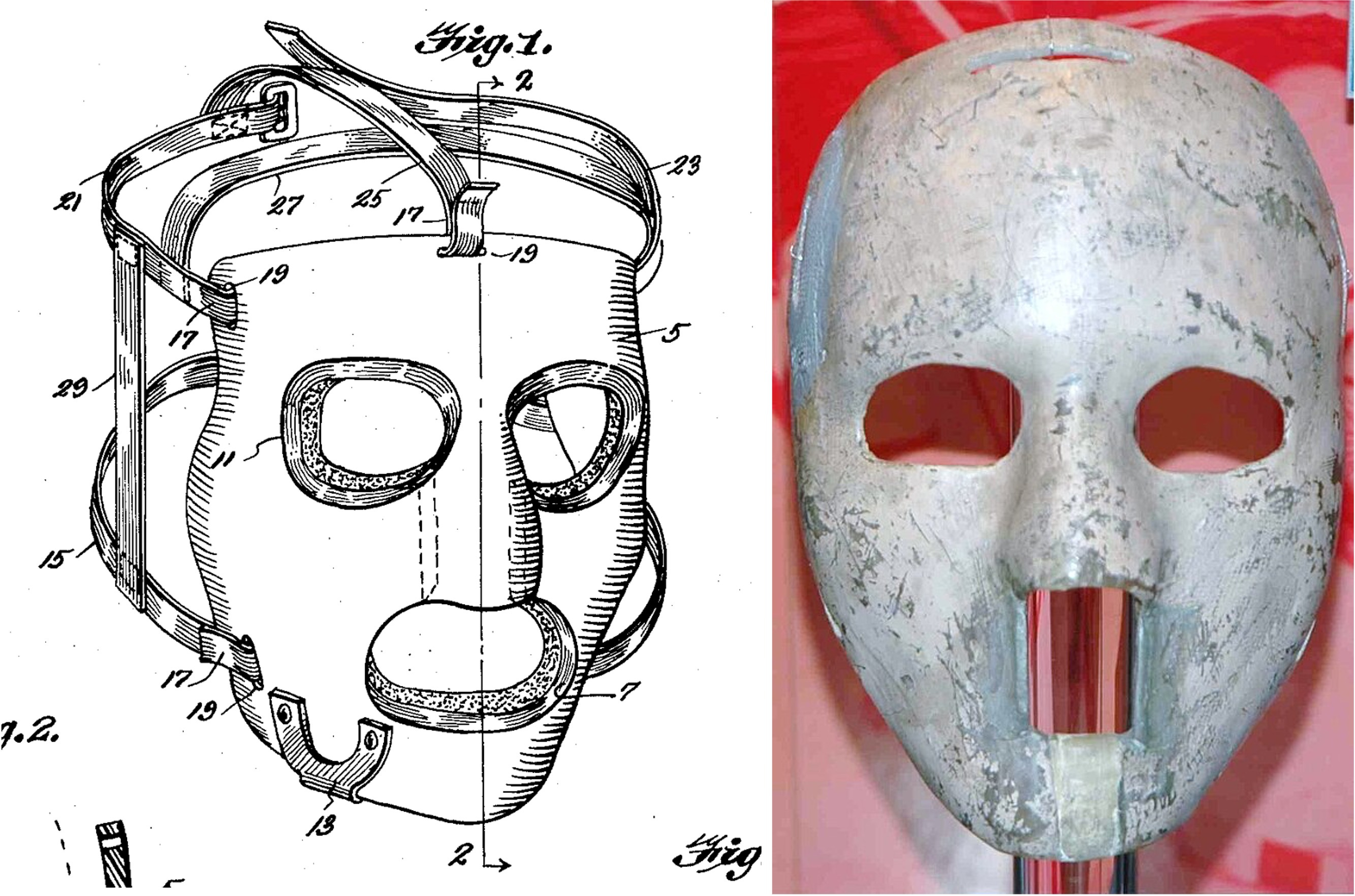
While no earth-shattering information emerged from my lucky stumble, it connected a few dots regarding the origins of certain football face-mask styles from the 1950s. It’s also interesting that while an entire style of football face mask descends from a hockey player’s face mask, Marietta’s patented full-face mask of 1949 closely resembles the one worn by Montreal Canadiens goalie Jacque Plante in 1959, when he pioneered mask-wearing among NHL goalies. On the other hand, when hockey skaters adopted face masks, they used bar-style masks similar to those worn by football players.
So, while multiple mask types were used in the 1950s, the bar style became popular in the NFL, eventually won out, and has dominated the sport for the next 60-odd years.
Football Archaeology is reader-supported. Click here to donate a couple of bucks, buy one of my books, or otherwise support the site.
Re: MacGregor--On-line sources about the firm's helmets over its history has so far escaped me. Have you written on this? ..
Ted Sowle - Michigan legend. Twenty-one years at Grand Rapids Catholic Central, four at Algonac (Go Muskrats!), three at Grant, and one in Pennsylvania. Had a 171-47-10 record before retiring at age 50.