
Today's Tidbit... That Time The Brits Wanted Us To Give Up Football

American football descends from rugby, meaning it started as rugby with a few tweaks. The rugby lineage began with Harvard playing a couple of games against Canadian teams, before it took hold in earnest when a few American colleges formed the Intercollegiate Football Association (IFA) in November 1876. The IFA adopted the 1876 Rugby Union rules almost verbatim, making minor verbiage changes and adding two new rules.
As in rugby, there were 15 players per side, so each team had one quarterback, two halfbacks, one fullback, and two three-quarterbacks. The IFA made several minor rule changes over the next few years, but found that the game was more interesting when they played a style of rugby different from that played in England. Specifically, the Americans liked picking up the ball and running with it, which was legal in rugby but was frowned upon. The typical Rugby Union game emphasized kicking the ball forward in the scrum and picking it up only when it inadvertently popped out.
To promote the open, running game, Walter Camp and Yale proposed reducing the number of players per side from 15 to 11 and instituting the rule of possession, which gave one team control of the ball at the start of each scrimmage. The team in possession could either kick it forward as before or heel it back to the quarterback, who picked it up and tossed it to a teammate to start a run.
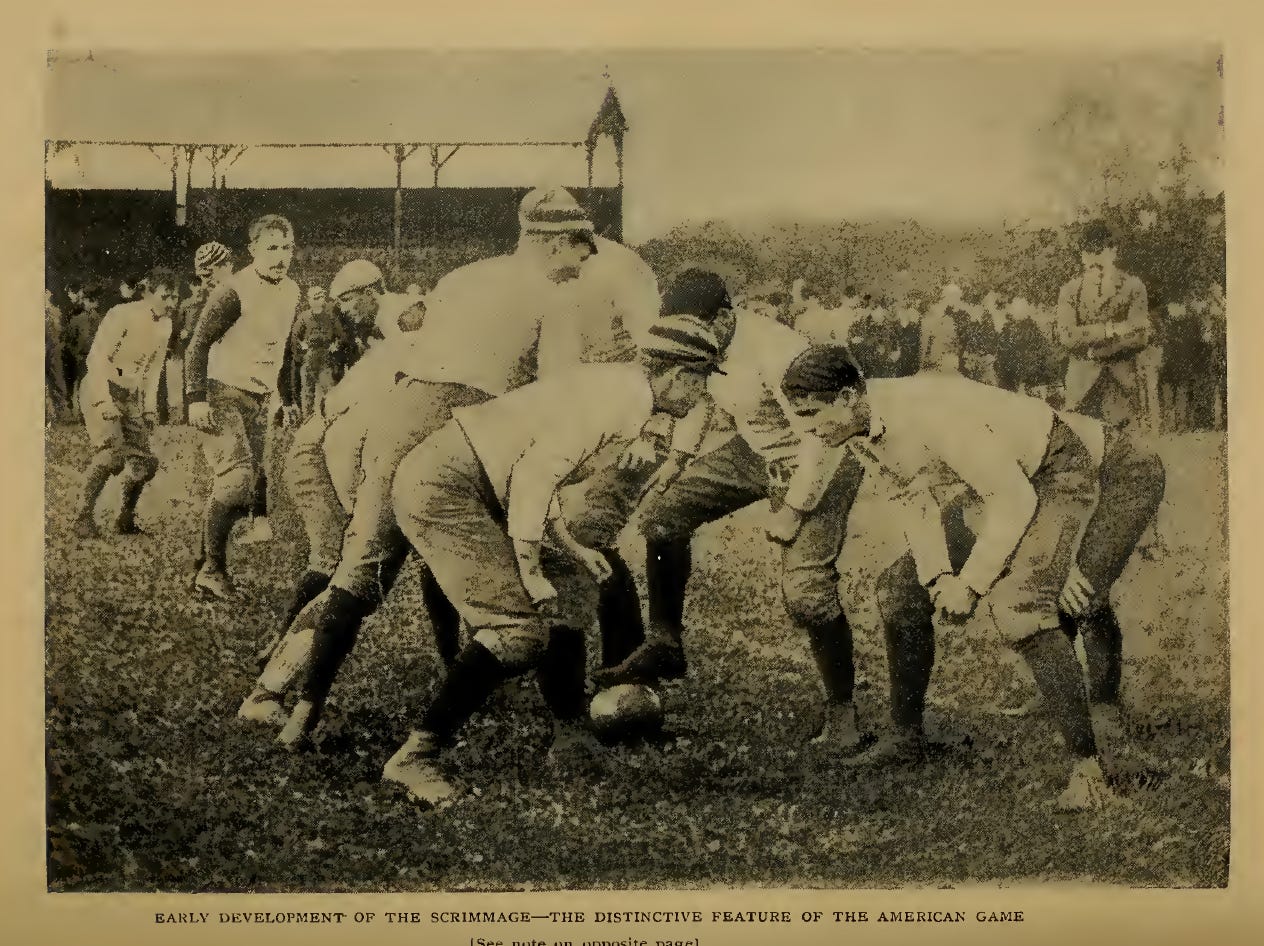
After rejecting Yale’s proposed rule changes once or twice, the IFA approved them in 1880. The problem was that the new rules gave one team possession of the ball but did not require them to relinquish it. The team with the ball did not have to advance it and was not penalized for safeties, which meant that teams -we’re looking at you, Princeton- sometimes found it advantageous to stall, not even trying to advance the ball.
Princeton stalled in the 1881 championship match against Yale, a game that was particularly boring and became known as the “block” game. It just so happened that a few subjects of Her Majesty, Queen Victoria, who were alums of Rugby School in England, attended the block game and found it appalling. Granted, they were right about that game, but rather than watch the IFA change a few more rules, they wanted the American sportsmen to give up their bastard game and return to playing Rugby Union rules.
To that end, James Rankine, Edward H. Moeran, and others began the new year by forming the British Foot-Ball Club in New York. They expected to have fun playing the game of their youth, challenge the American colleges to a few games, and convince the heathens of the error of their ways.
In January 1882, the 60-member club began meeting at St. George’s Cricket Ground in Hoboken, or the original Polo Grounds in Upper Manhattan, to practice and play amongst themselves.
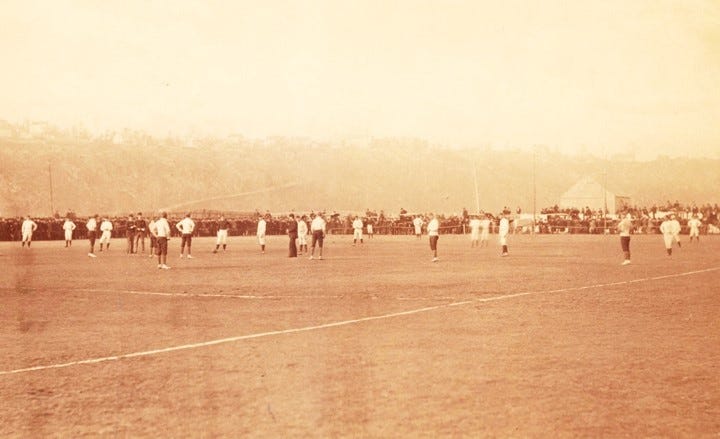
That April, Rankine, Moeran, and several other leaders of the British Football Club members invited the IFA to a meeting at Delmonico’s in an attempt to mentor the colonists. The IFA attendees included:
Princeton: E. C Pearce (captain) and J. S. Harlan
Yale: Walter Camp (captain) and Emmett Williams
Harvard: H. M. Manning (captain) and H. G. Leavitt
Rankine presented the IFA with a resolution proposing that they abandon the American game and play Rugby Union. The IFA members responded that they began playing under Rugby Union rules in 1876 and found them unsatisfactory, prompting modifications. The Irish-born Edward Moeran then told the Americans that he had witnessed two games played under American rules, and:
...if that were a sample of the way in which the games were to be played it would be better to crush foot-ball in its infancy.
‘The Game Of Football,’ New York Times, April 9, 1882.
Having told the Americans that their baby was ugly, Moeran gained few points by acknowledging that he appreciated the American practice of not tackling below the waist, before slipping further still when he said he did not like that Americans kicked the ball backward (i.e., heeling it back). Despite the Queensmen’s best arguments, the Americans wanted nothing to do with rugby as played at the time, and the meeting ended with the groups agreeing to disagree.
By that point, Camp and others were already discussing a rule change requiring the team with the ball to advance five (or lose ten) yards in three downs to keep possession, a rule they adopted at the October 14, 1882, meeting.
The British Football Club continued its efforts, aiming to show New York City and the college football world the beauty of rugby. They scheduled two November games against the Britannias of Montreal. Few people attended either game; the Britannias won both, and the British Football Club dissolved soon thereafter.

Of course, the rule of possession and the system of downs proved to be among football’s most important breaks from rugby, the forward pass being the other. Still, had the meeting at Delmonico’s with the British Football Club gone differently, you might be reading this article on the Rugby Archaeology site. Hell, had the decision gone the Brits’ way, Americans might speak English today.
However, that is not how it went, and America continued in its own direction, followed a few decades later by Canada, which chose its own variation on the gridiron theme. The rest of the world played Rugby Union, and/or developed their own national variants.
Regular readers support Football Archaeology. If you enjoy my work, consider a paid subscription, buy me a coffee, or purchase a book.


Edit:
OP, thanks for putting meat on the bones of the links between rugby and football. I did not know that stuff and am sending it to my rugby mates.
Football is such a good game. I played it for three years in junior high, got on the field only as part of our Brawny D (we had scrub strength) for 12 or 13 plays in that entire time. I was little and not particularly talented and did not make the cut for high school. I never played that game again.
I learned the rugby union position of hooker from a Brit at Oklahoma State in 1980, played on 4 continents, hooking with rare exception for most of it, and went on to play my last game (not counting a few old boys reunions later) in 2009 in Jerusalem, Israel hooking for the Jeruslem Lions (an expat team) in which we were beaten soundly by a bunch of Russian guys (expats or citizens of Israel I do not know) from Ashkelon. We had beers afterwards, as gentlemen do.
Rugby is also a good game. It is playable the world round, for the entirety of an athletic lifetime, however long that lasts for a person.
Funny how the son of rugby became so exclusionary for the marginally talented, while the dad... even if you suck, you can get 2 halves of B side rugby every weekend in season.