
Today's Tidbit... The CFL's 104-Yard Field Goal Attempt

As I pointed out a few days ago, the CFL exhibition season starts on Monday at 3 PM Eastern when Saskatchewan visits Calgary. Football Archaeology readers in Canada already know how to access the televised games, while those in other countries can access them and other games this season at cfl.ca/plus.
The larger field and three downs per possession rule make Canadian football more wide-open than the American game. The waggle, which allows receivers to run toward the line of scrimmage at the snap, also takes getting used to, but otherwise, the core of the game is football like that played south of the border.
Still, there are other rules differences, especially in the kicking game, that are noteworthy and fun, though most kicking game differences seldom come into play. The most visible difference in the kicking games and one of my favorite elements of Canadian football is that kicked balls remain live in more situations than in the American game, and a combination of interconnected rules strongly encourages the return team to field punts and kicks, and return them.
One of those rules is that Canada does not recognize the fair catch. You might think the absence of the fair catch would put punt and kick returners’ lives in danger, but coverage teams cannot penetrate a 5-yard circle around the returner while he makes the catch. The “No Yards” rule results in many more exciting punt returns per game.
Canadian football also does not have touchbacks. Balls kicked into or intercepted in the end zone need to be run or punted out of the end zone to avoid a rouge. (During live play following a change of possession, players can punt the ball back to the other team, a remnant of rugby that became illegal in American college football in the 1960s after being little used for decades.)
Canadian teams do not always run punts and kicks out of the end zone. For field position reasons, they often concede one point and then receive the ball from scrimmage at the 40-yard line, rather than deep in their territory, when an attempted run gains little ground.
Likewise, the ball remains live when kicked into the 20-yard deep end zones (aka goal areas). Failing to bring the ball out of the end zone results in a rouge, or one point for the kicking team. Punted or kicked balls that exit the side or back of the end zone have traditionally resulted in a rouge, but the CFL has changed that rule for the 2026 season. Now, only kicked balls that stay in the end zone result in a rouge.
Another Canadian rule allows open-field or downfield punts, such as a pass receiver punting the ball further downfield after a catch. Canada also allows onside/dribble kicks, meaning that the punter or kicker and any teammates behind them at the instant of the kick can recover the ball for a first down. (American football had similar rules until the early 1920s.)
Yet another difference in kicking rules comes on missed field goals. In American football, you can return missed field goals or allow the ball to roll dead in the end zone or on the field of play, with the next play starting on the 20-yard line or at the previous spot.
In Canada, the ball remains live on missed field goals, and the kicker or anyone behind him at the time of the kick, which normally includes only the holder, can recover the ball. The rule effectively forces the “receiving” team to return missed field goals.
Most teams attempt field goals only when their field position gives them a reasonable chance to make the attempted field goal. However, there was that one time...
When the Toronto Argonauts visited the Winnipeg Blue Bombers in the second-to-last game of the 1991 season, the Argonauts’ regular long snapper, J. P. Darche, was left in Toronto due to injury, so linebacker Chad Folks handled the snapping duties until he suffered a third-quarter knee injury. That left the Argos with linebacker and third-string snapper, Mike O’Shea, who could handle the short snaps for field goal attempts but not the long snaps to a punter. (O’Shea has been Winnipeg’s head coach since 2014.)

For the remainder of the game, every time Toronto was in a punting situation, they had O’Shea snap to Dan Giancola, the regular field goal kicker, who held the ball for Noel Prefontaine, the regular punter. The arrangement made sense since Prefontaine was also their kickoff specialist, whose powerful leg was less accurate than Giancola’s.
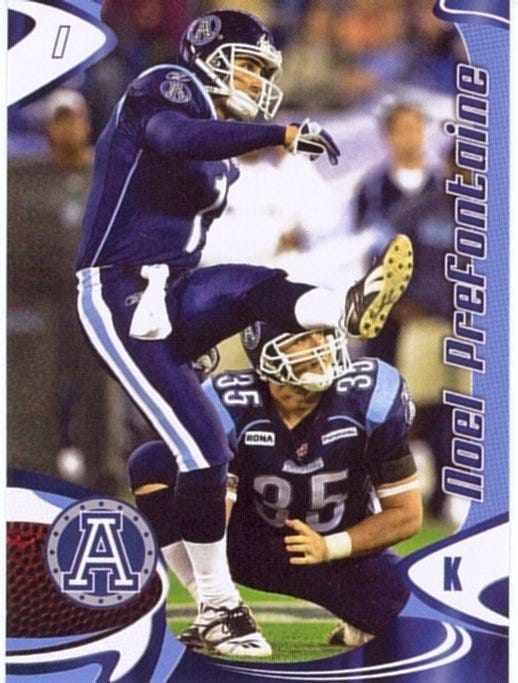
The Argos lined up in field goal formation five times during the remainder of the game as Prefontaine attempted field goals from 80, 104, 75, and 71 yards out, plus he punted once from field goal formation. (The 104-yard attempt comes shortly after the 1:00 mark). Winnipeg returned all five kicks and made solid yardage on most.
For each of the five kicking situations, the following video shows the second down play preceding the field goal attempts or punt, and the kicking play and return. The video also shows an exciting last play of the game.
Since American goal posts are on the end line, someone could conceivably attempt a 104-yard field goal from the team’s 6-yard line. However, because American rules return missed field goals to the 20-yard line when inside the 20 or to the previous spot when outside the 20, American teams generally do not attempt long field goals that are unlikely to be made. They likely would find other solutions to the missing long snapper problem, such as attempting a rugby-style punt off a shorter snap or a forward pass.
What would you do under similar circumstances when playing under American rules?
Thanks to Nate Sager for alerting me to this game and situation. I appeared on Nathan’s podcast a few months ago. You can listen here:

#/media/File:2025,_Coach_Mike_O'Shea.jpg)
If you enjoy Football Archaeology and are not a paid subscriber, consider buying me a cup of coffee here and there. You can also buy a paid subscription or purchase one of my books.

