
Today's Tidbit... The Double Quarterback Formation

Frank Leahy’s 1948 Notre Dame team started the season ranked #1 in the AP poll, but Leahy was not one to leave anything to chance. He had a trick up his sleeve as the Irish prepared to meet Purdue in the season opener.
Coming off two seasons with Johnny Lujack as the starter, including his 1947 Heisman campaign, senior, but relatively untested, Frank Tripucka took over as the Irish starter as their T-formation quarterback. Tripucka would become an NFL first-round draft choice and play four years in the NFL, seven in the CFL, and four in the AFL, but his career prospects were uncertain in September 1948. He also fathered a host of fine athletes, but that’s another story.
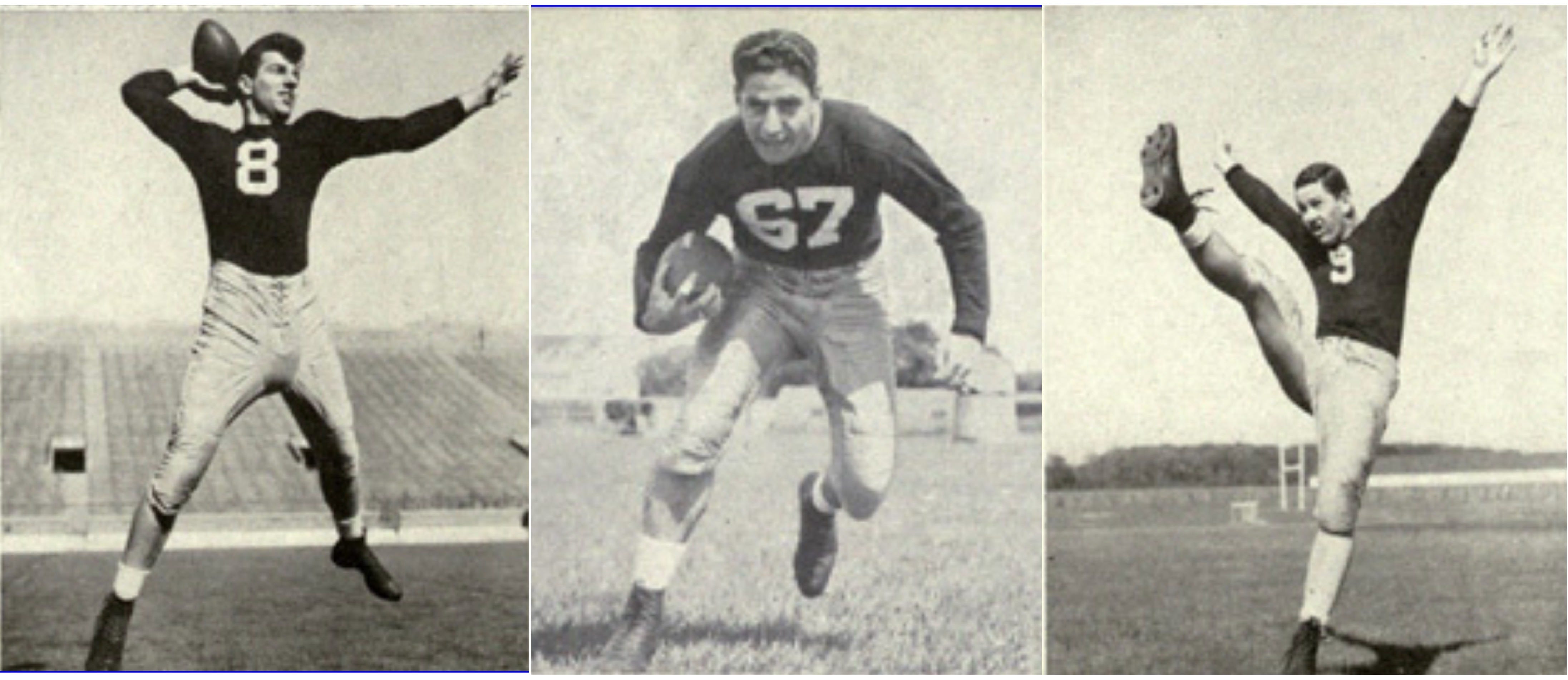
Notre Dame beat Purdue 28-27, aided by two interception returns for touchdowns, but the game was most notable for something else that came in twos: Notre Dame’s quarterbacks. Partway through the third quarter, Leahy sent backup quarterback Bob Williams into the game. Rather than replace Tripucka, fullback Panelli left the field, and when the Irish broke the huddle, both Tripucka and Williams lined up at quarter center, side-by-side, with their hands under center.
Leahy had observed that Notre Dame effectively blocked the front side on most plays, but often saw their backs tackled by weakside players.
“Plainly, there was a defect in our offensive pattern so I decided to experiment with something that might keep the weak side linesmen in position a fraction of a second longer. It occurred to me that the double quarterback scheme might be the answer. With two quarterbacks in action, the weak side defenders can’t commit themselves too soon, because if they do we have an alternate play to use.”
As seen in the diagram and game-action image, Notre Dame’s scheme kept the backside players home by having the two quarterbacks head in opposite directions: one to the right and the other to the left.
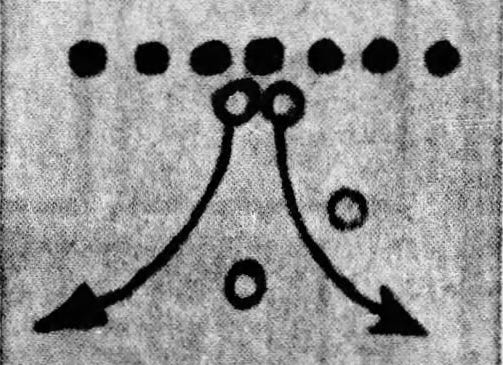
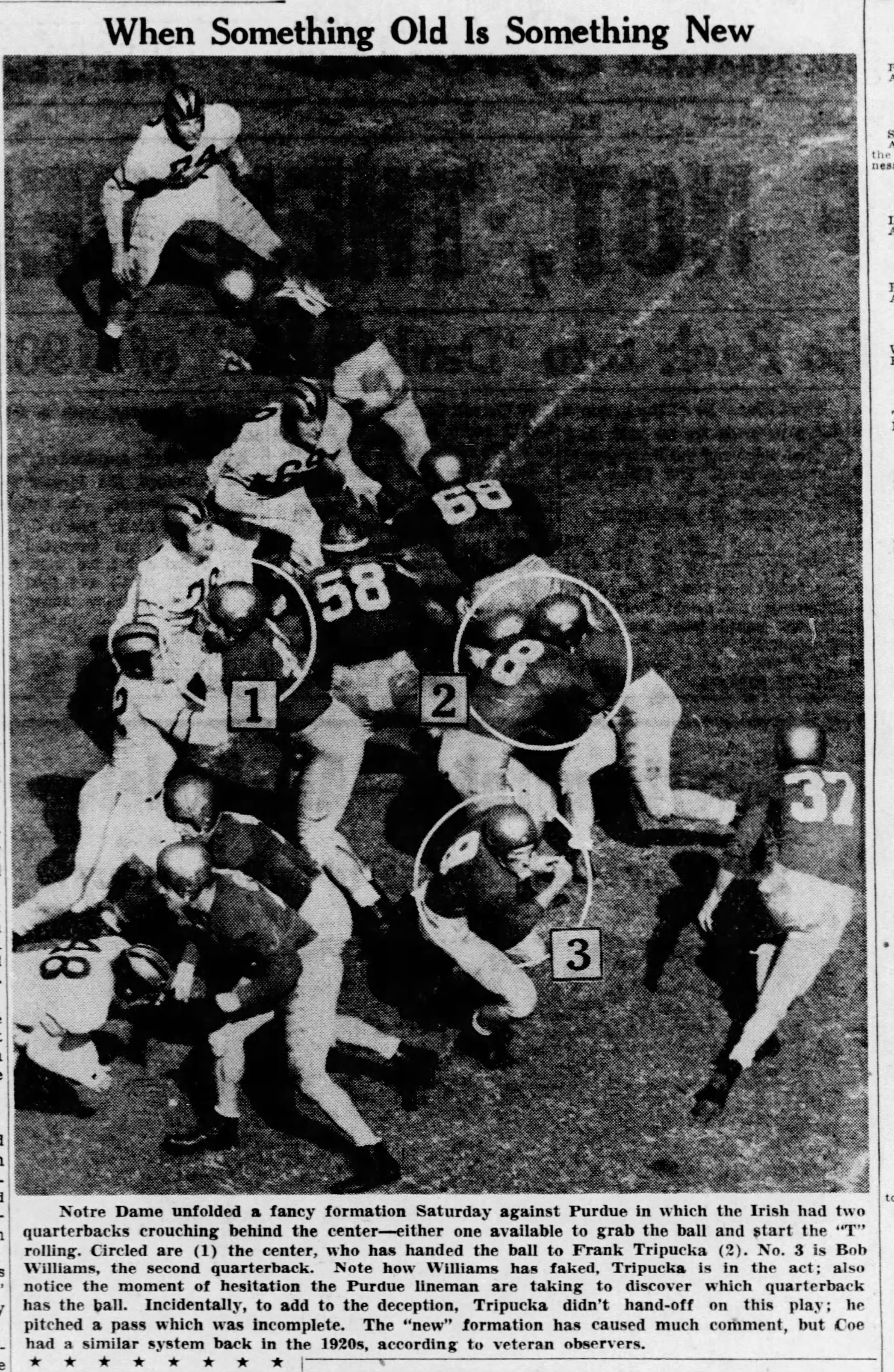
To allow the officials and defensive players to identify eligible receivers, football’s rules required offenses to have seven men on the line of scrimmage. The four backs had to be at least one yard behind the line of scrimmage, other than one back, who could be within one yard of the line if he had his hands under center. That rule required both quarterbacks to stand farther back than usual, and one had to pull his hands out from under center before the snap, which then made him an eligible receiver. (Quarterbacks were not eligible receivers when under center.)
The Irish ran the double quarterback play a few times, making two nice gains, before being sacked for a 10-yard loss and moving on to more traditional play-calling. Notre Dame did not use the formation again in 1948, but everyone knew they had the package, so future opponents wasted practice time preparing for it. They did, however, pull the old whisper play against Northwestern, variations of which appear from time to time. On the whisper player, Tripucka went under center as usual, but after a few seconds, he stepped back, seemingly confused, and walked over to one of his halfbacks to whisper in his ear. Mid-whisper, the center snapped the ball to the other halfback, and he ran for open territory.
The next time the formation had defenses seeing double was in 1959, when Nebraska opened its season at home against Texas, en route to a 4-6 season that fell short of the Lincolnites’ expectations. Anyway, they pulled the combo-QB a few times as Texas coach Darrell Royal screamed to the officials that the formation was illegal. Royal knew it was illegal after investigating and opted against it due to its illegality. Of course, Nebraska coach Bill Jennings also knew it was illegal, but he figured he would force the officials to call it and penalize the Cornhuskers, which they did not do that game. It didn’t work that well, so they returned to their standard formations, which also didn’t work.
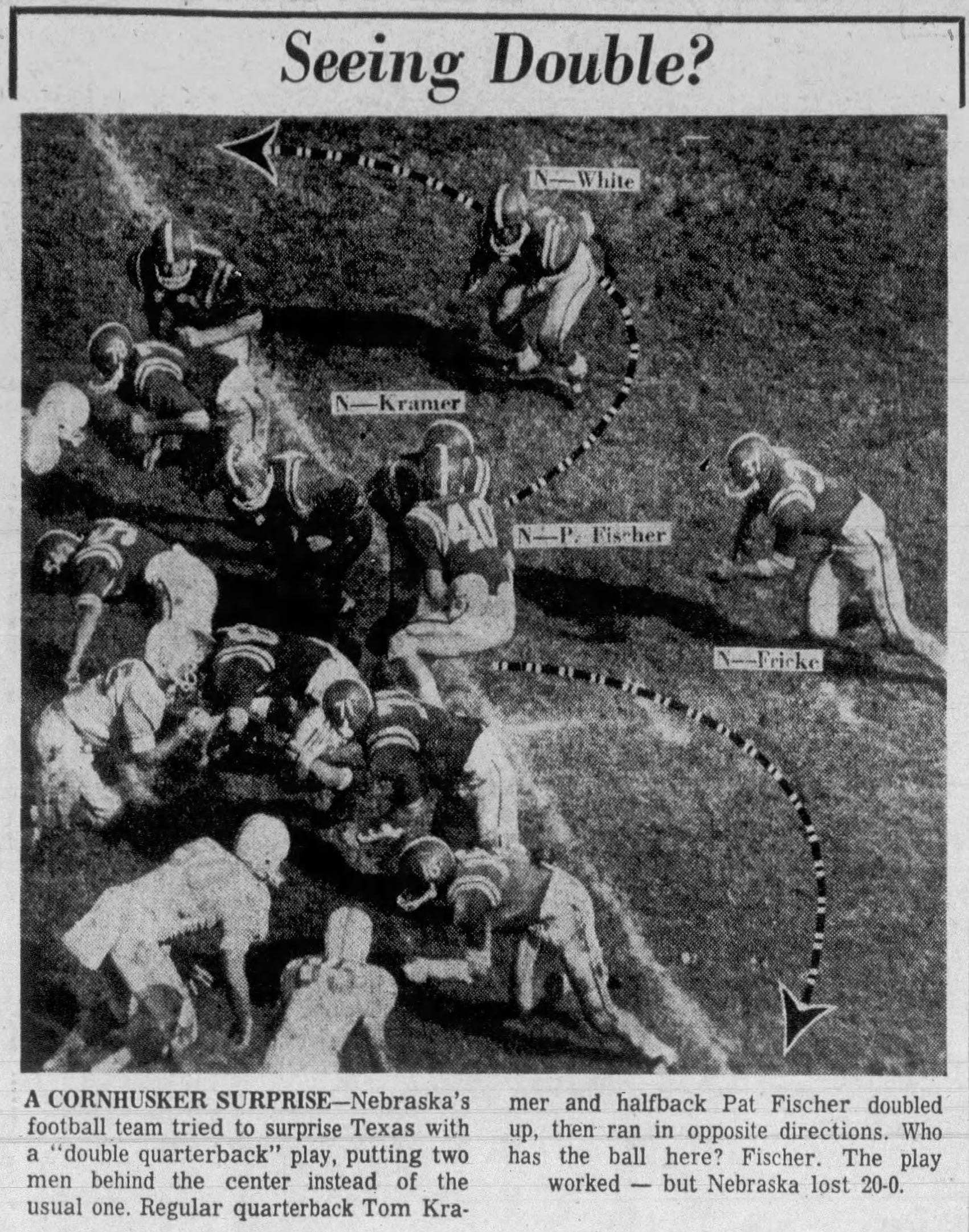
Unfortunately, for the Huskers, the publicity generated by the play alerted every coach and official in the nation to its illegality, so the Huskers could not go to the well a second time.
The last high-level appearance of the double quarterback system appears to have been with the 1962 Montreal Alouettes. They had rookie quarterback Sandy Stephens, a consensus All-American who was so good that he led Minnesota to the Big Ten championship and the Rose Bowl, a feat no one has matched since.
Whether Montreal truly ran the double quarterback and snapped the ball to the second quarterback is difficult to tell. The newspapers called it the double-quarterback formation, but the Alouettes’ highlight film shows them lining up with another back next to Stephens, then sending the second back in motion, as the Canadians are wont to do. The video below is a clip of five plays in which Montreal runs from the double quarterback formation. (Click the link if it does not embed.)
https://youtube.com/clip/UgkxVycn-paqUYe9k8dicPQgQN9fvgSg-tbP?si=IC2cY3TkBjtc8XN1
The double quarterback formation made appearances at the high school level from time to time, and here and there, teams run plays with two quarterbacks on the field at once. However, having two players listed as quarterbacks on the roster does not constitute a double quarterback formation unless they both line up under center.
The double quarterback formation is another in a long line of formations and plays that tested the letter of the law. Some prove effective, and others do not. Whether teams did not practice the double quarterback formation enough or the rules restricted its effectiveness, the double quarterback was something like the Tush Push of the day. Some folks called for new rules to rid football fields of the double-quarterback pestilence, while others cheered its inventiveness. Either way, despite football’s conservatism, you will never stop some coaches from concocting new schemes and testing the game’s limits. That’s how good and bad ideas are invented.
Regular readers support Football Archaeology. If you enjoy my work, get a paid subscription, buy me a coffee, or purchase a book.


Wow, that is tip-toeing the line on the rules of being one yard back, LOL Great story!