
Today’s Tidbit... The Flipping Coin Toss

While the world has bigger problems to solve, finding and pointing out errors that have crept into football history is among my pastimes. In some cases, the errors resulted from someone posting a tall tale online, which others scooped up and republished. Like weeds, they can be difficult to eradicate once established. An example of such a tall tale occurred with the origin of the quarterback sneak, which Wiki repeated for a while, though it has since been removed.

Similar incorrect or incomplete information concerns the evolution of the coin flip process over the last 150 years. The Pro Football Hall of Fame states that team captains handled the coin toss from 1892 to 1920, but this is likely because they trusted Rules Committee member and pre-eminent rules historian, Dave Nelson, whose 1991 Anatomy of a Game stated that the captains handled the coin flip until 1921. That turns out not to be true, though it was an easy mistake to make, as you will see.
When football began with the IFA slightly modifying rugby’s 1876 rules, the 39th rule called for the captains to toss to choose between goals and the kickoff.

The captains handled the coin flip themselves, though it's not clear who flipped the coin and called heads or tails. The referee and umpires were not involved in the process. However, it seems fair to assume there were problems with the process, since the 1884 rules had the new judges handle the coin flip. The judge positions soon disappeared, and by 1888, the rules had the captains tossing up once again.
Somewhere in that timeframe, some referees began handling the coin toss in a pre-game gathering with the captains. Their meeting also covered ground rules, the length of each half, and other game adjustments. The first mention I’ve found of a referee handling the coin toss came in the 1891 UNC-Duke game, when Duke was known as Trinity.

Likewise, before the 1893 Purdue-DePauw game, they had to flip twice:
The referee tossed a silver dollar into the air, but it alighted on the edge in the soft mud and another trial was made.
‘’Rah For Purdue, Indiana State Sentinel, December 6, 1893.
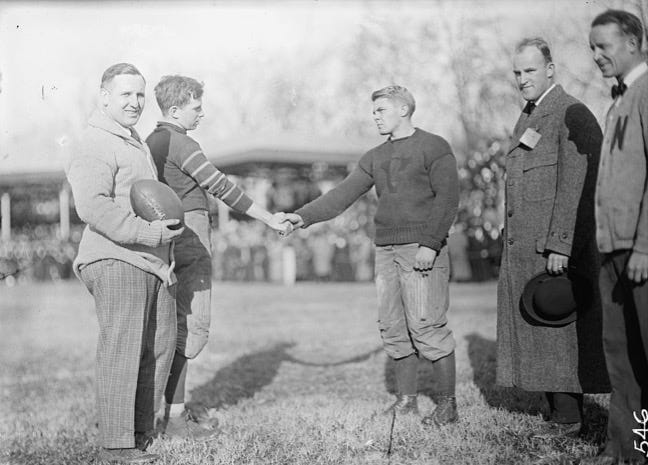
Mentions of the referee flipping the coin become more frequent after that, but as a mundane part of the game, who flipped off whom went unmentioned in most game reports, though it appears in images here and there.
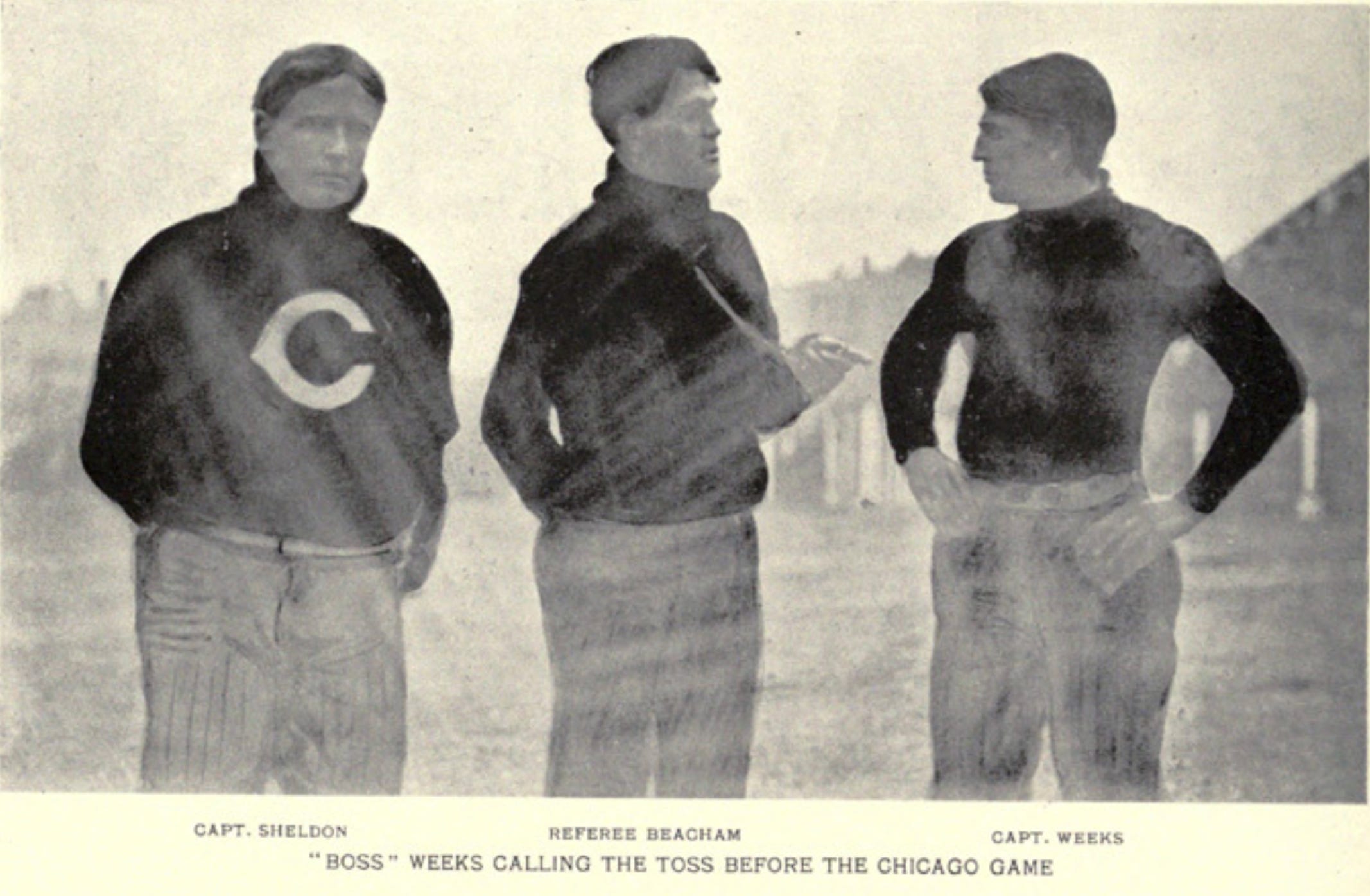
Still, by 1909, a primer on the game described the referee handling the coin toss and confirming the game’s length as being standard parts of the process, even though the rules still stated that the captains tossed a coin pre-game.
Dave Nelson and the Pro Football HOF might have looked at the old rule books and reasonably concluded that the behavioral change occurred when the rule changed in 1921:
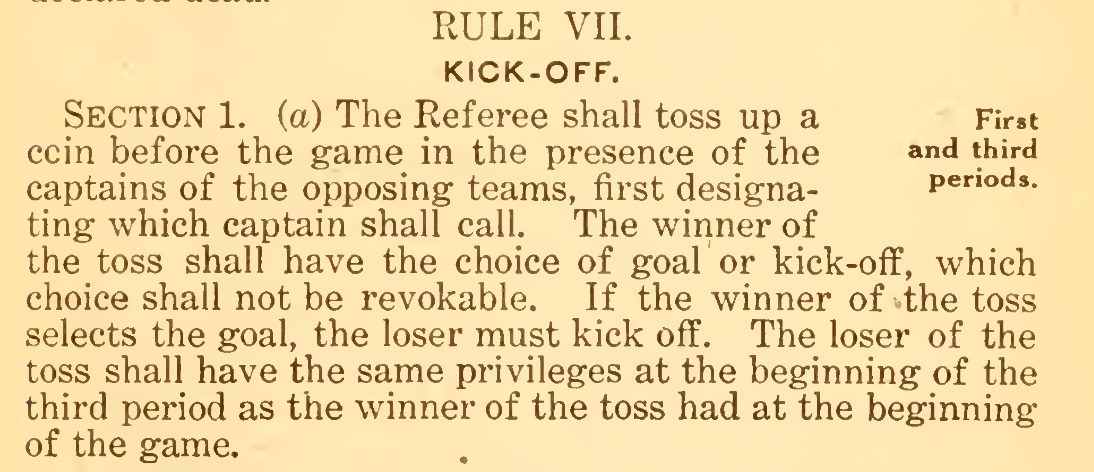
While the rule clearly changed in 1921, the NCAA rule books of the era opened with a description of the year’s most important rule changes, providing background on why various rules were altered. The 1921 explanation notes that the rule change codified an existing practice rather than introduced a new one. As shown in newspaper articles, the passage confirms that referees had been flipping the coin by custom for some time, despite the written rule.
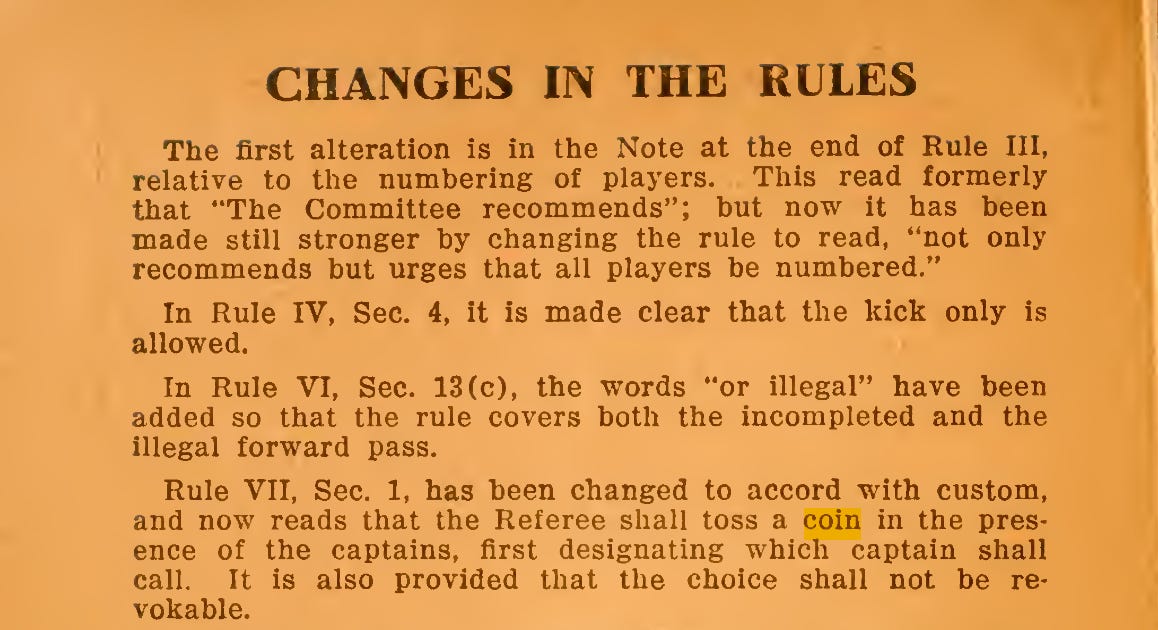
Football has had many instances in which the rules lagged behind the game as played. The acceptance of blocking, players wearing numbered jerseys, face masks, and short pants are other examples of the rules following the behavior. So, it is not out of the norm for the referee's practice of handling the coin to precede its inclusion in the rules.
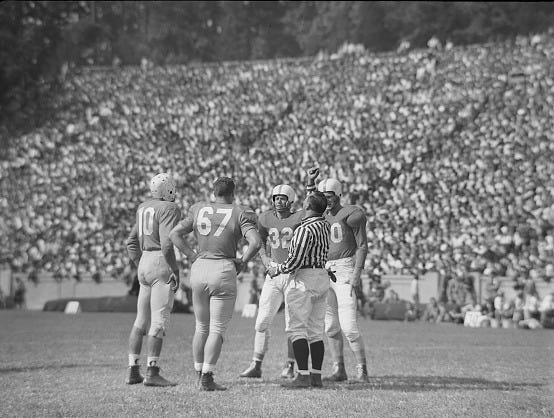
Perhaps more interesting is another point made in the Pro Football Hall of Fame timeline: the NFL moved the coin toss from 30 minutes before the game to 3 minutes in 1976. The NCAA made that move in 1952, at which point the rule book described the toss up as a ceremony. That tells us that a once-mundane element of the pre-game became a rite watched by those in the stadium and watching on television. Who among us has not cheered when the referee signaled that our team won the toss or had a different reaction when the flip went in the other team’s favor? And, more than a few have bet money on which team wins the toss, but that is a topic for another day.
If you enjoy Football Archaeology and are not a paid subscriber, consider buying me a cup of coffee now and again. You can also buy a paid subscription or purchase one of my books.


Bill Cosby did a whole comedy routine where the coin toss is performed before significant historical events...