
Today’s Tidbit... When Football Became A Contact Sport

There are many instances in the development of football uniforms and equipment for which we can point to an individual as the originator, and there other where a slew of people in different places, even at different times, contributed to their development. Among the latter are face masks, which began as nose guards in 1892, morphed into masks covering the face in 1921, and before evolving at multiple locations into custom-made sets of bars tied to and protruding from the helmet that protected players’ noses, cheeks, and eyes. This story focuses on the eyes, including how early face masks developed, in part, to protect players’ eyes and the vision correction devices they wore on the field.
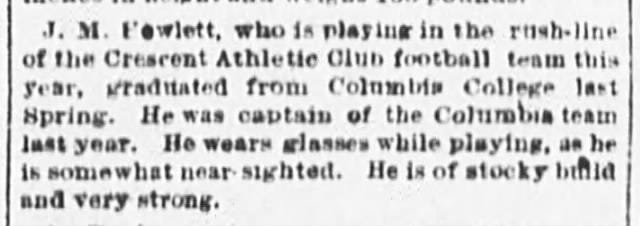
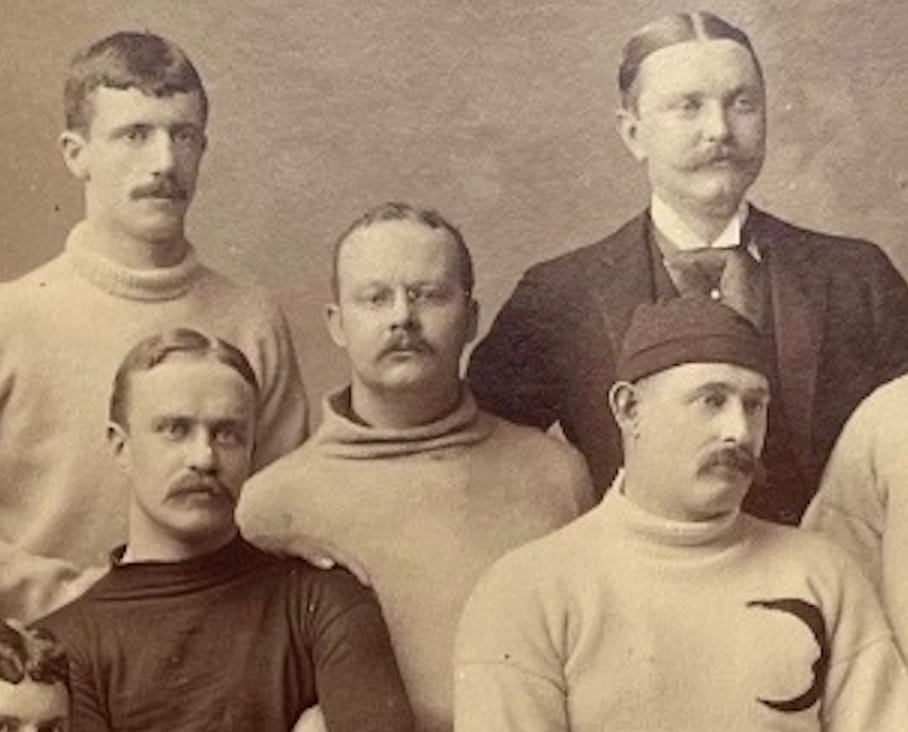
In the days before players wore helmets, some wore glasses on the field without any apparent means of protecting them. J. M. Hewlett, Columbia’s captain in 1889, who then played for Brooklyn Crescent Athletic Club, wore eyeglasses on the field.
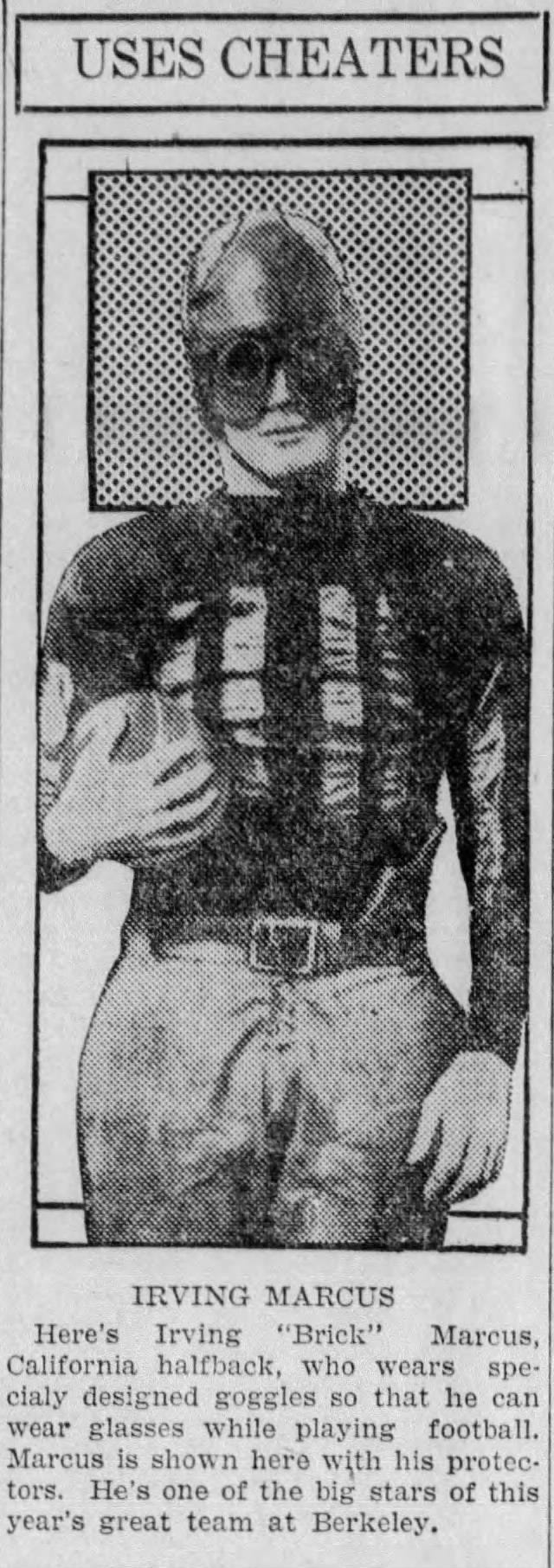
Likely driven by the use of goggles by aviators, the 1920s saw some players wearing prescription goggles on the football field, with Cal’s Irving “Brick” Marcus being among the best known.
The late 1930s saw the emergence of birdcage face masks, which protected the top half of the face with bars similar to today’s face masks. They literally popped out and up at Washington in 1939 when two tackles played far better when wearing eyeglasses and face masks.
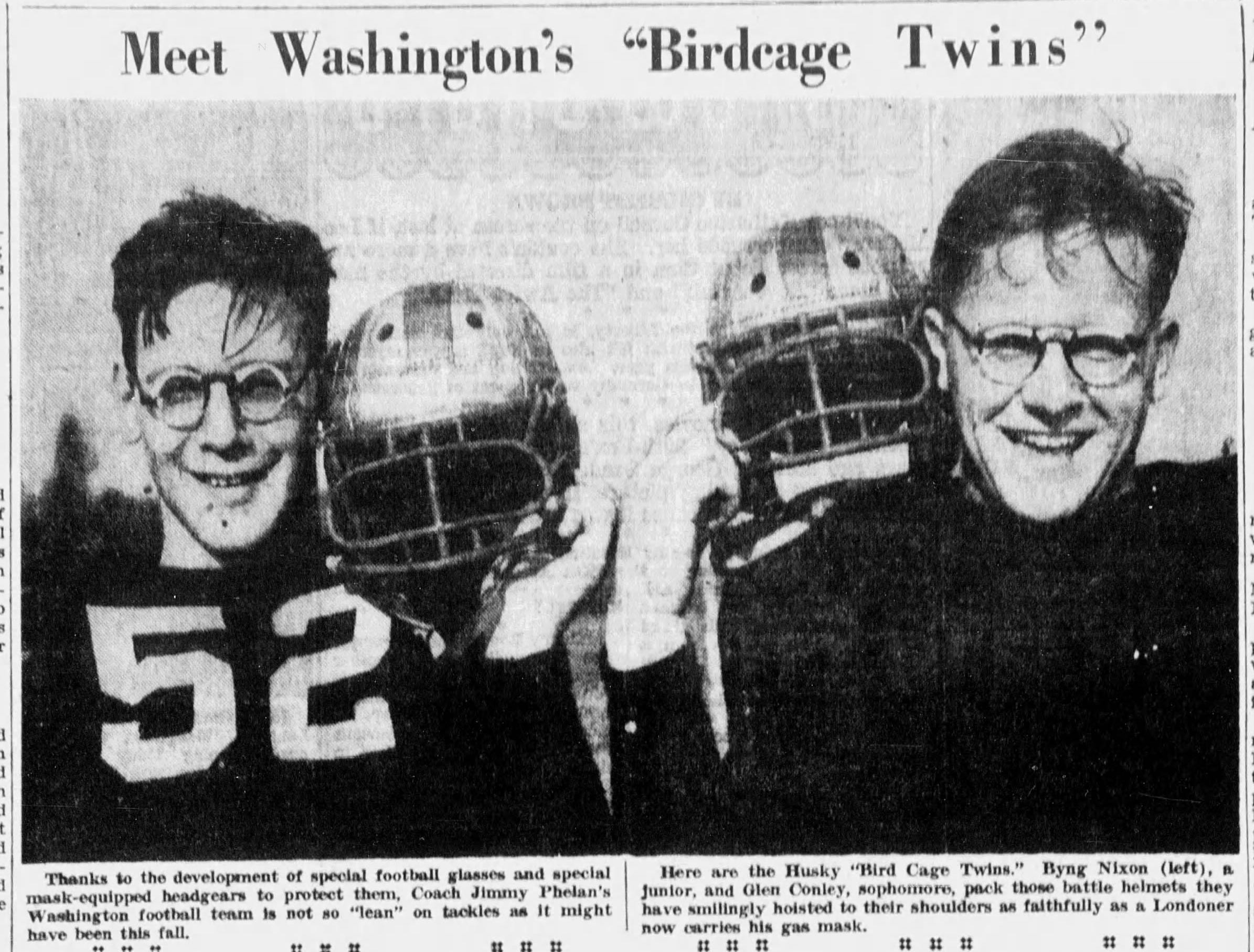
Although the combination of eyeglasses and birdcage masks allowed them to play more effectively, their glasses still got knocked around quite a bit and fogged up when they perspired.
On the other side of the country was a 6’ 6” end and hurdler, Thacher Longstreth, who, by name alone, belonged at Princeton. Apparently, his ancestors came to America in the 1600s. Despite their tremendous vision, he was terribly shortsighted with 1/20 vision, meaning he saw at 1 foot what a normally sighted person sees at 20 feet. Well-to-do, the family fortune disappeared in 1929, leading him and his brother to work their way through elite schools, including earning scholarships to Princeton.
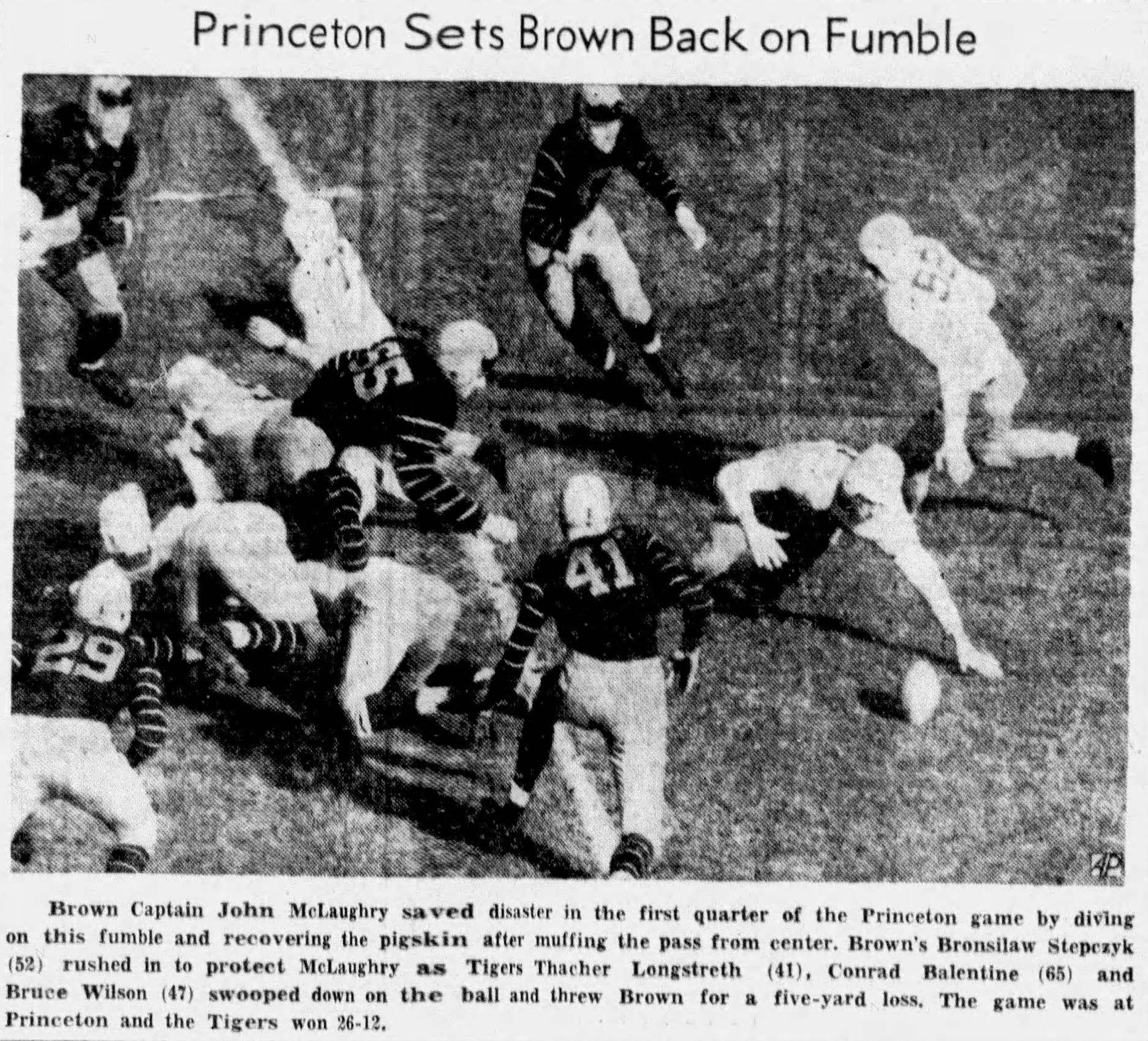
After playing freshman football in 1937, Longstreth started at right end in 1938 and 1939. He had trouble seeing balls passed to him -seemingly an important trait for an end. He later told the story that he once had the ball bounce off his hands, but then he saw the brown leather ball reappear in front of him. He grabbed the ball and would not let go as an opponent struggled to remove Longstreth’s hands from the ball. Longstreth then realized the brown object was not the ball, but his opponent’s helmet with his head inside it, so he let it go, resulting in an incomplete pass.
Trying to solve the sight problem, Longstreth began wearing glasses and a birdcage mask, but he found the steel glasses dug into his face.
During the 1939 season, Princeton’s trainer connected with Theodore Obrig, a pioneering optician, who joined with Ernest Mullen to develop the first plastic scleral contact lenses. The connection led Longstreth to become the first football player known to wear contact lenses.
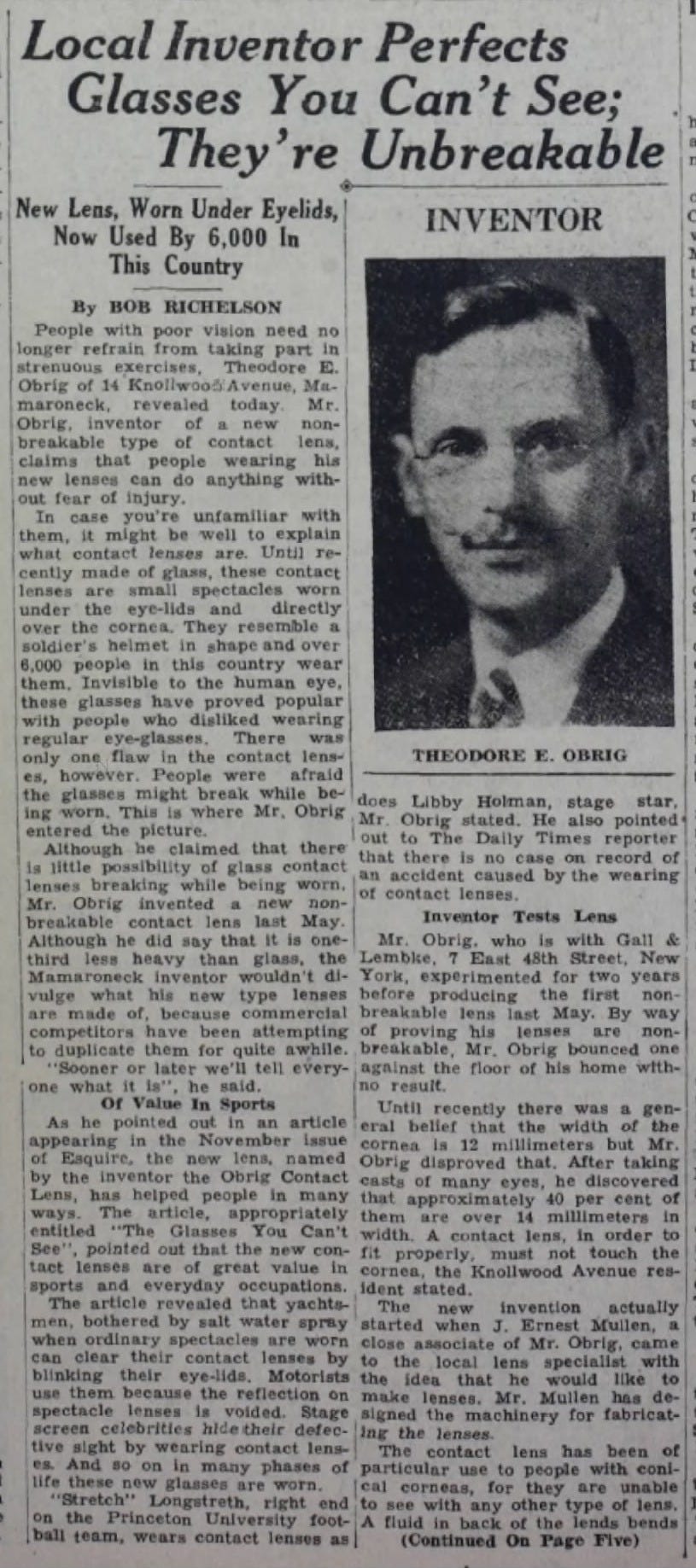
The contact lenses of 1939 were unlike those of today. Yes, they came into contact with the wearer’s eyes just like today’s, but they nearly covered the entire eyeball, and the backside was not custom-fit to the shape of the eyeball like today. The lack of a perfect fit meant the contacts became loose when the wearer’s head was jarred, which happens on occasion in football.
Whenever Lognstreth had a loose contact, he remained on the field since he played before free substitution came into play. To fix his contact, he pulled out a small suction cup, grabbed the contact, repositioned it, and played on.
Perhaps due to his vision issues, or the team’s shortage of tackles, the coaches moved him inside as a senior. Unfortunately, a bad leg sidelined him for much of the season before he suited up for the Harvard game, during which he never left the bench.
Disappointed, Longstreth, who spent his life as a teetotaler, went to a party that evening and knocked back a few, which meant he broke the team’s training rules. Disappointed in himself, he confessed his sin to Tad Wieman, the head coach, who promptly suspended him from the team. He was allowed back on the team a week or two later, but his senior season, contact lenses or not, was a disappointment.
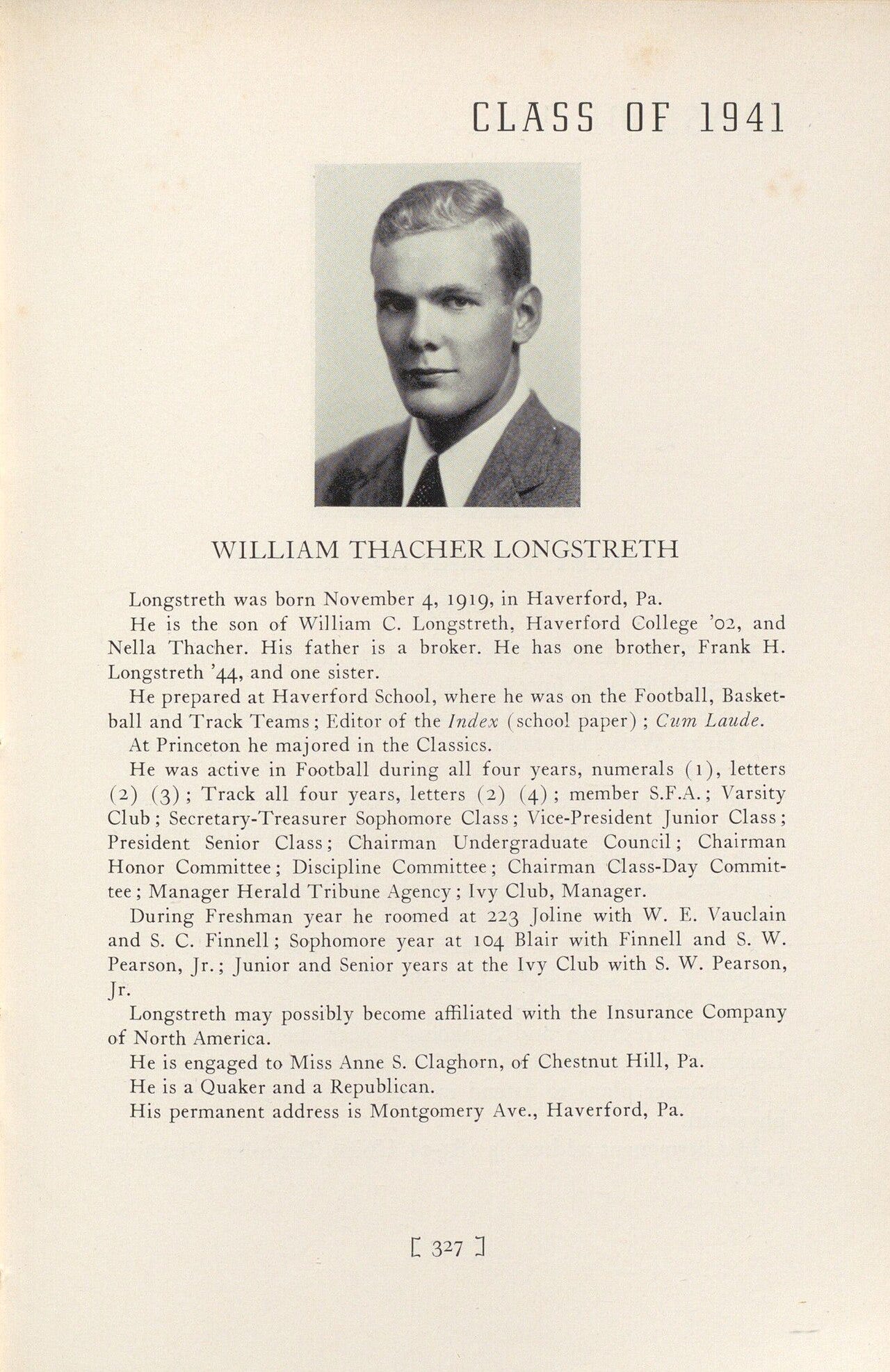

Graduating in 1941 as the senior class president, he took the physical to join the Navy and followed the rules by not wearing corrective lenses. They rejected him due to his eyesight, so he went to another location, surreptitiously wearing his contacts, and passed, allowing him to serve in the Pacific aboard the U.S.S. Wasp, an aircraft carrier, earning two Bronze Stars for bravery.
After the war, he worked in advertising and real estate, was president of the Philadelphia Chamber of Commerce for years, and twice ran as the Republican nominee for mayor of Philadelphia, losing both times.
For 35+ years, he attended every Princeton home and away game, until illness came his way. Longstreth passed away in 2003 at age 83, but never lost sight of his love of Princeton or the joy of telling tales about the days when he first saw the light on the gridiron.
If you enjoy Football Archaeology and are not a paid subscriber, consider buying me a cup of coffee now and again. You can also buy a paid subscription or purchase one of my books.

