

You should rewatch Nate Bargatze’s skit as George Washington at Valley Forge in 1777 before reading this story.
Soldier: “Why not use meters and kilometers?”
George Washington: “We will, soldier. But only in certain unpopular sports like track and swimming. For popular sports like football, we will use yards.”
On February 3, 1912, the NCAA’s Football Rules Committee reduced the size of the playing field from 110 yards to 100 yards by eliminating the 55-yard line. They also appended 10-yard end zones at each end while maintaining the field’s 160-foot width. With those changes, the American football field reached its current dimensions, but that leaves open the questions of how the field’s original dimensions came about and why several changes occurred along the way.
Like Nate Bargatze answering some questions with, “Nobody knows,” we’ll use the same response for a few questions, while answering others.
We inherited the original American football field from rugby because early American football was rugby, aside from a few tweaks to the English Rugby Football Union (RFU) rules. Back in merry old England, rugby fields varied in size based on the available grounds, though they were reasonably consistent by custom.
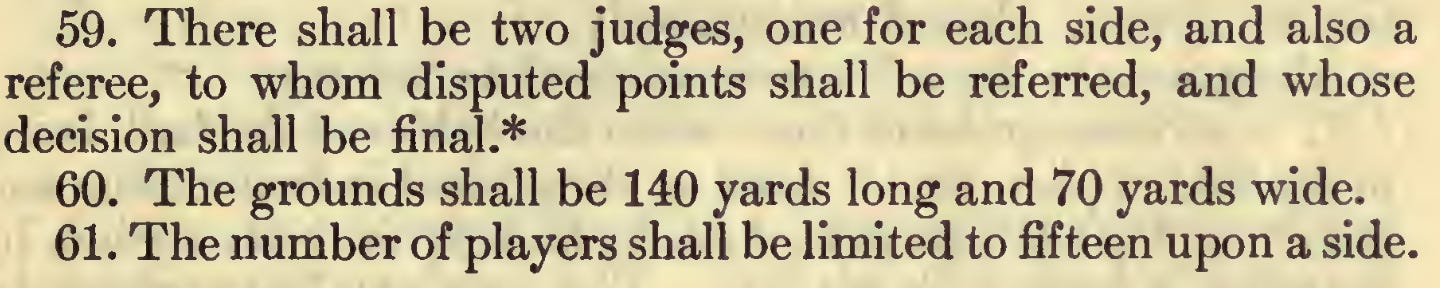
America’s early rugby or football players thought rugby’s rules lacked specificity, so while the Inter-Collegiate Football Association adopted most of the 1876 Laws of Rugby verbatim, it modified and added a few. Among the additions was Rule 60, which defined the field as 140 yards long and 70 yards wide, which means they specified the American football field before the RFU defined its field.
Despite making a few changes, American players were not looking to create a new game, only to adapt rugby’s rules to their preferences. Every rugby ball used in North America came from England, so there was likely communication among English, Canadian, and American rugby enthusiasts, when the Americans shortened their football field to 110 yards in 1879, three weeks before the RFU defined their field’s dimensions:
“The ground shall not exceed one hundred and ten yards in length, nor seventy-five yards in breadth.”
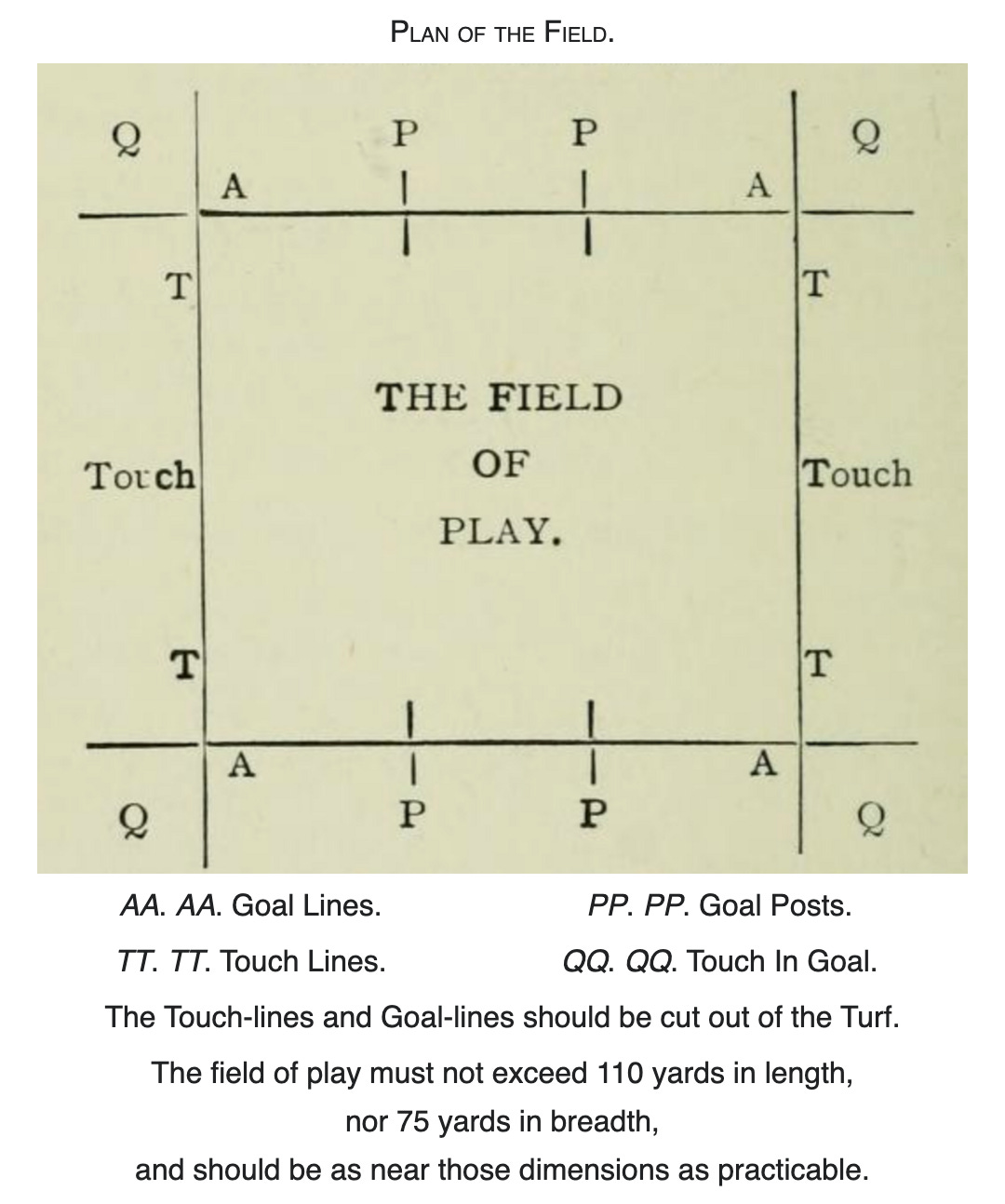
While the American players opted for a field that was only 160 feet wide (compared to the RFU’s 225 feet), let’s look at why both groups chose 110 yards as the field length.
Part of the answer is that the 110-yard field suited the game they played, but why did they choose 110 yards rather than, say, 100? The reason is that the 110-yard field is an artifact of the 1620 invention of the surveying chain by mathematician Edmund Gunter. Gunter’s chain consisted of 100 links that combined to reach 66 feet or 22 yards long.
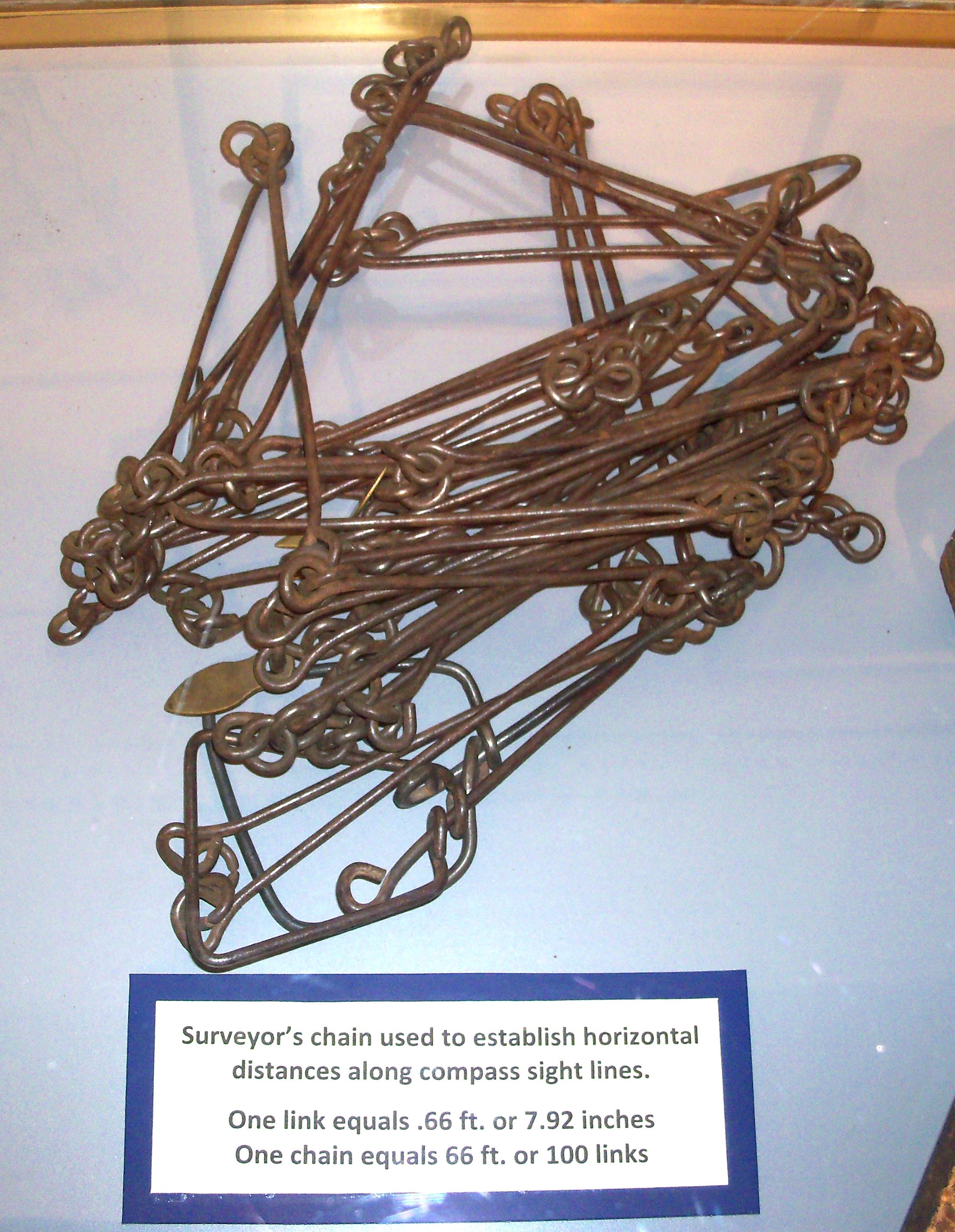
Why would Gunter create a surveying system based on a distance of 66 feet? He didn’t. He accepted as given a centuries-old system of measuring fields by a furrow’s length, known as a furlong, which was 660 feet (220 yards). Gunther’s 66-foot chain was one-tenth of a furlong’s length, and since the chain’s 100 links made surveying more precise, it became the standard surveying tool in England and many of its former colonies.
We deal with the aftereffects of furlongs every day. A square furlong is 220 yards by 220 yards, which we call an acre. Furlongs and acres were so ingrained in English thinking that, despite the Romans logically defining a mile as 5,000 feet, the Brits redefined a mile as 8 furlongs or 5,280 feet, leading to each square mile equaling 640 acres. Why did they do this? Nobody knows.
Since the chain was a standard method of measuring fields in 1870s England (and the U.S.), both locations defined their rugby and football field lengths at five chains. Since five chains at 22 yards apiece produced a 110-yard field, that’s what we ended up with. George Washington’s prediction proved correct in the long term. Americans use meters in track today, but for many years, we ran the 110-high hurdles, the 220-yard dash, the 440-yard dash, and the mile and two-mile runs.
Now that we know why our 100-yard football field started at 110 yards long, why is the field 160 feet wide? Documentation from the era is sketchy, but the traditional explanation for America’s narrower field suggests that football narrowed its field in response to the 1880 rule changes that reduced the number of players per side from 15 to 11 and adopted the system of downs. That narrative argues that since Walter Camp proposed the 11 per side and “system of downs” rules changes, he was likely behind the smaller field size as well.
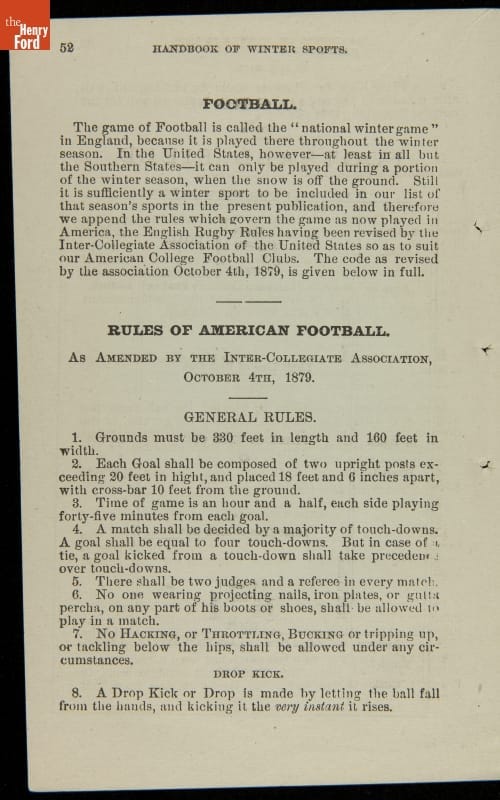
The problem with that explanation is that Parke H. Davis’ 1911 book shows that Camp proposed an enlarged field (400 x 200 feet) in 1879, which the IFA rejected. During the same meeting, they approved the 330 x 160 feet field, as shown by rule #1 in Chadwick’s Handbook of Winter Sports.
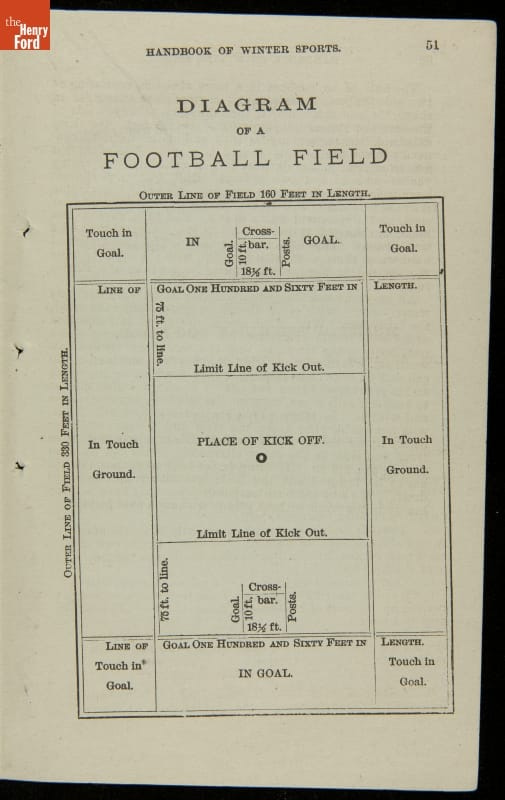

Likewise, a New York Daily Herald article covering the November 1879 Yale-Princeton game states that they played on a field measuring 110 yards by 160 feet.
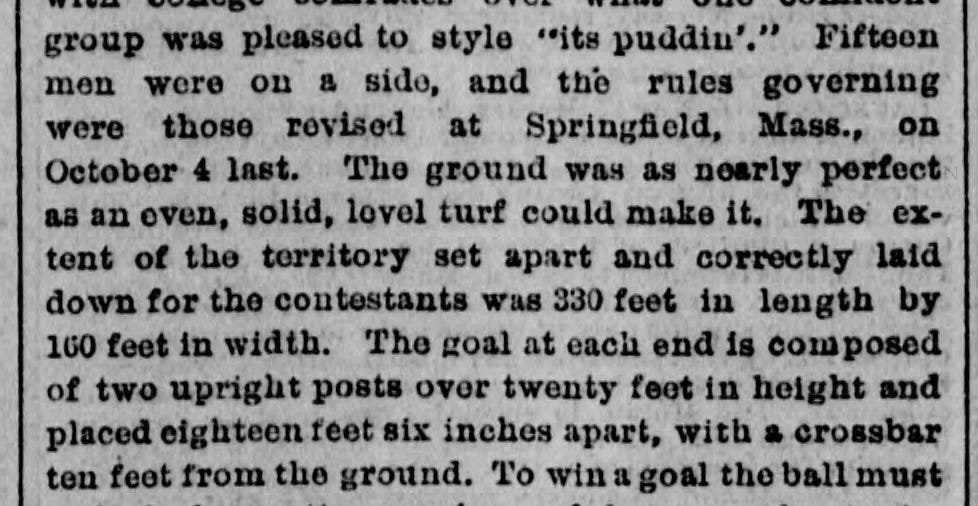
Clearly, the IFA approved and used the 160-foot wide field before the 1880 rules changes that reduced the number of players per side and created the downs-based game, so the traditional explanation goes out the window. Which leaves the question of why they chose a 160-foot-wide field, and the answer is, “Nobody knows.”
The rationale for reducing the field length from 110 to 100 yards in 1912 is much more straightforward. That year’s Rules Committee wanted to enhance teams’ ability to throw the forward pass. Previously, forward passes that bounced or flew across the goal line were touchbacks. To allow passes to be caught behind the goal line while also limiting their depth, the rulemakers added end lines 10 yards behind the goal line, thereby creating the end zones.
With two 10-yard end zones added to the field, the field was too long to fit in some key stadiums, so they eliminated the 55-yard line, leaving the game with a 100-yard field of play. The 100-yard field is a beautiful thing, combining the yardage of the British Imperial system with the decimal-like logic of Edmund Gunter.
Of course, if anyone knows or cares to speculate about the rationale behind the 160 field width, please have at it in the comments below.
It’s never too late to buy a last-minute gift, so add one or more books to your holiday lists. Make yourself and others merry.

Note that Canadian Football was a direct descendent from their RFU - and kept the same sized Rugby field for gridiron football. And they only reduced from 15 to 12 players. But they are now changing the CFL field to 100 yds. length keeping the same rugby-sized width. With that change they are also shrinking the end zones from 20 to 15 yds and putting the goal posts on the end line like in the U.S. version. So the only thing left even resembling gridiron football with goal posts on the goal line is League Rugby (such as the Australian NRL) with 13 players to a side and 6 “downs”.
If the field width was reduced by the same percentage as the length, the field would be 55-yds wide, or 165 feet, i.e. maintaining a 2-1 ratio of length to width.
I don't recall seeing a rationale for settling on 160-feet (https://open.substack.com/pub/jamesleegilbert/p/evolution-of-college-football-fields?utm_source=share&utm_medium=android&r=1hylf2), but it's possible a measurement ending in '0' was preferred over one ending in '5'. So why not 170 feet? I don't know.
That's very good info about the chains. I wonder if there's any mention of a pre-1912 football as almost an 1/8th of an acre.