
William Fellowes Morgan and Football's 1882 and 1884 Rule Books

Okay, fellow football history dorks. Raise your hand if you are familiar with William Fellowes Morgan and his role in football history.
I admit both my dorkiness and an ignorance of William Fellowes Morgan, which ended several days ago. Searching for information about Morgan led to yesterday’s story about the 1882 British Football Club and its attempt to convince the American football community to right its wrongs by returning to playing by rugby rules.
Now, about Captain Morgan, an honorific he earned as captain of Columbia’s football team in 1879. I learned of his role in football history while conducting my periodic search for early college football rule books. If you believe, like me, that American football, and American college football specifically, started in 1876 with the IFA’s slightly bastardized adoption of the Rugby Union rules, then the 2026 season will be the game’s 151st. Since the NCAA has not yet released its 2026 rule book, we have enjoyed 150 sets of rules to date, each of which shows how people believed the game should be played at the time, making each rule book a time capsule of the game for that year.
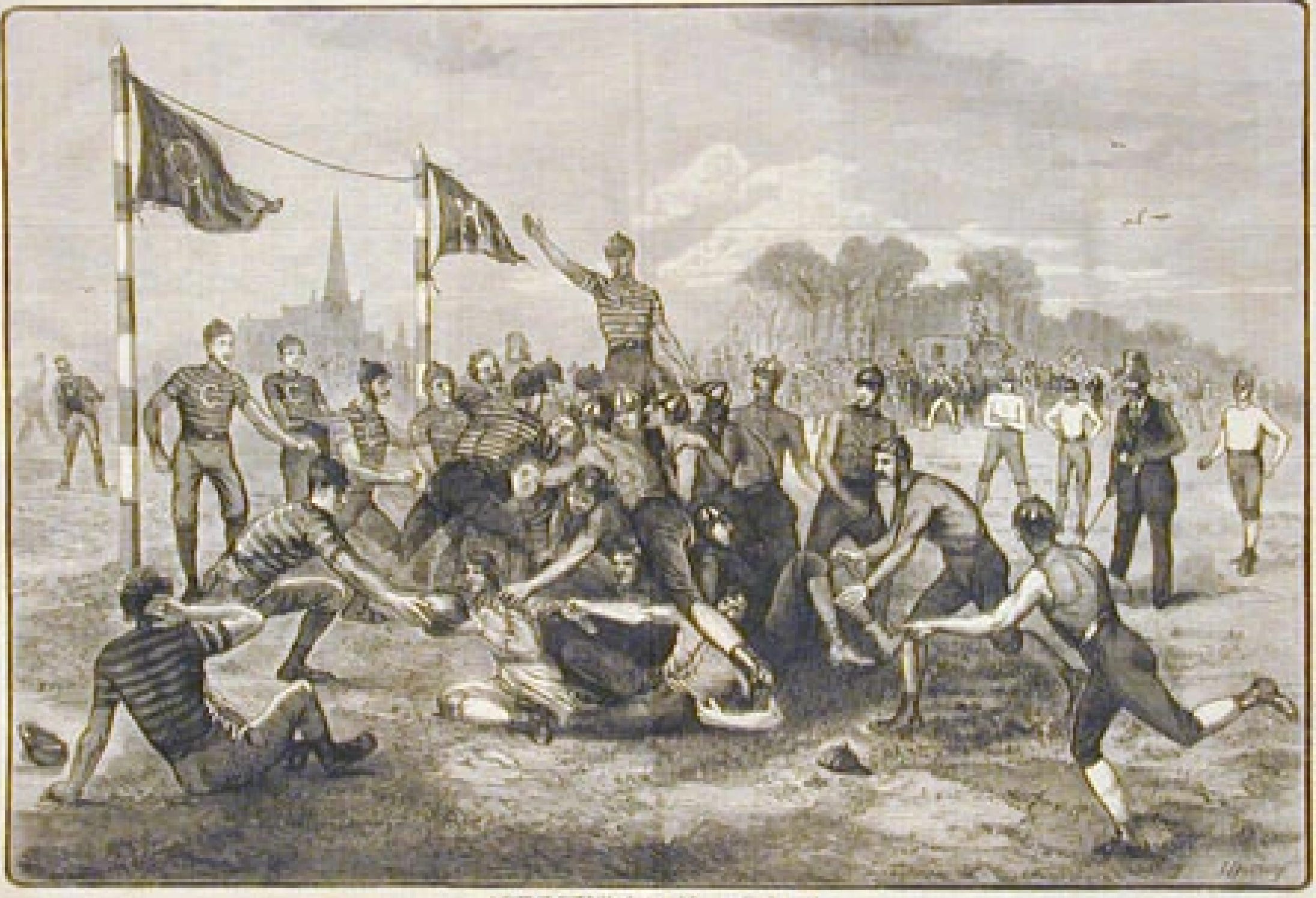
One of my life missions is to collect a copy of each of those 150 rule books. To date, I’ve sourced them by buying printed copies of Spalding’s Football Guides and their descendants. I’ve picked up a few from 1800s newspapers, which sometimes printed the full set of rules, since they were much shorter than today’s. I’ve also downloaded PDF versions of 1800s rule books from the Library of Congress, which is about the only affordable way to acquire them, and the 2000s, which is the only way the NCAA seems to have issued them.
In one form or another, I have “printed” copies of 127 of the 150 college rule books to date, and am missing the following years:
1877-1978, 1880-1881, 1884-1887
1985-1991, 1993-1995, 1997, 1999
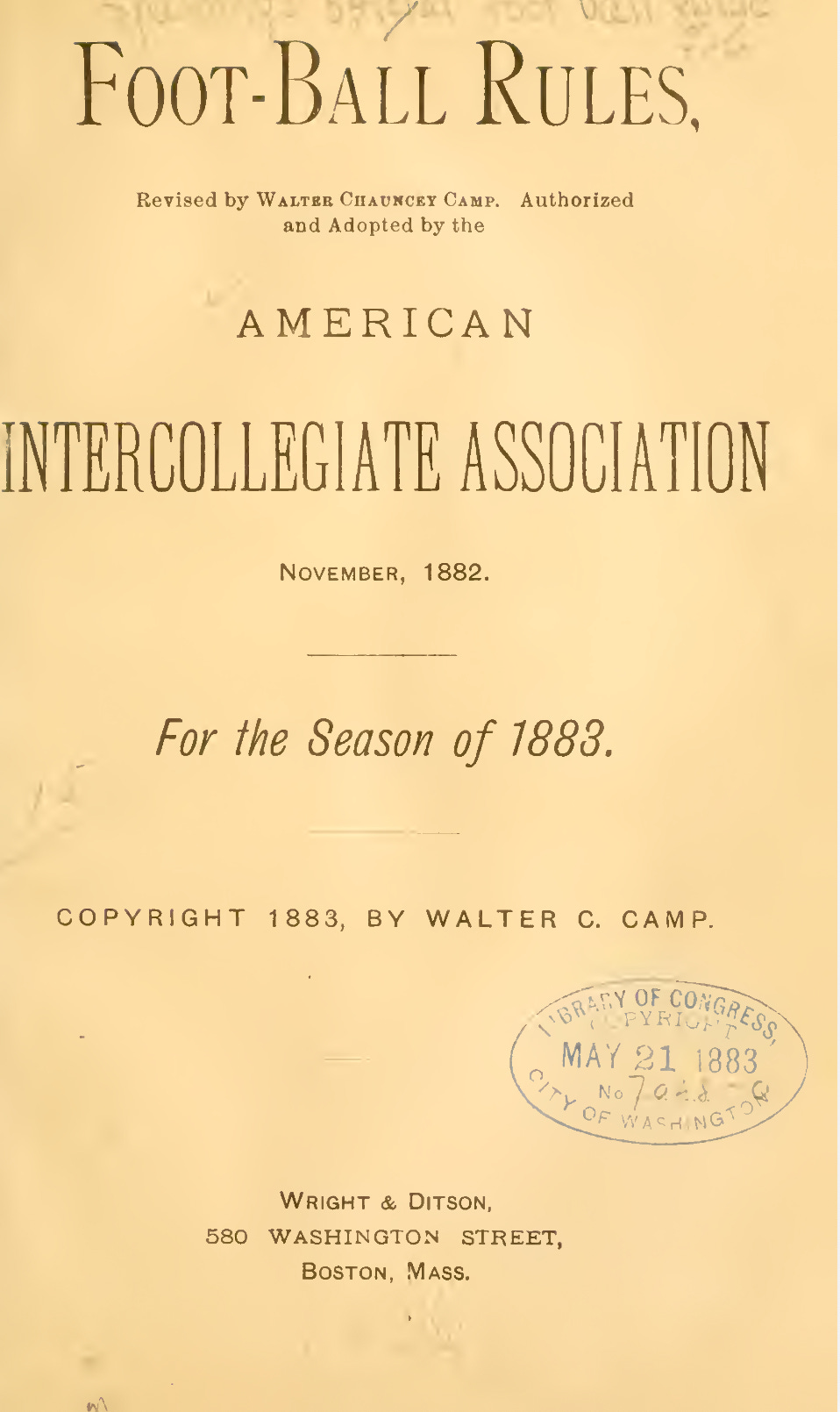
So, my periodic search led me to take another look at the 1882 rules issued by the American Inter-Collegiate Association (aka the IFA), and I noticed that William Fellowes Morgan, the previously identified Columbia captain, had copyrighted them.
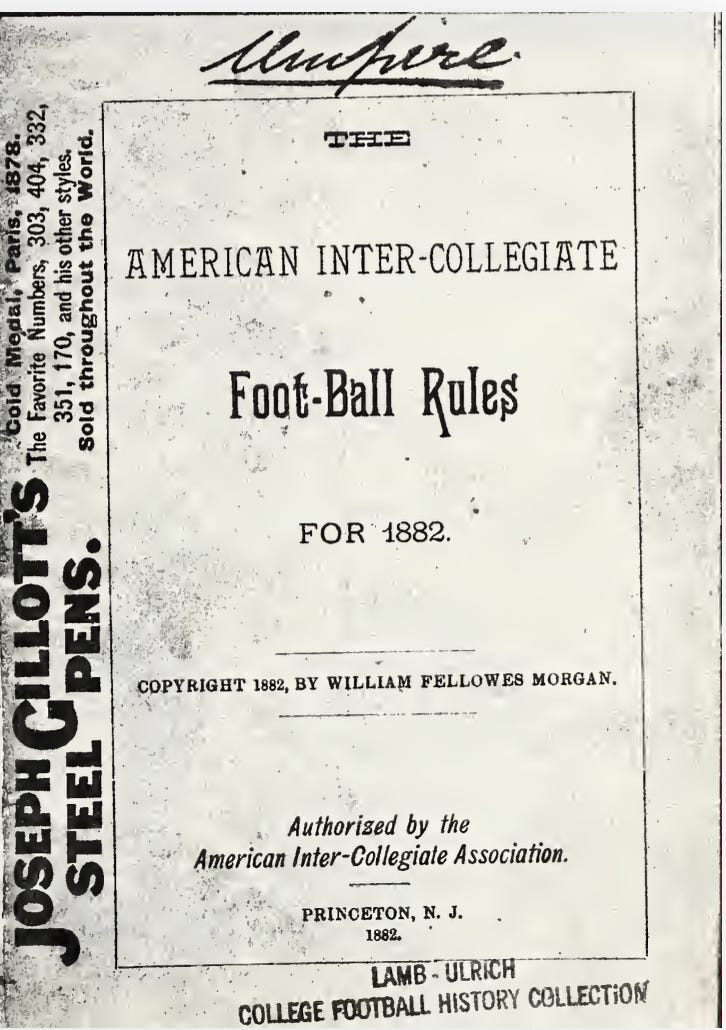
The IFA members named Morgan its secretary that year, so he was responsible for recording their meeting minutes, handling the association correspondence, and publishing their rules.
Having never heard of the guy, I looked into him and found that he came from a prominent family and apparently spent at least one year attending Rugby School in Rugby, Warwickshire, England. Morgan enrolled at Columbia in 1876 and joined the football team, which did not win a game against Harvard, Yale, or Princeton during his four years, though it beat Rutgers, Penn, and the Stevens Institute.
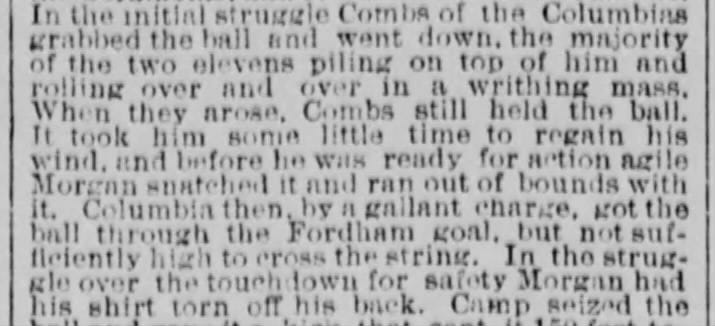
Playing under the 15-player rugby rules of the time, he variously played halfback, three-quarterback, or fullback, and was often cited in newspaper reports as a splendid runner. One report of a May 1878 game with Fordham described him running with the ball after snatching it from a winded teammate, though it was for naught, as Columbia failed to kick it over the string. (Early crossbars were often a length of rope between two posts.) He suffered the indignity of having his shirt torn off his back later that game.
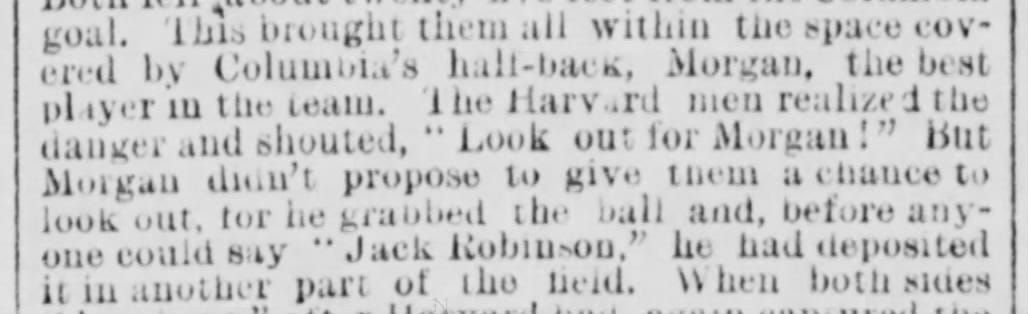
Morgan attended graduate school at Columbia after that, which allowed him to play two more years with the boys, when they still considered him Columbia’s best, as seen in a report from their November 1882 game with Harvard.
So, Morgan is a guy you and I have never heard of before, yet he issued football’s rules for the 1882 season. Who took his place as secretary and issued the rules for 1883? Someone named Walter Camp.
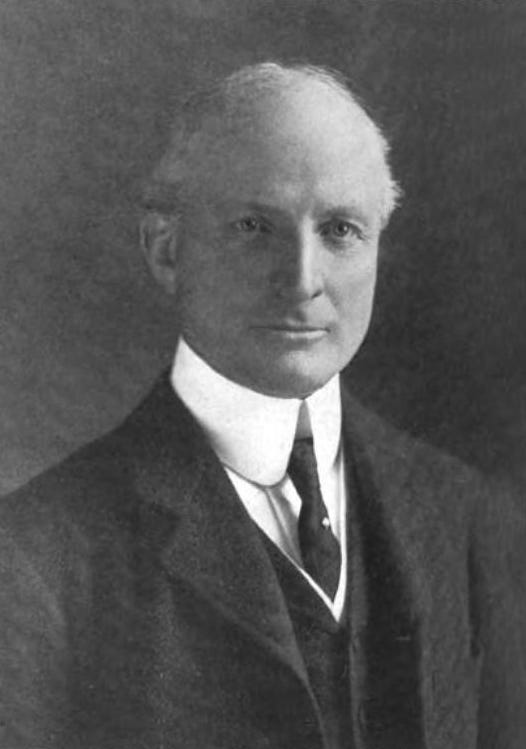
Morgan left the football scene after the 1882 season, eventually making a fortune in the emerging fields of refrigeration and cold storage. Outside the workplace, he held numerous leadership roles in amateur tennis and golf, served as a trustee at several colleges, and was president of the National Society for the Prevention of Blindness.
I’ve told you almost everything I know about Morgan and the 1882 Rule Book, but the same search process that brought me to Morgan also led me to the 1884 Rule Book, which was the second edition published under Camp’s name. It is one of the years I have not found in a printed edition, but the search helped me discover that the Library of Congress has a copy of the 1884 rules. For one reason or another, they have scanned only the title page, not the full edition, so it is not available to the public, as are many early rule books.
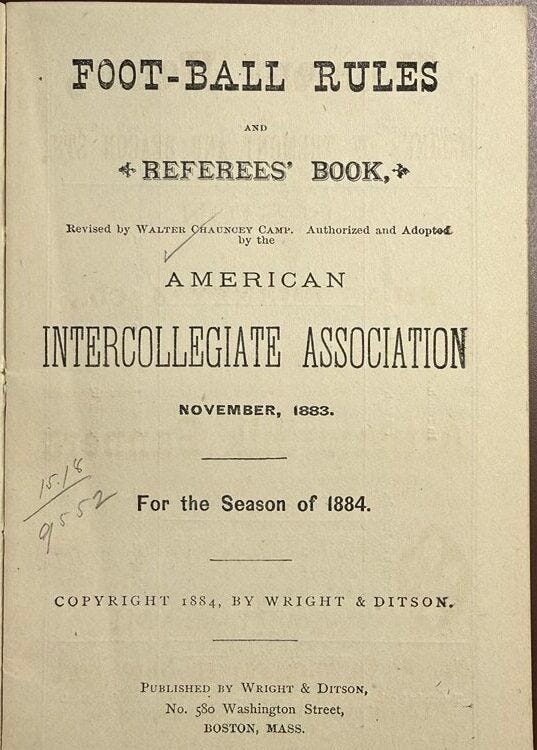

My searches have not identified anyone else with an edition of the 1884 Rule Book, so I contacted the Library of Congress to determine the cost of scanning the 1884 rules. After receiving quick, informative replies, I learned it will cost $200 to $250. As much as I would like a PDF of the 1884 rule book in my computer’s grubby little hands, I am unwilling to pay that freight, so I’ve decided to crowdfund the effort.
It would be great to help the Library of Congress share this document with the world, and I am asking readers (especially those who are not paid subscribers) to pony up for this effort. Whether you get a new paid subscription ($5/mo or $50/year) or donate through Buy Me A Coffee ($3 at a time), I’d like to raise the money to make this document available to everyone.
Once the Library of Congress scans it, I’ll encourage them to make it available (or I will do so). I will also come back with a story about the rule changes and the 1884 season, which will surely be among my most scintillating efforts to date.
What do you say?
Postscript
Bill Claypool alerted me to the fact that almost all the missing 1980s and 1990s rule book PDFs are available on the NCAA site. They appear to have added some recently, and I was not searching the database correctly.
The running total as of April 29 is three new annual subscriptions and 8 coffees for $214.00
Thanks, Vasav, Andrew, Chris, Billy, Steve, and another anonymous coffee buyer.
To support scanning the 1884 Rule Book, grab a new paid subscription or buy me a coffee or two.


In the Fall of 1988 I made a tour of several significant research sites, as well as meeting Hamilton Fish in his Park Avenue digs. I began in Washington at the LoC, bleary after a red-eye flight. In trying to explain my needs to the desk clerk, he said--ahem--'This sounds like a fairly esoteric subject'. (Football?) 'Here ..' He gave me a stack pass! Beautiful little thing; 'still have it. The experience was altogether overwhelming, but the collection alarmingly small. I wish I'd known ..
W. F. Morgan had a brother, David Percy Morgan, who I believe played for Princeton and was also on the rules committee in 1882 (see Parke Davis's book, page 469 - listed as D.F. in April 1882 and D.P. in October 1883). Their father was a very prominent New York banker, but was only distantly related to J. P. Morgan. I think only rich kids had both money for college and time for football.