
How Roughing the Passer Came, Went, Returned, and Expanded

Quarterbacks are a protected species nowadays, but that was not always the case. For many years, football’s rulemakers thought passers deserved no more protection than anyone else on the field, and, perhaps, even less. Other years, they changed their minds, so the roughing the passer penalty came and went several times in the early days. It was not institutionalized until the more commercially oriented NFL recognized that fans paid to see star halfbacks and quarterbacks throw the ball, leading it to take steps to ensure passers remained on the field, doing so 40 years before the colleges.
The 1906 rules that legalized the forward pass did not include protections for the passer, and sinc the original rules also allowed pass interference, it is not surprising that passers went unprotected.
Still, from early in the forward-passing era, some argued that passers should receive protection for much the same reason punters gained additional protection. As shown in the article linked below, punters earned that protection in 1903, though not for the obvious reasons. Instead, football still had rugby-inspired rules allowing members of the punting team who were behind the punter at the time of the kick to run downfield and recover the punt. In addition, when the punter ran downfield, any teammate he passed also became eligible to recover the punt. To prevent punters from running downfield and putting teammates “on side, receiving teams beat up or “roughed” punters to keep them from going downfield.

When football eliminated the kicking team’s punt recovery options in the early 1920s, the roughing the punter penalty took much the same form as it exists today (i.e., running into versus roughing). Passers were protected only by the unnecessary roughness penalties covering everyone on the field, but it took some severe roughness for the referee to call the penalty.
The first attempt to protect the passer separately came in 1914, when they made intentional grounding illegal and created a 5-yard roughing the passer penalty by adding it to the existing roughing the punter penalty.

Unfortunately for the pill tossers, that protection went away in 1917, so teams once again made it a point to hit the passer at every opportunity, hoping to remove him from the game or affect his accuracy.
Running into and roughing the passer returned as penalties in 1920, the same year they made clipping illegal. Despite the NCAA rule, the Big Ten decided in 1922 that there was no need to protect the passer more than other players on the field. Each player was responsible for protecting himself. The NCAA followed suit a few years later, removing the roughing the passer penalty while specifically naming passers under the general rule against roughing players who are clearly not involved in the play. Even that special mention went away in 1928, and college rules explicitly protecting the passer did not return for five decades.

The reluctance to keep the roughing penalty likely stemmed from the nature of football at the time. The T formation dropback quarterback did not yet exist; while teams had their best passer throw the ball most of the time, multiple backs threw it, and everyone played defense. The highly specialized positions in modern football did not yet exist, and punishing the other team’s best thrower was an accepted game strategy.
The modern view of protecting the passer emerged in the 1938 NFL, with Sammy Baugh often credited with inspiring the rule. Baugh led the Washington Redskins to the 1937 NFL championship using his arm and punting leg. Seeing the potential for more entertaining play, the league eliminated several restrictions on forward passing in 1938 and beyond. It also made roughing the passer subject to a 15-yard penalty to help protect the league’s assets and resulting ticket sales.
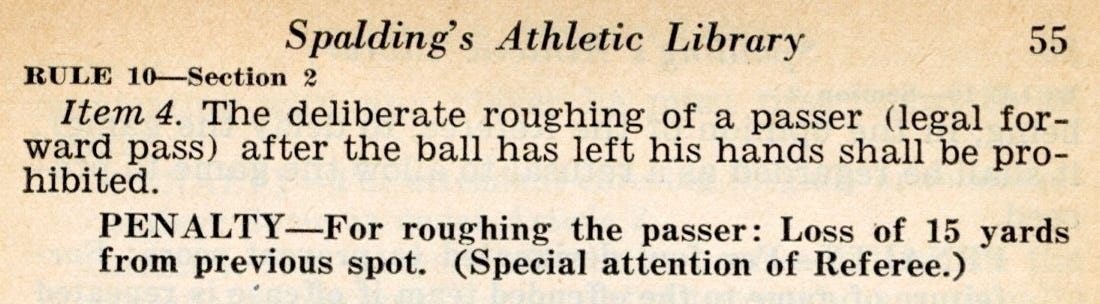
The NFL’s enforcement of the roughing-the-passer penalty also changed during this period. Initially, roughing the passer was a spot foul, which caused problems when quarterbacks dropped back and scrambled. At times, they were roughed so far behind the line of scrimmage that enforcing the penalty would have left the team behind the original line of scrimmage, so they enforced the penalty from the previous spot. By 1945, the NFL tacked the roughing the passer penalty onto any yardage gained on the play.
After dropping mention of the passer in 1928, the NCAA did not give passers explicit protection again until 1979. Until that time, players, fans, and reporters sometimes described certain penalties as examples of roughing the passer, but they were personal fouls that went beyond the pale.
In 1979, the NCAA described roughing the passer within the personal foul rule as follows:
o. No defensive player shall charge into a passer when it is obvious the ball has been thrown.
The NCAA added the roughing the passer penalty signal in 1981.
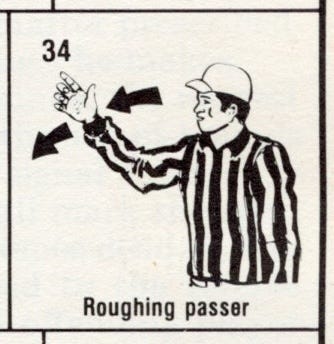
The NCAA has since combined numerous penalties under the personal foul umbrella, including roughing the kicker, holder, and passer, so the penalty now has equal footing with others. Beyond roughing, the quarterback has gained additional protection against hits below the knees, above the shoulder pads, and when sliding. They can also intentionally ground the ball in various situations today. So, times have changed: quarterbacks receive more protection than in the past, which reduces the number of second- and third-string QBs paraded out there, so it is a good thing for QBs and fans.
Regular readers support Football Archaeology. If you enjoy my work, get a paid subscription, buy me a coffee, or purchase a book.


Suppose the passer is Ben Roethlisberger? ..
Every season in week 1 lately they throw flags for burping the Quarterback, ruining the sport. By midseason thats over with and by the postseason, QBs get ROCKED. I heard whiny guys complaining at the SB party who hadnt seen a single live snap all year probably Im like LOOK AT DRAKE MAYE after every throw! Ah, thats, uh, nothing. He's no uh, tom brady now that guy got hit a lot. Blah blah my wife doesn't actually let me watch football blah.