
Standing Tall Among AAFC Preseason Camps

Preseason or training camps away from their home locations were becoming common in the second half of the 1890s among top Eastern and Midwestern college football teams. Training camps of the time were unlike those of today. Generally camping in tents or cabins in the woods, going remote developed camaraderie as the teams entered “training,” which meant abstaining from alcohol and tobacco, while eating a restrictive “training table” diet.
Those woodsy or seaside days involved long walks and runs, plus swimming to loosen the boys’ muscles and ease them into shape for the real work that started upon returning to school. Teams often did not bring any football gear to camp, though that changed over time.

Professional football teams held remote training camps beginning in the 1930s for many of the same reasons as colleges, with the added aim of avoiding the temptations of big cities. From the beginning, most pro training camps were held at small colleges in cool, northern climes, with Wisconsin being a disproportionately popular location. Curly Lambeau even promoted other teams choosing Wisconsin at the NFL owners’ meetings in 1939, which may have helped the state teachers college in Superior land the New York Giants that year, while the Chicago Cardinals were just across the border in Duluth.
Today, we have air conditioning, which allows teams to hold preseason camp at their year-round or headquarters facilities, complete with meeting rooms, weight rooms, and other accouterments of modern football. Among today’s NFL teams, only the Dallas Cowboys camp more than an hour and change away, choosing California as their home away from home.
Mentioning California allows us to transition to 1946, the first year the NFL rival All-American Football Conference played ball. Unlike NFL teams, which had a few years of training camps under their belts, the AAFC teams were all new and choosing their training camp sites for the first time. That allowed numerous towns to market themselves as the ideal location to host 60 or so very large men with insatiable appetites for food, drink, and family-friendly entertainment.
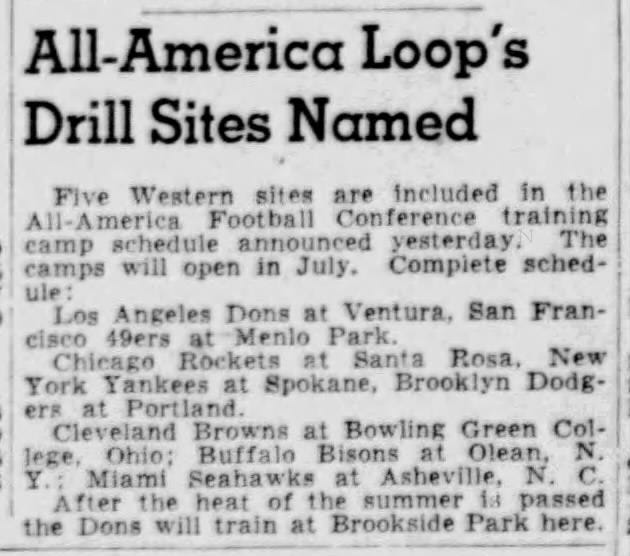
Each AAFC team made their decisions by early May. Press releases announced their camp locations. with five of the eight teams choosing the West Coast, despite only two teams calling the Left Coast home.
People in Bend, Oregon, read in the newspaper that the AAFC’s Brooklyn Dodgers were looking for a training camp location in the Northwest. The Chamber of Commerce got busy, formed a committee, and dreamed of the Pacific Northwest becoming the home of pro football training camps, much as Florida was for baseball. Their hard work and determination led to the city fathers and Bill Cox, the Dodgers’ owner, signing on the dotted line twelve days later.
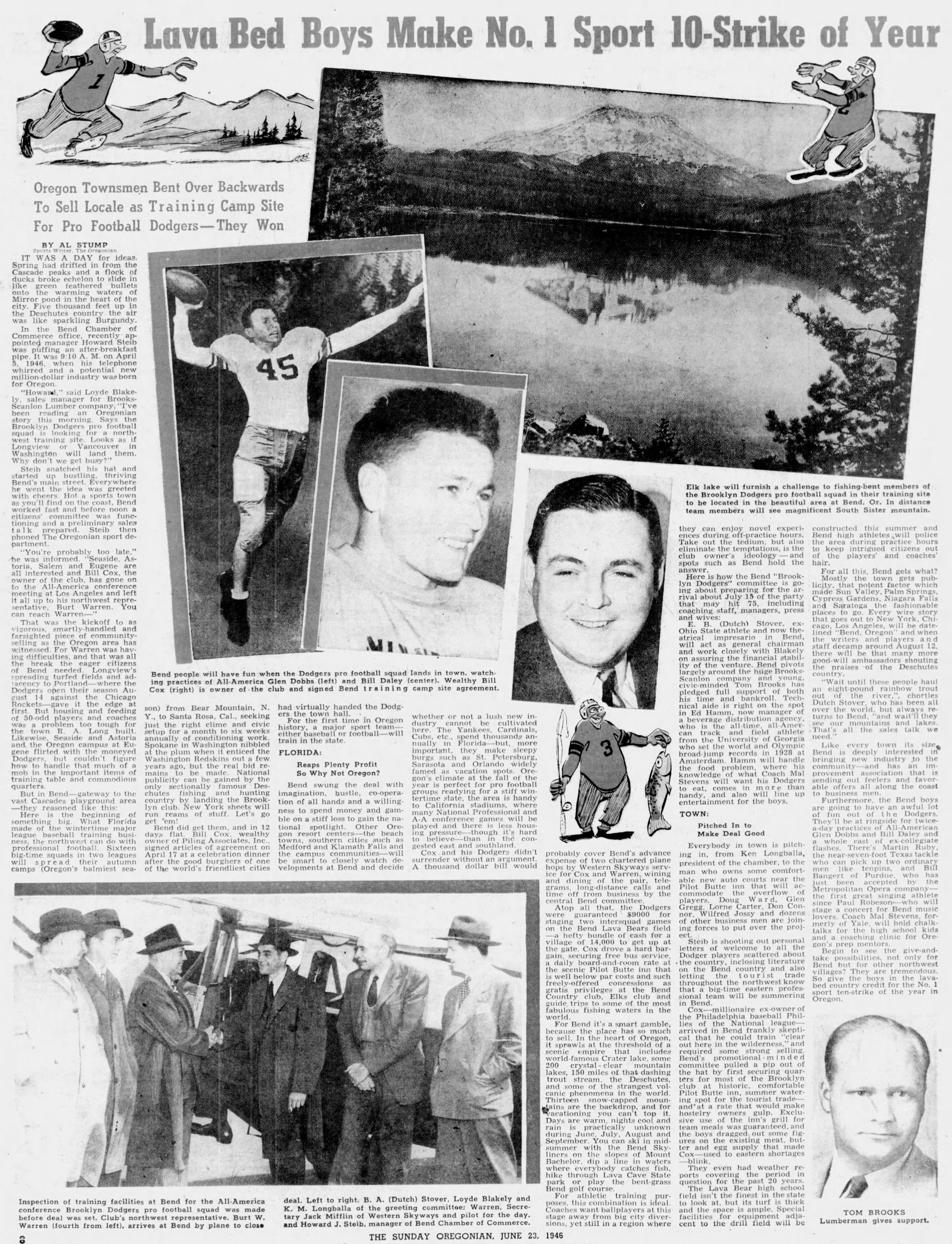
Proving themselves willing to Bend over backward, the town burghers guaranteed $9,000 in gate receipts for two intrasquad games in town, below-market pricing for the team’s stay at the Pilot Butte Inn, access to the local country club, and guided fishing trips. In exchange, Bend mostly received publicity, as newspapers across the country printed Bend, Oregon, in the byline of every story about the Dodgers. Meanwhile, the townsfolk received six weeks of excitement watching professional athletes play on the local high school field and stroll about town.
The Buffalo Bisons, who initially planned to camp at St. Bonaventure in Olean, New York, learned that the glut of returning servicemen taking summer classes at the school left no room in the inn for a pro football team, leading them to shift west to the comfy climes of Oconomowoc, Wisconsin, which the pronunciation-challenged refer to as Wisconsin Five-O.
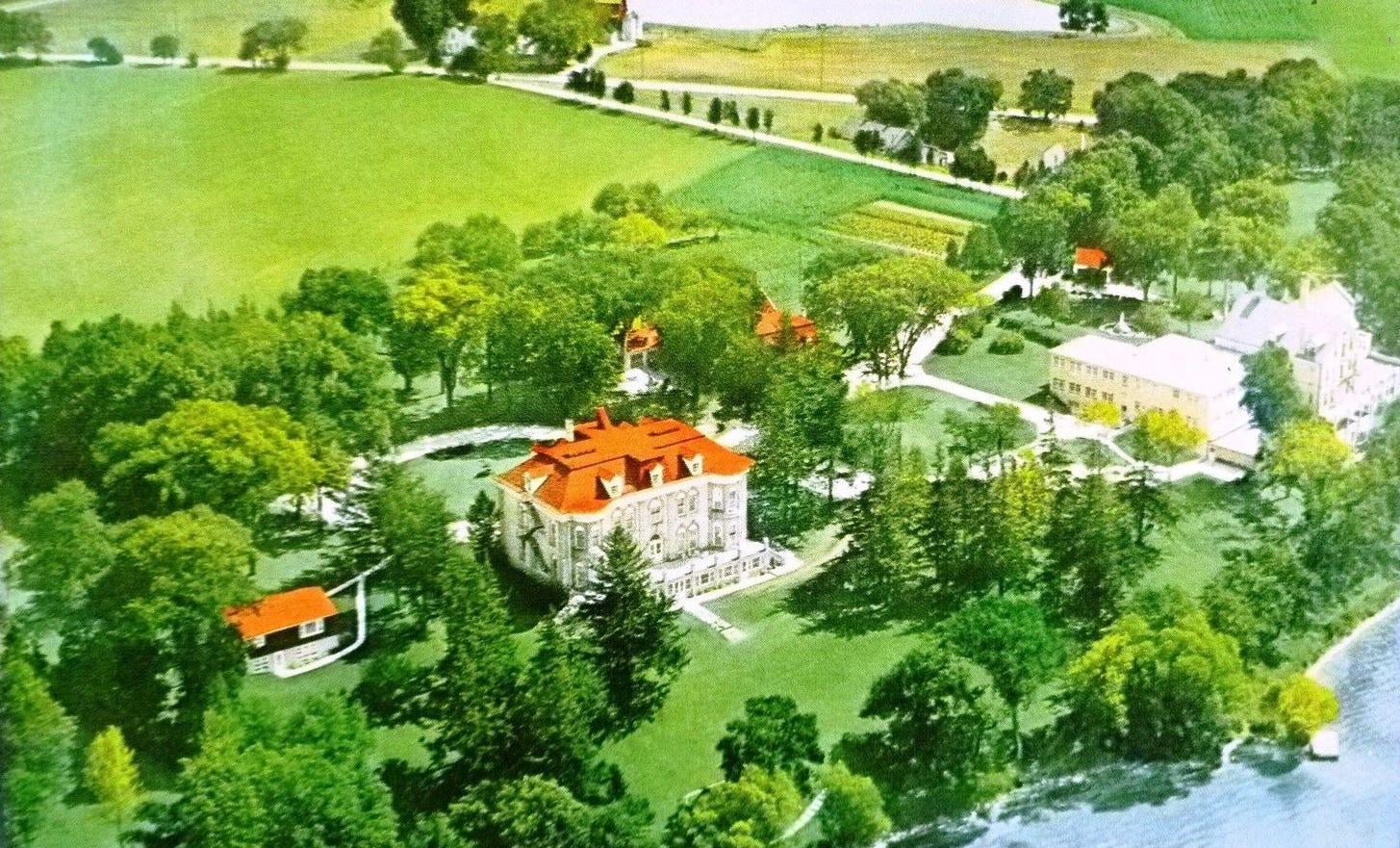
If you’ve ever wondered where in Oconomowoc you might find a home for Bison to roam, they found it at a grand home built by a tycoon on the shores of Okauchee Lake in the 1870s. The site became a hotel, then an abbey for Cistercian monks, and apparently had extra space for 65 football players and coaches in 1946. Like the good citizens of Bend, the leaders of Wisconsin Five-O bent over backward to host the team, providing access to the high school facilities and local armory.
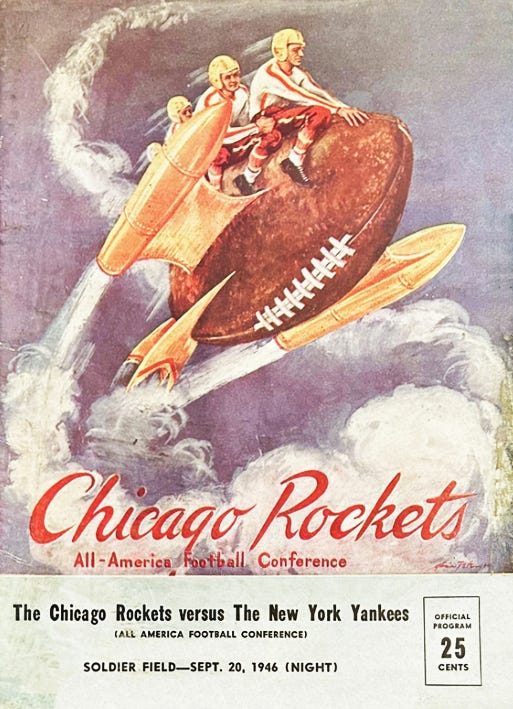
Another franchise, the Chicago Rockets, camped in Santa Rosa, California, north of San Francisco and Napa Valley, allowing them to scrimmage and play exhibition games with other West Coast teams, including the San Francisco 49ers and the Los Angeles Dons.
While Santa Rosa was a perfectly fine place to train in 1946, the Rockets switched locales in 1947, choosing Two Rivers, Wisconsin, instead. Located where two rivers empty into Lake Michigan, the town’s name is pronounced “Trivers” by locals. As in similar towns, the leading citizens of Trivers had stars and dollar signs in their eyes, envisioning that more than one pro football team might train there and spend money on facilities, food, drink, and gas. Members of the press would tag along, and others would come into town to see what the fuss was all about.
The area had previously hosted the Philadelphia Eagles, Columbus Bulls, and Pittsburgh Steelers, so adding more teams was not out of the question, but the town needed to market itself. What do you do in Trivers to sell yourself to pro football teams as the ideal training camp location? You build a roadside sign for all to see on their way into town.
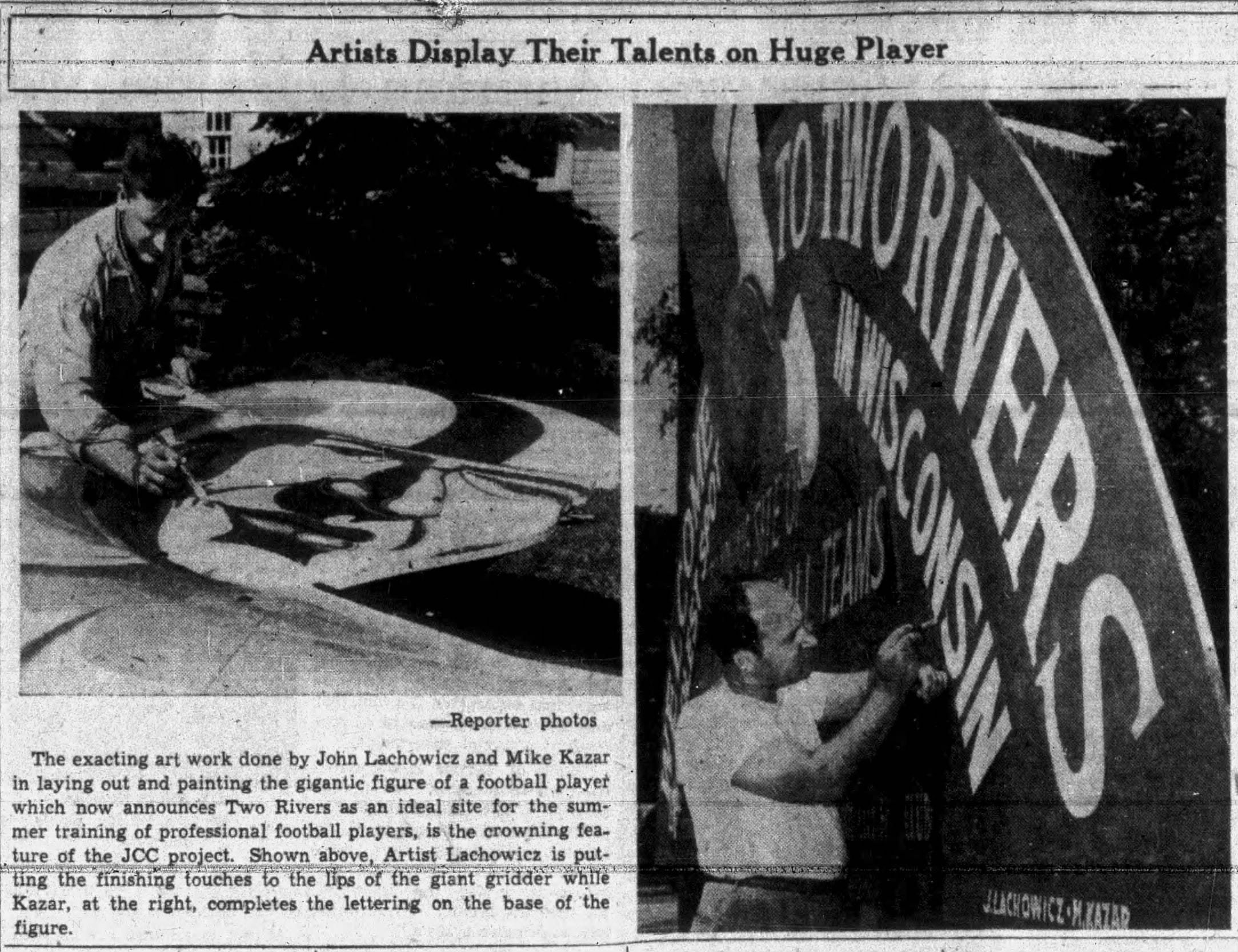
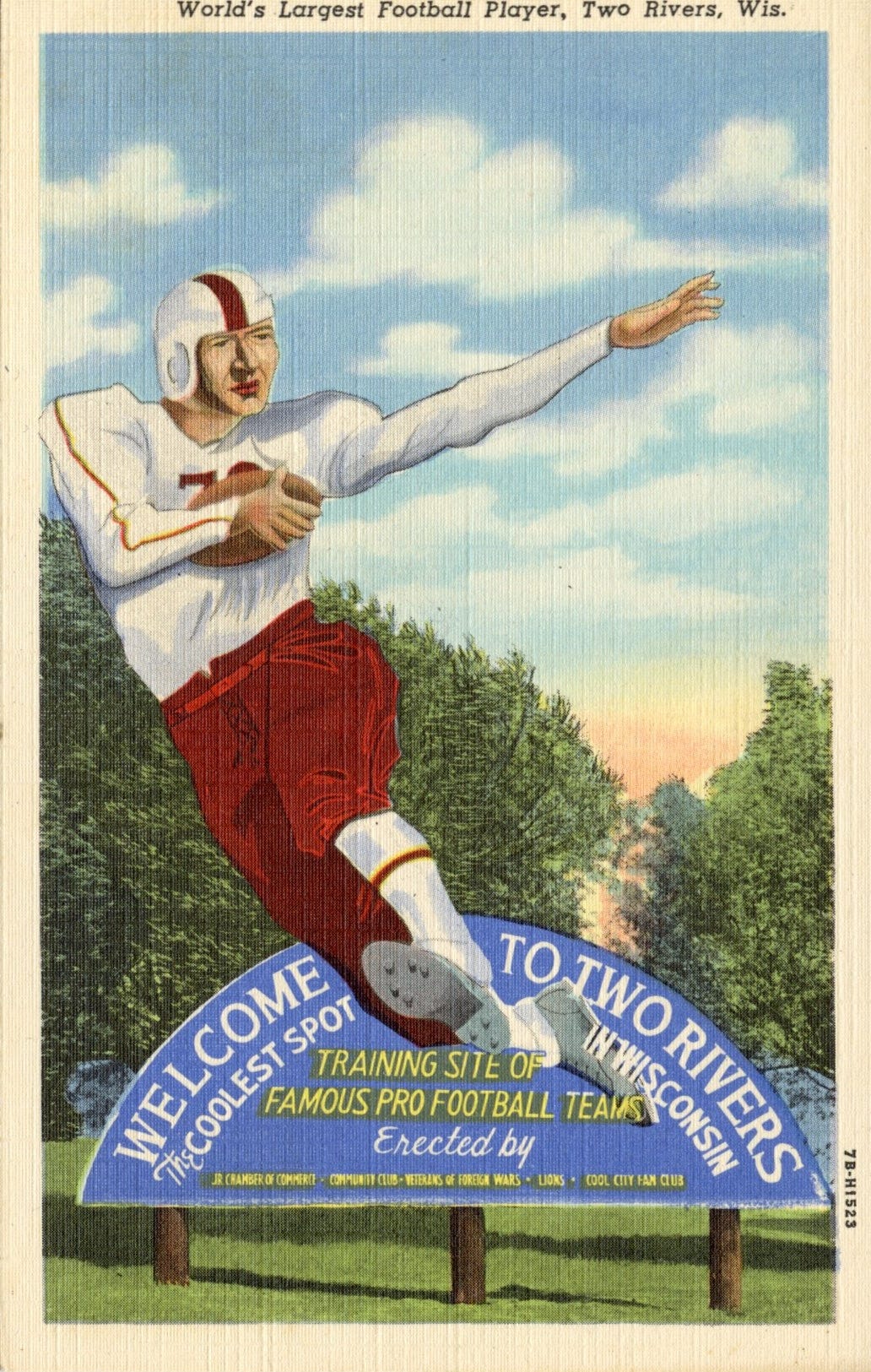
Sure enough, the Chamber of Commerce and others got together to design a sign featuring a very tall wooden football player dressed in a scarlet Rockets uniform to welcome people as they entered town.

While the sign made the unverified claim that the monster was the world’s largest football player, he stood 35 feet tall, had a 22-foot-long arm, and a 5-foot hand, so he was a pretty big boy. John Lachowicz, a city employee, managed the monster’s design and construction, ably assisted by his vacationing cousin, Mike Kazar, an art teacher at Milwaukee’s Pulaski High.
Someone also got the idea of printing linen postcards of the Trivers monster to promote the town and its welcoming attitude toward pro football teams. Luckily, one of those postcards arrived in my mailbox today, allowing me to share its full-color glory with you. Ain’t it a beaut?
Despite the welcoming attitudes of Bend, Oconomowoc, and Two Rivers, all three learned that pro football teams can be rather fickle. In April of 1947, the Dodgers announced their intention to return to Bend for camp, but a month later, Sun Valley, Idaho, stole the show.
The Buffalo Bison, renamed the Bills in 1947, opted to stay close to home that year, camping in nearby East Aurora, New York.
Despite the best efforts of the Trivers populace, the Chicago Rockets did not return to town after the 1946 season. Instead, they spent their summers in Ripon, Wisconsin. They did the same in 1949 when they had become the Chicago Hornets.
The AAFC folded after the 1949 season, and neither the Dodgers, the Bills, nor the Hornets were among the franchises welcomed into the NFL. Opportunities for small towns to attract pro football training camps were limited until the AFL arrived in 1960.
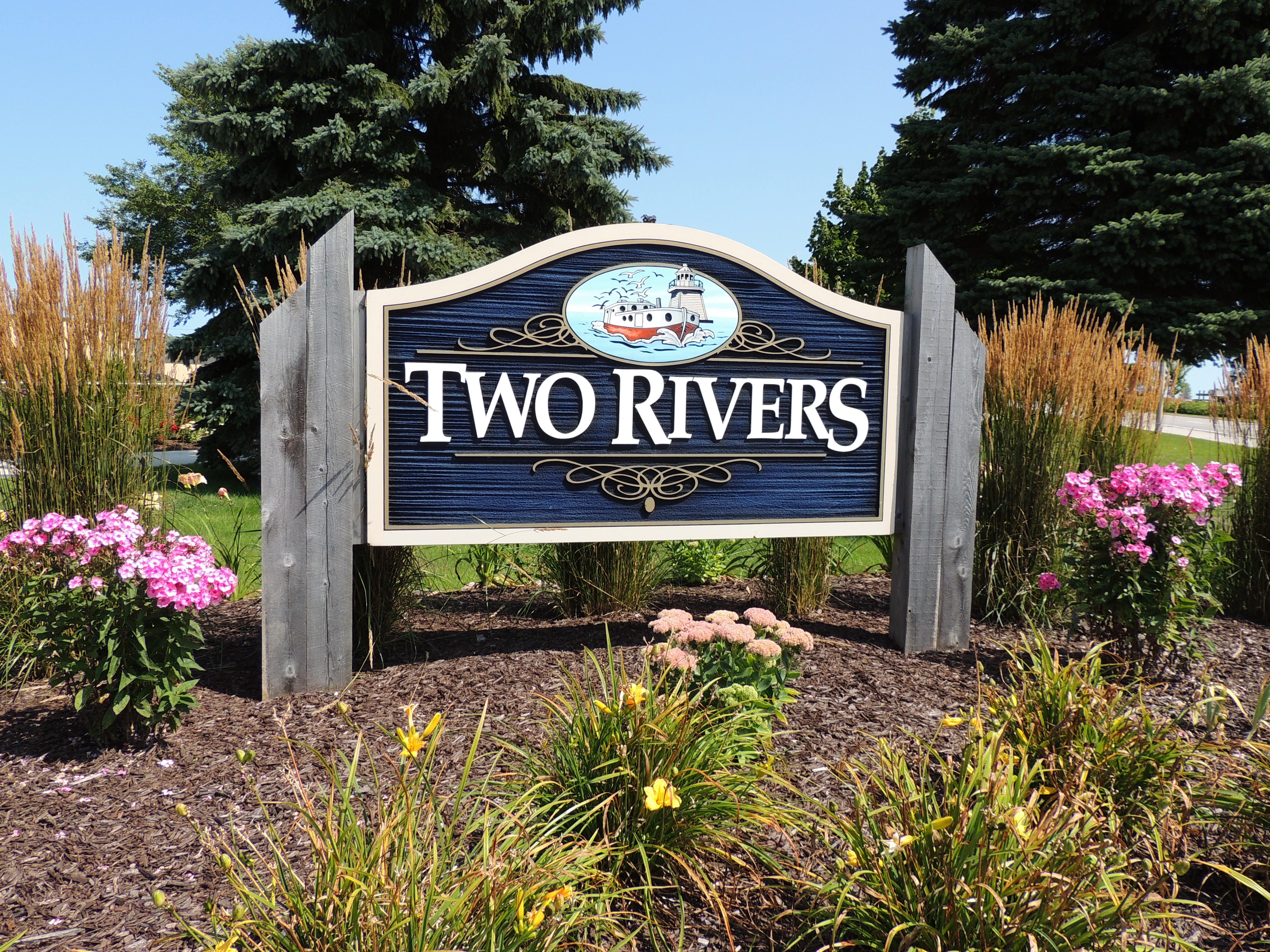
It is unclear when the world’s largest football player lost his roadside home at the Trivers city limits. The town has a new roadside sign today, which, other than the words printed upon it, is indistinguishable from the welcome sign of any other town or subdivision across the country.

Whatever you might think of the Goliath that once welcomed visitors to Trivers, he was unique and helped the town stand out from the crowd, though not enough to get the Rockets to return there after the AAFC’s second year.
Regular readers support Football Archaeology. If you enjoy my work, consider a paid subscription, buy me a coffee, or purchase a book.


I am not going to inquire if the Brooklyn Dodgers and New York Yankees of the AAFC had any relation to the same-named major league baseball teams, or if the Buffalo Bills and Pittsburgh Steelers were the ancestors of the current-day NFL franchises with those names. It seems unlikely..