
The Twists and Turns of Spotting Dead Balls

Some aspects of football are so basic, so elemental, that you forget that someone or several someones had to define rules we take for granted today. One of those areas involves where to spot the ball at the end of a play. Football’s early rules were silent on the matter, but eventually adopted a rule similar to the one used to determine whether someone scored a touchdown.
The rugby rules of the 1870s were not always clear, especially for those trying to learn the game by reading the rules. The rules had no apparent order, terms were undefined, and much was open to interpretation. The combination encouraged America’s collegians to devise their own rules, clarifying their intent and preferred style of play. Still, even America’s early rules left much to the imagination.
Where to spot the ball at the end of a play is a critical issue for a game that depends on teams progressing down the field, but there was less need for precision in the 1870s before the system of downs arrived. The game was essentially rugby, so wherever the ball went out of bounds, or someone was tackled, a player would put the ball back into play or place it on the ground to start a scrimmage. It was inexact, but rugby, soccer, and American football got along just fine without today’s measurement rigidity.
For example, the 1876 Laws of Rugby, which were the feedstock of the football rules we have today, included two interrelated rules:
9. A Touch Down is when a player, putting his hand upon the ball on the ground in touch or in goal, stops it so that it remains dead or fairly so.
17. The goal-line is in goal, and the touch-line is in touch.
So, the touchline (now called a sideline) was out of bounds, and since the goal line was part of the goal area, a player had to touch the ball down behind or on the goal line to score a touchdown.
Everyone was apparently happy with those rules, but in 1882, the rules gave teams three downs to gain five yards. Suddenly, where you spotted the ball at the conclusion of a play might make the difference between a first down and turning the ball over to your opponent. Despite the apparent need for clarity on how to spot the ball, the rules continued to ignore the issue, and everyone seemed to have played the game without problems.
Another change came in 1885 when football eliminated the maul-in. Maul-ins seem crazy now, but since players had to touch the ball to the ground to score a touchdown, the defense sometimes tried to keep the ball carrier upright and push him back onto the field of play so he could not touch the ball to the ground. Those situations were maul-ins, and their dangers led to their removal from the game in 1885.

So, how did they know whether someone scored a touchdown if they no longer had to touch the ball down? I don’t have a copy of the 1885 rules, but the 1888 rules say:
Rule 4. A touch-down is made when the ball is carried, kicked, or passed across the goal line and there held.
So, the referee credited teams with a touchdown when the ball crossed the goal line and remained in their possession. What constituted crossing the goal line is unclear, and the same mushiness applied to how they spotted the ball after each play. Of course, in their fast-paced rugby-style play, the ball carrier set the ball down, the teams lined up, and the team in possession snapped the ball. The ref generally did not intervene or spot the ball unless the teams disagreed about its location, which was infrequent.
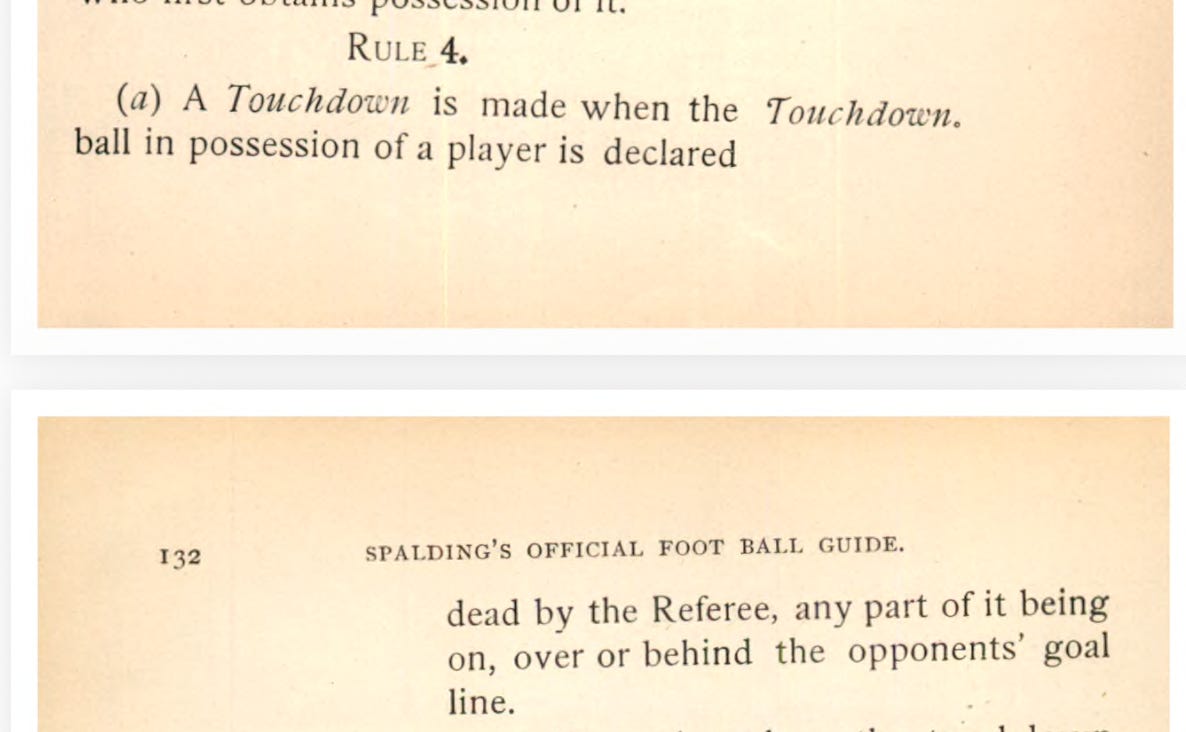
It was not until 1898 that the definition of a touchdown gained more precision with a rule stating that a touchdown occurs when the ball is on, over, or behind the goal line.
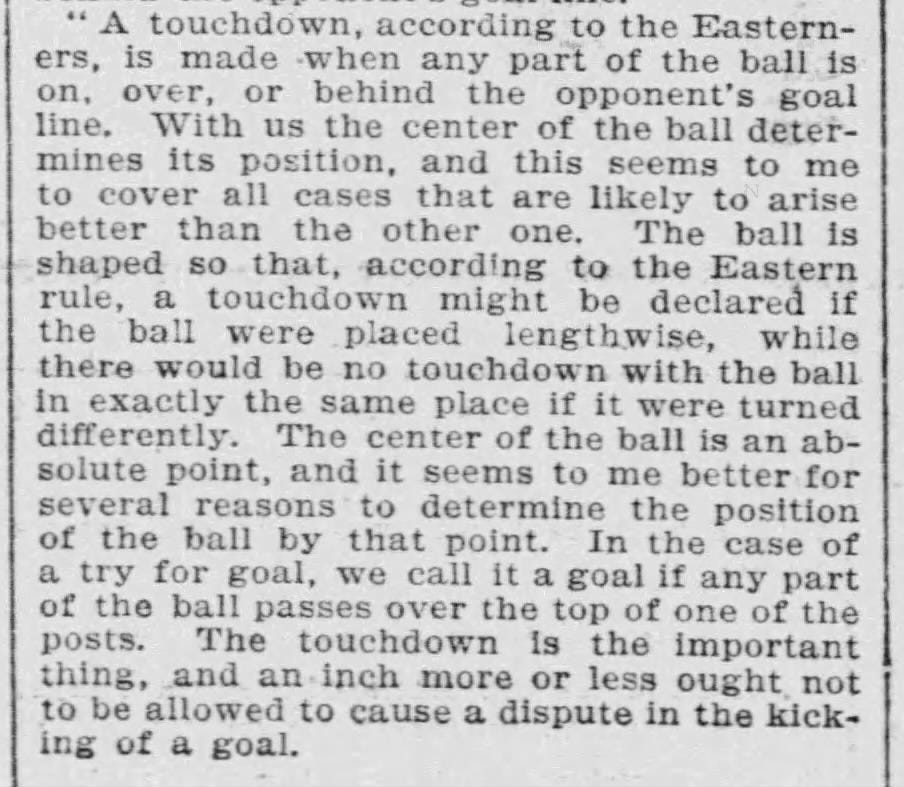
But even that led to an argument. In the late 1890s, football experienced a schism due to the Eastern rulemakers excluding other parts of the country from the rulemaking process. That led teams in the West to create their own rulebook, resulting in a few differences, including how to define a touchdown.
Amos Alonzo Stagg, a leader of the Western coaches, noted that the East considered it a touchdown when any part of the ball was on, over, or behind the goal line, whereas the Western rules based the score on the center of the ball. Stagg argued that the center of the ball made more sense, since the referee rotating the ball might make the difference between scoring or not. That may seem like a silly distinction given the error inherent in spotting the ball and locating the chains, but that was the Western position.
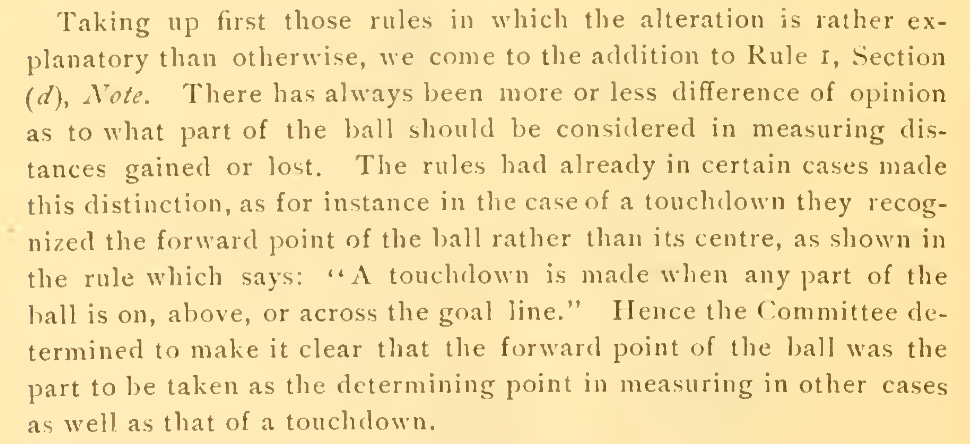
The Easterners stuck to the “forward-most” part of the ball approach. Still, in Walter Camp’s summary of rule changes for the 1900 season, he acknowledged the controversy about judging a touchdown and noted that the same logic now applied to spotting the ball in the field of play. The forward-most part of the ball determined the progress made on a play.
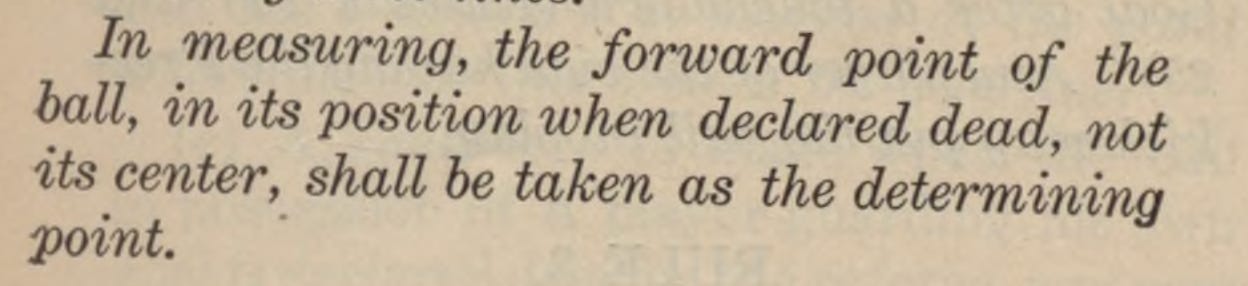
The Easterners gave in to demands for Western representation on the Rules Committee by adding Stagg in 1904. One year later, Stagg’s point about rotating the ball was adopted in the college rules, with a note stating that the referee should not rotate the ball when determining whether the offense had gained a first down.
The reign of the unrotated ball lasted until 1973, when the Rules Committee determined there was sufficient imprecision in spotting the ball and instructed officials to rotate the ball each time to ensure its long axis was parallel to the sideline. One suspects that television viewers picked up on the varying ball positions in close measurements, leading to ill feelings when a rotated or nonrotated ball favored the other team.
Either way, the 1973 rule remains in place today. The ball should always rest perpendicular to the sideline when a measurement takes place.
Regular readers support Football Archaeology. If you enjoy my work, consider a paid subscription, buy me a coffee, or purchase a book.


Surely you mean "parallel", not "perpendicular", yes?
NFL Rule 7, Section 3, Article 3: "The ball shall be rotated so that its long axis is *parallel* to the sidelines before measuring while maintaining the forward most point."
Or maybe I'm misunderstanding your point.