
Today’s Tidbit... Don’t Handicap Eugene “Gus” Neely

Nearly two years ago, I wrote about Bennie Owen, one of the top coaches of the 1900-1925 era of college football, when he set the standard at Oklahoma.

Beyond his excellent work in the activities we expect of coaches, he inspired others after the right-handed Owen lost that arm following a midseason hunting accident in 1907. He continued as Oklahoma’s football, basketball, and baseball coach despite missing an arm, but his coaching depended more on his brain than on the rest of his body.
While Owen is rightfully praised for his performance, others succeeded on the gridiron as players despite losing a limb. One of these was Eugene “Guy” Neely, who was named a first-team All-American while playing left guard for Dartmouth.
Born in Comanche, Texas, a hunting accident at age 15 led to the loss of his right arm above the elbow. Despite the accident, he played baseball and football as a junior and senior at Terrill School for Boys, making a name for himself on the gridiron and in the classroom.
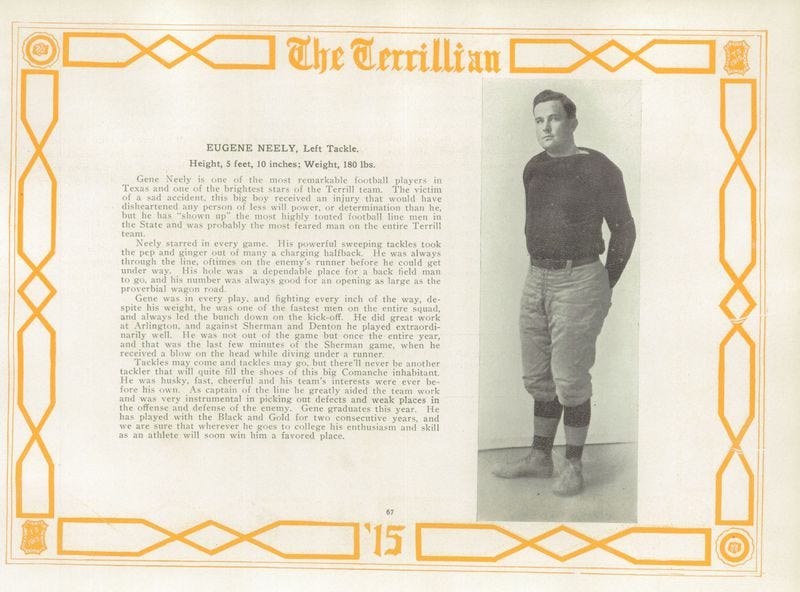
Neely entered Dartmouth in the fall of 1915, and he quickly established himself as the top freshmen lineman, so the Hanoverians focused on his on-the-field production rather than whatever might be missing from his game or body.
Still, word circulated that Dartmouth had a one-armed freshman football player, and while Neely gained a few headlines, many newspapers then and for several years after mentioned Neely in articles about local players missing arms or hands.
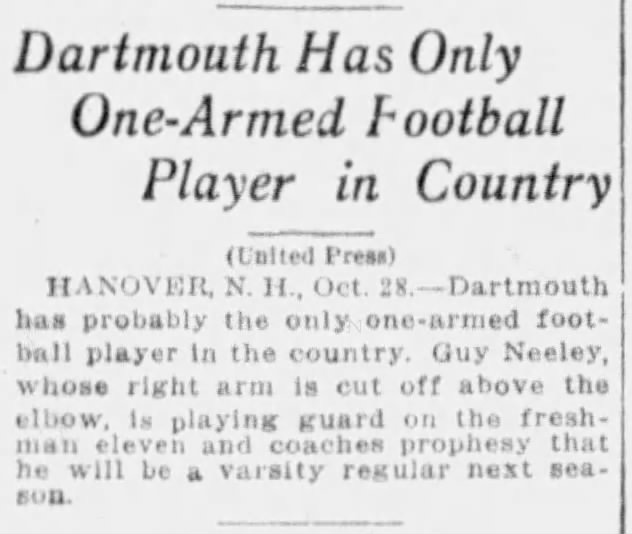
Neely started as a sophomore, gaining recognition for his play, and, of course, his deficit, especially after intercepting a pass and blocking a kick versus West Virginia.
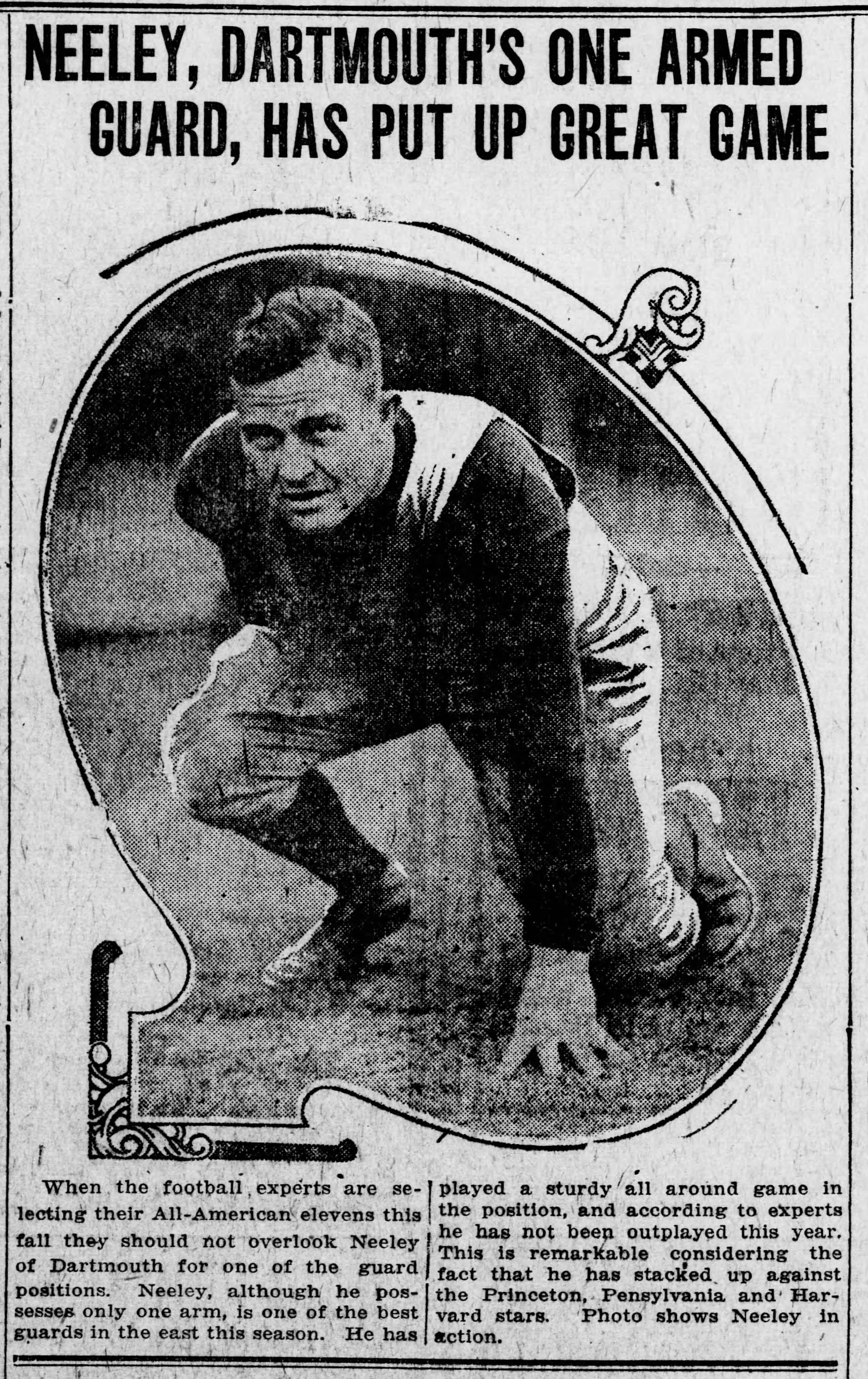
Despite the attention on his missing arm, Neely excelled on the field as a junior, earning first-team All-American status on Bill Veiock and the New York Tribune’s teams.
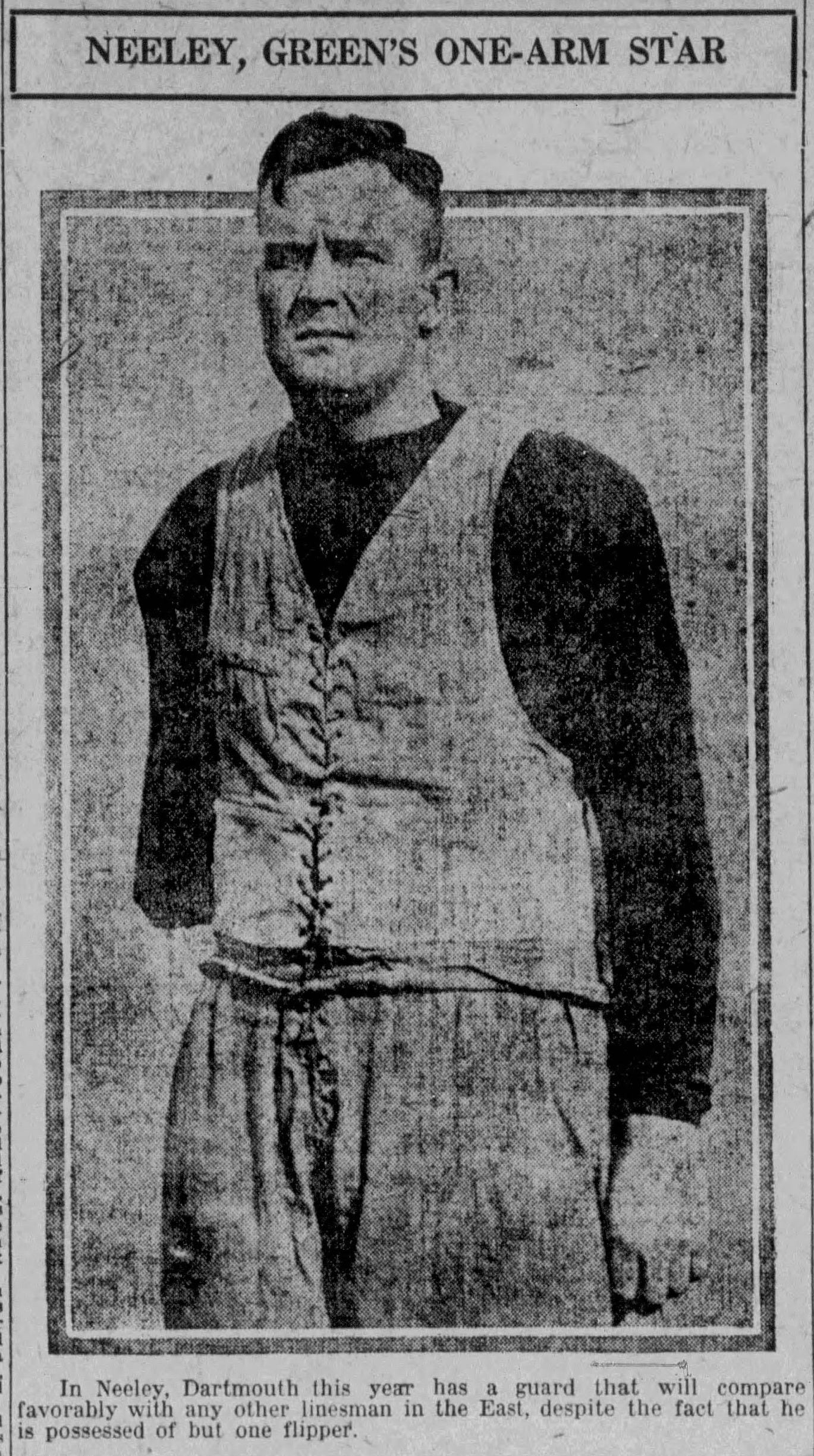
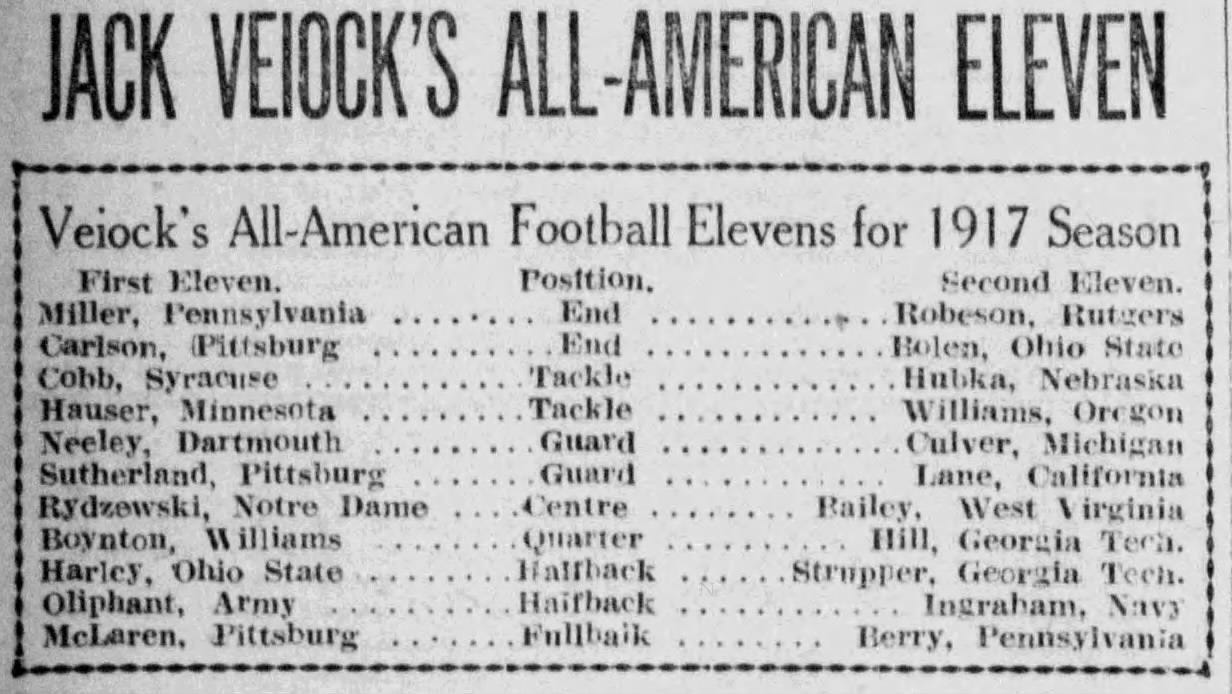
Neely did not play in 1918, his senior season, when many U.S. colleges did not field varsity teams. Instead, with most college campuses effectively taken over by the U.S. Army, Dartmouth fielded an SATC (Student Army Training Corps) team. Athletes missing the better part of an arm, neither qualified for the Army nor an SATC team, led Neely to work as an assistant coach with the football team at Camp Dix in New Jersey.
Neely spent the 1919 season at his high school alma mater, the Terrill School, where he led them to an undefeated season.
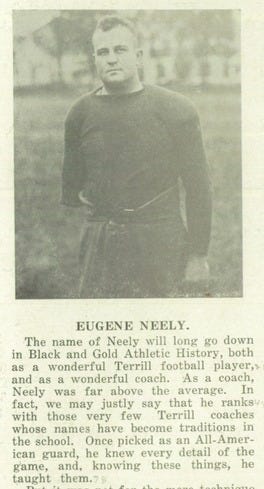
After coaching at Terrill, Neely entered the oil business while coaching Austin College to a 5-4 record in 1921. He later pursued a career in the securities business before passing away at age 53 in 1949, making him the only known major college All-American football player to play while missing an arm.
In the next day or two, we’ll look at another football player of the same era, Hank Crisp, who succeeded in multiple sports despite losing a hand before his college career began.
Regular readers support Football Archaeology. If you enjoy my work, consider a paid subscription, buy me a coffee, or purchase a book.

