
Today's Tidbit... Of Rugby Balls and Leather Helmets

A 1925 Reach catalog with its beautiful cover arrived in the mail today. The cover shows three players wearing the earth-tone gear of their day, along with splashes of red in the runner’s jersey and socks. Our runner evaded two tacklers, perhaps more, despite not carrying the ball high and tight as one should.
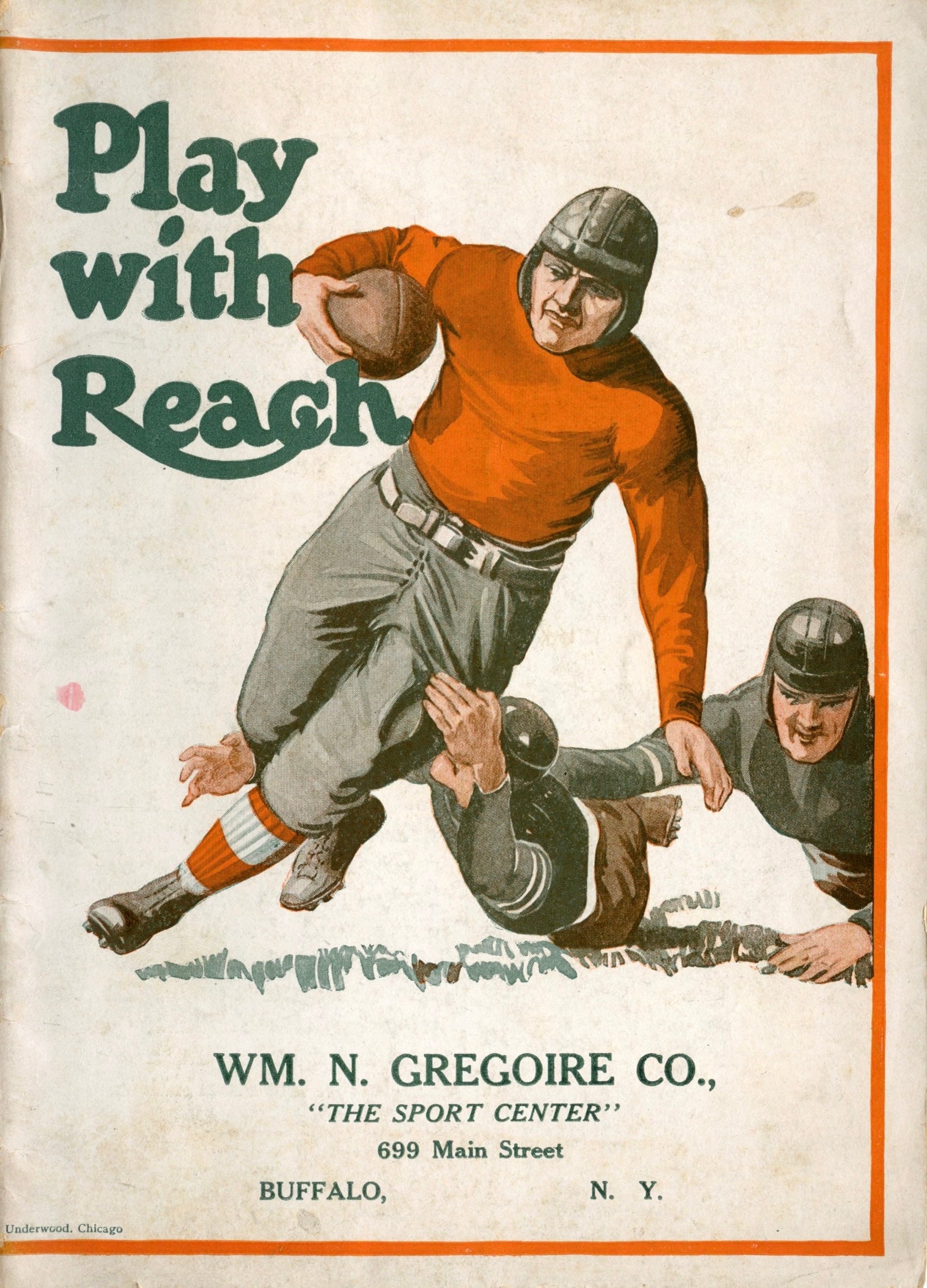
It might have been harder to carry a football high and tight back then, since the ball was two inches thicker around the middle with more rounded ends, but it would have been more important to do so. The manufacturers had not yet developed methods to make football leather as tacky as today, and playing on the poorly drained, often muddy fields of the day made the ball more slippery, leading to fumbles aplenty.
You know the balls were different by the fact that Reach still called them Rugby Foot Balls, a practice that was still mainstream.
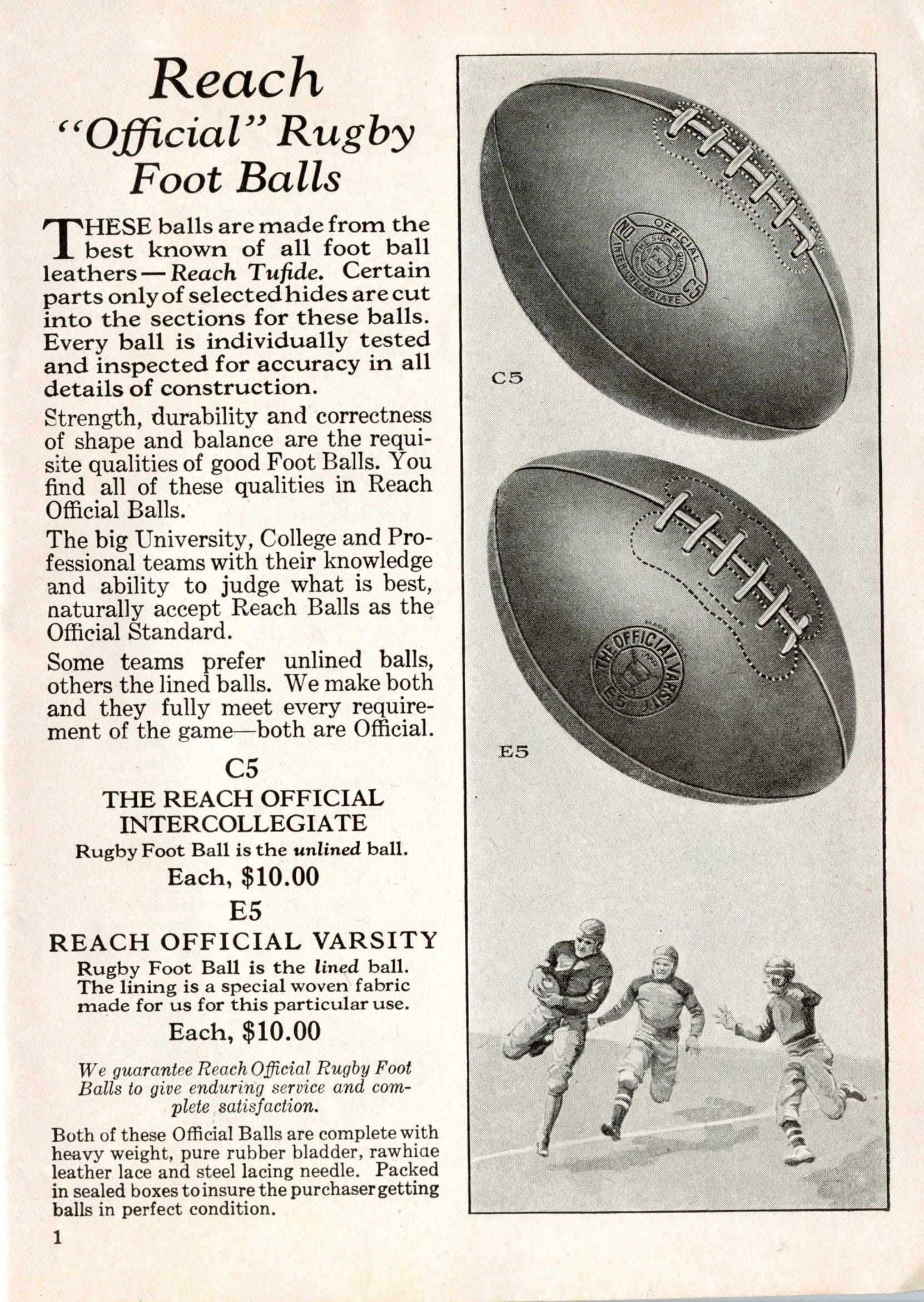
Available in lined and unlined versions, the unlined balls supposedly flew higher and farther when kicked, though they often were misshapen by the end of a game. The C5 and E5 balls cost $10 apiece.
Below the $10 premium ball, Reach sold Rugby Foot Balls at many price points. They offered the 5EW “Nite” Rugby Foot Ball, made of white cowhide, which was great for late practices, and the earliest example of a commercially available night ball I recall seeing. The price of balls falls steadily until the nadir of the $1 youth ball, with a tough canvas lining that hopefully allowed for endless afternoons of play.
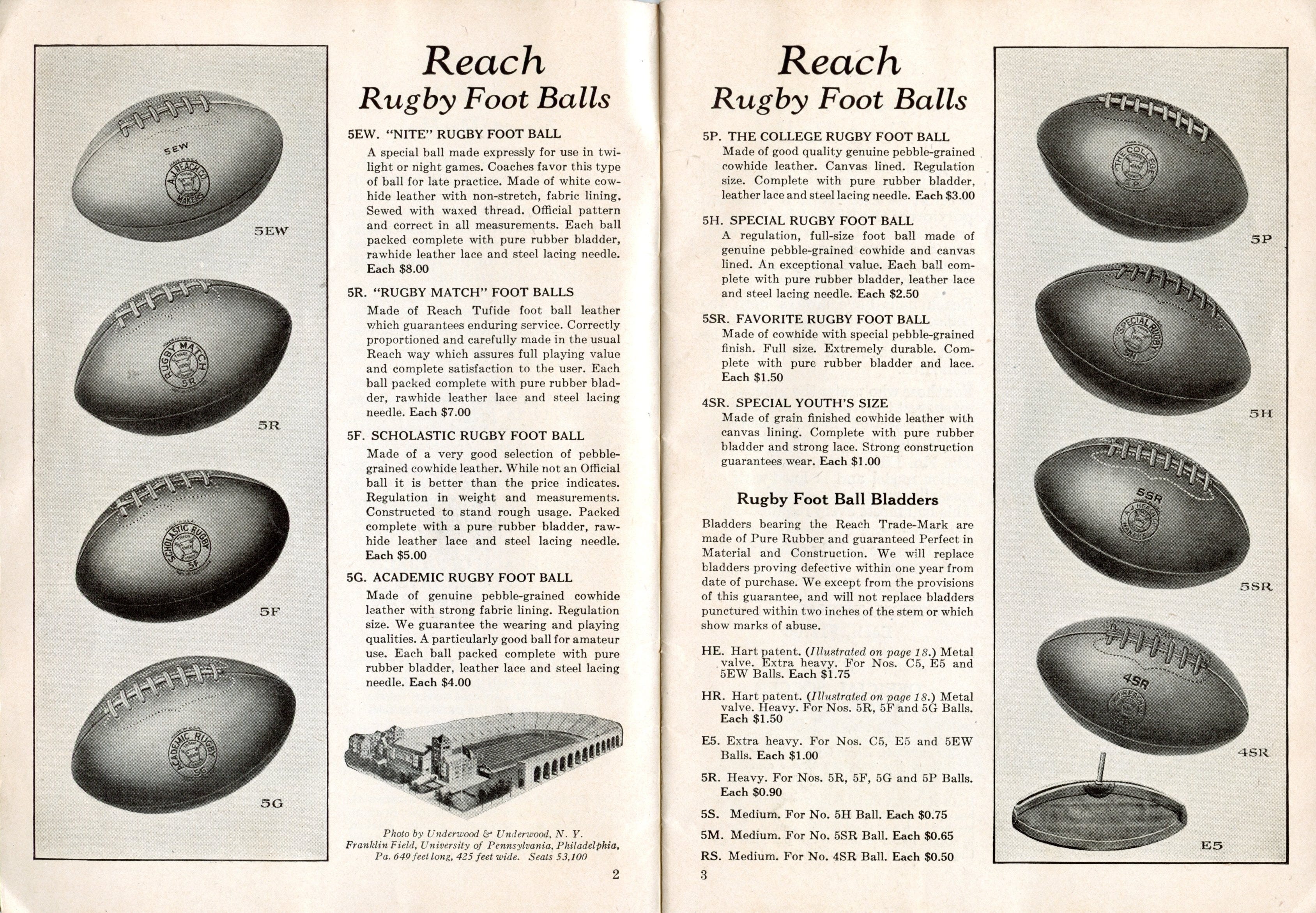
Of course, none of these balls had surface-mounted valves, so they had to be unlaced to reinflate them. That’s why they shipped every foot ball and accompanying bladder with a lacing needle in the box. Some assembly required.
Then there were the helmets, which offered top-of-the-line protection against concussions and other head injuries. The 1AA model cost $10, just like Reach’s best Rugby Foot Ball, which is equivalent to $190 today. The 1AA was:
…up to the minute in design, material, and construction. Special features built into our helmets, were developed by players who know the value of comfortable fitting head gear which allows complete freedom of action and affords positive protection to the wearer.
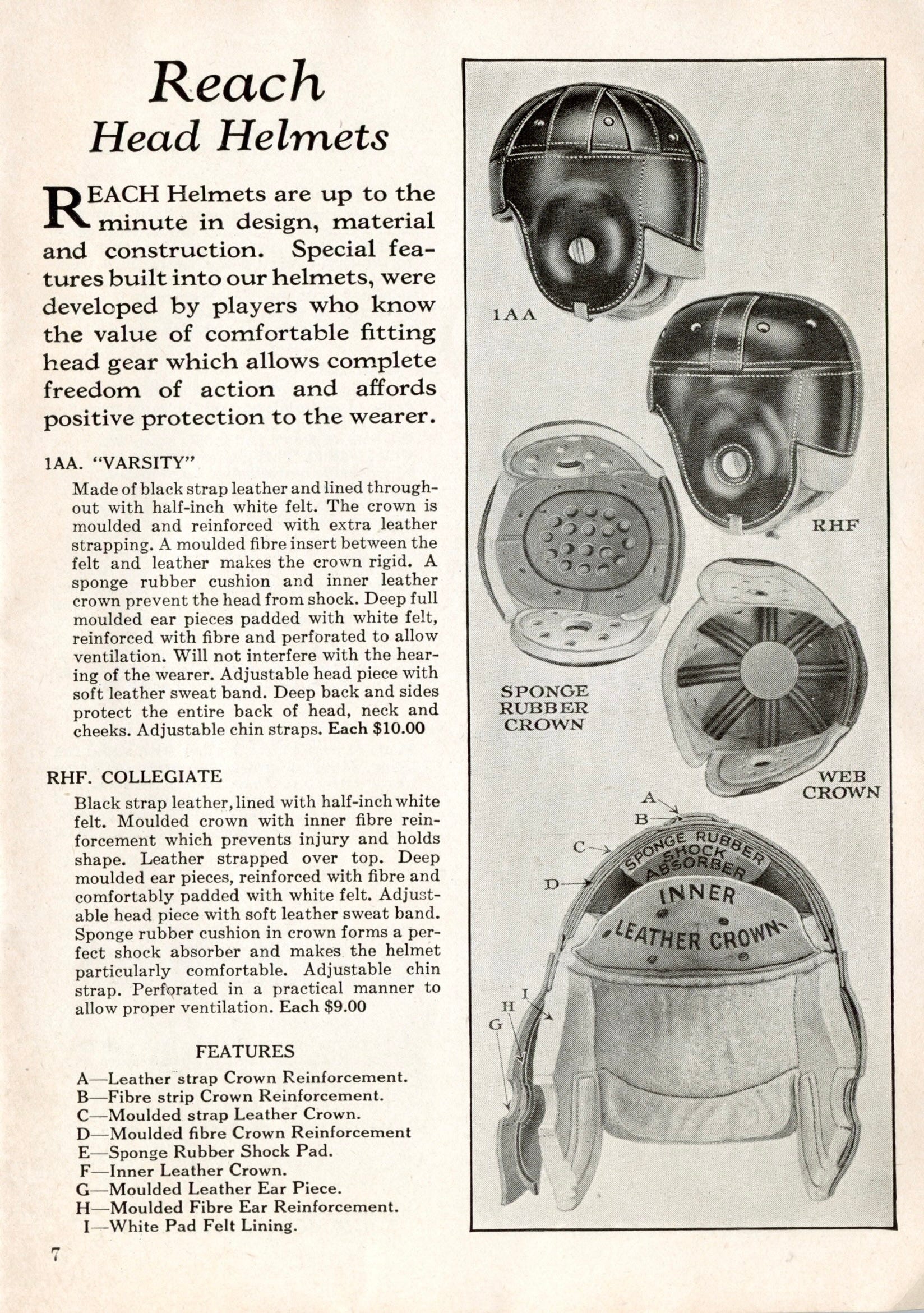
Besides the written description of the model’s excellent padding, the illustrations show the sponge-rubber crown, the fibre crown, inner web crown, the half-inch thick felt padding, and other elements that went into such a fine instrument.
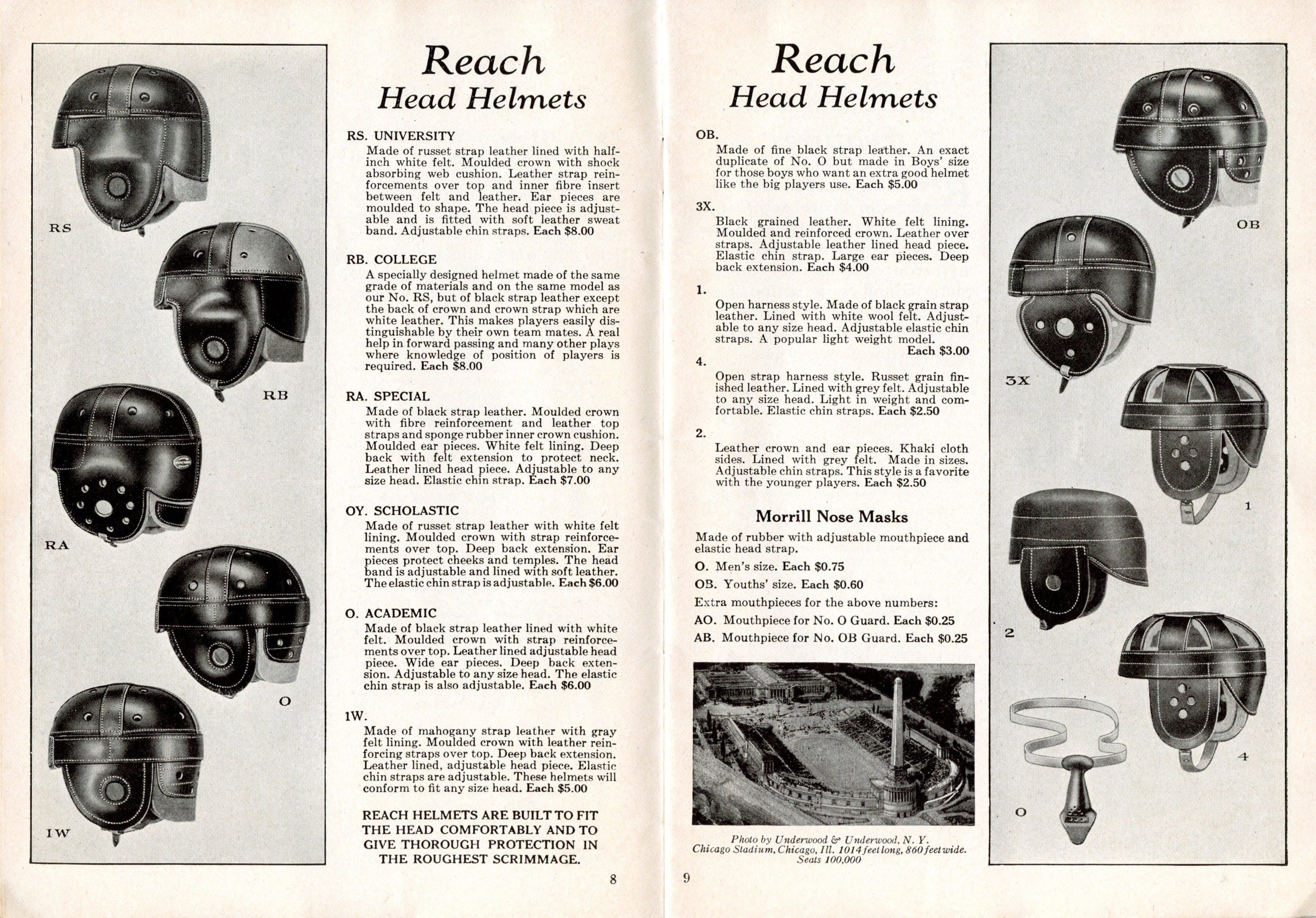
Notable among the offerings was the RB College model (shown second from the top of the left page), which they covered in black strap leather except for the back half of the crown, since:
This makes players easily distinguishable by their team mates. A real help in forward pass and many other plays where knowledge of position of players is required.
Yep, in the days when opposing teams often wore nearly the same shade of red or black and blue, and everyone wore brown or black helmets, a spot of white leather on a helmet’s back helped distinguish your eligible receivers from the other seventeen players on the field.
And, like Reach’s foot balls, not everyone could afford a $10 helmet, but for $2.50 you could get one of two head harnesses or the padded flattop version.
Then there were those pricey shoulder pads, topping out at $12 per. Two models are worth mentioning. One is the #27 Varsity, which, like the others, has armlet straps to keep the shoulder pads in place and side or chest straps that became the norm among future shoulder pads.
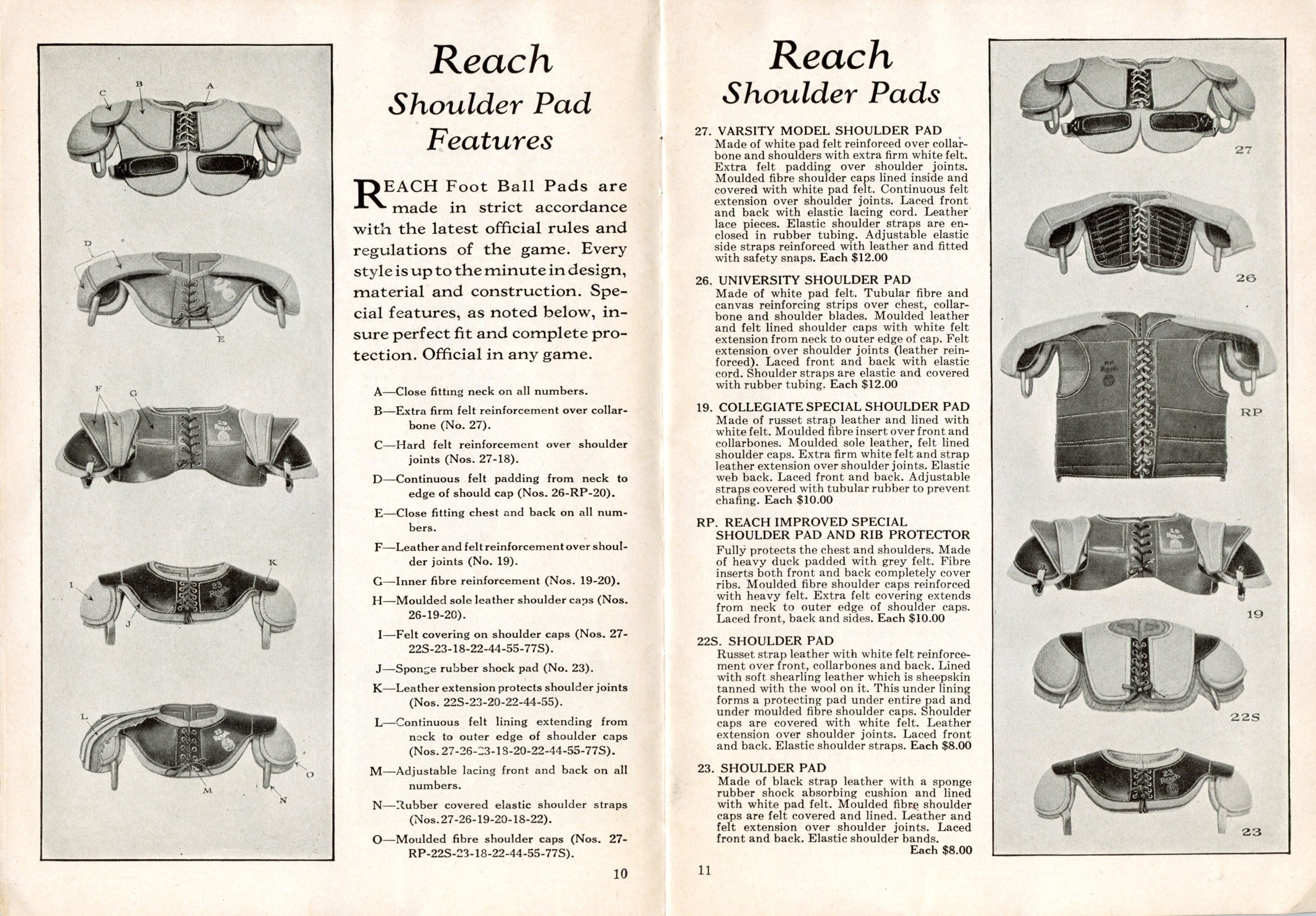
The RP model, aka the Reach Improved Special Shoulder Pad and Rib Protector, is a beautiful specimen, and one hopes that a few remain on display in someone’s collection. The number of cows harmed to protect a player’s ribs is unknown, though the wearer paid his penance every time he laced each of the fifteen rows.
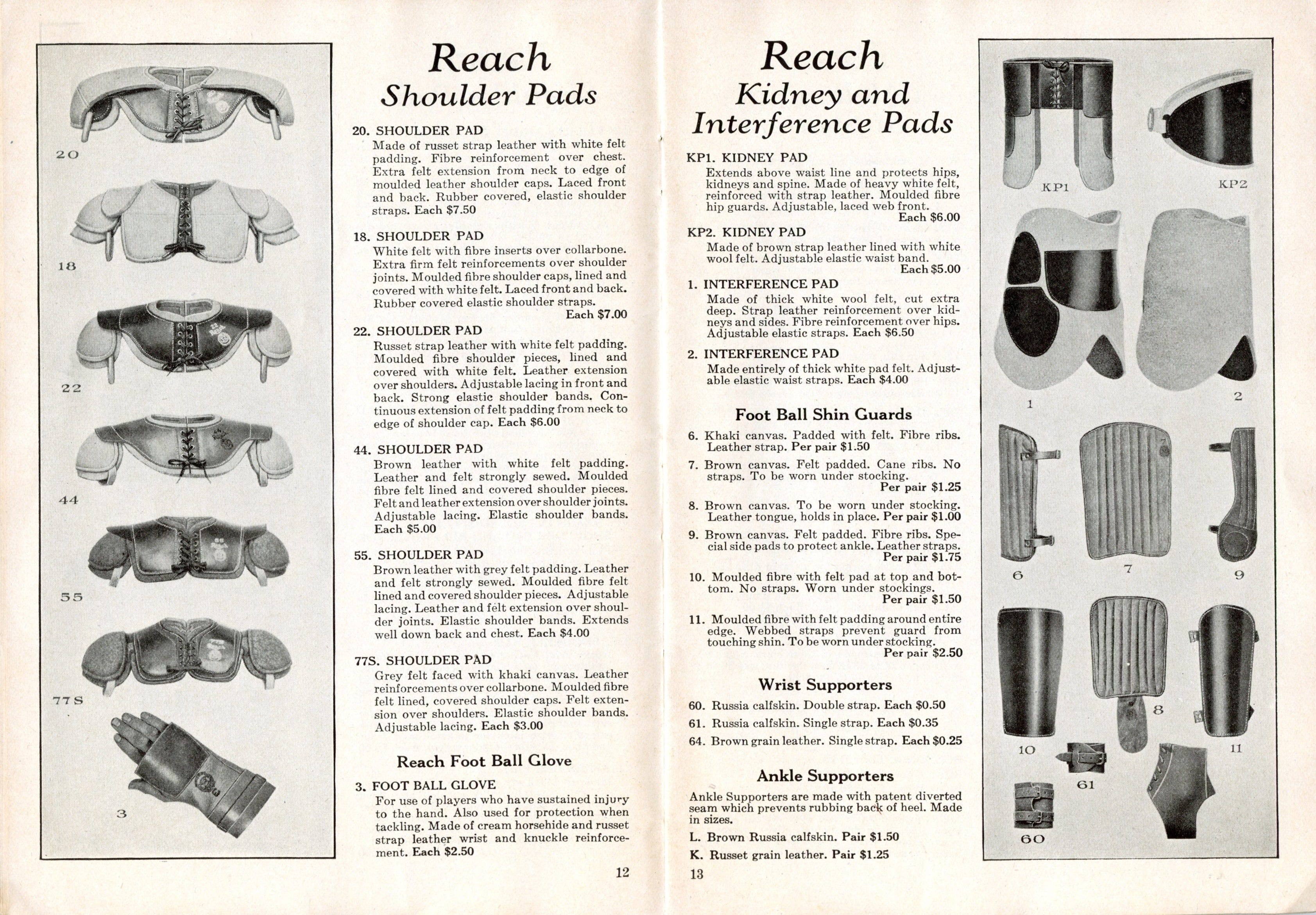
They also sold kidney, blocking, shin, and other pads for the well-protected fellows out there.
That’s is for the 1925 Reach catalog review. Saturday’s article included a crowdfunding appeal to pay for the Library of Congress scanning of the 1884 college football rule book, which is in their collection but not available online. A few kindhearted and intelligent readers have already acquired paid subscriptions or bought a few coffees, which is wonderful, though we remain short of the goal.
Nevertheless, their actions as faithful readers helped move Football Archaeology to #24 on Substack’s Rising Sports blog list.

A few more paid subscription and donations will take us to the goal and move Football Archaeology further up the charts.
Regular readers support Football Archaeology. If you enjoy my work, consider a paid subscription, buy me a coffee, or purchase a book.


What are the stadiums pictured in the catalog? I couldn't enlarge to read the accompanying text. I wish I could remember the equipment at my high-school better. It was from the 1950s and not all that different from this much older catalog. Fun history!
I’m curious when the practice of each team using its own game ball when on offense began.