
Today's Tidbit... When Airlines Became Central To Football

Until recently, college athletic conferences were regional, mainly due to the limits of transportation technologies. Despite being regional, many early conferences, including the Big Ten and the Southern Intercollegiate Athletic Association, were formed based on athletic philosophy and eligibility standards rather than as scheduling platforms. Despite being in a conference, teams generally played schools in their home and nearby states, aside from occasional intersectional trips that always involved train travel. Since train travel was relatively slow, teams playing distant conference foes two weekends in a row stayed on the road for the week in between rather than return to campus.
All that began to change after WWII, with the explosion of charter and commercial air travel. The war brought tremendous advances in flight speed and safety, along with a surplus of planes and pilots. Even then, NFL and AAFC teams that flew across the country found it more convenient to remain on the opposite side of the Rockies for the week between coastal games.
That’s a roundabout way of introducing today’s story, built around a 1958 Central Airlines pocket schedule.
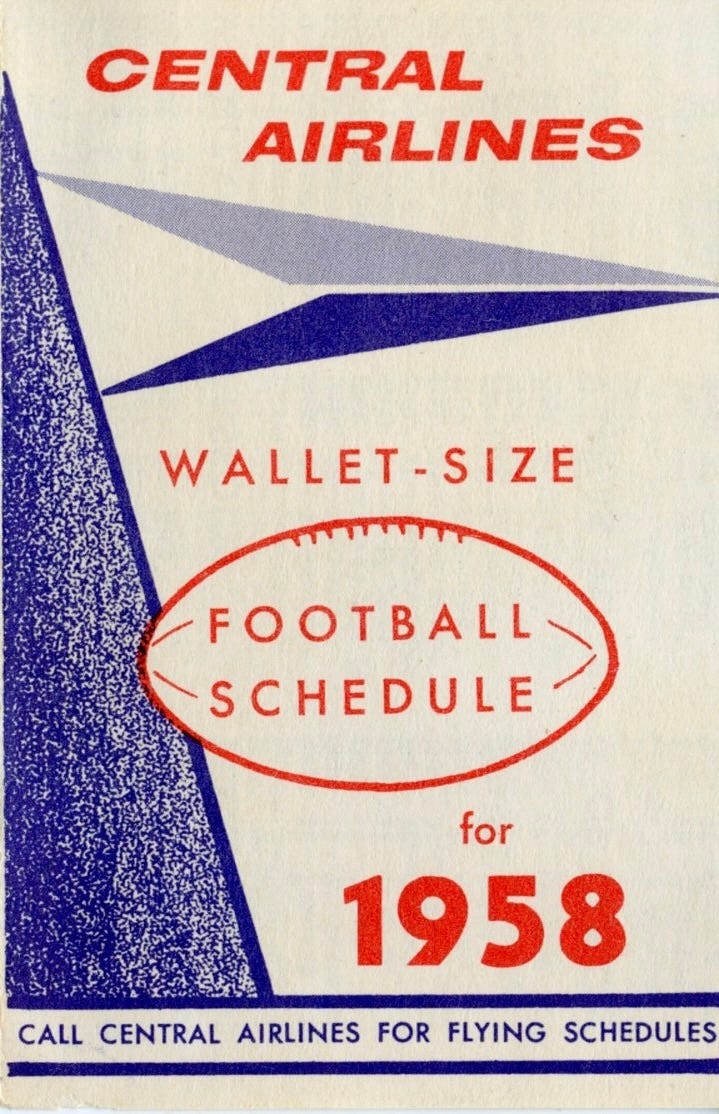
I hadn’t heard of Central Airlines until I came across the schedule, and I assume most readers are in the same boat. Central Airlines, which operated scheduled flights from 1949 to 1967, flew only propeller planes, though jets were on order when it was gobbled up.
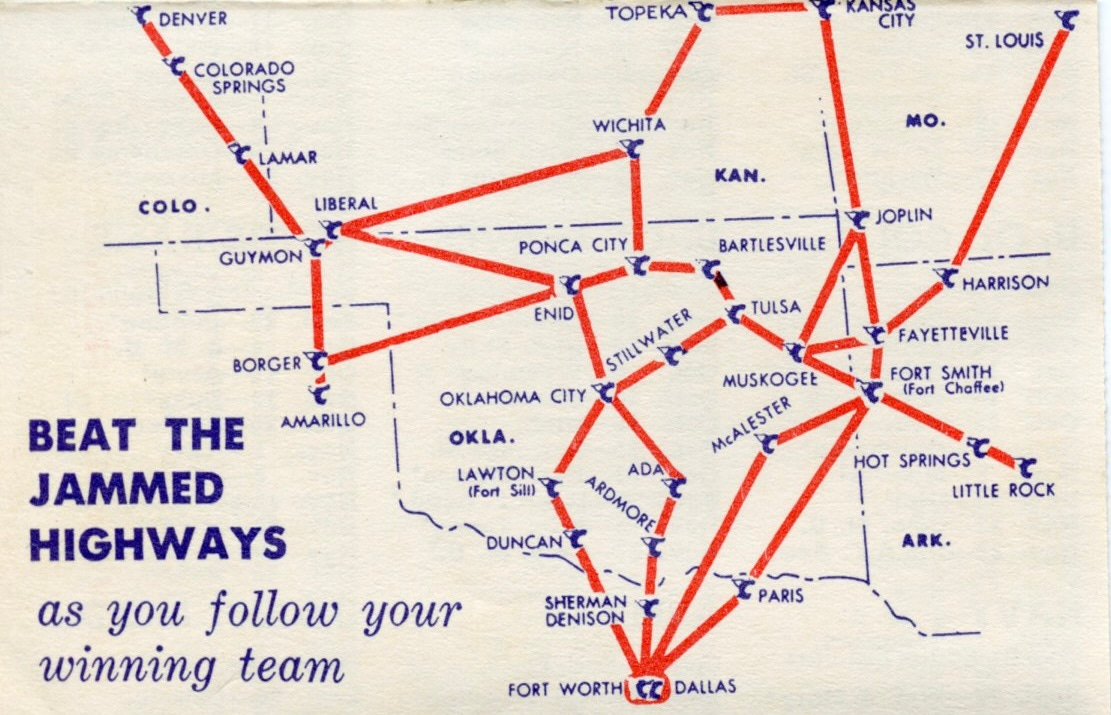
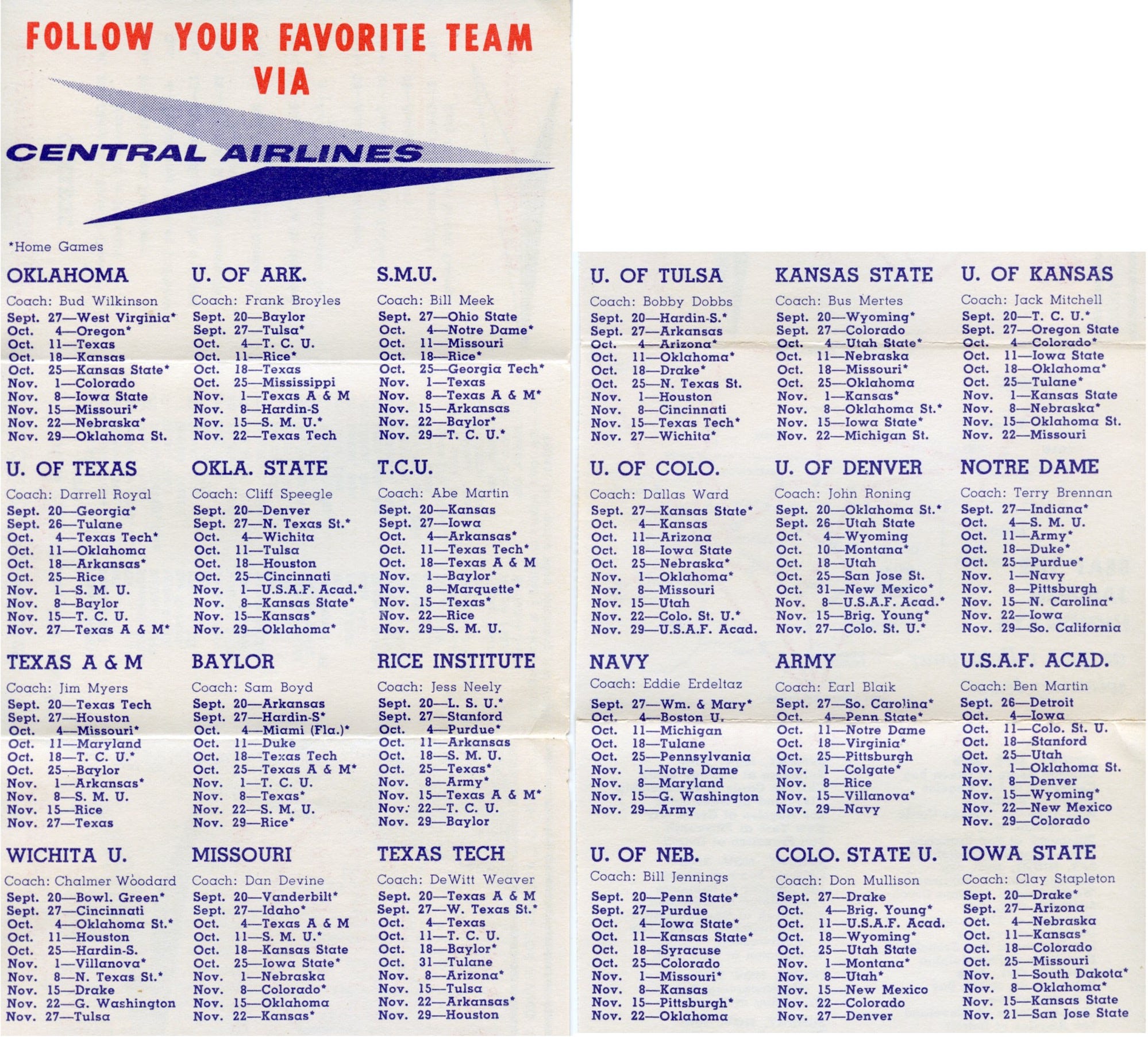
Central’s 1958 schedule focused on teams in the old Southwest and Big Eight conferences, regional teams like Denver and Wichita, as well as Notre Dame and the service academies, so their focus was regional since that was the nature of most airlines at the time.
The airline industry, like many others, is a story of consolidation. Airlines did not pop up one day, flying from coast to coast and beyond. Instead, like football conferences, they were regional, ranging from New York City to Poughkeepsie, from Chicago to Peoria, and from San Francisco to Pasadena. Regional airlines merged into today’s integrated giants, with Central Airlines partnering with Pennsylvania Central Airlines, which folded into Frontier, which continued with Continental, which unified with United. (The story linked below shows that United Airlines flew coast to coast by 1940, though they did not fly south of Louisville.)

Although traveling by air in the 1940s and 1950s is often portrayed as luxurious, that was not the case for Central initially. Passengers on their DC-3s in 1950 had access only to cool water. They received no other food or refreshments in flight. Things were much simpler then. A 1952 innovation allowed Central’s ticketing agents to book connecting flights with another regional airline, such as Delta, during the initial call, making arranging a football road trip easier.
Originating in Fort Worth, Central served 25 cities in Texas, Oklahoma, Arkansas, and Kansas before adding a route to Norman in 1951, which allowed them to offer a 25 percent discount to fans flying in and out of Norman on game day.
Central encouraged football fans to take weekend flights rather than drive or ride the rails to watch their favorite team.
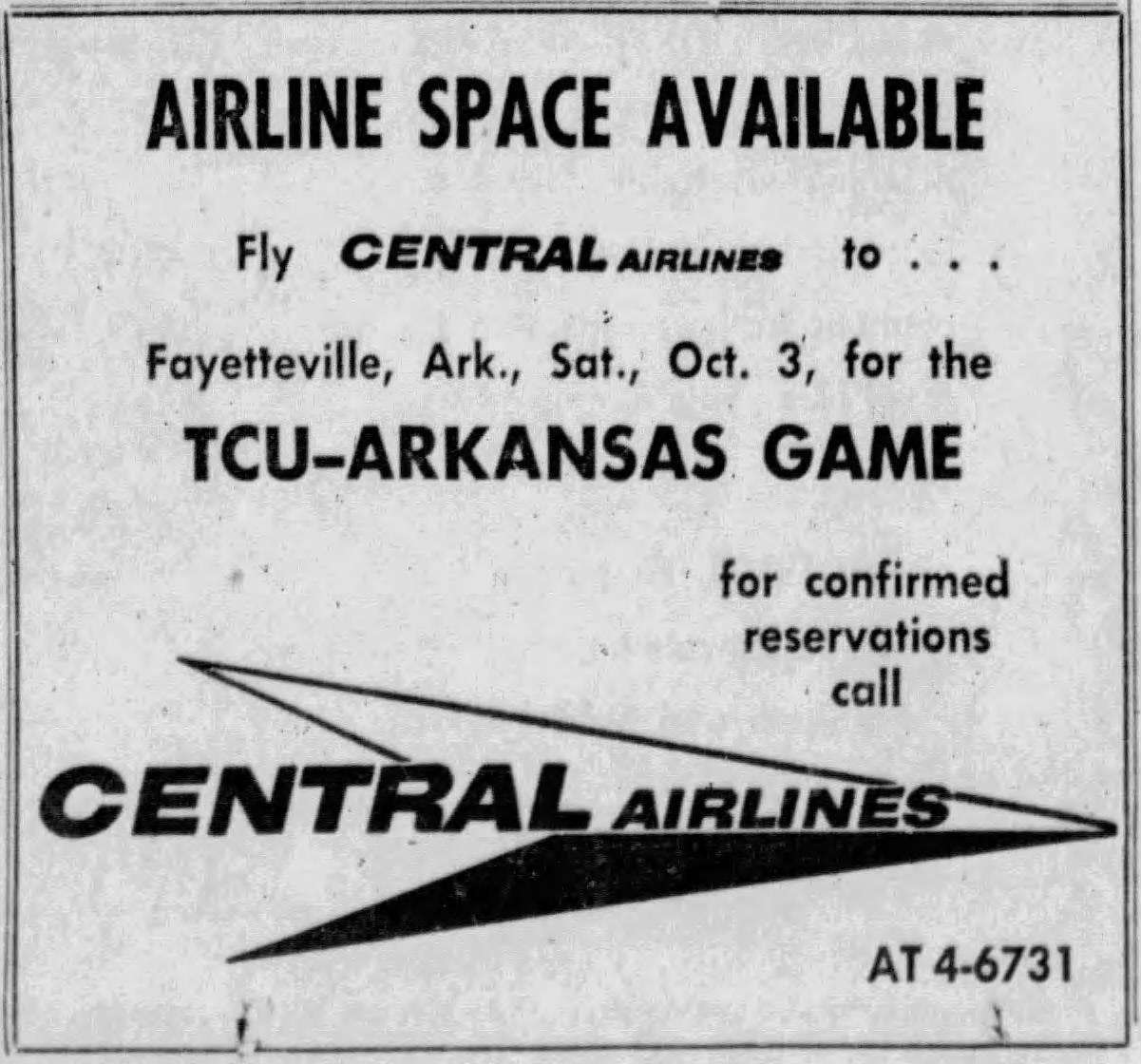
Likewise, Central offered deep discounts for passengers 22 and under, allowing students to fly to school or away games.
Airlines like Central also flew teams to games via charter and commercial flights, and sometimes both. A 1959 story covered a Central Airlines charter flight carrying Arkansas’ freshmen team making a fuel stop in Hobart, Oklahoma, while on their way to Texas Tech, which, apparently, was big news in Hobart.
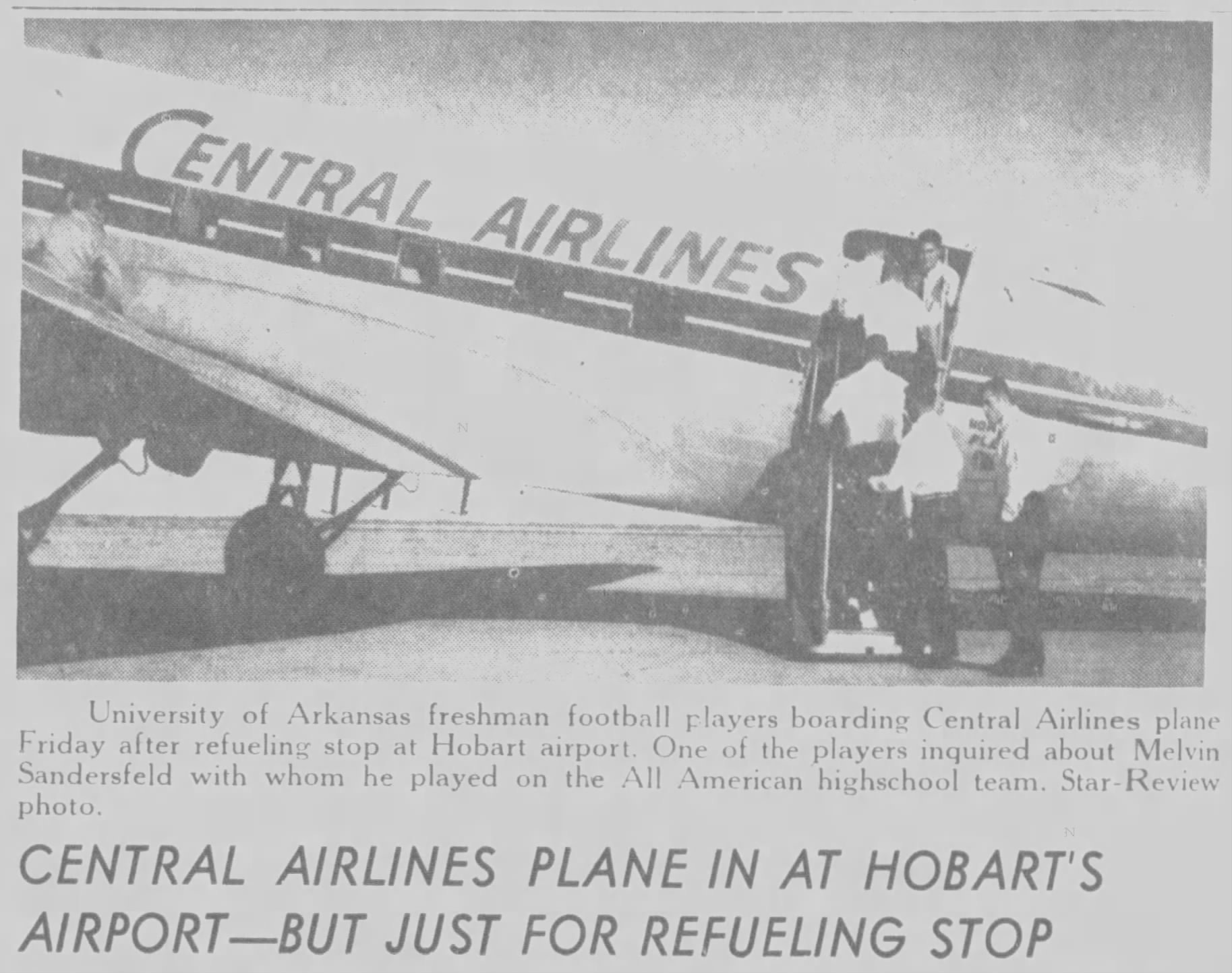
Although flying freshmen football teams to games was a source of revenue for airlines, the costs to athletic departments were a primary reason the NCAA removed the ban on freshmen eligibility in the early 1970s. Until then, however, Central and other airlines pursued the business of flying freshmen and varsity teams on charter and commercial flights. Small airlines like Central sometimes lacked the planes to bring an entire football team and traveling party to a destination by charter, so some team members flew charter, while others flew commercial.
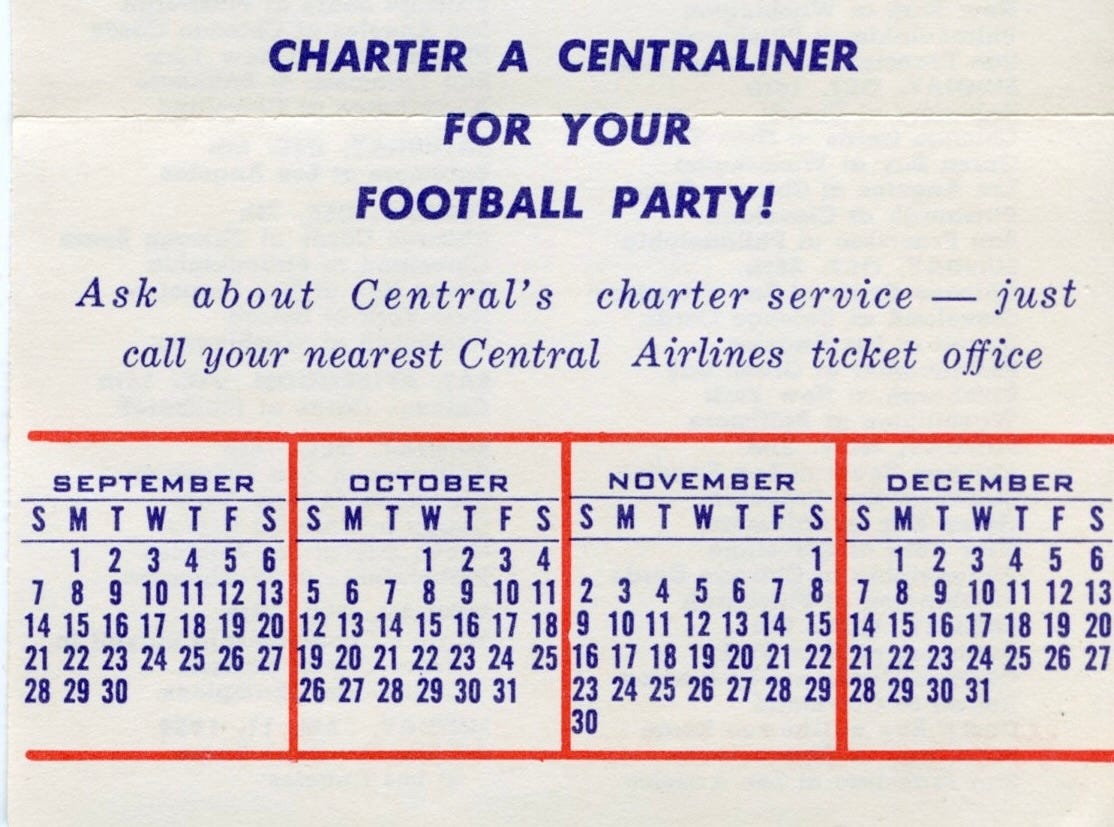
Of course, if Central could fly chartered flights for teams, they could do so just as easily for fans. Those fortunate enough to root for one of the college teams listed on the pocket schedule could encourage the local alumni chapter to sponsor an annual flight to an away game to cheer on the boys.
Central Airlines is long gone. So is the Southwest Conference. Only Kansas, Kansas State, and Iowa State have stayed true to the Big Seven Conference of 1958. The old Border Conference, which included Arizona, Arizona State, Hardin-Simmons, New Mexico State, Texas Western, and West Texas State, is long gone. Still, Central Airlines served many a football team and fans back in the day. So they have that going for them, which is nice.
Football Archaeology is reader-supported. Click here to donate a couple of bucks, buy one of my books, or otherwise support the site.
I remember in the early to mid 60’s Packers playing Rams and 49ers last two weeks of the season on the west coast on Saturdays and staying the week between games. I could be wrong it was a long time ago.
Really interesting! This may be taken to the next level if the NFL expands outside the country. Some of the same phenomena for modern times.