
Today’s Tidbits... Coaches As Game Officials

In its early days, the football community did not draw sharp distinctions between player, coach, official, and journalist roles. More accurately, they drew those distinctions, but individuals commonly played more than one role, occasionally simultaneously and more often sequentially.
Player-coaches and even player-coach-owners were common, and many coaches also wrote magazine or syndicated newspaper articles during their seasons. Camp did much of his writing after he finished coaching, but Heisman, Warner, Zuppke, Rockne, and others regularly commented on the state of the game, offered plays or coaching points, and predicted who they thought would win upcoming games.
Walter Eckersall, the 1906 All-American quarterback at Chicago, exhibited another combination several years later -the game official-newspaper reporter- when he officiated football games each weekend and then wrote about those games as the lead college football reporter for the Chicago Tribune. Herb Dana served a similar role on the West Coast in the 1930s, officiating big games and handling a radio talk show and other media efforts during the week.
A lesser-known combination involved head coaches who also officiated games, with the oddest likely offered by Amos Alonzo Stagg. Stagg played four years at Yale and one at the Springfield YMCA Training School before taking the football coach and athletic director job at the newly-created UChicago in 1892.
UChicago was short on talent in his inaugural year, so he often played in games. Unfortunately for the Maroons, Stagg sprained his ankle and was unable to play in the season finale at Illinois. Unable to play in the contest, the Illini coaches agreed that Stagg should referee the game, which the Illini won 28-12.
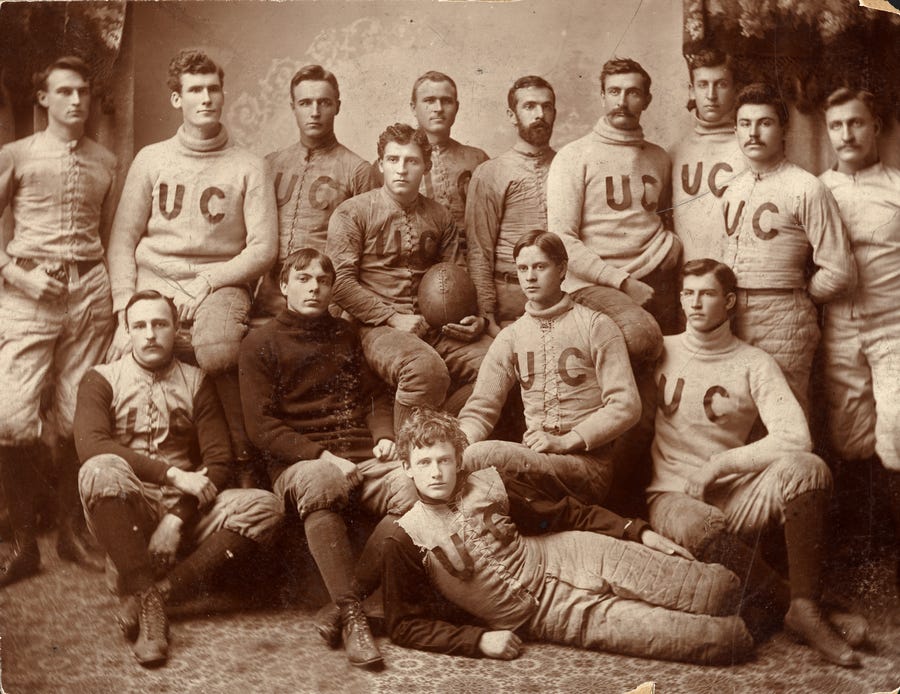

Two years later, in the midst of Chicago’s 22-game 1894 season, when they played four high schools, three YMCAs, five athletic clubs, and the Chicago Dining Club, the team had a bye on a mid-November Saturday, so Stagg refereed the Michigan-Oberlin game in Ann Arbor. The Detroit Free Press was not impressed with Stagg’s work that day, noting:
A. A. Stagg was referee, and was decidedly one-sided in his decisions, giving Oberlin the ball four times for holding and also 40 yards for off side.
... Stagg’s biased decisions and fierce playing on both sides kept the game seesaw back-and-forth near the center.
‘Michigan and Oberlin Played Well,’ Detroit Free Press, November 18, 1894.
Stagg later refereed the Arkansas-Washington U. Thanksgiving Day game in 1909 without incident, though he had a potential conflict of interest since Arkansas coach Hugo Bezdek played fullback for Stagg at UChicago.
Al Sharpe, the former Yale football player, was the head coach at Cornell from 1912 to 1917. During the first three years of this Ithaca tenure, he umpired the Army-Navy game following the end of his season. Whereas officials commonly wore their college letter sweaters to demonstrate their impartiality, Sharpe officiated wearing a Cornell football uniform, though he wore a white sweater atop the Big Red jersey.
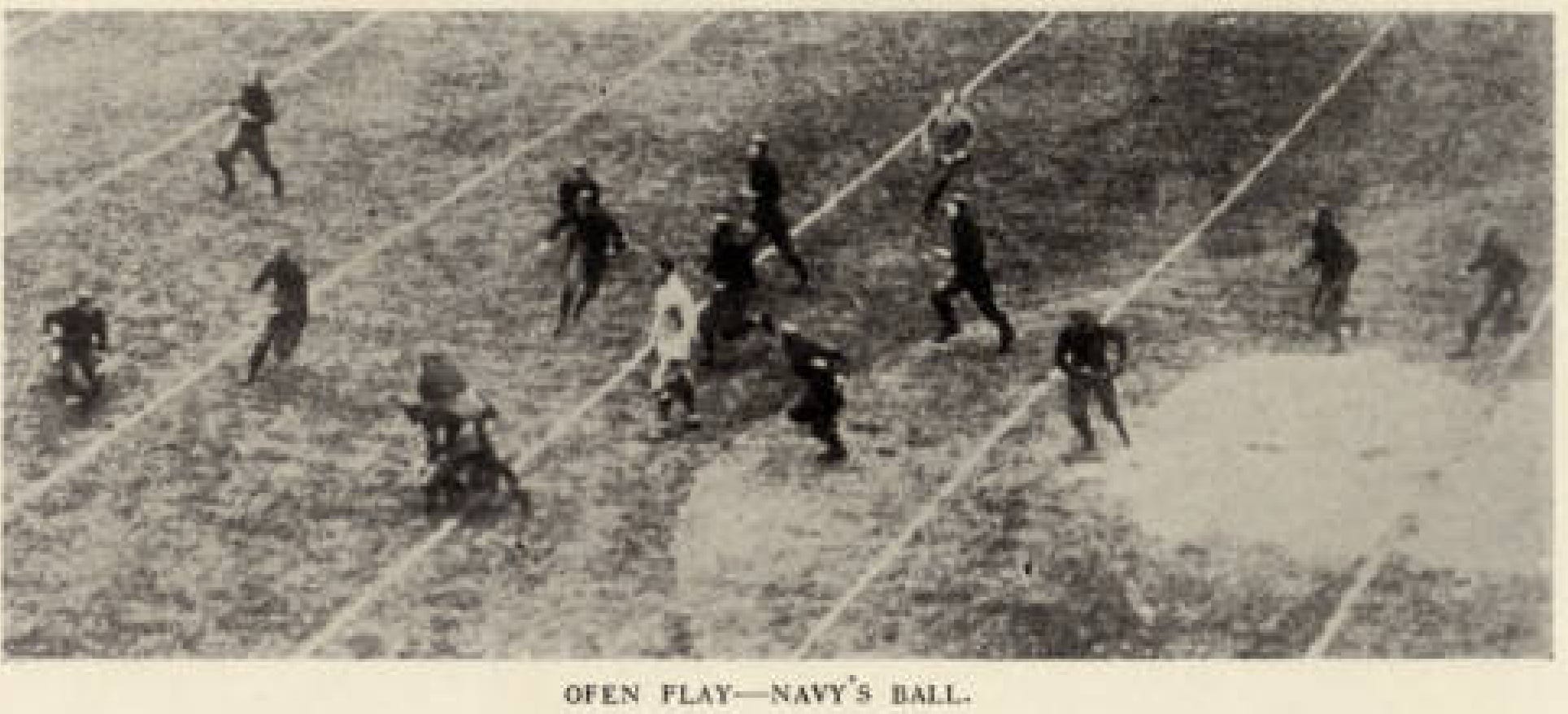
Despite reports that Fielding Yost would officiate the 1906 Army-Navy game, he did not appear on the field that day. His chance to whistle while he worked waited until the 1917 game between Great Lakes Naval and the Army’s Fort Sheridan, both located north of Chicago along Lake Michigan, though they played at UChicago’s Stagg Field on the South Side. Eight former Michigan players were on either the Army or Navy team, and they all benefited from an all-star officiating crew. Wisconsin head coach John R. Richards refereed, Yost umpired, Northwestern coach Fred Murphy was the head linesman, and Walter Eckersall, the Chicago Tribune reporter, was the field judge.
Great Lakes dominated the game, winning 27-0, and the officiating became lax at times. Ring Lardner reported that Fielding Yost was sufficiently relaxed that he was seen shaking hands with a friend on the sidelines during one pass play. Despite Yost’s nonchalant attitude, one other celebrity paid attention until the end of the game. That person was the Great Lakes Navy’s band director, Lt. John Phillip Sousa, who had his 400-piece band recognize Fort Sheridan’s poor efforts by playing Chopin’s Funeral March as the clock ticked down to end the game.
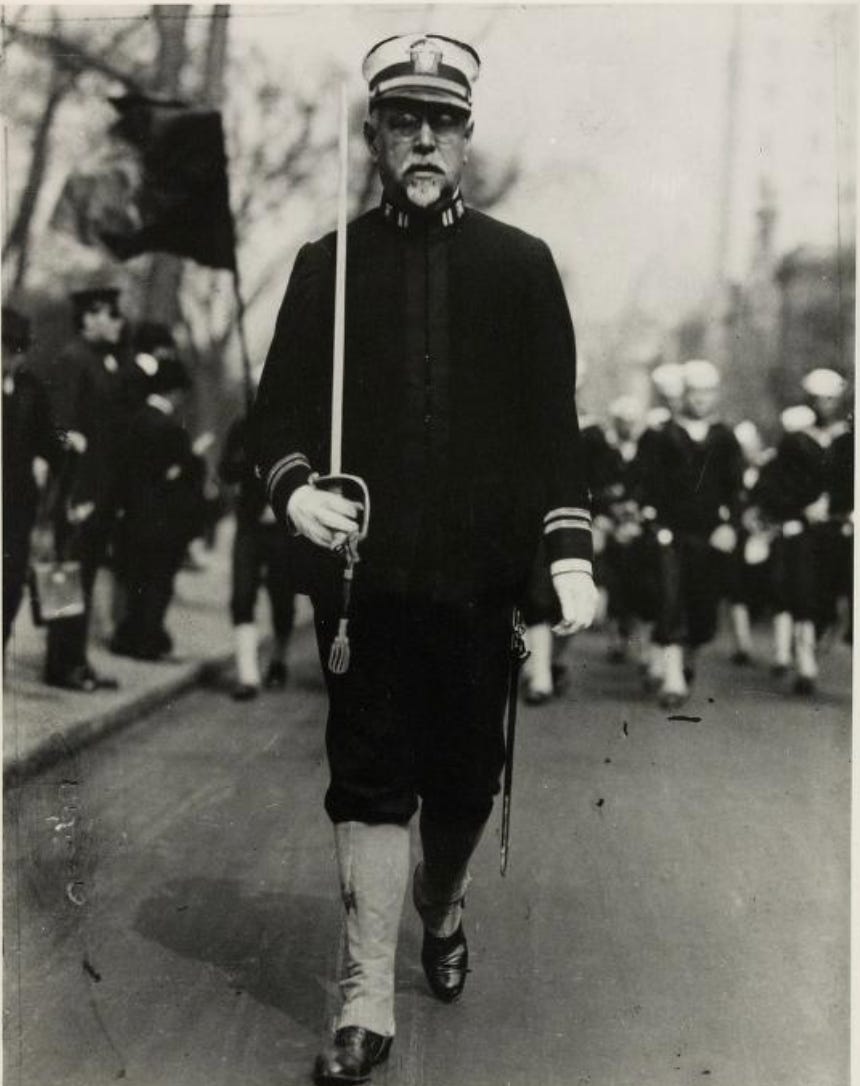
Walter Eckersall, surprisingly, did not submit a newspaper report on the game. Perhaps that was due to his leaving for another military camp game in Omaha immediately after the game in Chicago, or his hospitalization a few days later.
Despite coaches and others wearing multiple hats, Yost’s lack of focus was the exception rather than the rule. Coaches who officiated games did so because they were respected and trusted to observe and rule fairly, even though fans or others sometimes claimed otherwise. The folks doing the hiring knew these coaches would handle their roles to the best of their abilities, which was all they could ask.
Regular readers support Football Archaeology. If you enjoy my work, get a paid subscription, buy me a coffee, or purchase a book.


No way they would let a coach ref a game now...