

The traditional story holds that the first college football game in the Midwest came in 1880, when Michigan played Racine College in Chicago. It is a story I accepted and wrote about in 2024.

Unfortunately for Michigan fans (and me), I recently came across an 1876 article reporting on the Chicago Football Club (CFC) playing Northwestern University on February 22, 1876, four years before the Michigan-Racine game. It is a story that Northwestern fans discovered more than a decade ago, and appears on several Wildcat-related sites and the program’s Wiki page. Even the Illinois Legislature passed a 2025 resolution claiming the February 1876 game was the first football game in the Midwest.
So, while I must accept responsibility for failing to dig up that particular fossil until this week, it is my duty to inform Northwestern fans and the Illinois Legislature that the CFC played another college before taking the field against the purple-clad boys. I will present the facts of this case after addressing two definitional questions and providing background on the Chicago Football Club.
The first question concerns the definition of a football game, or, asked another way, at what point in rugby’s evolution in America did the game become football? I addressed the same question in an article while trying to identify who scored football’s first touchdown.

We all know the 1869 Princeton-Rutgers game was not football, it was soccer or something like that, but what about games involving college teams playing under rugby rules? The 1876 CFC-Northwestern game was played under rugby rules, though since Northwestern was new to the game, the CFC allowed Northwestern to field 20 players to the CFC’s 15. Also, the frozen ground kept them from setting up goal posts or placing stakes in the ground to mark the boundaries, but they played on, with the CFC winning three goals to nothing. Still, if we consider rugby games to be football, then the CFC @ Northwestern game passes the test, as do all the Harvard, Yale, and Princeton games of the era.
The second question concerns whether both teams must represent colleges or universities for a contest to be considered a college football game. One could make that argument, and I can already hear Michigan fans making it, since their game seems to be the first Midwestern matchup between two college teams. Of course, if we need two college teams to consider it a college football game, we should expect Michigan to remove from its all-time history its 10-1 record against prep and high schools, its 5-0-1 record against military teams, and perhaps its 3-0 record against medical schools. I’m fine with keeping those games on the record since that was the nature of the times; everyone played such teams. Still, if rugby matches involving one college team are candidates for the first football game in the Midwest, then Northwestern wins the prize; that is, until we identify an earlier example.
So, what was the Chicago Football Club, and how did it come about? You will recall that the Great Chicago Fire occurred in 1871, leaving 100,000 people, or about one-third of Chicagoans, homeless.
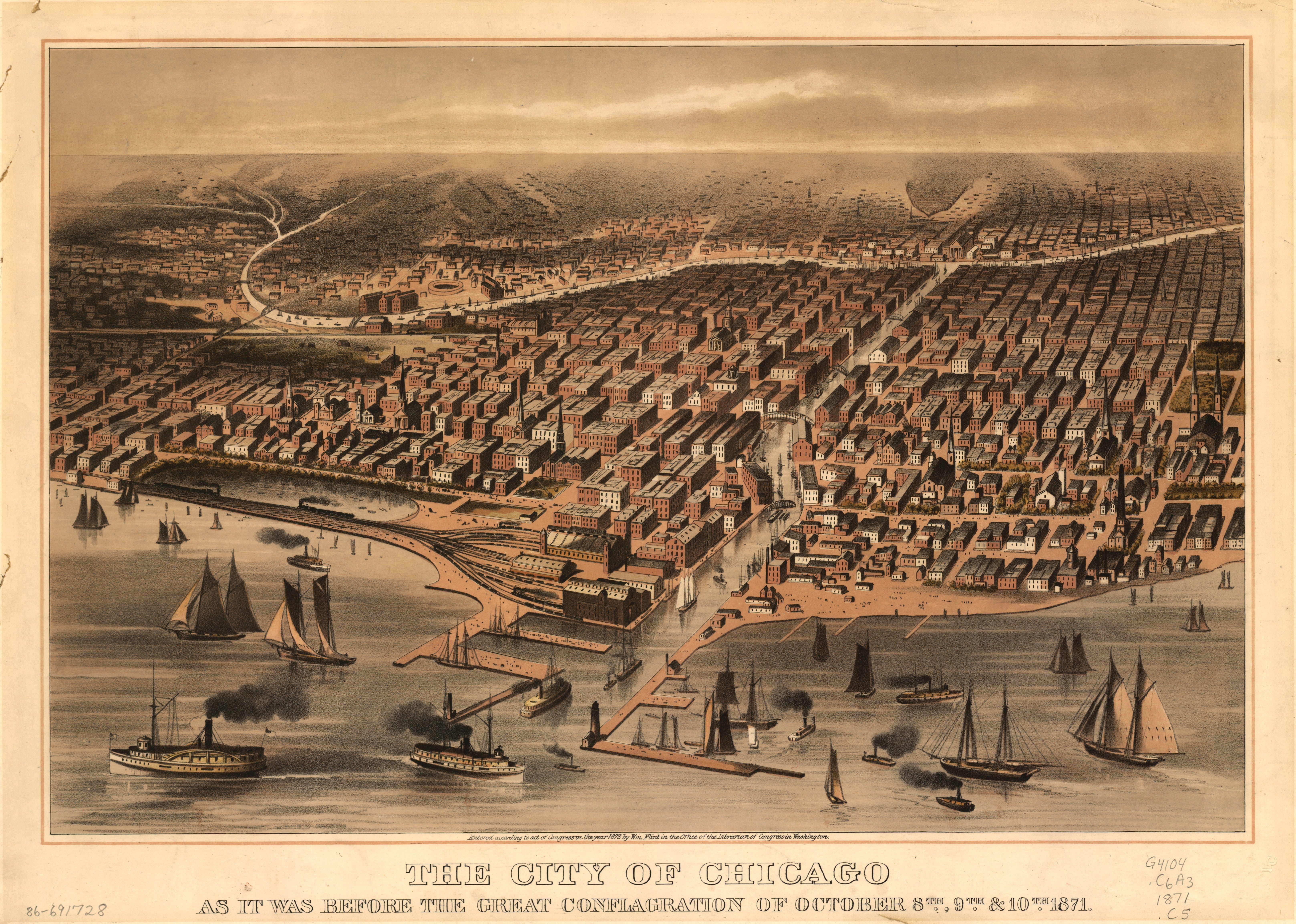
But the city came roaring back. It was a major Great Lakes port, the nation’s primary rail hub, and home to stockyards, tanneries, and businesses of all sorts, which attracted immigrants from all over the world, including the English. Canada played the seminal role in introducing Harvard and the Eastern schools to rugby, but football arrived in the Midwest thanks to English immigrants, especially Augustus Hornsby.
Hornsby, an Englishman born in India, was well-known in Chicago’s athletic circles when he penned a letter to the editor of the Chicago Tribune extolling the virtues of football (rugby) as played in England, Canada, and the Eastern schools. He also suggested that those interested in forming a football club contact him at his office.
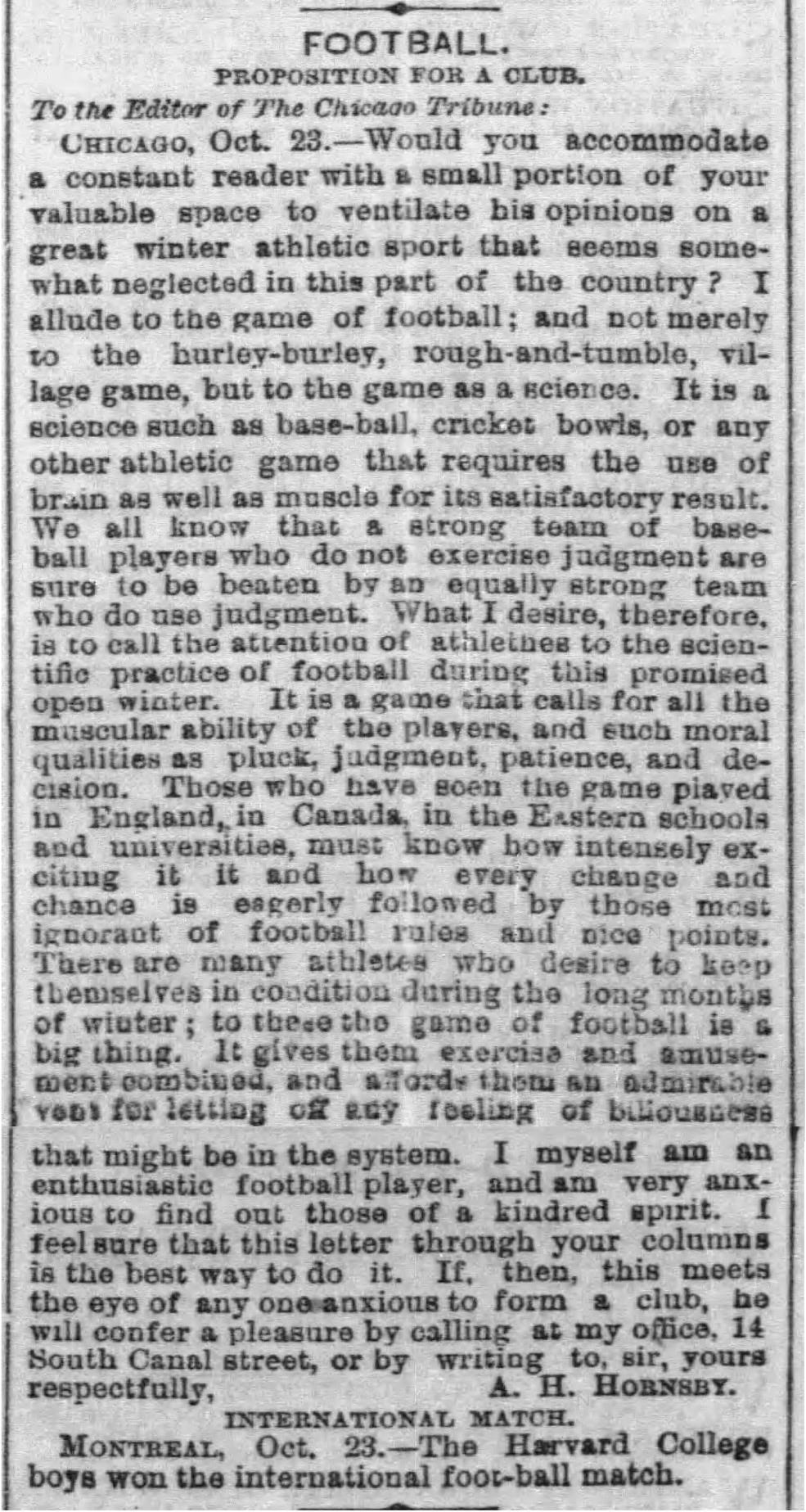
His letter spurred the formation of the CFC, which adopted a constitution in mid-November 1875 to play games under Rugby Union rules. Hornsby, the captain, made copies of the rules available to club members, most of whom were Englishmen, since, as a reporter told readers:
Americans as a rule have never cottoned to any class of amusement that calls for undue physical exertion, and football as a scientific game may be said to be almost unknown on this side of the Atlantic.
‘Football,’ Inter-Ocean (Chicago), November 16, 1875.
They scheduled their first game at the White Stockings baseball grounds against the Chicago Barge Club, but too few Bargers showed up, so they played a pickup, mixed-roster game instead. Nevertheless, the CFC was sufficiently organized that they appeared in uniform: blue stockings, white knee pants, and blue jerseys. Plus, they committed to order a new ball from England and hoped to:
...enter into a contest with the best clubs in the country, including that at Harvard College, as well as clubs in Canada which have achieved some renown as patrons of the game.
‘Football,’ Chicago Tribune, November 21, 1875.
The CFC scheduled a Thanksgiving Day game with Northwestern, but it did not take place, leaving the opportunity for another college to slip in a game with the CFC before the Northwestern game took place in February 1876.
That sacred event occurred on December 9, 1875, when the CFC met the Athletic Club of St. Ignatius College on the White Stockings Grounds; the game ended in a 1-1 tie.
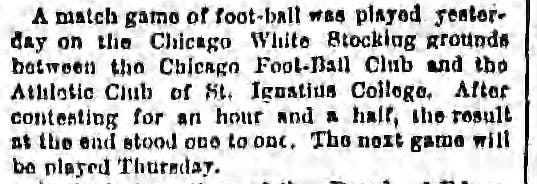
Who or what was St. Ignatius College? Founded in 1870, the school changed its name in 1909 to Loyola University or Loyola University Chicago. Loyola appears unaware of the 1875 game, claiming 1882 as their first year of football, even though they played seven years earlier. Since Loyola played in 1875, Northwestern and Michigan are out of luck. Until someone identifies an earlier college football game, Loyola, which dropped football in 1930, can lay claim to christening college football in the Midwest.
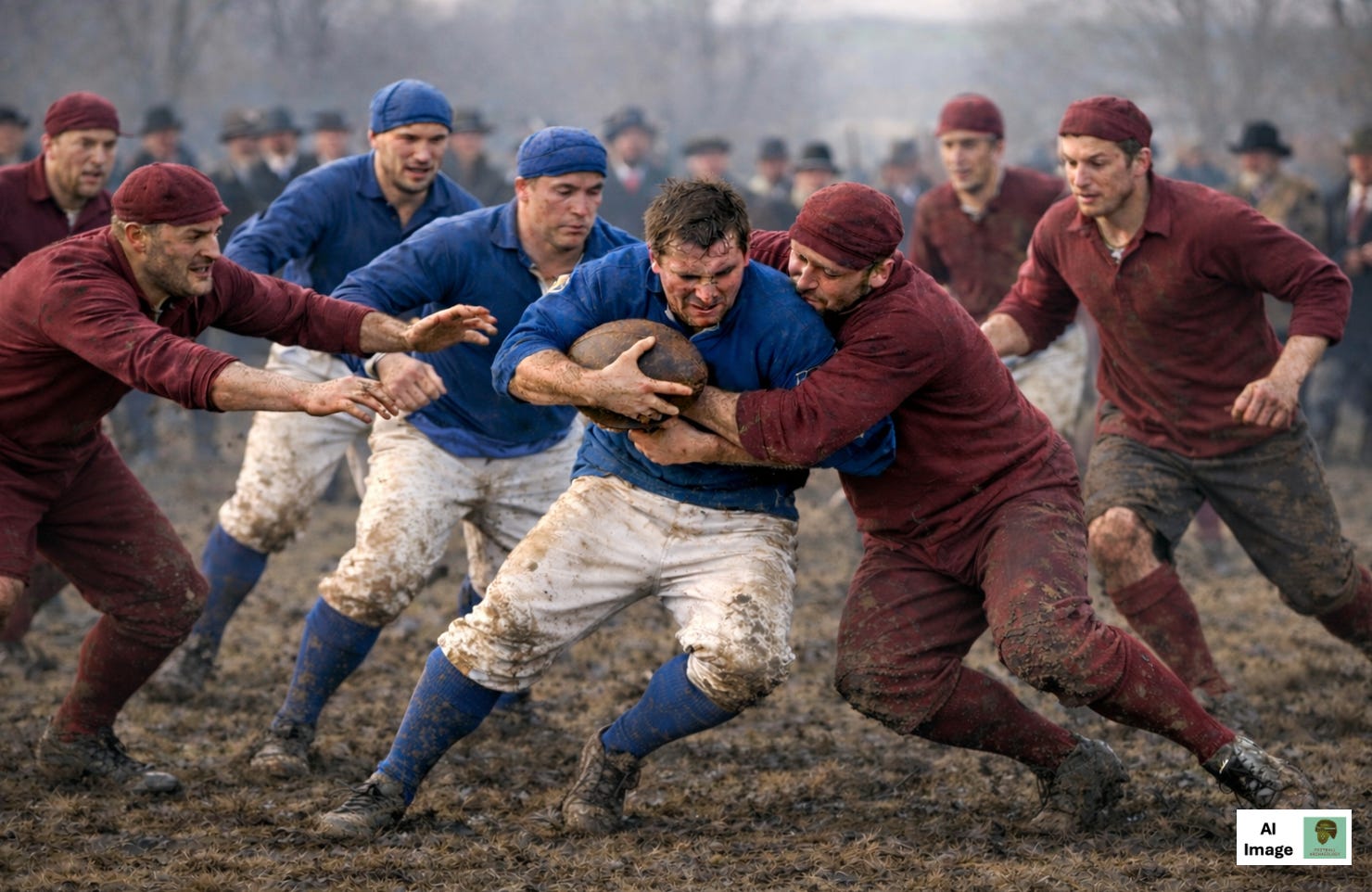
Finally, what became of the CFC? After playing in 1876, they held meetings and played a few intra-squad games in 1877 and 1878, but they appear to have folded in 1878. Later, the unrelated Chicago Athletic Association was formed in 1890 and became nationally competitive, stocking itself with Eastern stars such as Pudge Heffelfinger and former University of Chicago players.
So, hats off to Loyola for playing the first game in the Midwest in which college boys kicked the ball over the crossbar instead of under it. Unfortunately, we approach the 100th anniversary of Loyola dropping the game, so we’ll need to find it in our hearts to forgive them.
FWIW, another longstanding claim is that the first legal forward pass came in the St. Louis U-Carroll game at the start of the 1906 season. Despite being a Carroll grad and believing that lore for years, I later showed that claim to be untrue. The first known pass occurred several days earlier when New Hampshire threw an incomplete pass versus Maine.


Regular readers support Football Archaeology. If you enjoy my work, get a paid subscription, buy me a coffee, or purchase a book.


NW played a game without goal posts? Im going to use that as my excuse for why it doesnt count haha. And as Loyola no longer plays, I feel like Michigan's claim us to be the "first midwestern college to play football that still plays football"
This is at a time when the game was mostly about scrumming up and down the field, right? And then kicking for a goal? How did they score any goals without goalposts, I wonder?
Also im annoyed 150 years later at that reporter calling Americans lazy.
Tim, although 1906 was the first season the NCAA legalized the forward pass nationwide, as you probably know, there was a game played in Wichita, Kansas, in 1905 (Christmas Day) between what is now Wichita State University and Washburn University in which legal forward passes were thrown. The game was refereed and overseen by John Outland (then also head coach at Washburn). It would appear the game was intended as an exhibition by the NCAA to experiment with the forward pass, as well as the possibility of instituting a new rule requiring three downs to make ten yards for a first down. Of course, both rules were instituted the following year, despite the fact that while Outland reported to the NCAA that the forward pass was advisable, he told them that the three-to-make-ten was not workable.