
Football’s 1884 Rule Book: Section I - Rules Used As Definitions

At the end of April, I wrote a story about William Fellowes Morgan, a Columbia player who published the IFA’s 1882 rule book. The research led me to the Library of Congress, which has a previously unavailable-to-the-public copy of the 1884 rule book. Like the 1883 version, it was edited by Walter Camp and published by Wright & Ditson, a Boston sporting goods company. To gain access to the rule book, I asked readers to fund its scanning, and several of you did so within a few days.
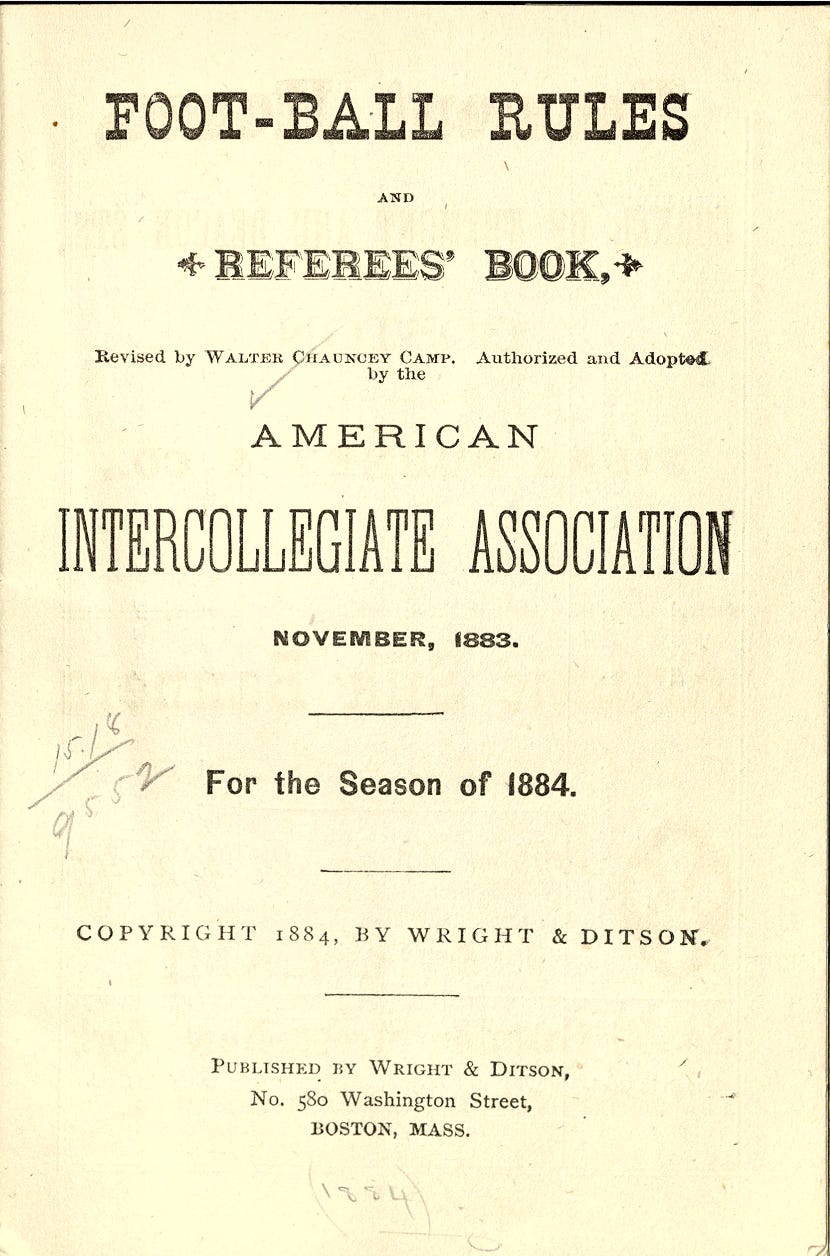
The Library of Congress has since scanned the document and provided me with a PDF, which I will share in sections over the next few days. In each section, I’ll comment on the rules themselves and how they compare to the first rules of football, outlined in 1876. Football changed substantially in those nine years. Many of those changes are summarized nicely in the Substack Amator Ludis, though we still disagree on when football started. (He says 1883. I say 1876.)
As additional background, longtime readers may recall that I reviewed each of football’s 61 rules from 1876 in separate posts in 2022 and 2023. The link below takes you to the last article in the series, which includes links to all the articles.

Football’s 1876 versus 1884 Rule Books
We’ll cover the details as we go along, but the 1876 and 1884 rule books differ for several reasons. First, the 1876 rugby rules, which the IFA’s rule book copies nearly verbatim, were a disorganized mess. They read as if a committee brainstormed the rules, jotted them down in the order someone yelled them out, and did not bother organizing them.
American players struggled to understand this new game and worked to clarify and organize its rules. By 1884, their modified rules were organized in five sections, including:
Section I: Rules Used As Definitions
Section II: Rules Preliminary To The Game
Section III: Rules Bearing Directly On The Play, plus a Field Diagram and Score Sheet
Referee’s Duties
Interpretation of Rules
Second, early football players sought greater specificity in the rules, so they added more detail to some of them and consolidated others, leaving only 38 rules. Third, American players changed rugby’s rules to reflect the style of play they preferred. The possession system (controlled scrimmage), the downs system, the points-based scoring system, and the early allowance of blocking were the primary changes.
Despite the improvements made from 1876 to 1884, modern readers will still see much archaic language and concepts that are no longer part of the modern game.
Section I: Rules Used As Definitions
Rules 1 and 2 show little change in concept between the rule books and are quite similar to today, while Rule 3 covers the kickout. Our current touchback procedures largely substitute for the kickout.
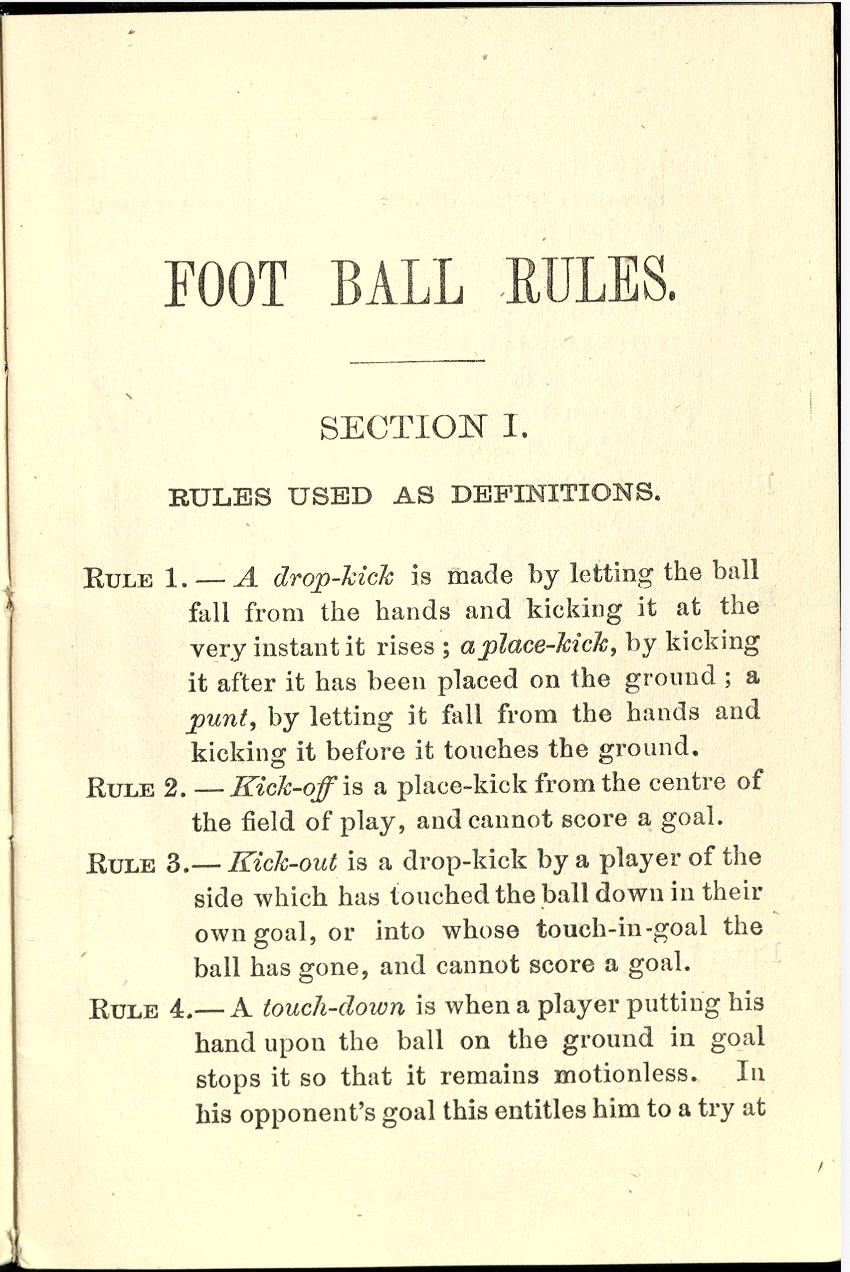
Rule 4 is a mishmash since it covers a player putting the ball on the ground:
In the opponent’s goal, leading to a try at goal (a free kick)
In his own goal, leading to a kickout
In his own goal, leading to a safety
The safety as a distinct scoring act came in 1884. Before, it either did not play a role in scoring or it came in to play only under certain conditions.
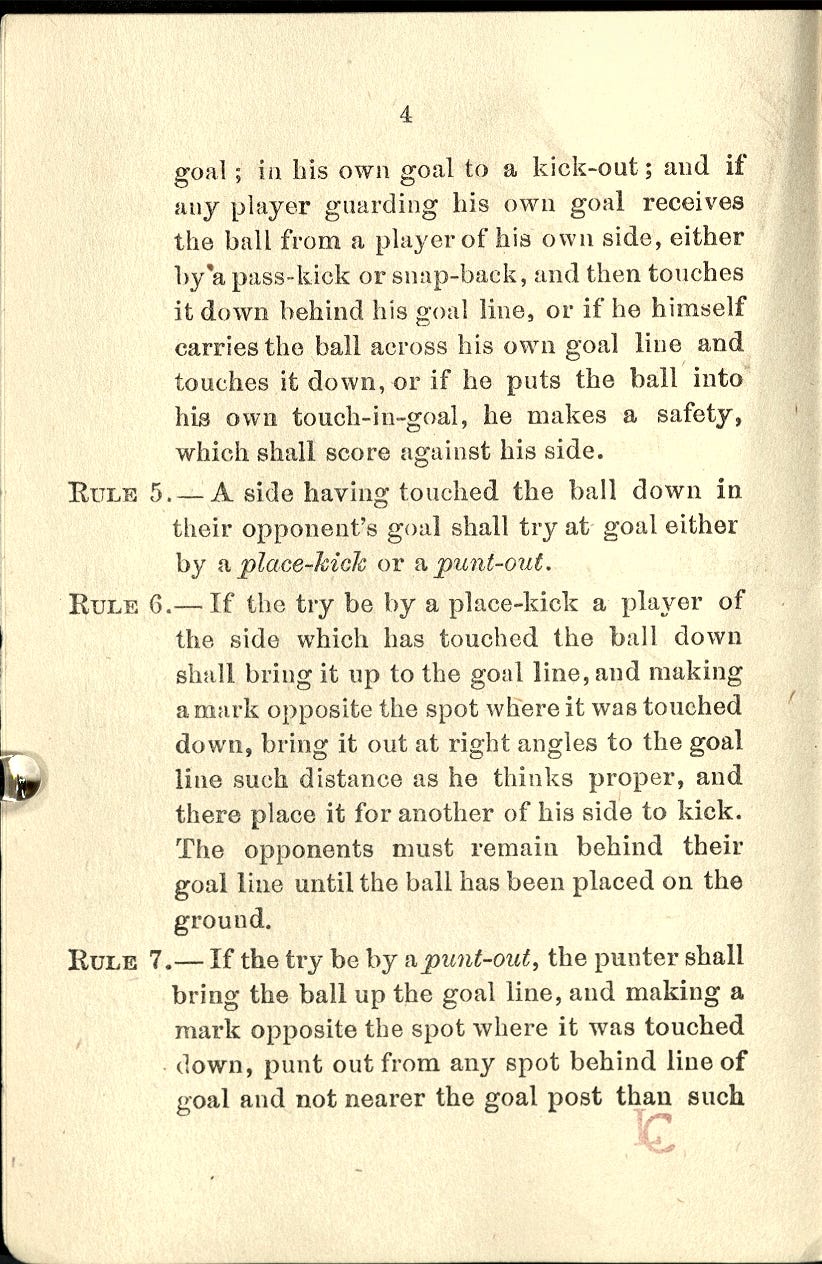
Rules 5 to 7 are much the same concept as in 1876, though under different rules, and outline the process for kicking a goal after a touchdown or trying a puntout. Teams generally attempted the kick when they scored a touchdown near the center of the field, and opted for the puntout when scoring closer to the sideline because of the kick’s angle and distance. Puntouts disappeared from the game in the early 1920s.
Rule 8 covers the punt-on, which allowed a player making a fair catch on a puntout to punt it again, ideally to a teammate positioned in a more favorable position for a kick at goal, who might fair catch the ball. Teams could execute multiple punt-ons as needed.
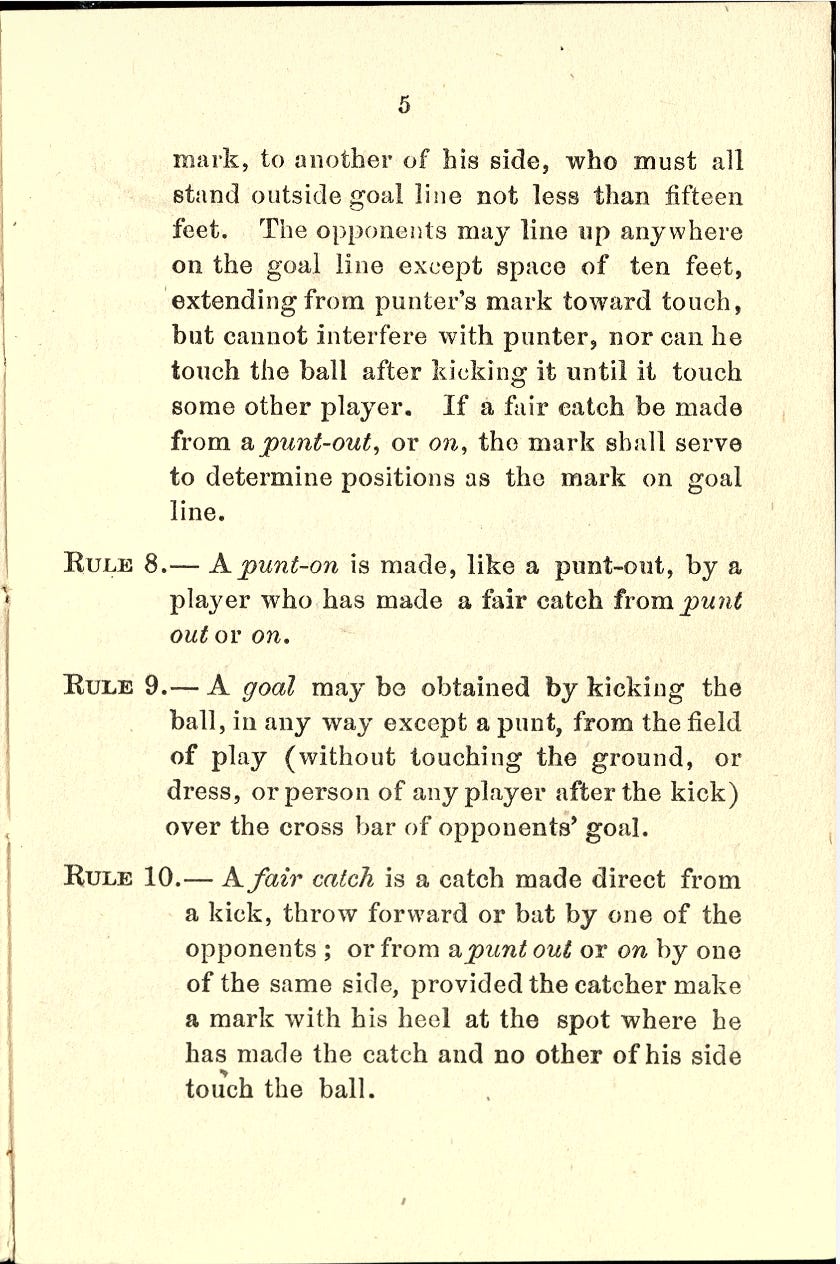
Rule 9 describes how teams could score goals by any kick other than a punt. It also describes posters, which occurred then when the ball hit the post or crossbar, which we now call a “doink.”

Rule 10 defines the fair catch made from a kick, throw forward, or batted ball. The fair catch on a kick functions as it does today, whereas opponents throwing the ball forward or batting it, also called “knocking on,” was illegal. However, on first down or other circumstances, teams might gain an advantage by “intercepting” the thrown or batted ball via a fair catch, so it was part of the rules.
Rule 11 reflects the better-organized 1884 rule book, since the five conditions in which the ball is dead were spread across the 1876 rule book. Camp and others consolidated those conditions in one spot.
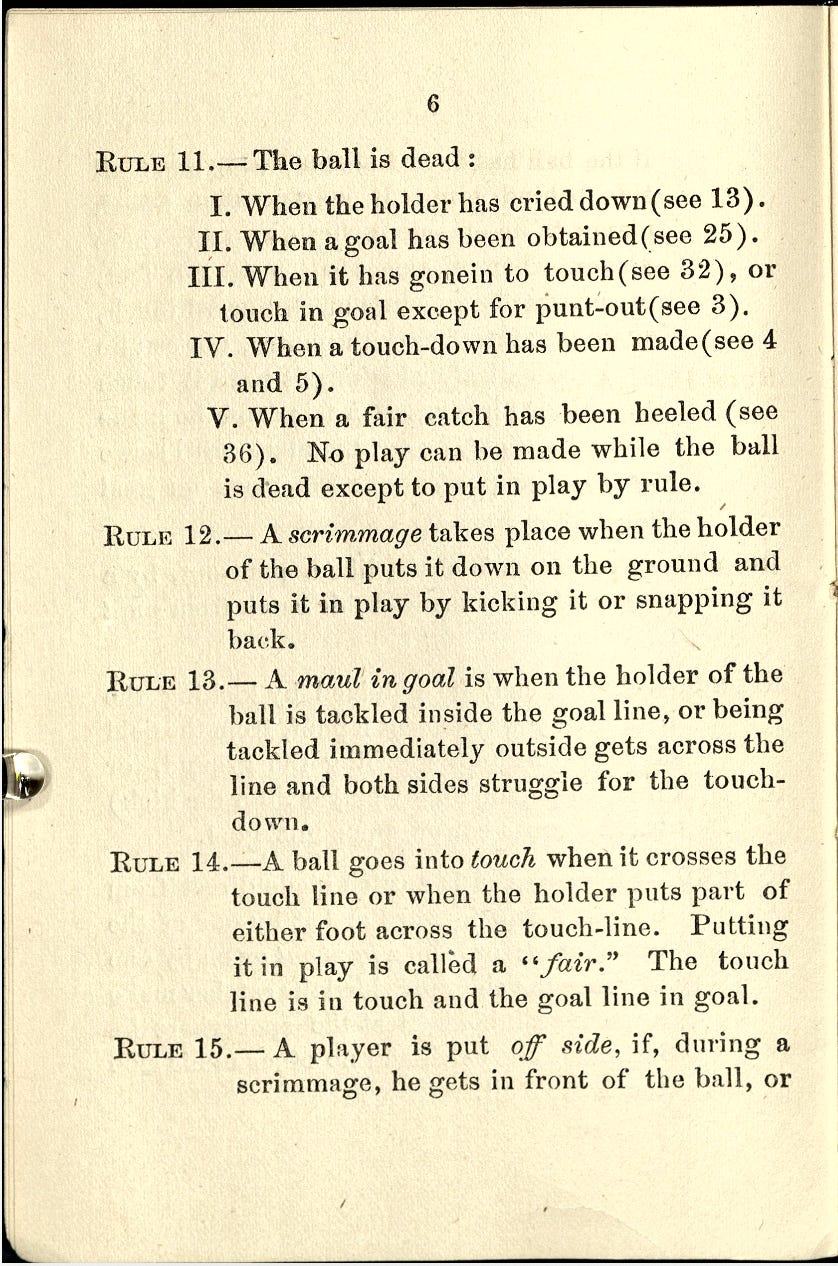
Rule 12 reflects a fundamental difference in the game compared to 1876. The scrimmage of 1876 focused on kicking the ball forward, as in rugby, while the 1884 rule reflects the adoption of the possession system in 1880, with play beginning either by kicking the ball forward or by snapping it back with the foot. The new scrimmage resulted in structured, pre-planned play rather than the free-flowing rugby game. As we will see in the interpretation section, the 1884 rules allowed the snapper to place his hand and foot on the ball. Though he could not pick up the ball, he could roll it back, eventually leading to snappers using only their hands and lifting the ball.
Rule 13 is little changed from 1876, though the defending team could no longer gain possession of the ball during the maul-in. Maul-ins disappeared in 1885. Today’s tush push is a very distant cousin of the maul-in.

Rule 14 defines the touch line (aka sideline) and tells us that the touch lines and goal lines are out of bounds and part of the goal, respectively. Other than terminology, the rule remains the same today.
Rules 15 and 16 cover the off-side rules, which were more involved in 1876 than in 1884 and in 1884 than today. The creation of the controlled scrimmage in 1880 simplified the off-side concept, though remnants of it remained until American football eliminated the onside punt/kick in the early 1920s.
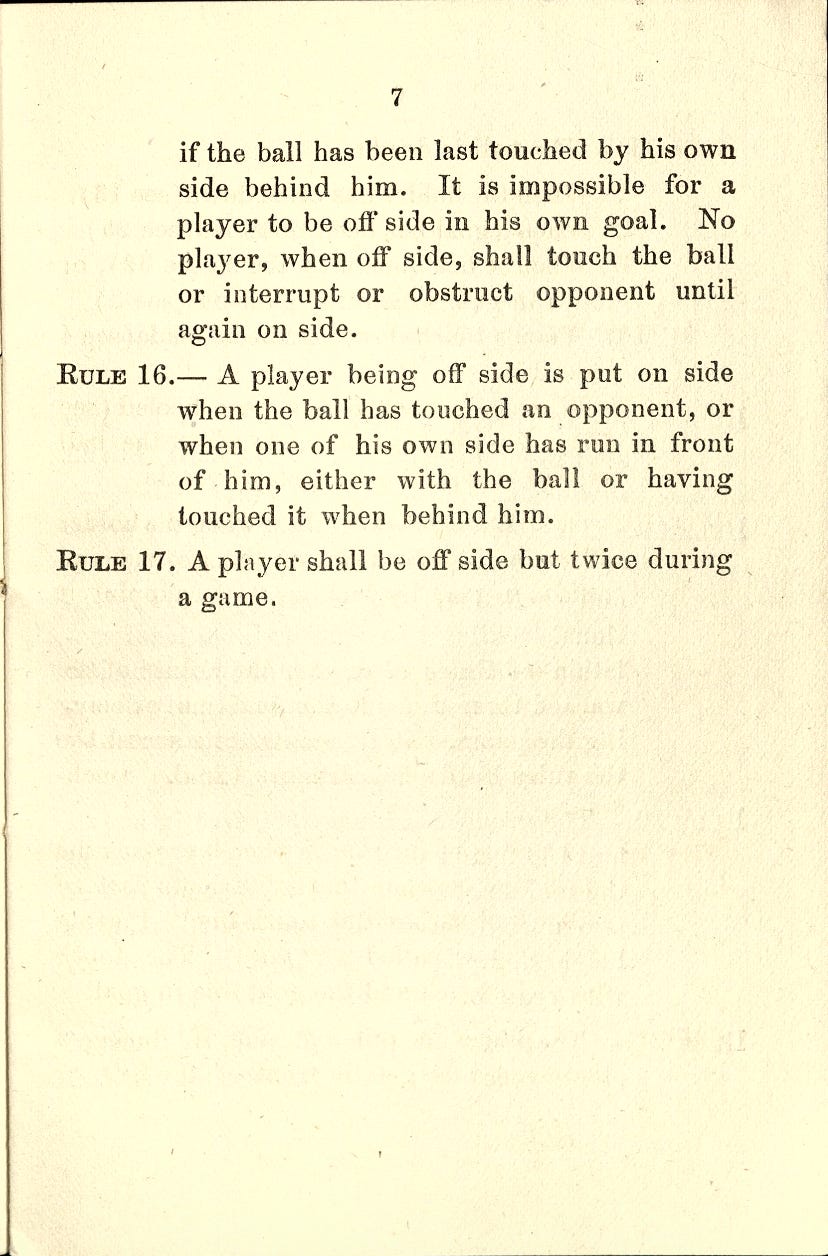
Rule 17 limits a player to being off-side twice in a game, with the second offense being a disqualifier. The number of offenses allowed for off-side and other unsportsmanlike acts was central to Harvard and Princeton’s concerns about the game at the time. They wanted players removed for their first offense, not given multiple opportunities. This conflict eventually resulted in Harvard’s faculty barring their students from playing in 1885.
As will be discussed, the 1883 and 1884 seasons were important for selected rule changes, but more so for setting the stage for faculties and schools seeking to take control of intercollegiate athletics. More important than the rule changes were the beginnings of policies we took for granted for decades regarding who controls the game rules, eligibility standards, amateurism requirements, and like. We’ll cover some of this situation, the battle between Harvard and Yale, and related topics in the series summary.
If you enjoy Football Archaeology and are not a paid subscriber, consider buying me a cup of coffee here and there. You can also buy a paid subscription or purchase one of my books.

