
Football’s 1884 Rule Book: Section II - Rules Preliminary to the Game

This article is the second in a series covering the 1884 Intercollegiate Football Association rule book. The first article provided background on the series, including information about locating the book in the Library of Congress and funding its scanning.
This article focuses on Section II: Rules Preliminary to the Game, which covers Rules 18-27 and defines the officiating, playing field, number of players, and other procedural elements, including the game’s scoring rules. As in the previous article, we’ll briefly examine the differences between the 1876 and 1884 rules and how they relate to the present.
Section II: Rules Preliminary to the Game
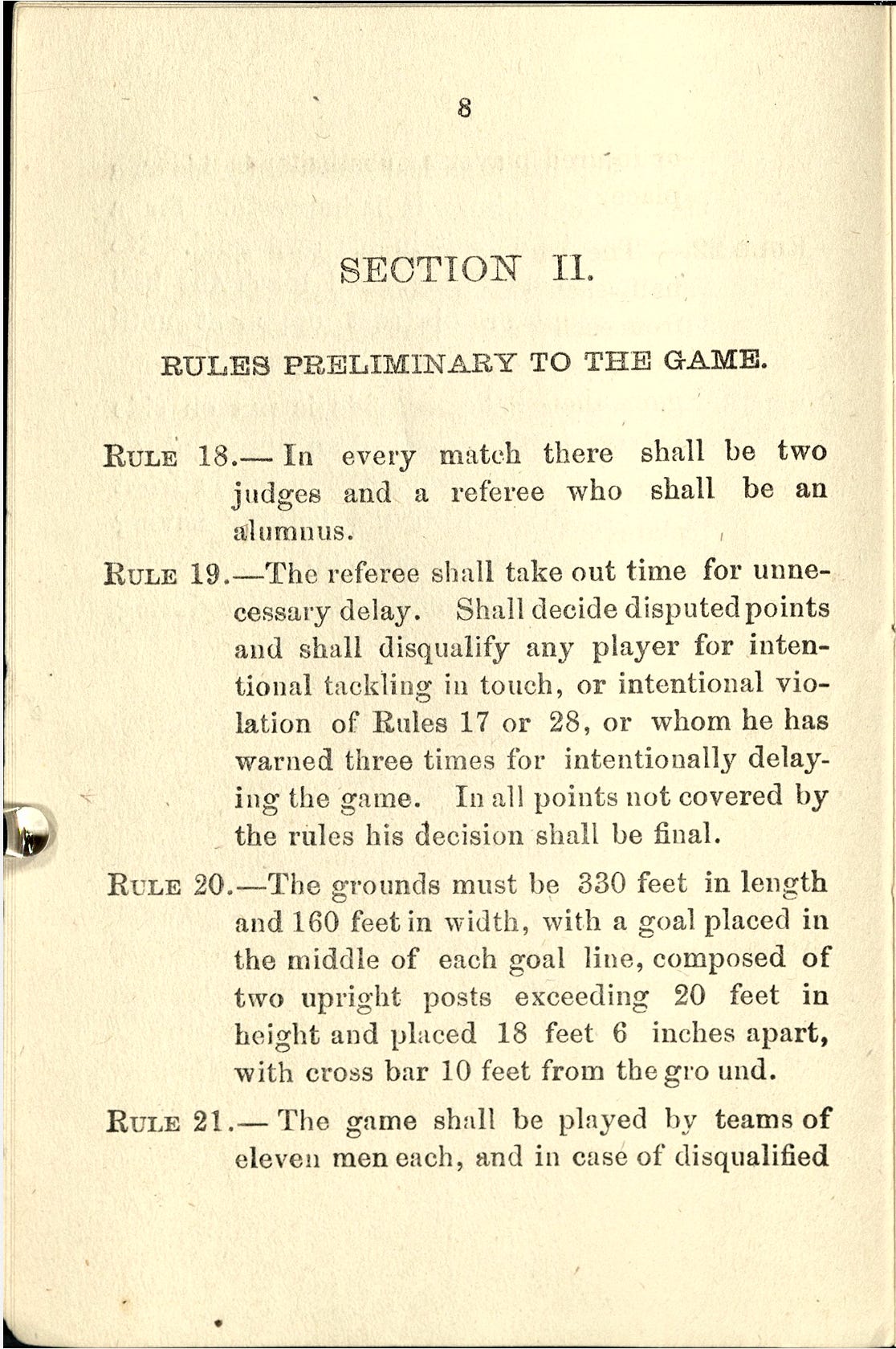
Rule 18 describes the game’s officials, two judges and a referee, with the 1884 edition adding the new requirement that the referee shall be an alumnus. The alumnus requirement was likely intended to ensure the referee was knowledgeable about the game.
The 1876 rules also provided for a referee and two judges, with the judges serving as advocates for the respective teams. By 1884, the judges were neutral assistants to the all-powerful referee.
Rule 19 outlines the game’s penalty structure for players who are off-side (Rule 17) or who commit various personal fouls (Rule 28). Football did not yet have distance penalties beyond returning the ball to the spot for certain fouls. Fouls led to turnovers, loss of a down, or player disqualification. Allowing players to commit three fouls before being disqualified was central to Harvard’s dispute with the IFA and to its faculty’s decision not to allow Harvard to play football in 1885. The referee also controls the clock during certain stoppages, rather than the running clock of 1876.
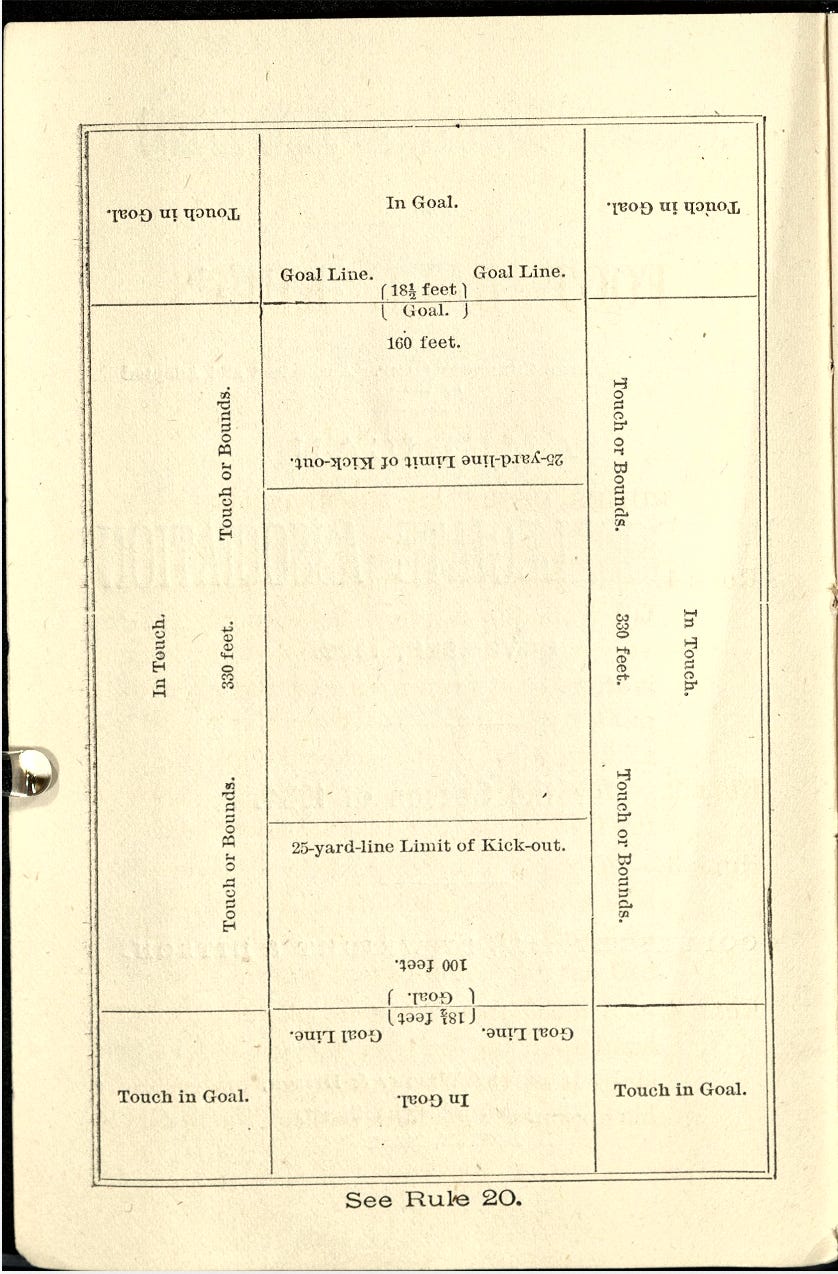
Rule 20 defined the playing field as 330 feet long (110 yards) by 160 feet wide (53⅓ yards), whereas the 1876 field was 140 yards long by 70 yards wide. The goalposts were also taller than required in 1876. The interpretation section, covered in a later article, includes the requirement:
The field should be marked with transverse lines every five yards.
The yard lines spaced five yards apart is not reflected in the playing field diagram despite that requirement being put in place in 1882.
Rule 21 states that each team has 11 players on the field. The game did not allow substitutions as we think of them today. The starters played the full game unless they were disqualified or injured.
Each game consisted of two 45-minute halves with a 10-minute intermission (Rule 22). The game is decided by the combined score of the two halves.
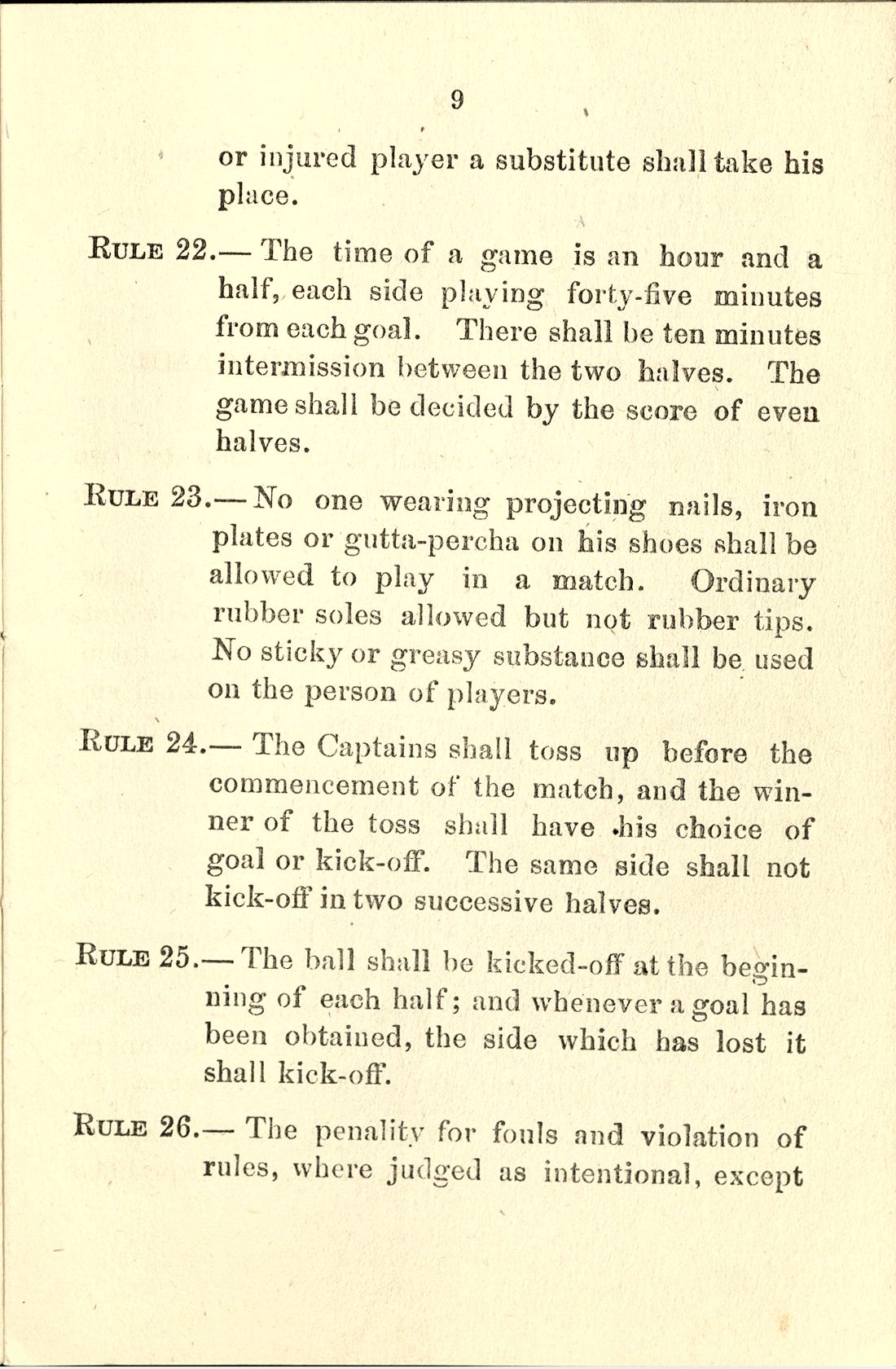
Rule 23 identifies legal and illegal player equipment, banning hard, sticky, or greasy substances, as well as rubber cleats on shoes.
Rule 24 covers the captains “tossing up” pre-game, which we know as the coin flip. The winner gets his choice of the goal or kicking off. At the time, the kicking team typically dribbled kicked -similar to soccer- and retained possession of the ball. Princeton introduced the V Trick in 1884, later leading to the Flying Wedge.

Rule 25 tells us a kickoff occurs at the start of each half and following each goal. The team that gave up the score kicked off, allowing them to keep the ball by dribble kicking. That logic became problematic in the 1890s when they eliminated the dribble kick and Flying Wedge by requiring kickoffs to travel at least 10 yards.
Rule 26 provides for a loss of down when fouls were deemed intentional.
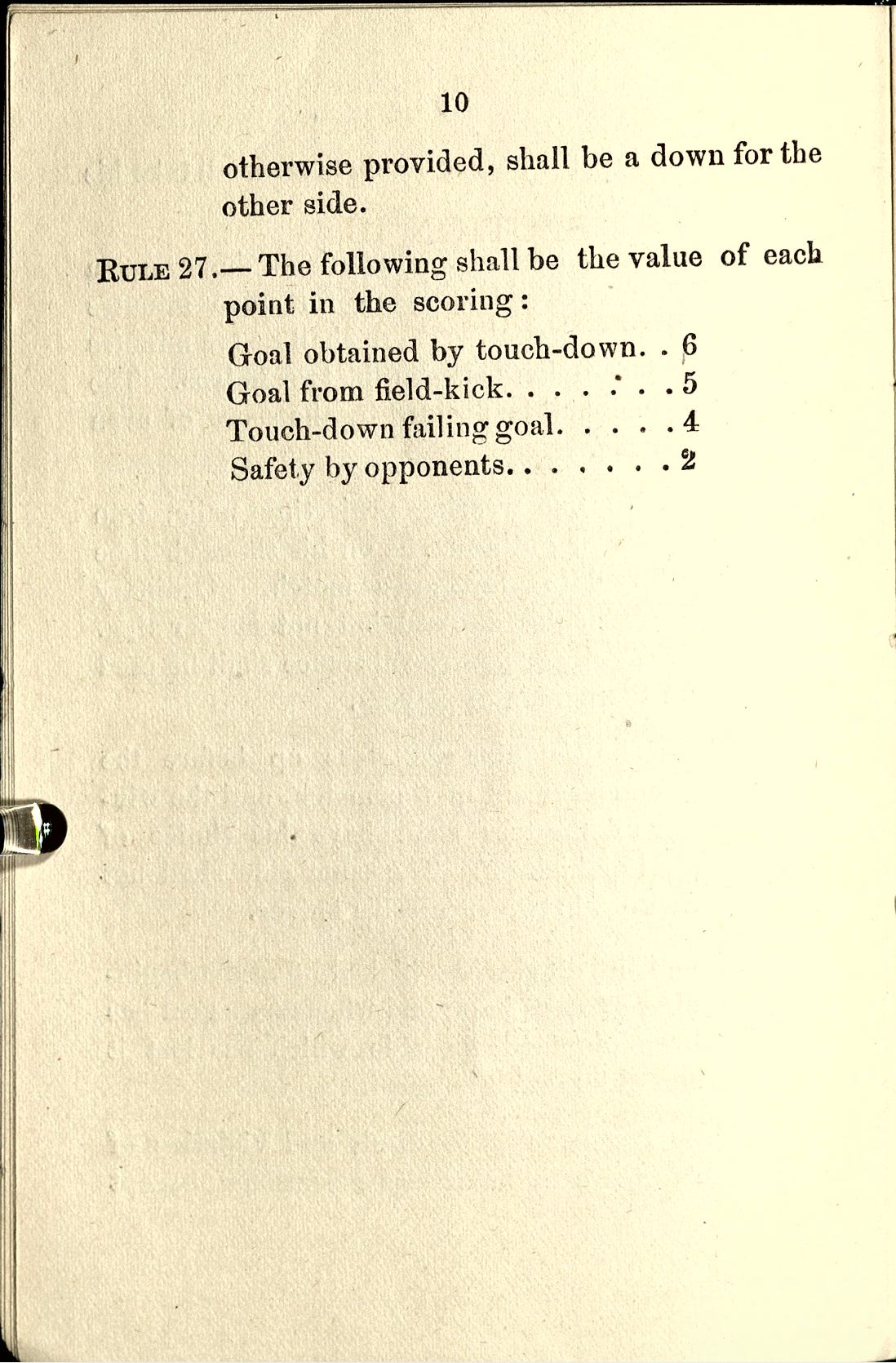
The last rule in Section II, Rule 27, covers scoring. Football’s points-based scoring system debuted the previous year with touchdowns counting 2 points, goals from field counting 5, goals after touchdowns were 4, and safeties were 1 point.
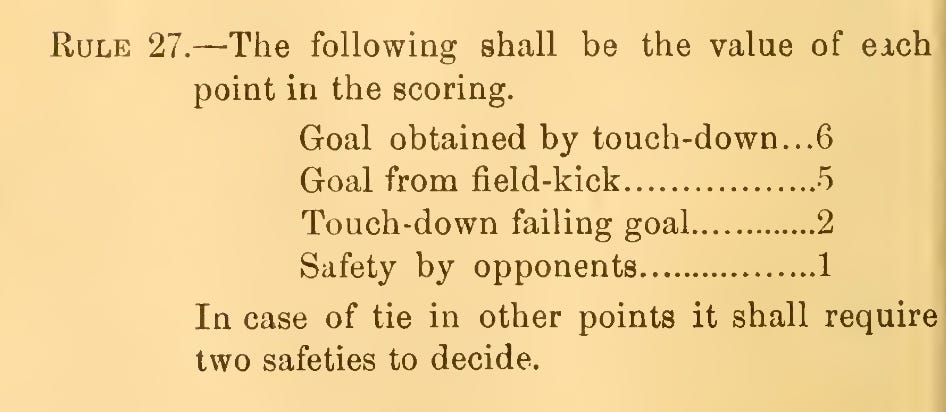
The 1884 rules effectively switched the point values for touchdowns and goals after touchdown to emphasize the value of the touchdown rather than the kick that followed it. Safeties also doubled in point value.
The 1884 rule book also includes a score sheet on page 16, which appears to have been a referee’s aid. The top half of the sheet tracks the game’s timing, including the time the game began, the timeouts, and the corrected end of each half based on play stoppages. The section headers refer to the First Three-Quarters and Second Three-Quarters, which seems odd until you remember that each half lasted 45 minutes or three-quarters of an hour.
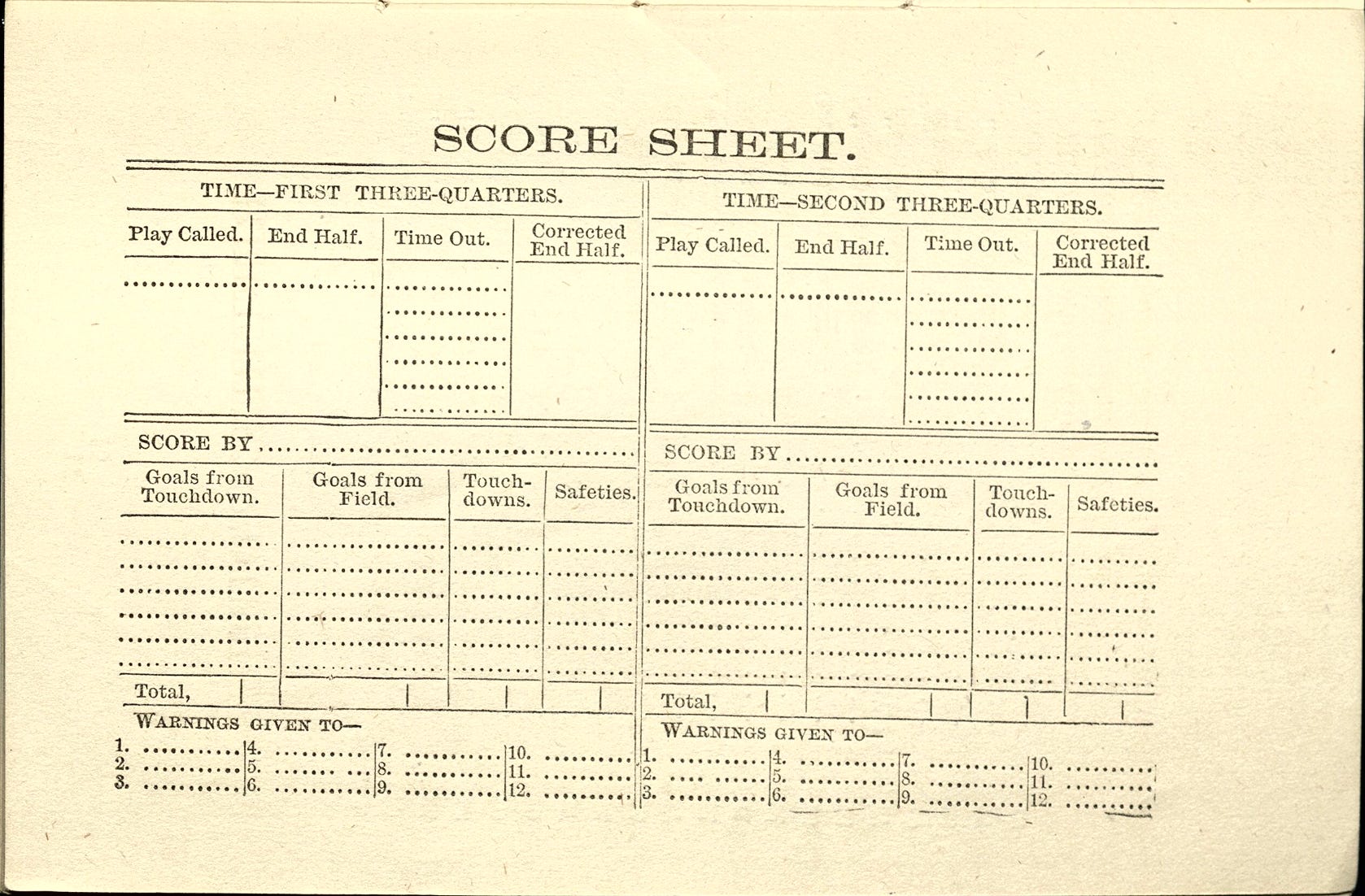
The bottom half of the page helps track the game’s scoring, and players warned for fouls. It appears that the referee or others scoring the game were to list the individuals who scored rather than tick marks.
Next up is Section III: Rules Bearing Directly on the Play, which covers the game’s rules on tackling, snapping, out-of-bounds, fair catches, and the like.
We’ll cover that section in the next day or two.
If you enjoy Football Archaeology and are not a paid subscriber, consider buying me a cup of coffee here and there. You can also buy a paid subscription or purchase one of my books.


I don't recall when the practice of posting officials' alma maters beside their names ended ('90s?). It was a common practice on ACC syndicated TV games for a long time. Chuck Amato's brother was a long time ACC official, and played at NC State.
In rules-making parlance, should is a preferred practice, shall is a requirement.