
Football’s 1884 Rule Book: Section III - Rules Bearing Directly on the Play

This article is the third in a series covering the 1884 Intercollegiate Football Association rule book. The first two articles provided background on the series and Sections I and II of the rule book.
The third section, concerning Rules Bearing Directly on the Play, covers the game’s rules on tackling, snapping, out-of-bounds, fair catches, and the like, so it covers the meat of the game. It includes Rules 28 to 38, most of which are quite lengthy and some of which are convoluted.
Rule 28 lists unsportsmanlike behaviors that result in fouls. It barred hacking, or intentionally kicking an opponent in the shins, and throttling, or choking, and other self-explanatory fouls.
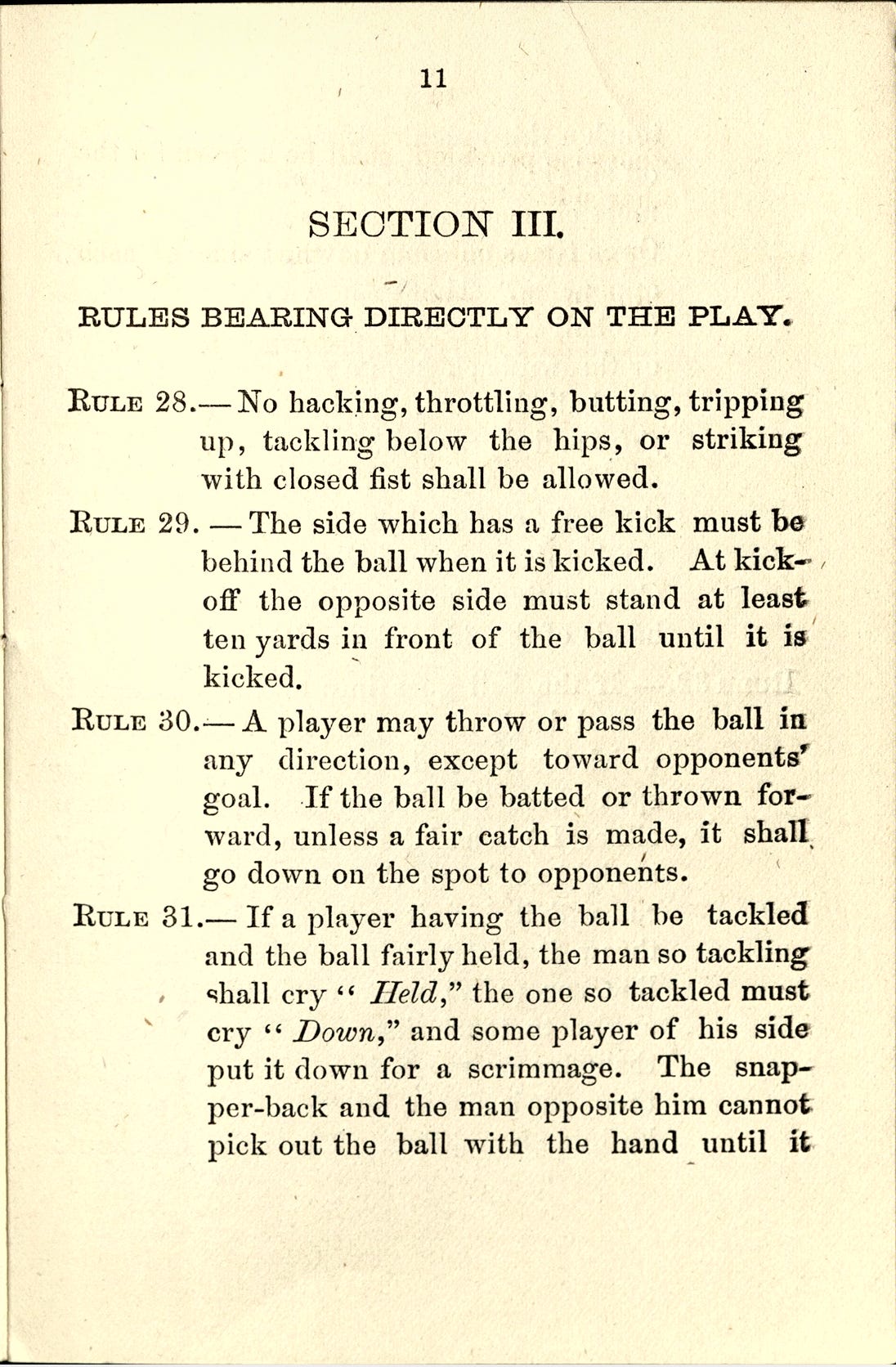
Rule 29 covers free kicks and kickoffs, which are a form of free kick. Everyone on the kicking team’s side must be behind the ball on a free kick, and the opposite side must stand at least ten yards behind the restraining line.
As mentioned in an earlier story, Rule 30 tells us it is illegal to throw or bat the ball forward, but the opposing team can fair catch balls sent forward if it is to their advantage.
We clearly are in the old days when tacklers yelled “Held” and ball carriers yelled “Down,” which were important procedures before the officials used whistles and horns. Rule 31 also requires that the player receiving the snap or fair (a toss onto the field from out of bounds) cannot run with the ball and must pass it to a teammate.
Balls went into touch (out of bounds) in 1884, so Rule 32 tells us the methods to get the ball back into play:
Bound the ball onto the field and run with it
Kick or throw it back to a teammate (who is behind the ball)
Execute a fair by throwing the ball at a right angle to the touch line (similar to rugby today)
Walk the ball 5 to 15 yards onto the field and set it down for a scrimmage
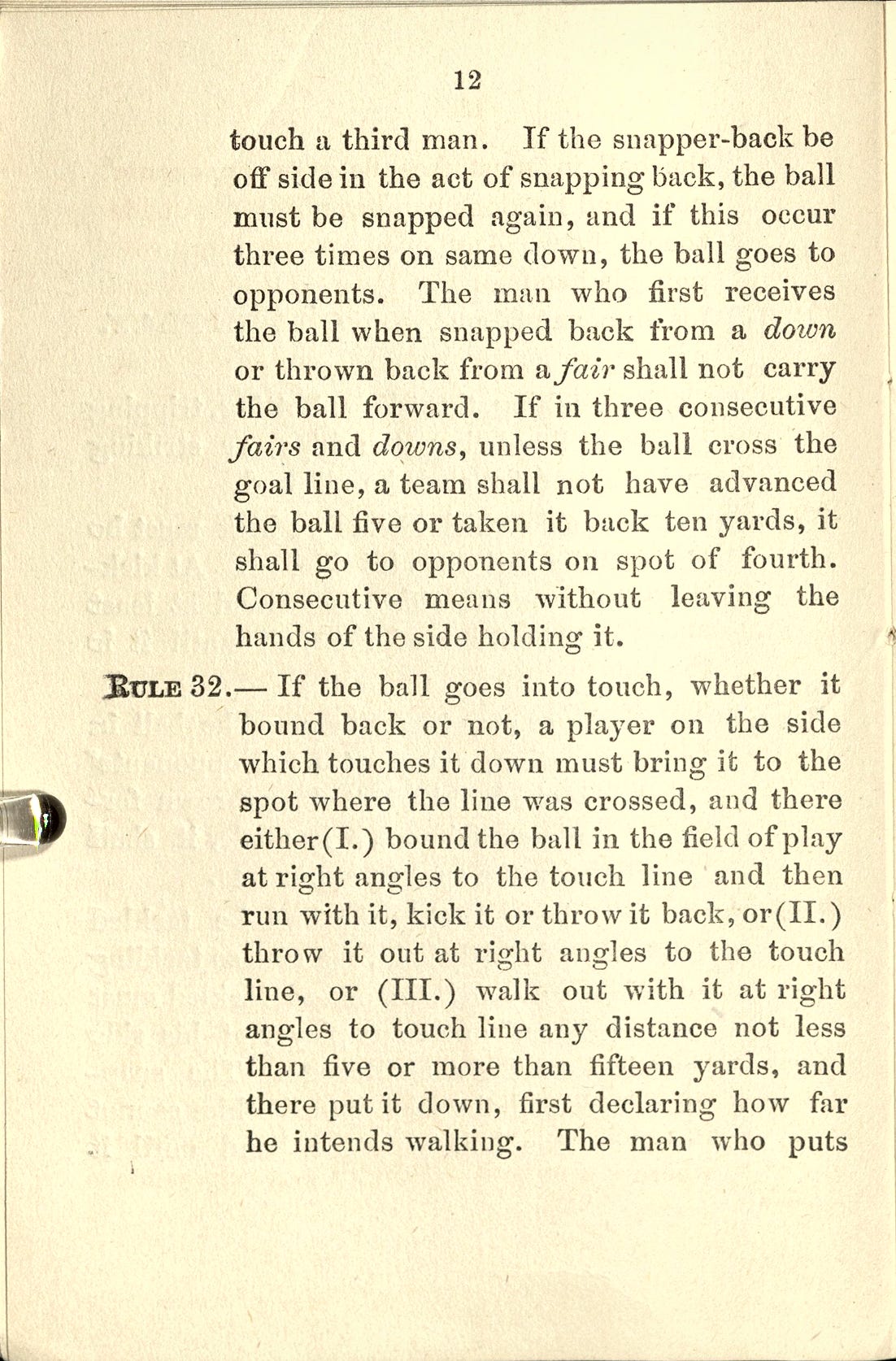
We covered maul-in in Section I, but Rule 33 tells us maul-ins were not free-for-alls. Only players touching the ball with their hands when the ball crossed the goal line could participate in the maul-in.
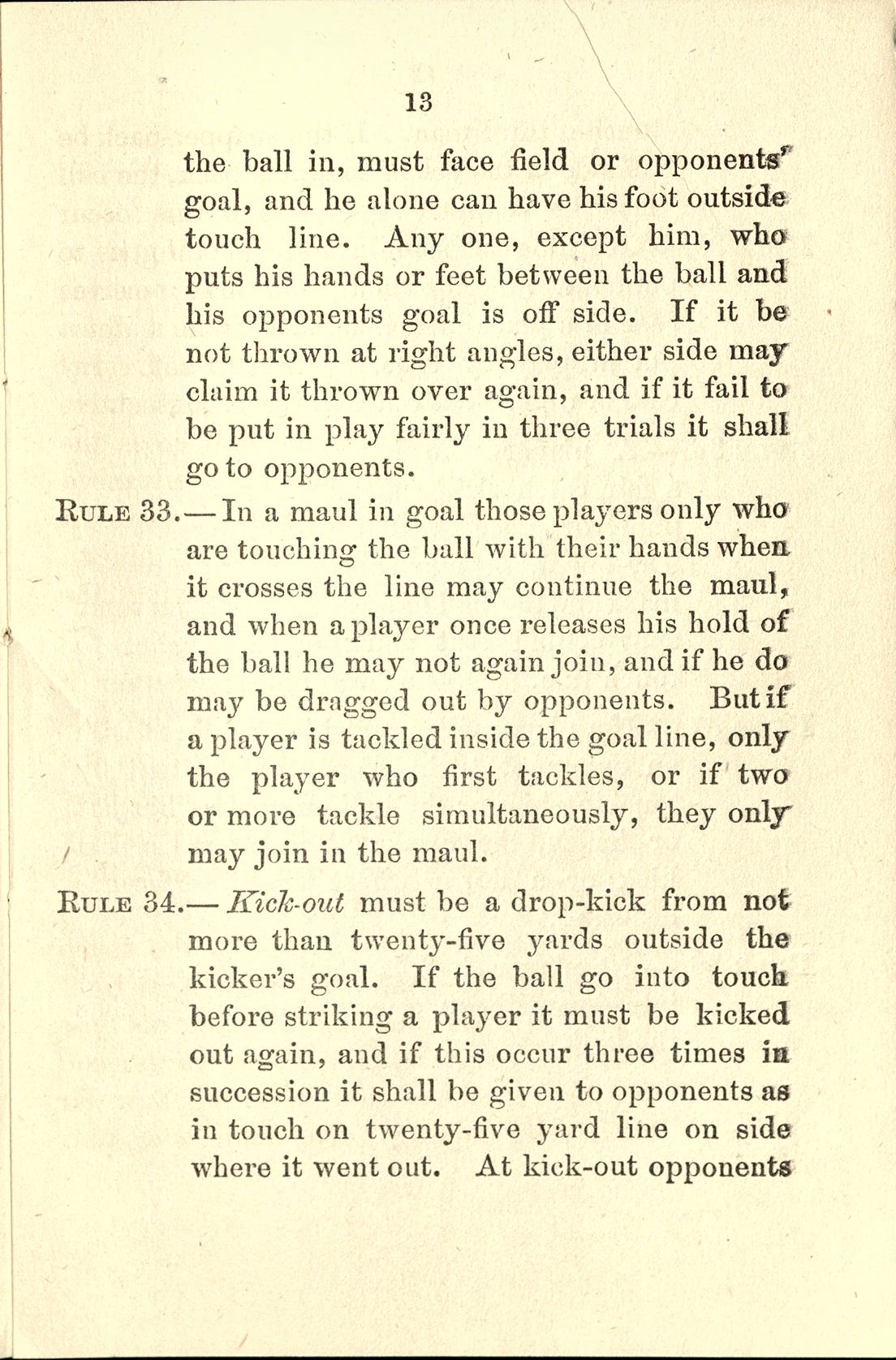
Rule 34 covers the procedures for kickouts, situations now covered by touchbacks. One of the few markings on early fields was the 25-yardline, which was there due to kickouts. As with kickoffs, the ball had to be kicked in bounds or result in a turnover.
Rule 35 seems to cover a lot of territory, but tells us when the defending team can charge, or rush, the kicker or punter. The ability to rush the placekicker when the ball touched the ground is why teams used the over-under holding technique.
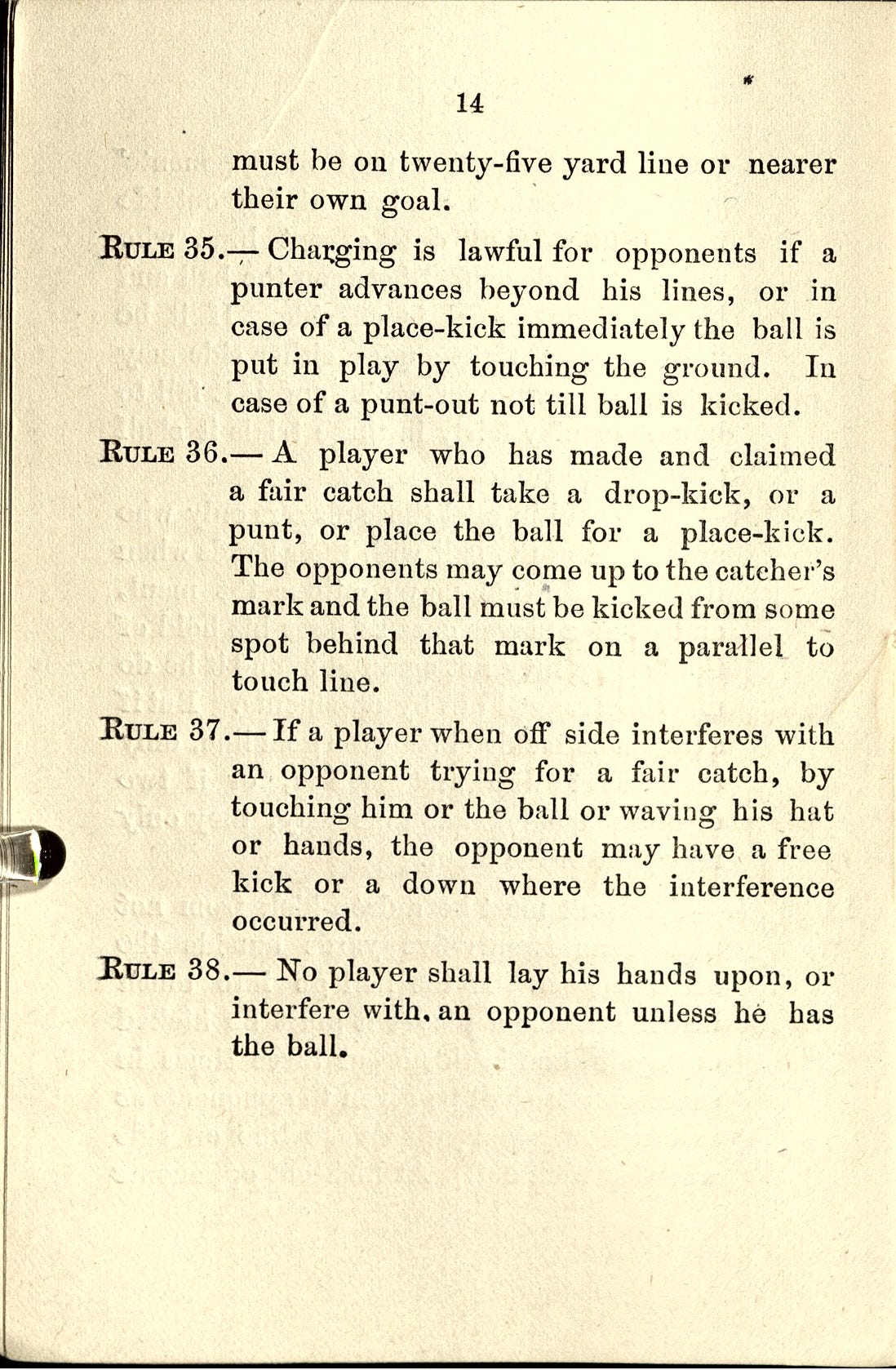
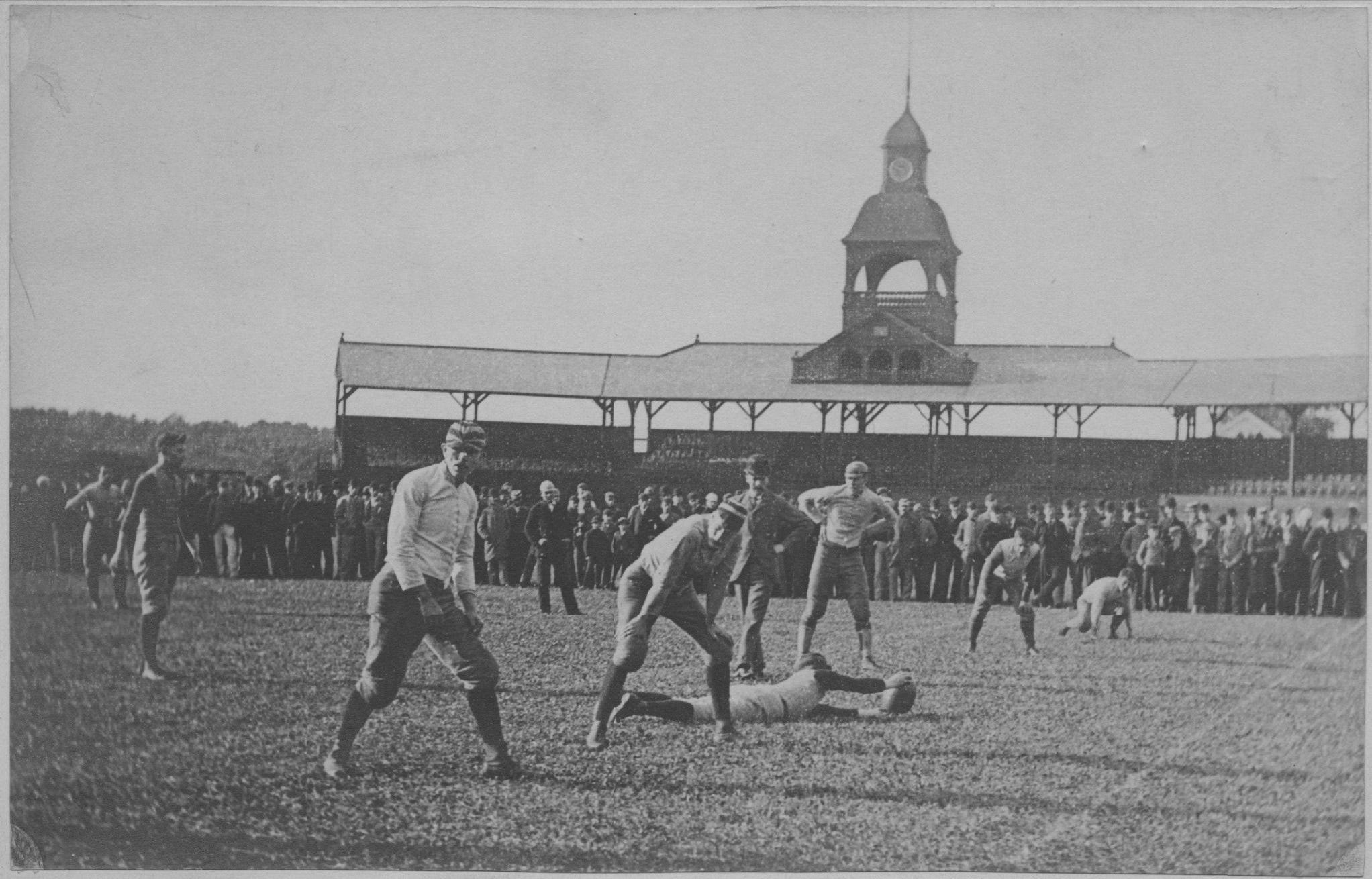
Rule 36 defines what occurs on a fair catch and defines the restraining line based on where the fair catch was made.
A foul occurred when a player interfered with a fair catch by touching the fair catcher or waving one’s arms or hat to distract them. (Teams mostly wore stocking caps or short-brimmed hats at the time, leading to them whipping their caps near the receiver to distract them.) Rule 37 put an end to that practice.
Rule 38 essentially says you could not touch a player of the other side unless he had the ball. The game was in transition in 1884 as the practice of warding or interfering, what we now call blocking, began to emerge. The acceptance of blocking is surely one of the top several changes that have pushed football further out of rugby’s orbit.
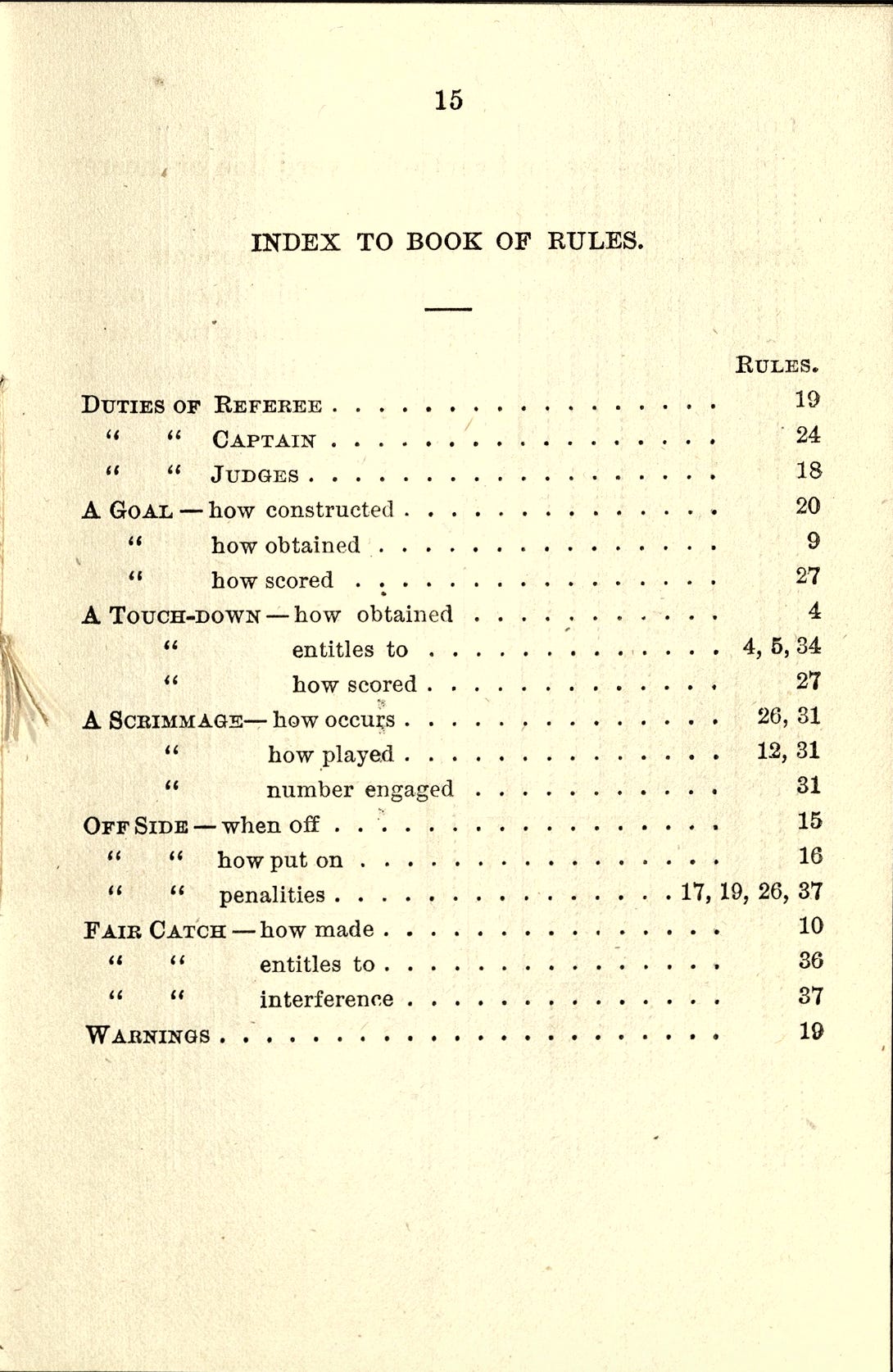
Page 15 is the Index, which, besides being in an odd location in the rule book, is also organized in a way that baffles the modern mind.
We’ll cover the Duties of the Referee next and cover some of the Interpretation of Rules section as well.
If you enjoy Football Archaeology and are not a paid subscriber, consider buying me a cup of coffee here and there. You can also buy a paid subscription or purchase one of my books.


Rule 28 will be revisited, I predict.
Was the Yale kickoff photo taken at Princeton (judging by the cupola'd grandstand)? ..