
Today’s Tidbit... The Nineteenth Street Trojans

Most football fans focus on games played by elite athletes, whether in college or the pros. Their games appear on television, receive attention in other media, and feature in our office water cooler conversations, virtual and otherwise.
Yet football is most often a game played by those who toil in obscurity and never make the big time, so it makes sense to occasionally look at the game played by the average Joe or Jose. Often, that involves teams sponsored by middle and high schools, even small colleges, but sports teams once had a wider range of sponsors, including businesses large and small. In big cities, factories and other enterprises had employee teams playing tackle football in industrial leagues.

Outside the cities, town teams played one another.

The best of these teams achieved semi-pro or even professional status. The Staley Starch Company sponsored the Decatur Staleys in the late 1910s and early 1920s, before the team became the Chicago Bears in 1922. The Acme Packing Company sponsored Curly Lambeau’s team in little Green Bay, where they’ve managed to stay thanks to the NFL sharing its broadcast revenues.
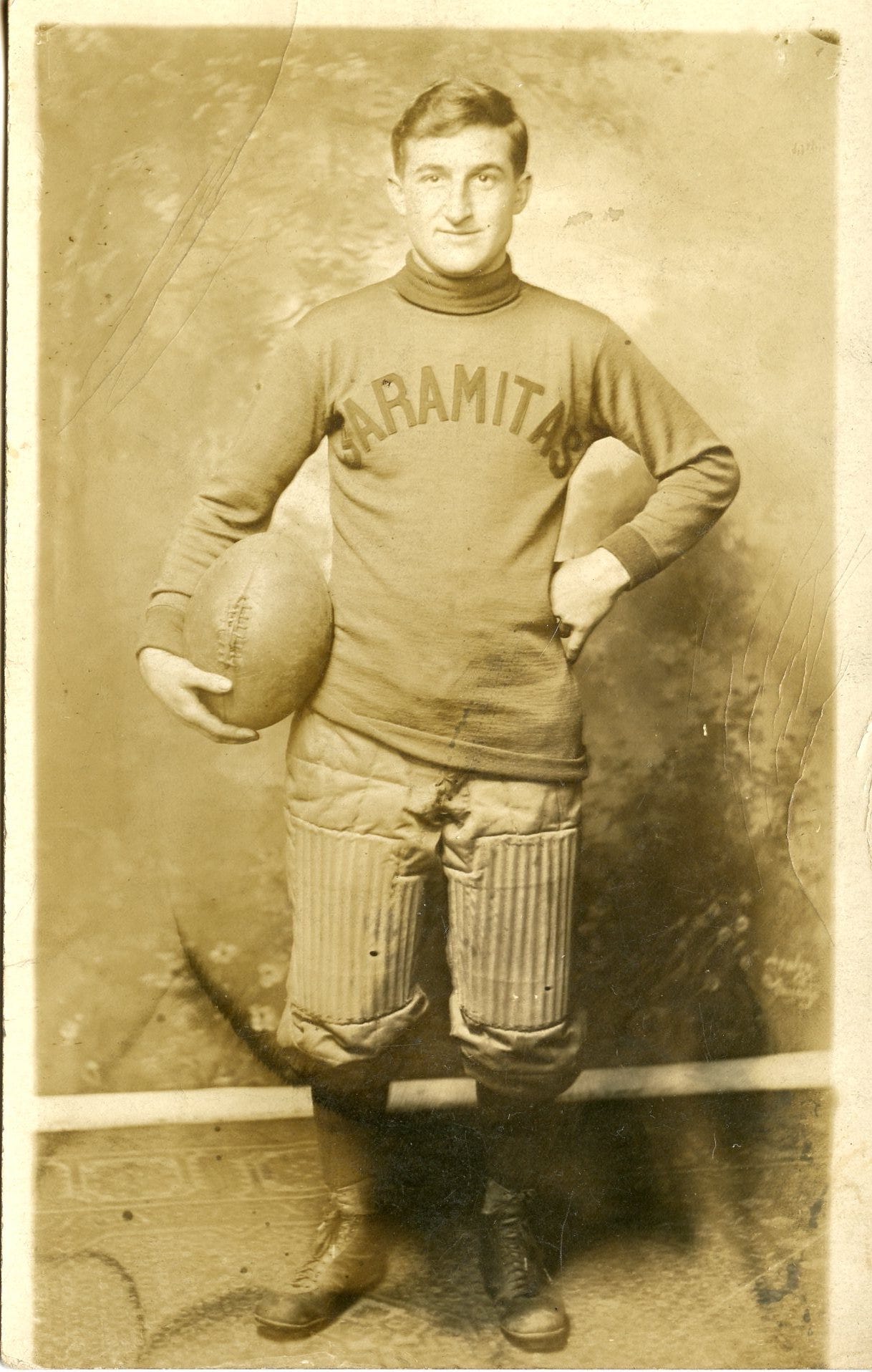
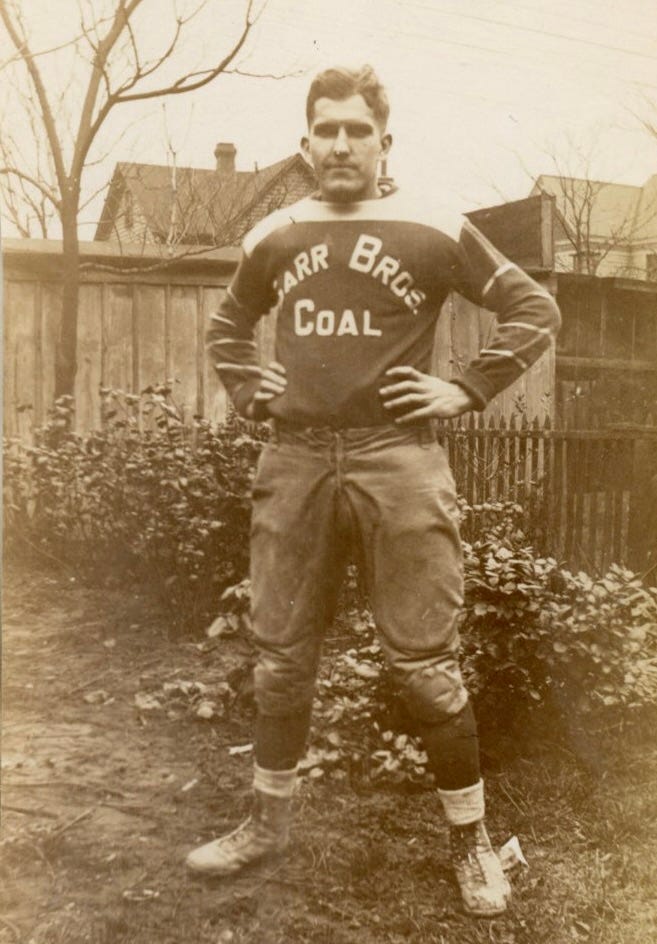
Generally, each team had one sponsor, but when a team could not find one sponsor willing to foot the bill, they found multiple sponsors. The players pictured below have sponsor names on their jerseys. Their teams may have had only one sponsor, but I don’t think so.
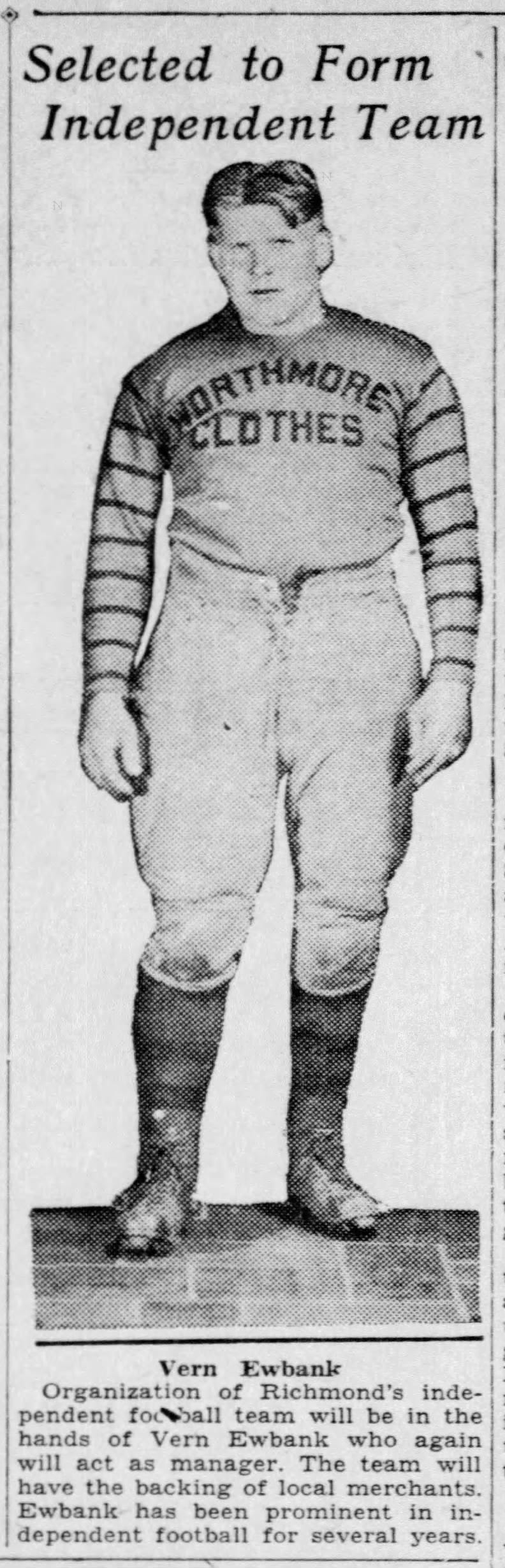
An example of the multi-sponsor system involved Weeb Ewbank, who played on semi-pro teams his older brother Vernon managed in Richmond, Indiana. One team, called the Richmond Merchants, had each player’s jersey bear the name of the merchant who sponsored them.

That setup brings us to the Nineteenth Street Trojans, whom I discovered through the image below, which shows a group of teenagers wearing football jerseys atop street clothes.
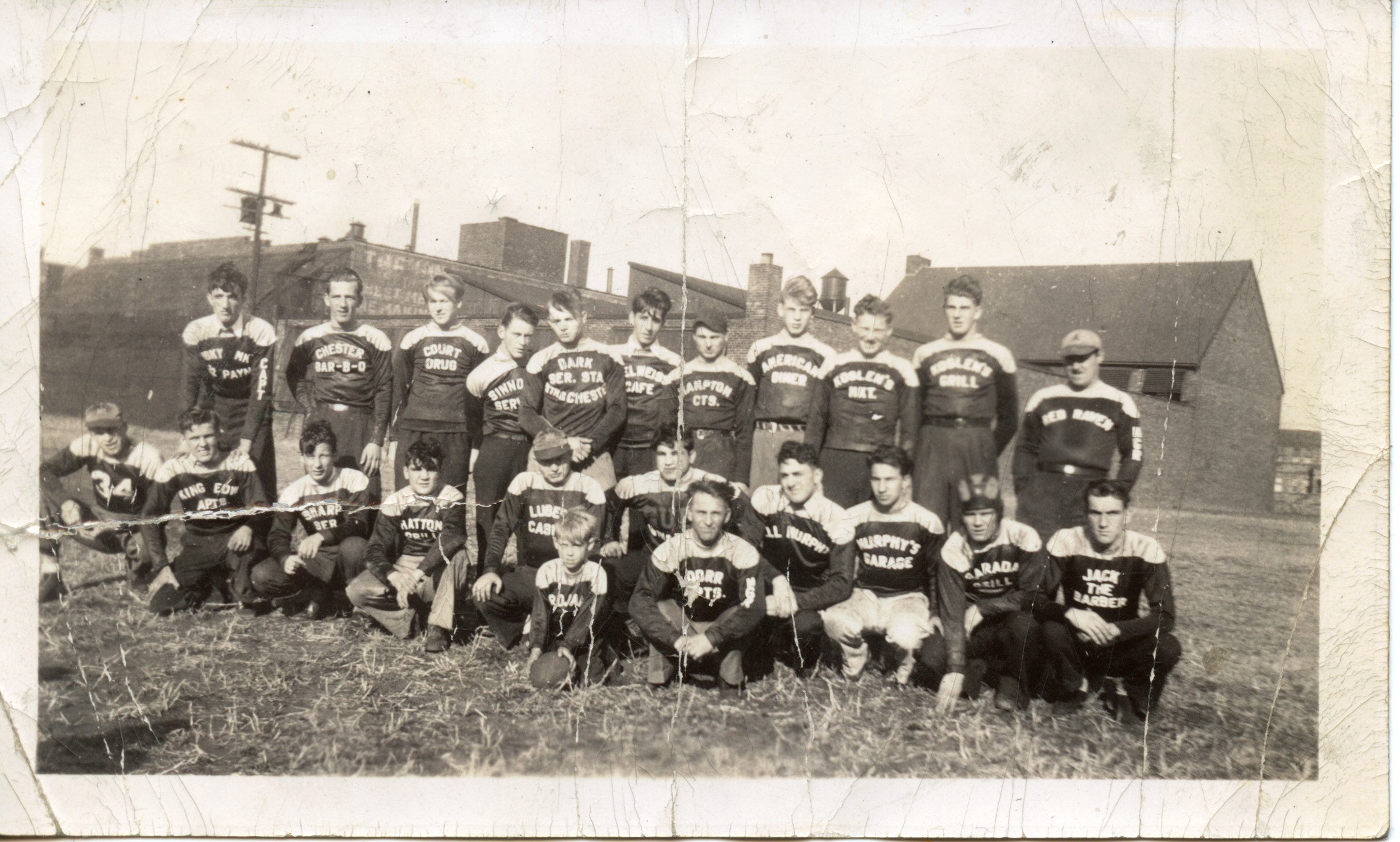
One player wears a helmet as they squat or stand in an unkempt field with a factory or warehouse in the background, bearing a painted sign for a sheet metal company. The back of the photograph identifies the team as the 1938 Nineteenth Street Trojans, but what’s notable is that each member has the name of a different sponsor on their jersey. Among the businesses whose names are legible are:
Barada Grill | Chester Bar-B-Q | Court Drug | Dark’s Service Station
Hampton CourtsJack the Barber | King Edmond Apartments | Koslen’s Grill
Murphy’s Garage | Red Raven | Sharp Service
Had the Nineteenth Street Trojans worn jerseys with the team name or logo, figuring out where they played would have been difficult. There are many Nineteenth Streets across the country, and only one team named the Nineteenth Street Trojans shows up in the newspaper archives between 1935 and 1945. It was a Pee Wee baseball team in Anniston, Alabama, so they were clearly not our boys.
However, with 22 different sponsors named on the jerseys of the players, coaches, and mascots, a search for those names shows they were small businesses in Cleveland, specifically the area around Cleveland State University’s Krenzler Field, the school’s soccer stadium, which opened in 1985. In fact, the location of one sponsor, the Hampton Courts apartments, is now occupied by the Krenzler Field stands and press box.
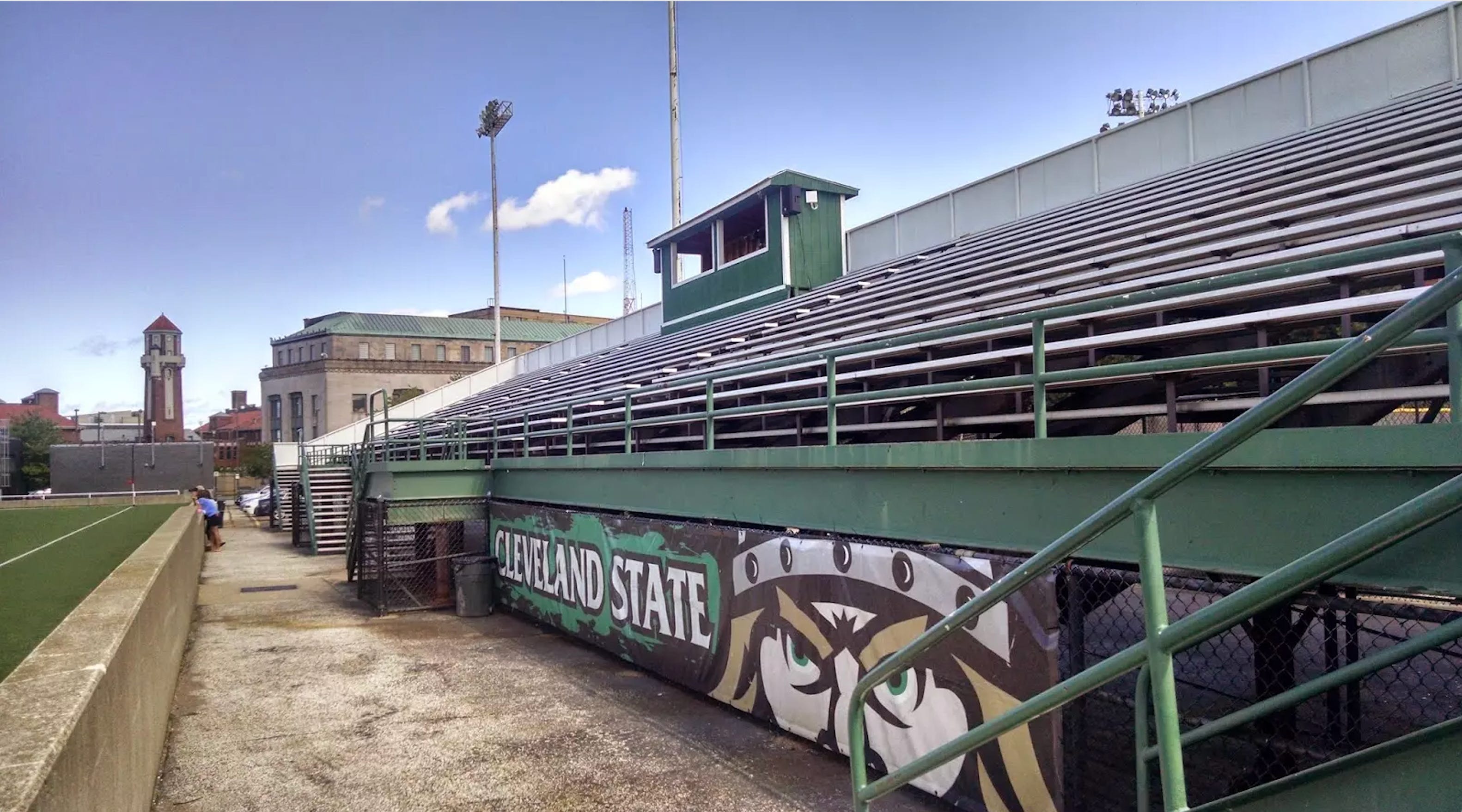
In the 1930s, Cleveland State was Fenn College, a small commuter school, situated in a dense, working-class neighborhood. Parts of the neighborhood were razed when I-90 came to town in the 1960s. Cleveland State and other businesses took over other parcels, many of which are now parking lots, so there is little trace of the old neighborhood the Nineteenth Street Trojans called home.
Despite various searches for information about youth or touch football teams in Cleveland during that period, and the individual sponsors, little information turns up. Without the printed team picture that has survived the last 80 years, we might not know that the Nineteenth Street Trojans ever existed, or that twenty-some small businesses ponied up a few bucks to sponsor players.
The same disappearing act will happen to most of us, our neighborhoods and towns, and our local teams. What will sports historians in the year 2114 know about our teams and us? What tools will they use to make those discoveries 88 years down the road? Will they be stumped in finding information, as has happened with the Nineteenth Street Trojans? Will our family libraries of digital images be preserved and accessible like family photo albums and postcard collections of the pre-WWII era?
Your guess is as good as mine.
Regular readers support Football Archaeology. If you enjoy my work, consider a paid subscription, buy me a coffee, or purchase a book.


Interesting history. When you see the medicine ball in that 1910 photo, makes sense why they didn't bother much with a passing game.
As I have probably noted before, this practice extended to other semi-pro sports besides football at that time.