
Joe Lipp, Walter Eckersall, and Innovations in Football’s Chains and Down Markers

Although many tried, there have been few improvements on football’s chains since they debuted in 1894. After all, once they substituted a length of chain for the cord tied between two poles, there wasn’t too much you could do to improve those things.

Sure, they added pennants or flags atop the poles, and eventually added a target-like disc, but all the improvements were variations on a theme. The down box or marker is another story, as countless inventors have improved those devices to better communicate the down to players, coaches, and fans alike.

Until today, I did not realize that one inventor improved both the chains and down marker, and even had his devices adopted by the NFL, at least for a few years, before they faded from memory. I also learned why one of his devices was known as the “Eckielipp” Linesman Equipment, a tale I will tell shortly.
Born in Chicago in 1888, Julius Jeffrey Lipp used progressively shorter nicknames -Joel or Joe or JJ- which befit a man standing 5 feet 4 1/2 inches tall. He attended the University of Chicago for one year, participating in football and track, before leaving school to make money.
He came to run the J. J. Lipp Paper Company, which survived him and was run by his son for several decades. Still, he was best known as a sports official, both as a football head linesman and a timer of everything else. He invented timing devices for swimming and track, personally timed numerous world records, and was the timer of record for boxing matches in Chicago, handling Joe Louis and other fights.
Lipp also worked with Swiss watchmakers to create a 75-minute watch for football officials, which kept time for both halves and the 15-minute intermission.
On the football field, he officiated his first Big Ten game in 1917, and you’ll find his name in box scores over the next 25 years, handling many big games, including the 1927 USC-Notre Dame game, the first two college all-star games in Chicago, and East-West Shrine games in San Francisco.
For much of the 1920s, Lipp was the head linesman on an officiating crew with referee Walter Eckersall, the UChicago All-American and Chicago Tribune reporter, as well as umpire John Schommer, a four-time basketball All-American and winner of 12 letters at Chicago.
Lipp filed for a patent in 1925 for a device that enhanced football measurements. The combination included the classic four-sided down box and two sets of chains connected to the poles.
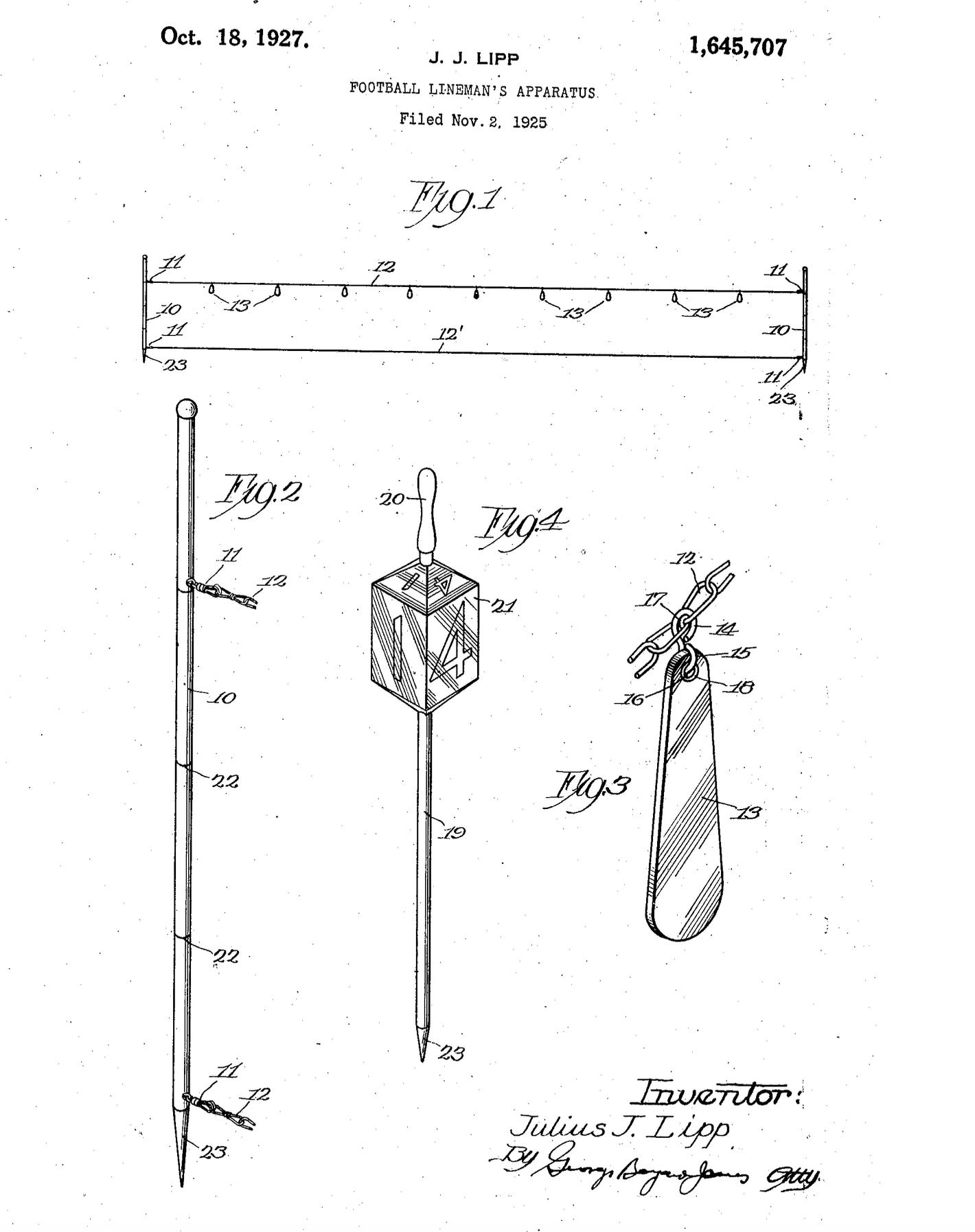
They marketed the grouping as the “Eckielipp” Linesman Equipment, after the more famous Walter “Eckie” Eckersall and Lipp, who received second billing.
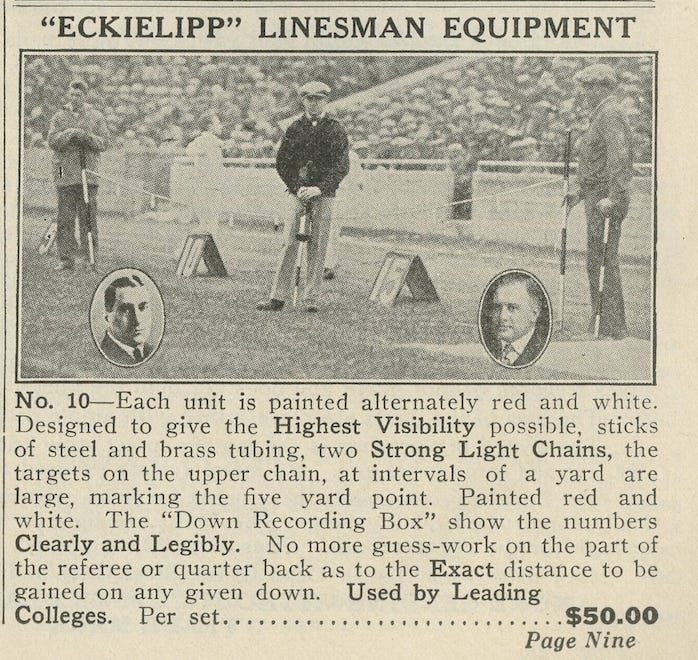
Why were there two sets of chains? One chain sat on the ground, like on all other football chains, and a second chain rose three feet off the ground. Suspended from the upper chain were 9 markers, much like hotel key chains of old, spaced one yard apart.
Before the 240 Lockney Lines were added to football fields near the inbound lines and along the sideline in 1954, football fields only had lines every five yards, so officials and everyone else had difficulty knowing how many yards a team had to gain for a first down. The markers dangling from Eckielipp’s upper chain helped enough that football teams used them.

In 1941, Lipp stopped officiating college games and switched to the NFL. At that point, he convinced Elmer Layden, the Notre Dame Four Horseman and recently appointed NFL commissioner, to use his devices in NFL games starting with the 1942 season.
Not only did the NFL adopt the “Eckielipp” Linesman Equipment, they also adopted his new Down Recording Disc, which replaced the short box that most people in the stands could not see with a large metal disc atop an 8-foot pole.
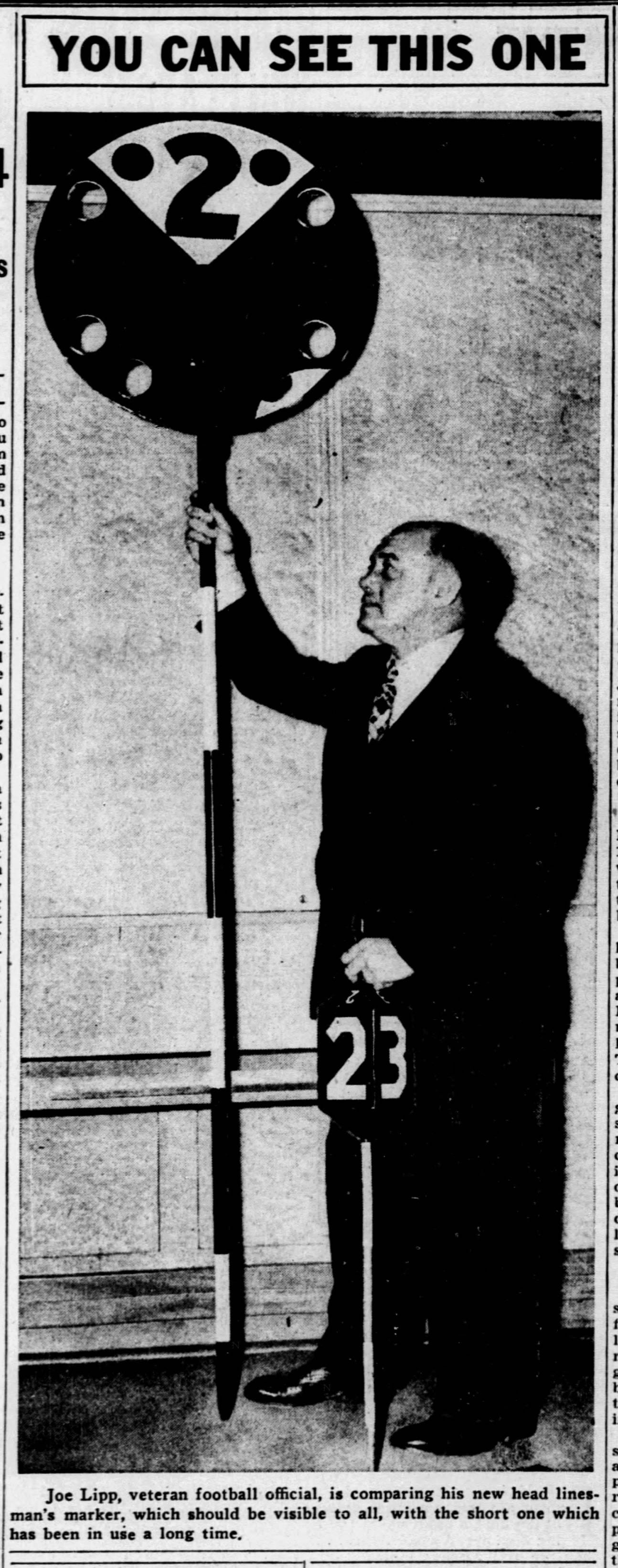
The assistant linesman handled the big disc, rotating a color-coded internal disc to indicate the down:
First down: Black 1 on amber background
Second down: Green 2 on white background
Third down: Black 3 on amber background
Fourth down: Red 4 on white background
(It is worth noting that NFL rule books of the era referred to the guys holding the sticks as “rodmen.”)
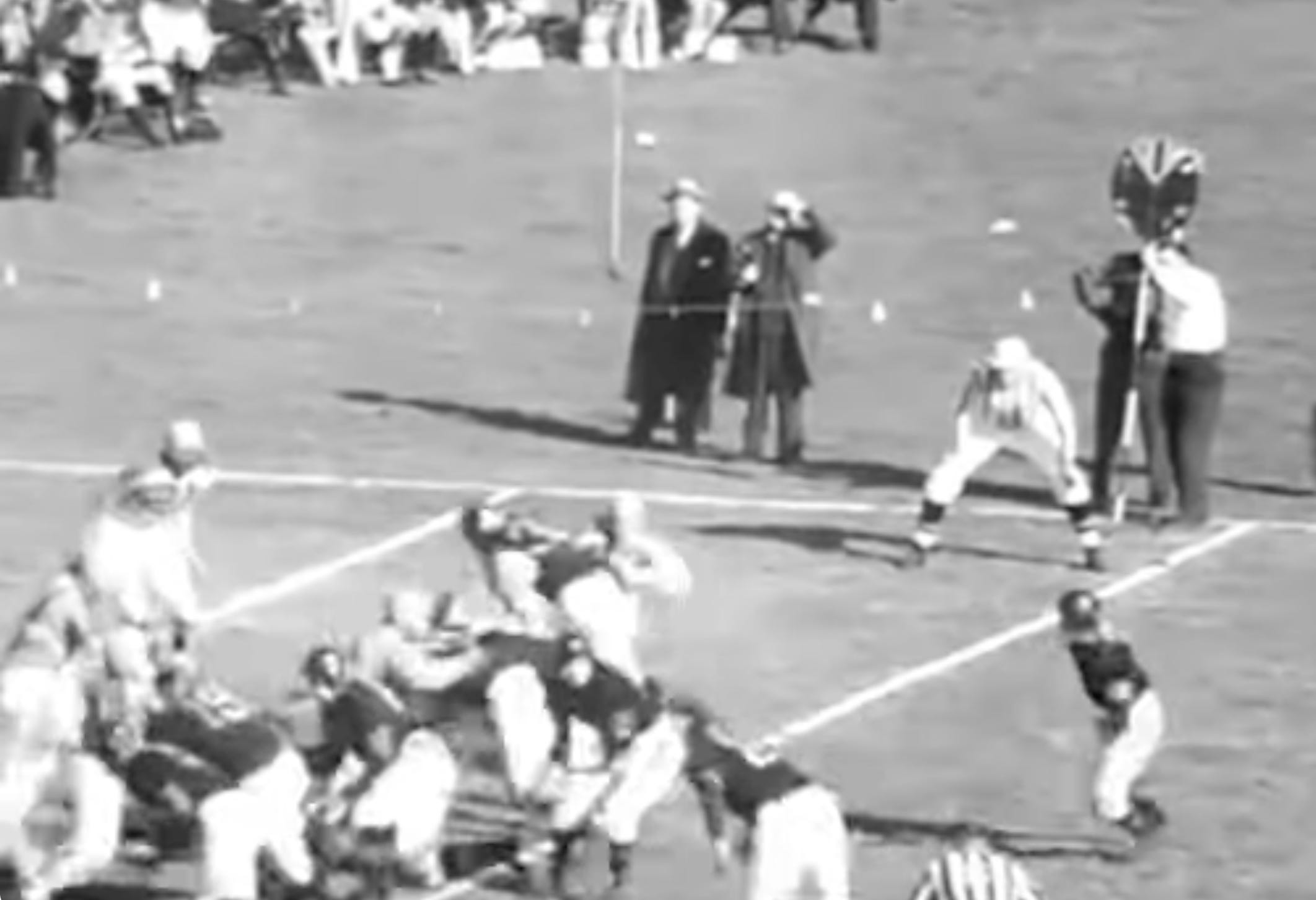
For those who enjoy old game films, below is five and a half minutes of YouTube highlights of the 1944 Chicago Bears-Cleveland Rams game, during which you can see the Down Recording Disc along the far sideline. At the 2:27 mark, you can clearly see the Down Recording Disc and the markers dangling from the “Eckielipp” Linesman Equipment.
Lipp officiated during the 1943 season, and then retired from the game. By then he had already developed an illuminated down marker for use in night games, and had plans to build goal posts of Lucite, which would illuminate at night. However, since Lucite was a war material, it was not available on the civilian market to make goal posts. Whether he pursued his Lucite goal post dream after the war is not known.
A look at game film from the 1946 NFL championship game shows the Down Recording Disc was no longer on the sideline, though perhaps it remained in use in some locations. Unfortunately for Lipp, Roy C. Baker developed the flip-style down marker in the early 1940s as well, and his device became the new standard while he was away at war.

Despite Baker’s device becoming the go-to down marker, let me know if you spot an image of a Lipp’s Down Recording Disc in the wild. I’d love to find a higher-quality image of his invention.
Last, I believe someone sent me an image of the Down Recording Disc a few months back, but I don’t recall who did. If you are reading this and sent me the image, please stand up and be counted.
If you enjoy Football Archaeology and are not a paid subscriber, consider buying me a cup of coffee now and again. You can also buy a paid subscription or purchase one of my books.

