

As discussed in Factoid Feasts I, II, III, IV, V, VI, VII, VIII, IX, X, XI, XII, XIII, XIV, XV, XVI, XVII, and XVIII my searches through football history sometimes lead to topics too important to ignore but too minor to Tidbit. Such nuggets are factoids, three of which are shared today.
Getting Blown Up
Old habits die hard. A recent story described how the process of inflating footballs did not change overnight simply because a new technology became available. People still inflated footballs the old-fashioned way.

Shortly after publishing that article, I stumbled across the image below, which shows Lehigh quarterback Jack Kirkpatrick inflating a football just as he might have inflated a kid’s balloon. Kirkpatrick displayed his wind power two years after flush valve footballs came on the market and a decade or longer after stem valves became part of balls. Despite the new technologies being available, manufacturers still produced, and customers bought footballs lacking valves.
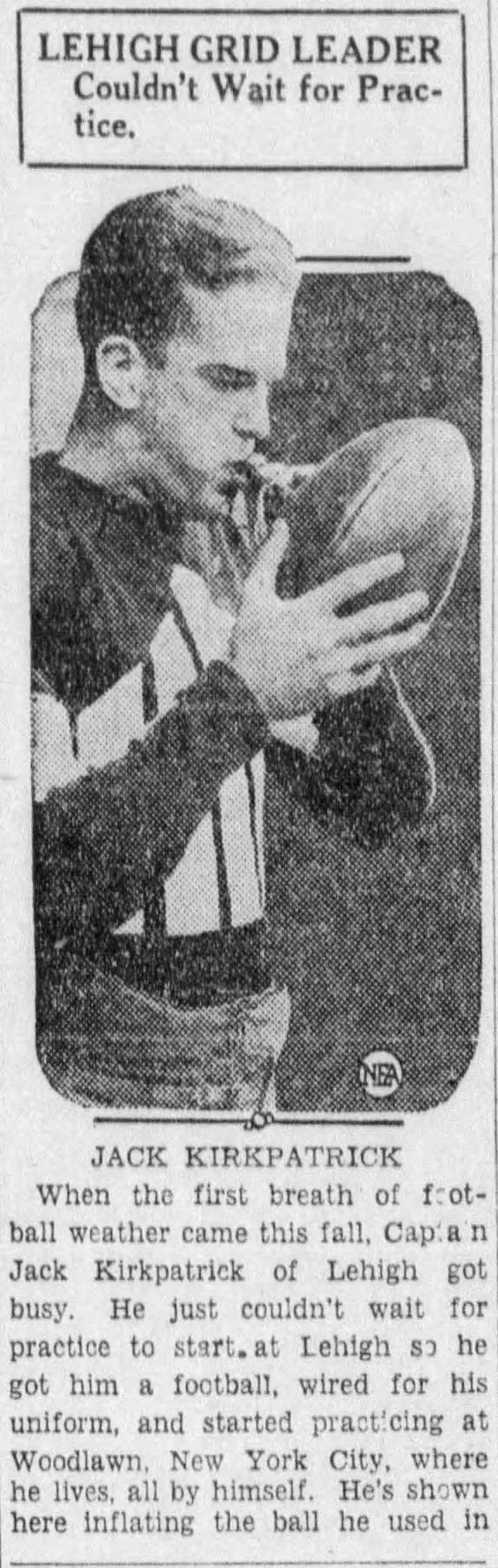
Kirkpatrick was Lehigh’s captain. However, he played tackle, so that may explain why he was unfamiliar with the advances in footballs that occurred during his time in Bethlehem.
Origins of Thud/Thump
A key change in football over the years has been the reduced level of contact in practice during the season, particularly at higher levels of the game. George Seifert, the San Francisco 49ers coach from 1989 to 1996, is often credited with popularizing the approach. However, Bob Falwell held similar views during this time, coaching Lafayette, Washington & Jefferson, and Penn in the 1910s and 1920s.
A recent discovery shows that the desire for limited contact in practice goes back at least to 1893, when one of the meanest and nastiest players around captained the Yale Bulldogs. Frank Hinkey, who played end and captained the team, made it known that the running backs were to be treated with kid’s gloves under his watch.
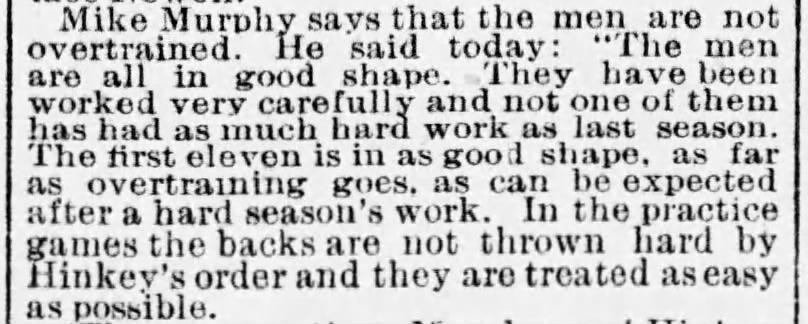
Since few wanted to be on Frank’s bad side, the team likely followed that rule quite closely.
Another Unfair Act
I wrote about unfair acts a while back, which is one of the few situations in which the referee can award points if an unfair act -such as a player coming off the bench to tackle an opponent- kept them from scoring. Such plays tend to occur when the player coming off the bench is overcome by emotion. Still, a reader, Cristopher Haack, submitted another story telling of a dastardly deed on the football field.
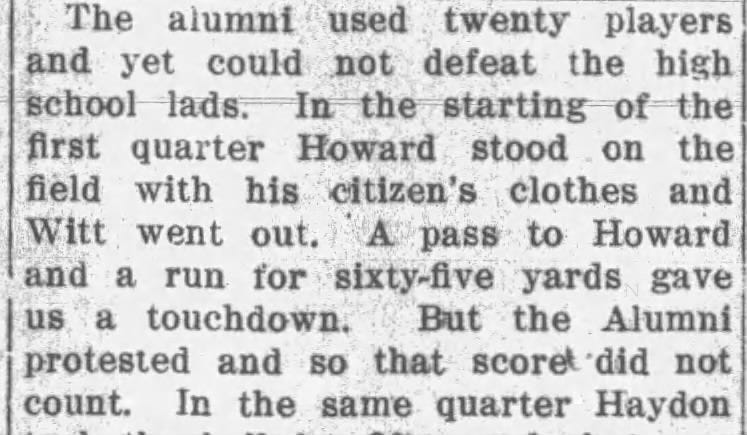
The story goes that the St. Joseph High (MI) football team of 1913 played the alums on Thanksgiving Day and won 6-0. However, they must not have been confident that they would prevail since they pulled a version of the old shoestring play on the alums early in the game.
In a shoestring play, teams had a player kneel near the sideline as if tying their shoes. Those players sometimes went unnoticed and uncovered until the offense lateraled the ball or threw them a forward pass. Benton Harbor’s version of the play had the right halfback, Witt, leave the field, while Howard stepped onto the field in street clothes.
Howard went unnoticed until he received a pass and scored an apparent touchdown. Of course, the alums protested, and the referee disallowed the score. Howard must have changed into his football gear then, since the article says he was one of the game’s stars.
Regular readers support Football Archaeology. If you enjoy my work, get a paid subscription, buy me a coffee, or purchase a book.


I just stumbled upon your blog. My father-in-law, Gino, just passed away at 101 years. Aside from being a WWII veteran, and former POW in Germany, he played for the Detroit Raiders, the only American team ever in the Canadian Football League. I believe they only lasted one season, 1958, because we have a team roster, and I've not been able to find anything on line about the team. You seem to have a wealth of sources, and if you have any knowledge of the Detroit Raiders, I would love to find out more about the team. Cheers!