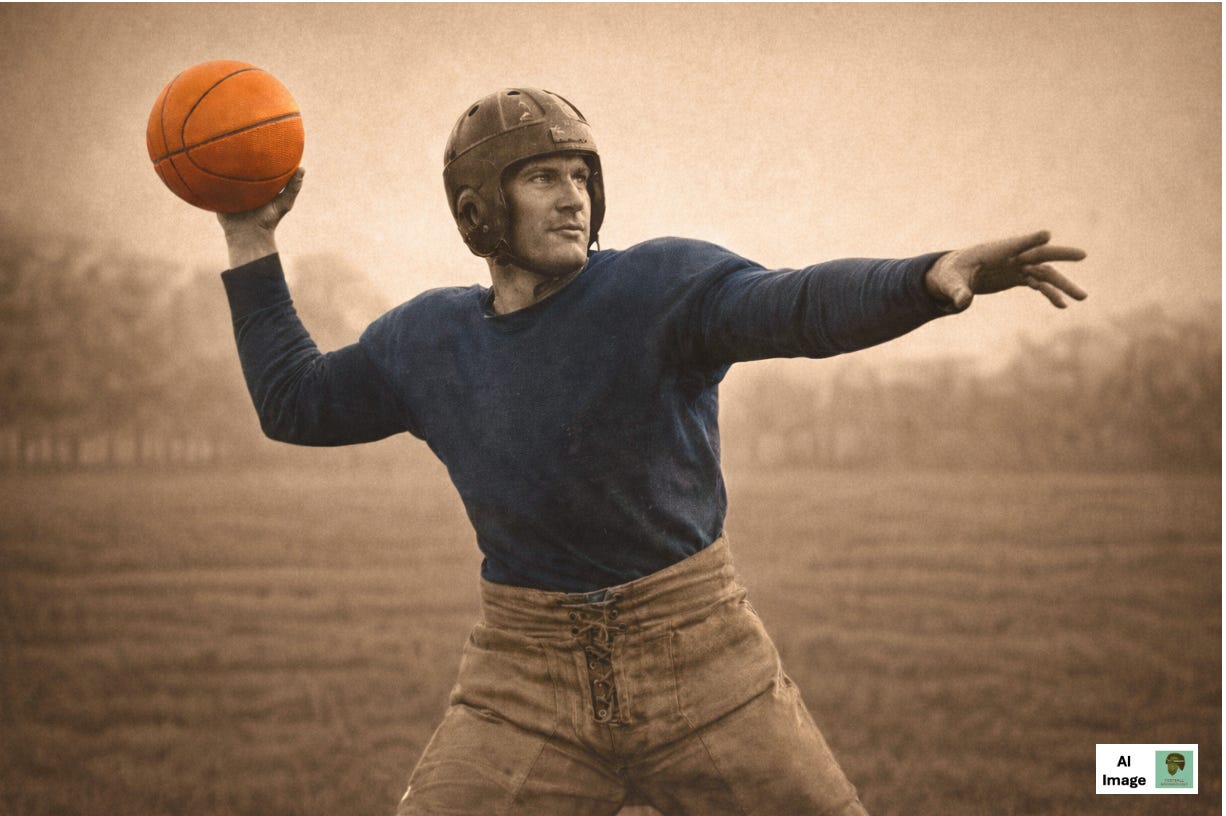
Terminology: Basketball on Grass

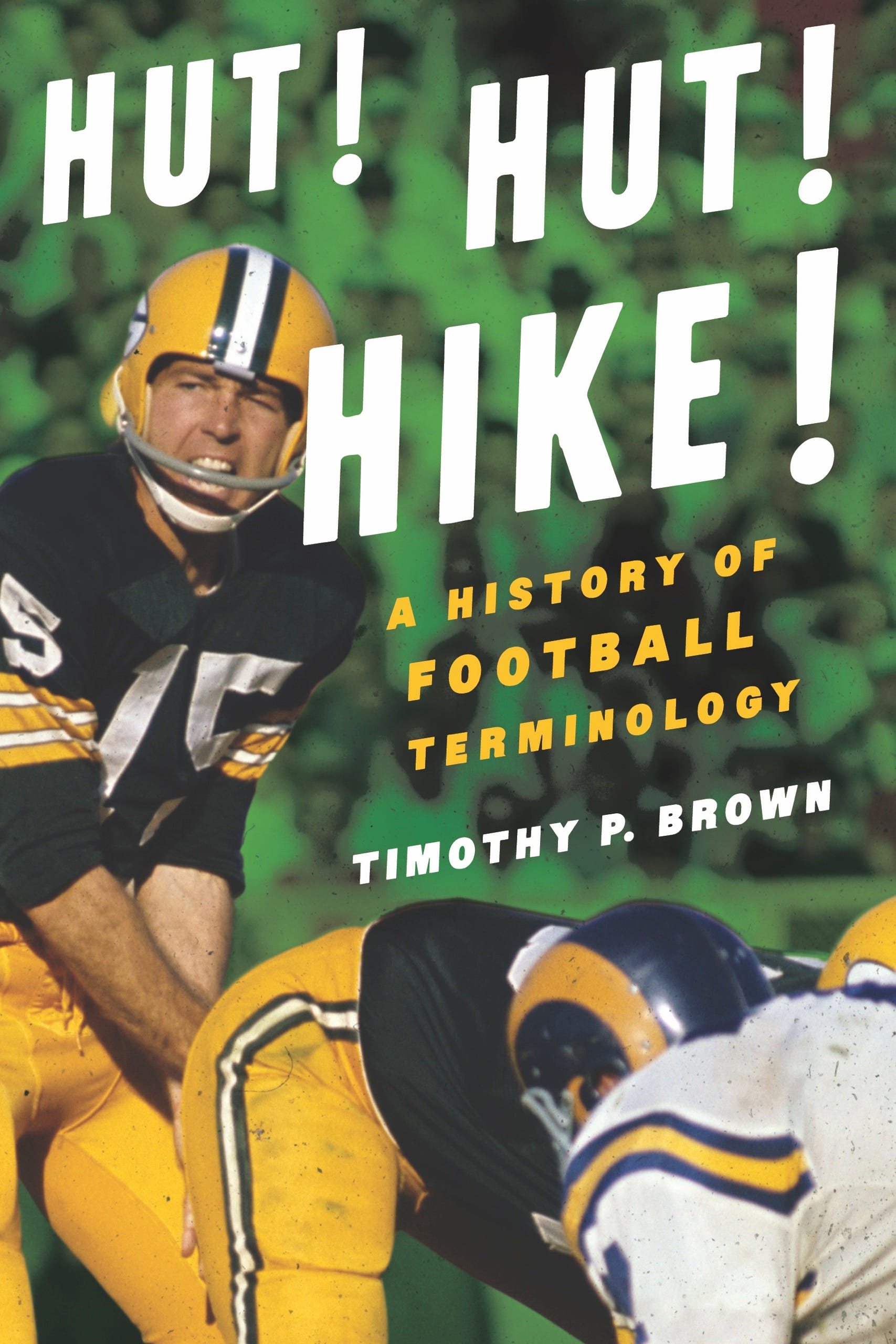
This is article is part of a series on the origins of football terminology. See the article links at the end of the article or consider buying my book, Hut! Hut! Hike!, which covers the history of football terminology.
Although the forward pass is the primary means of gaining ground in football today, the game has had a love-hate relationship with it from the beginning, even before the beginning. Football was a game in which teams earned yards the old-fashioned way: by rushing it.
The idea of tossing the ball forward left many aghast, including Walter Camp, who thought the forward pass would turn football into lacrosse:
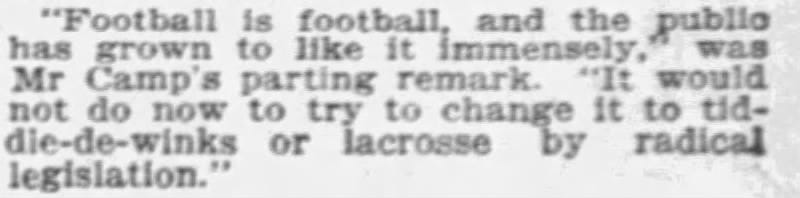
While Camp derided the forward pass as a lacrosse play, most opponents claimed it turned football into basketball. In 1920, Harvard’s former coach, Percy Haughton, argued that the forward pass turned football into basketball, even baseball.
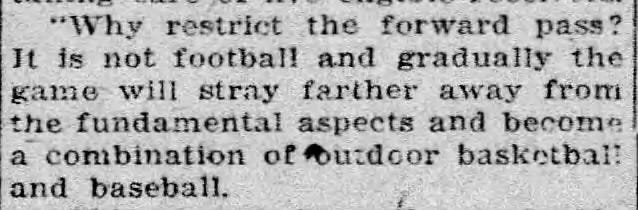
The growing popularity of the forward pass in the early 1920s led a series of coaches and others to argue against it, claiming football was becoming “outdoor basketball.” Kid Gore, the UMass coach, argued in 1924 that to keep football from becoming outdoor basketball, touchdown passes should count 3 points and receivers should not be able to advance the ball following the catch.
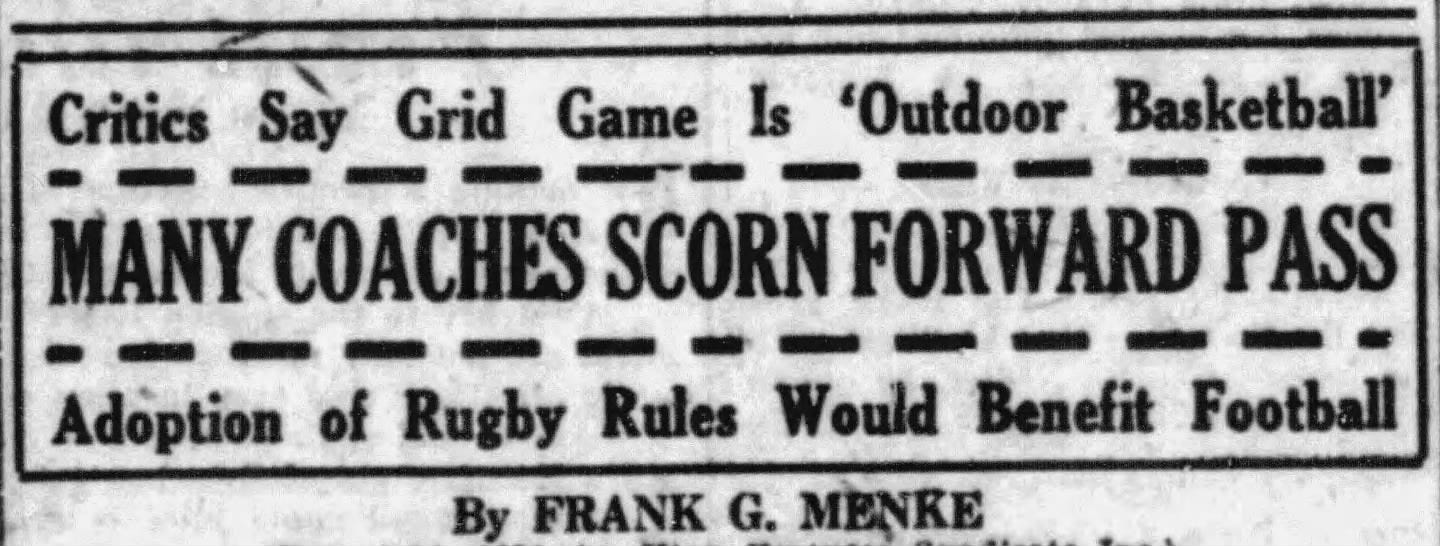
Critics of the mid-1920s favored “outdoor basketball” as the pejorative term for throwing the ball, but most of them crawled back into their holes for the next fifteen years, with few comparing football to basketball.
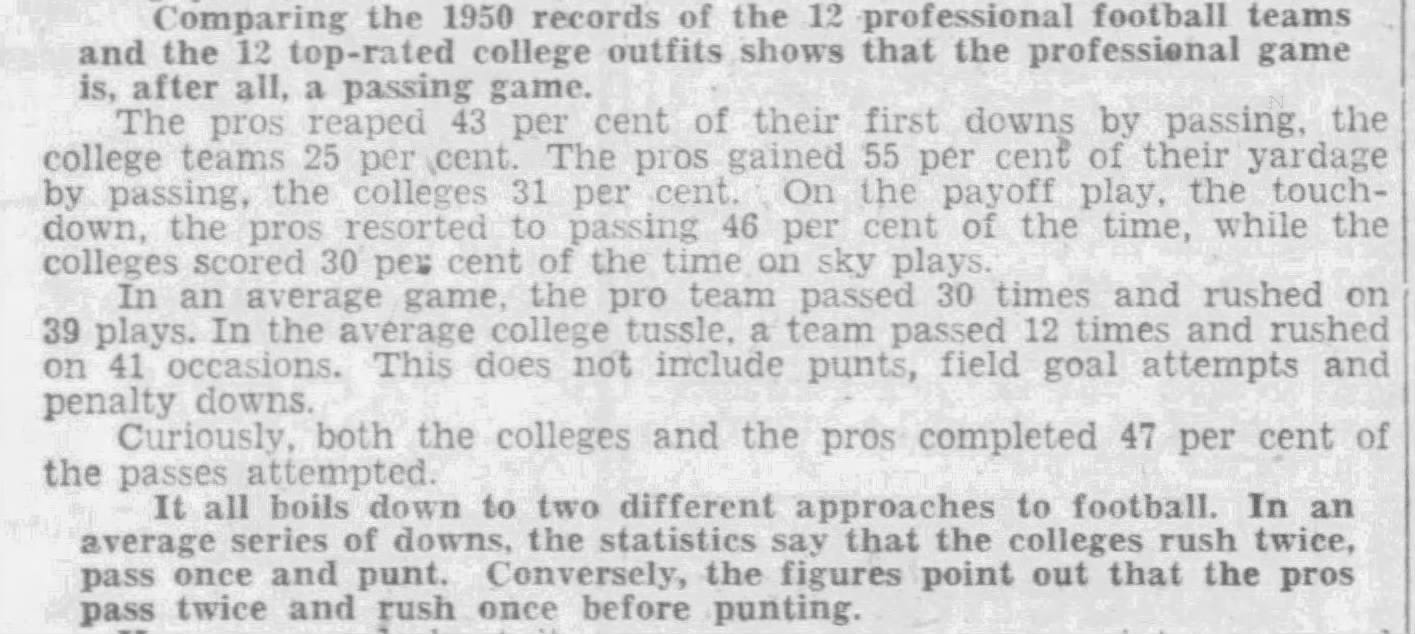
The knives came out again in 1950, when Army coach Red Blaik criticized the NFL for a lack of team play and spirit, which hit the pros hard because they were experiencing attendance problems. H. G. Salsinger, the Sports Editor of the Detroit News, blamed the attendance shortcomings on the NFL’s frequent passing, which he described as “basketball on grass,” making him the apparent originator of the phrase. The statistics supported the distinction, with the pros passing twice as often as the top college teams.
Despite Salsinger attributing low attendance to the NFL’s frequent passing, the conventional wisdom has been that the NFL’s passing-friendly brand of football led to its increased popularity, and whatever the cause-and-effect relationship, “basketball on grass” transitioned from a derogatory to a descriptive term. Folks applied basketball on grass applied to six-man football generally, and any team that passed more often than the norm.
The term hibernated when Lombardi’s Packers dominated the game, with writers referring to the Packers’ sweep as the opposite of basketball on grass. Still, it staged a comeback when Don Coryell took over the St. Louis Cardinals and San Diego Chargers. Basketball on grass references became more common as the run-and-shoot offense and its variations became popular. Dennis Erickson’s Wyoming offense adopted the basketball-on-grass moniker, which stayed there after Joe Tiller took over, and then travelled east with Tiller to Purdue.
Basketball on grass was here to stay, and despite most accepting the forward pass as a central part of modern football, some yearned for the smashmouth play of days gone by. One writer, following the Cowboys’ blowout of the Bills in Super Bowl XXVII, pointed out that the Cowboys used a pro set rather than a one-back formation, and celebrated that brand of football, noting:
“Football just isn’t football without a fullback. Everything else is just basketball on grass.”
McEwen, Bill, ‘Fullback Suits Dallas Pro-Set To Tee,’ Fresno Bee, February 3, 1993.
The same attitude persists to this day, including among some NFL players, such as Patrick Queen, now of the Pittsburgh Steelers. During his 2023 season with the Ravens, he distinguished the Ravens from Miami and others saying:
We play a brand of football that people don’t want to play. Everybody wants to be out here (being) cute, playing basketball on grass, and stuff, and we are not with all that. You can do all that stuff — we are just going to hit you in the mouth every play, honestly.
‘Baltimore Looking To Take Miami Down A Peg In the AFC,’ Dickinson Press (ND), December 30, 2023.
Of course, Miami coach Josh McDaniels did not care for the characterization, which points out that “basketball on grass” is an accepted description of how teams play while also suggesting a level of softness that real football men do not want as part of their brand.
Links to previous articles covering the origins of football terminology include:
1,000-Yard Rusher | Basic Fundamentals | Bull Rush, Swim Technique, and Forearm Shiver | Drop Kick, Place Kick, Punt, Goal from Field, Field Goal, Goal from Touchdown, Placer, and Holder | Football, Rugby, Soccer, and Varsity | Football Coach, Offensive Line, and Offensive Line Coach | Game of the Century | Gang Tackle and Oskie | Goal Line Stand | Granddaddy of Them All | Hail Mary Pass | Lateral and Handoff | Numbering Defenses | Pass, Forward Pass, Complete, Uncomplete, Incomplete, and Incompletion | Receivers | Rouge, Safety, and Touchback | Popping Shoulder Pads | Pro Bowl | Shovel Pass | Signals, Cadence, and More | Tee | Three Yards and A Cloud of Dust | Training Camp | Trickeration | Two-A-Days | Wind Sprints | X’s and O’s
Football Archaeology is reader-supported. If you enjoy my work, consider a paid subscription, buy me a coffee, or grab a copy of Hut! Hut! Hike!, which covers the history of football terminology.