
Today's Tidbit... Going Out on a Limb with Coaching Trees

A “coaching tree” refers to a coach’s assistants and players who later became successful coaches themselves. The term is relatively new, with far fewer rings on the tree than you might imagine.
While “coaching tree” appeared here and there in the late 1930s and 1940s, it referred to the population of coaches, with schools choosing a coach as they might pick an apple from a tree. Later, it came to mean the succession of coaches at a particular job, often when none had been particularly successful.
The current meaning of "coaching tree” did not emerge until a few decades ago, in part because the football world differed early on. The terms “coach” and “coacher” did not arrive in America until the late 1880s. Also, the dominant Eastern schools followed the graduate coaching model, in which the previous year’s captain coached the team the following season, working jointly with the current captain and assisted by former players who volunteered for a week or two each season. As a result, people associated coaching philosophies and tactics with schools, such as the Princeton and Yale systems.
Professional coaches, as we know them, became the norm by WWI and changed the dynamic, so styles increasingly were tied to coaches rather than schools. Even then, many coaches worked alone, without formal assistants, so most of the branching came through former players rather than assistants.
By the 1910s, football’s dominant offenses were the Notre Dame Box and the Single and Double Wings, which were associated with Knute Rockne and Pop Warner. However, Rockne learned the offense from Jesse Harper, who had played for Stagg at Chicago. Rather than being described as part of coaching trees, players who became coaches were often described as pupils, disciples, or proteges of their college coach.
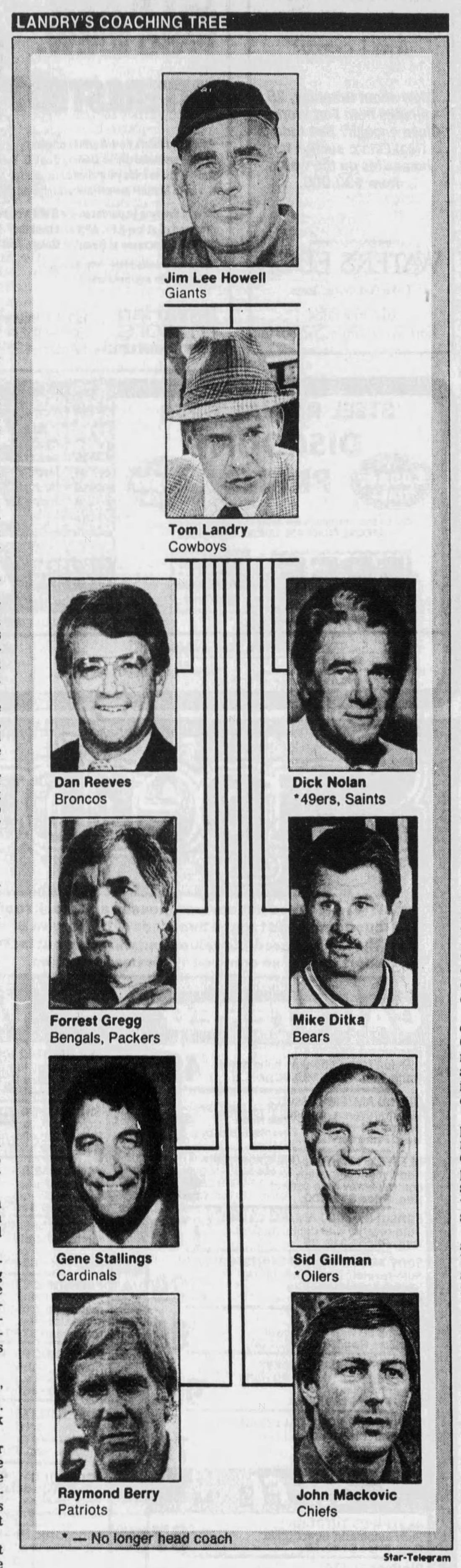
The current meaning of "coaching tree" dates to the 1980s. Johnny Major spoke of Bear Bryant’s coaching tree in 1982, and there were a few references to Don Coryell’s coaching tree the next few years. A solid profile of Tom Landry’s tree came in 1986, and Sam Wyche commented on being part of Bill Walsh’s tree before the two faced off in the 1989 Super Bowl, but the term’s usage did not explode until the 2000s.
Anyway, despite not being called coaching trees at the time, let’s look at a handful of old-growth coaching trees.
Amos Alonzo Stagg
Stagg, who played at Yale, became the first year-round professional coach when he accepted a faculty position at the new University of Chicago. His tree includes:
Jesse Harper: who coached Rockne and Gus Dorais (UDetroit, Detroit Lions) during their senior year at Notre Dame
Hugo Bezdek: who coached the Mare Island Marines and Penn State in the Rose Bowl
Walter Steffen: long-time Carnegie Tech coach and one of the few to twice beat Rockne’s Notre Dame boys
Pat Page: Butler and Indiana coach
Fritz Crisler: Minnesota, Princeton, and Michigan coach who brought Michigan their silly helmets, pioneered two-platoon football, and won three national titles
Fielding Yost
Yost coached Ohio Wesleyan, Nebraska, Kansas, and Stanford before arriving in Ann Arbor, where he won six national titles. His branches included:
Bennie Owen: Long-time Oklahoma coach and forward pass innovator
Dan McGugin: Long-time Vanderbilt coach
Ray Morrison: Played for McGugin and enjoyed a 35-year career, primarily at SMU, Vandy, and Temple
George Little: Coached Michigan and Wisconsin. Long-time Rutgers AD
Harry Kipke: Won two national titles at Michigan. His coaching tree includes former college coach Gerald Ford.
Pop Warner
Warner coached eight programs, though his Carlisle, Pitt, and Stanford tenures stand out, including 4 national titles
Albert Exendine: 25-year coach from Otterbein to Oklahoma State
Lone Star Dietz: Coach Washington State and the Mare Island Marines in the Rose Bowl
Gus Welch: Coached Washington State, Virginia, and others in a 20-year career
Andy Kerr: Coached Stanford, then spent years at Colgate and the East team in the annual Shrine game
Jock Sutherland: Coached Lafayette, Pitt, and two NFL teams
Tiny Thornhill: Assisted Warner at Stanford before taking over the program upon Warner’s departure
Knute Rockne
Rockne’s former players became a diaspora that spread across the country, holding coaching jobs large and small. Some of the larger branches include:
Jim Crowley: Coached Georgia, Michigan State, and Fordham, where Lombardi played for him
Frank Thomas: Won two national titles at Alabama, where he coached Bear Bryant
Hunk Anderson: Took over at Notre Dame following Rockne’s death, then headed NC State and the WWII Chicago Bears, winning the 1943 title.
Frank Leahy: Coached Boston College before winning four national titles at Notre Dame
Elmer Layden: Coached Duquesne and Notre Dame before becoming the NFL’s first commissioner
Slip Madigan: Spent 20 years at St. Mary’s and a few more at Iowa
Buck Shaw: Coached Nevada, Santa Clara, Air Force, and spent 10 years with the 49ers and Eagles.
Harry Stuhldreher: Spent 10+ years each at Villanova and Wisconsin
Adam Walsh: Coached Santa Clara and Bowdoin. Won the 1945 NFL title with the Cleveland Rams
Most of the coaches mentioned in the old-growth section played for the coach. Once full-time football assistants appeared in the 1950s, the number of connections exploded as assistants moved around, working for a given coach for a year or two, or even a decade.
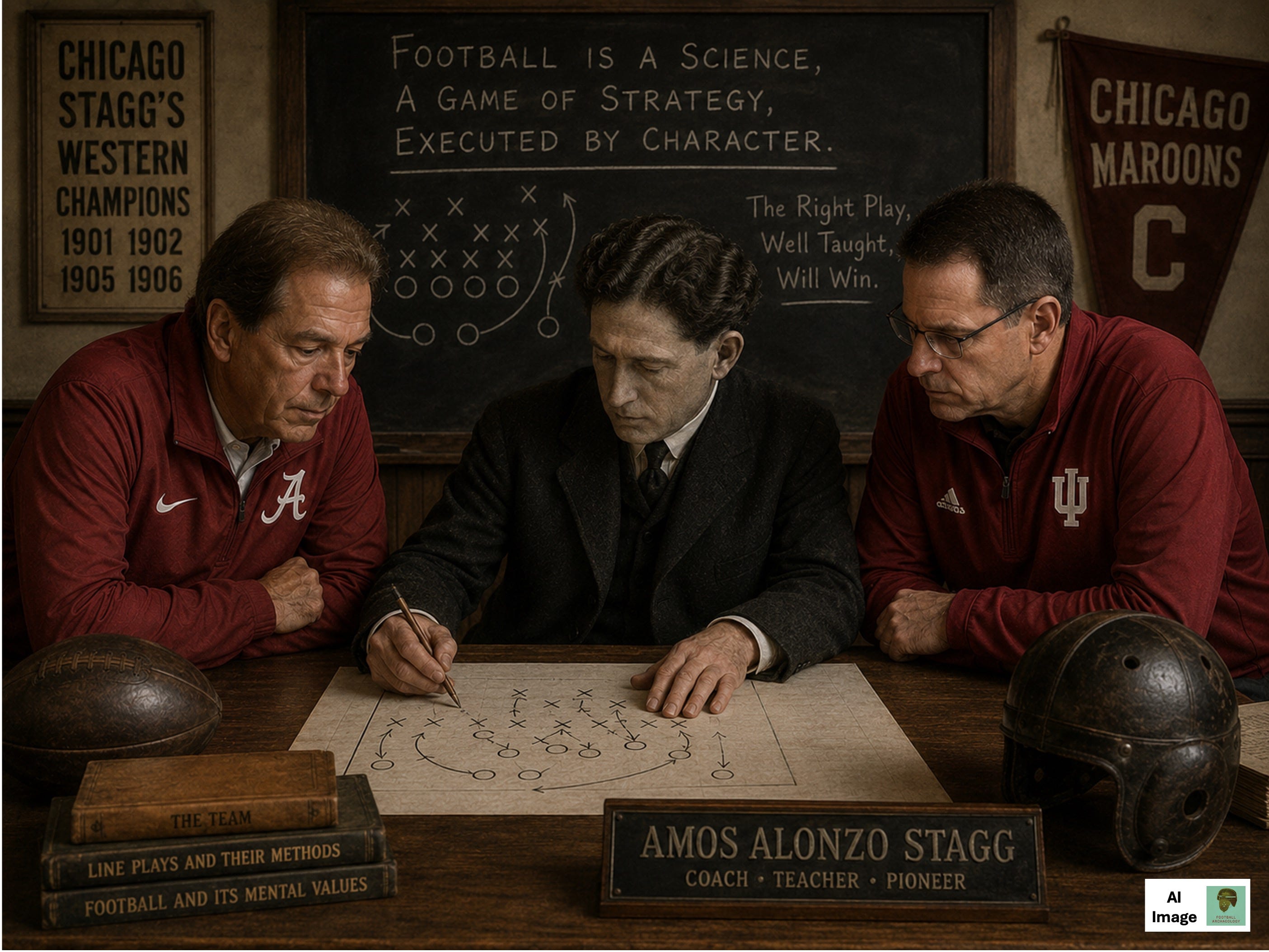
Given the many connections, we can trace the lineage from Stagg to today’s top college coaches, particularly Nick Saban and his assistants:
Stagg » Harper » Rockne » Frank Thomas » Bear Bryant » Paul Dietzel (assisted Bryant at Kentucky) » Bill Peterson (assisted Dietzel at LSU) » Don James (assisted Peterson at FSU) » Nick Saban (played for James at Kent State).
While we can trace Nick Saban’s connection to Stagg, it’s rather tenuous, and it is a challenge to identify a specific philosophy or approach that carried through that long line. In addition, the football world has changed, and already-excellent coaches have chosen to work with Saban in a finishing-school environment, allowing him to surround himself with outstanding assistants. As an example, all four 2026 College Football Playoff semifinal coaches — Curt Cignetti, Dan Lanning, Mario Cristobal, and Pete Golding — were Alabama assistants under Saban.
So, the explosive growth of coaching trees in recent decades allows us to trace connections, but branching more than once or twice puts us out on rather weak limbs. As with the transitive property, head-to-head outcomes are worth examining, but more distant relationships generally hold little meaning.

If you enjoy Football Archaeology and are not a paid subscriber, consider buying me a cup of coffee now and again. You can also buy a paid subscription or purchase one of my books.


Great stuff, as always!
Woody Hayes and numerous others were together at Miami University. And Hayes had numerous coaches on-staff whom later found success elsewhere. That Ohio/Midwest/Notre Dame/Big Ten-type tree would be worth exploring.